

The Australian construction industry is currently losing over $10.8 billion every year due to a massive productivity gap. You likely feel this pressure daily as you juggle razor-thin profit margins of just 2 to 5 per cent. It’s frustrating when unreliable contractor performance leads to delays or when fragmented communication creates high overheads. By focusing on optimizing construction workflows, you can stop the margin leak and reclaim your time.
This guide explores how to bridge the gap between high-level strategy and boots-on-the-ground execution. We’ll show you how to eliminate site bottlenecks through strategic process management and skilled labour alignment. You’ll learn how to secure reliable trades and create a seamless flow between the office and the site. It’s time to move beyond traditional hurdles and drive operational excellence across your NSW or QLD projects. Discover how to build a business that runs efficiently even when you aren't there to oversee every detail.
Key Takeaways
- Understand why standard site processes fail in the 2026 Australian market and how to build a foundation for operational excellence.
- Implement a clear, declarative 5-step framework for optimizing construction workflows to reclaim your time and project margins.
- Discover how to secure reliable, skilled trades to fill the critical labour gaps currently affecting NSW and QLD firms.
- Learn to integrate high-level strategy with on-site execution for a seamless, end-to-end project lifecycle.
What Does Optimising Construction Workflows Actually Mean in 2026?
A construction workflow is the end-to-end sequence of tasks that moves a project from initial strategy through to the final handover. It isn't just a Gantt chart on an office wall. It's the pulse of your site. In 2026, standard workflows are failing because they don't account for the current volatility of the Australian market. With material costs for HVAC equipment rising by up to 12 per cent and a national labour shortage costing the industry $10.8 billion annually, your processes must be airtight.
True excellence requires distinguishing between busy work and value-added activity. Busy work includes chasing missing paperwork, re-explaining site plans, or waiting for a late subbie. Value-added activity is the actual physical progress that builds equity. Redefining excellence means shifting the focus from simply getting it done to getting it right the first time through precision management. By optimizing construction workflows, you move from reactive fire-fighting to proactive project control.
The Cost of Inefficiency on Australian Sites
Inefficiency is expensive. In NSW, the financial impact of rework and idle time can quickly erode the typical 2 to 5 per cent profit margins builders operate on. Beyond the balance sheet, poor workflows lead to trade burnout and increased safety risks. When teams are rushed or confused, mistakes happen. The average cost of a serious workplace injury claim in Australian construction now exceeds $240,000. Workflow drift is the primary margin killer in 2026. This occurs when the daily reality on-site slowly deviates from the original project plan, leading to compounding delays.
Beyond Software: The Human Element of Optimisation
Many firms try to fix these issues by buying the latest app. However, software often fails when the underlying business process is broken. You can't automate chaos. Successful Construction management relies on human alignment and clear communication protocols. If your office and site aren't speaking the same language, no digital tool will save the project. Apps are merely tools; they aren't the strategy itself.
This is where professional guidance becomes essential. For scaling firms, construction business consulting Australia provides the structural fix that software cannot. It’s about building a culture of accountability and refining the physical movement of trades. When you focus on optimizing construction workflows at a structural level, you ensure every person on-site knows exactly what they are doing, when they are doing it, and why it matters. This clarity is what separates elite firms from those just trying to keep their heads above water.
The Three Pillars of Construction Operational Excellence
Operational excellence doesn't happen by accident. It’s the result of three core elements working in harmony. Most Australian firms focus on one and neglect the others. If you have a great strategy but poor labour, projects stall. If you have skilled trades but no process, you lose money on site drift. Achieving a seamless integration requires a balanced focus on strategy, systems, and people. When these pillars are aligned, optimizing construction workflows becomes a natural outcome rather than a constant struggle.
- Strategic Advisory: Setting the foundation before the first shovel hits the ground.
- Process Management: Creating repeatable systems for every stage of the project.
- Skilled Labour: Ensuring the people on-site have the expertise to execute the plan.
Strategic Business Advice for Modern Builders
Growth often hides the bottlenecks that eventually kill a construction business. Many owners find themselves trapped "working in" the business, handling every minor site drama instead of "working on" it. Strategic advisory identifies these structural leaks before they become catastrophic. Implementing a construction business growth strategy NSW is about long-term sustainability. It moves you from surviving the next project to building a scalable asset. This high-level planning ensures every decision aligns with your profit goals and operational capacity. Without it, you’re just busy, not necessarily profitable.
Refining Your Process Management Framework
Ad-hoc problem solving is the enemy of profit. You need repeatable systems for every stage of the project lifecycle to maintain control. This transition from gut feeling to systematic management is critical for optimizing construction workflows. Research into Production Planning and Control shows that rigorous planning is the only way to maintain site efficiency and reduce waste. Systems provide the guardrails for your growth.
Your process framework should align office-based strategy with site-based reality. This means creating clear, declarative steps for everything from procurement to handover. Full-cycle management reduces friction because it removes the guesswork for your team. When your processes are standardised, you spend less time fixing mistakes and more time delivering quality results. If you want to see how these pillars come together on your next project, you can partner with an end-to-end consultant to bridge the gap between your strategy and site execution.
Solving the Labour Gap: Why Skilled Trades are Workflow Critical
The current labour void in NSW and QLD isn't just a minor headache; it’s a structural threat to your project margins. With the Australian construction industry needing an estimated 499,000 additional workers in 2026, simply finding "boots on the ground" is no longer enough. You need precision. A single missing trade can derail an entire multi-stage workflow, causing a domino effect of delays that ripple through your project timeline. This makes vetting construction subcontractors Australia a vital step for quality assurance. You shouldn't view trade provision as simple labour hire. It is a strategic asset that determines whether your site thrives or stalls.
When you treat trades as a commodity, you invite inconsistency. High-tier tradespeople bring more than just technical skills; they bring a workflow mindset. They understand how their work impacts the next trade in line. This awareness is fundamental to optimizing construction workflows. By securing reliable, skilled contractors, you eliminate the friction caused by poor handovers and substandard workmanship.
The Impact of High-Tier Trades on Project Velocity
High-tier tradespeople operate with a level of autonomy that generalist labour simply can't match. While inexperienced teams require constant supervision and hand-holding, seasoned contractors anticipate issues before they occur. They solve problems on the tools rather than waiting for a site manager to intervene. This autonomy is crucial for optimizing construction workflows because it reduces the management burden on your senior staff. Trade reliability is the secret sauce of workflow speed. When your subbies show up on time and execute to a high standard, your project velocity remains predictable and profitable.
Bridging the Gap on Complex Construction Sites
Managing diverse trades across complex sites in QLD presents unique logistical challenges. You need a system that integrates external services into your internal processes without friction. This is where modern methods of construction (MMC) and high-level project management intersect. Adopting a more integrated approach allows for better coordination between strategy and site reality.
PK Services leverages 15 years of industry expertise to select trades who fit your specific project culture. We don't just provide people; we provide the missing link in your execution chain. We understand the local nuances of the NSW and QLD markets, ensuring that the trades we provide are ready to hit the ground running. By aligning skilled labour with a robust project strategy, you ensure that your business remains resilient in the face of ongoing industry shortages.
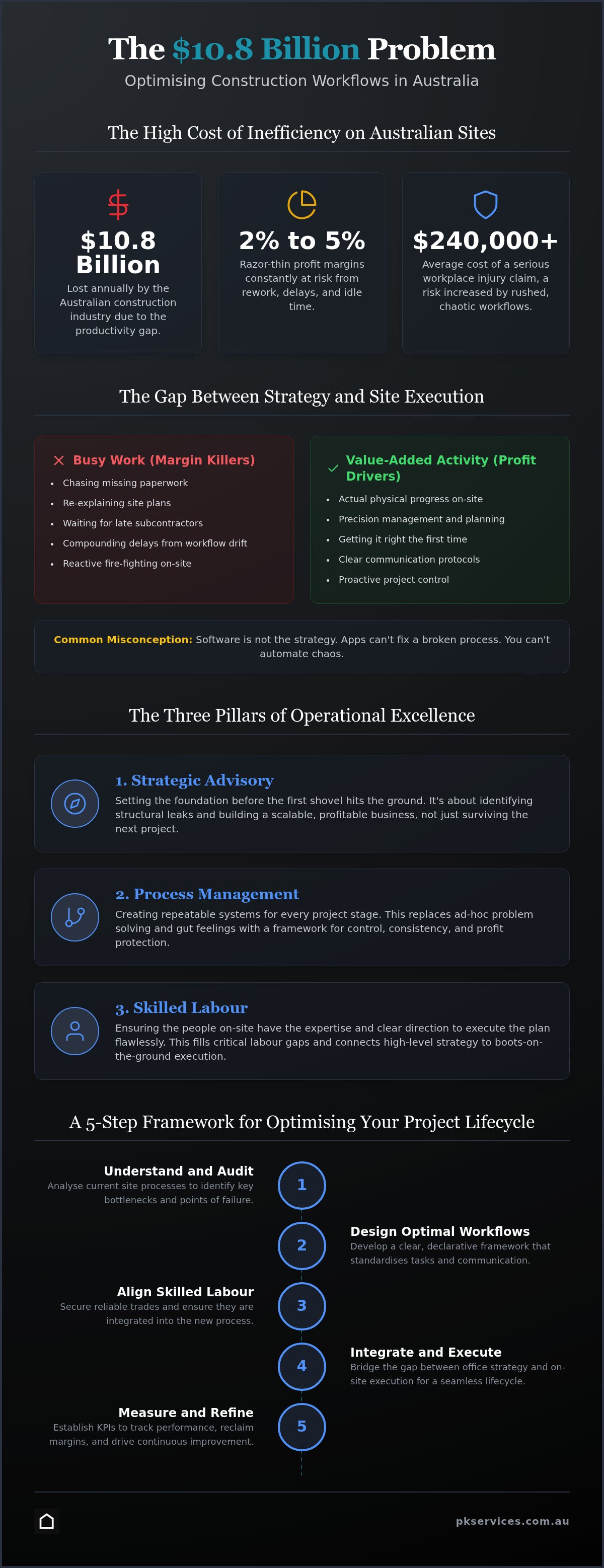
A 5-Step Framework for Optimising Your Project Lifecycle
Optimising your project lifecycle requires more than just better tools. It requires a structured approach that bridges the gap between the head office and the site fence. By following a dedicated framework for optimizing construction workflows, you can transform a chaotic site into a precision-engineered environment. This process moves beyond ad-hoc fixes and establishes a new standard for operational performance.
- Step 1: Audit — Identify the specific points where time and money are leaking from your site execution.
- Step 2: Standardise — Create clear, declarative protocols for every high-frequency task to eliminate guesswork.
- Step 3: Resource — Match skilled trades to the specific requirements of each project phase to ensure quality execution.
- Step 4: Execute — Maintain total oversight through full cycle construction project management to keep the project on track.
- Step 5: Review — Use project data and site feedback to refine the next workflow cycle for continuous improvement.
Auditing Your Site for Maximum Productivity
Inefficiency often hides in plain sight. "Invisible" delays in material handling or clunky trade transitions can eat up to 12 per cent of a project's total value. You need to look closer at the communication gaps between your site leads and project managers. Professional construction quality control management services help you audit these processes with an objective eye. This step isn't about finding fault. It’s about finding the specific bottlenecks that are killing your margins. Identifying these leaks early allows you to course-correct before the budget is blown.
Implementing Seamless Integration on the Ground
A new workflow is only as good as its implementation. Site teams often resist change if it feels like extra paperwork or office-led interference. To ensure success, keep your standardised processes punchy and direct. Manage the transition period carefully to avoid project disruption. This is where having a friendly, expert guide makes the difference. People respond better to a partner who understands the grit of a site rather than a consultant who only sees spreadsheets. Successful optimizing construction workflows depends on getting buy-in from the people actually doing the work. When your team sees that a better process makes their job easier, excellence becomes the new baseline. Partner with PK Services to implement a framework that actually works for your site teams.
Partnering for Performance: The PK Services Approach
PK Services operates on a core philosophy of redefining excellence from the initial strategy to the final site handover. We aren't a distant consultancy that delivers a report and disappears. We are an end-to-end partner. Managing the entire process from start to finish allows us to close the gap between office-based planning and on-site execution. This holistic view is essential for optimizing construction workflows in a market as volatile as ours. While generic global firms offer cookie-cutter solutions, we provide a boutique, high-standard alternative. This approach prioritises personal connection and agile results, specifically tailored to the unique challenges of the NSW and QLD construction landscapes.
15 Years of Redefining Excellence
Our 15 years of industry experience mean our roots go deep into the Australian building sector. This history allows for more precise trade selection and strategic advice that actually works on the ground. We understand the grit of a real site because we've spent over a decade navigating complex logistics and site huddles. We don't just look at digital twins; we look at how the trades are interacting and where the physical bottlenecks are forming. Our commitment to superior standards and modern refinement ensures your business stays ahead of 2026 building regulation changes. We provide a redefined approach to professional relationships, acting as a reliable, down-to-earth partner for your firm. By bridging the gap between strategy and boots-on-the-ground execution, we ensure that every project phase contributes to your long-term growth.
Taking the First Step Toward Operational Excellence
Transitioning from operational chaos to a streamlined, profitable firm requires a partner who can handle the heavy lifting. Whether you need a comprehensive business health check or boots-on-the-ground project management support, we provide the framework for success. We focus on creating a business that runs efficiently without the owner's constant intervention. This is the ultimate goal of optimizing construction workflows. It’s about reclaiming your time while driving operational excellence across your entire project lifecycle. You deserve a business that works for you, not the other way around. Moving from fragmented communication to seamless integration is the first step toward reclaiming your profit margins. To start your journey toward a more profitable and integrated future, organise a strategy session with PK Services today.
Building a Future of Operational Excellence
Optimizing construction workflows is the most effective way to protect your razor-thin margins and reclaim your time. By auditing site leaks and standardising high-frequency tasks, you eliminate the "workflow drift" that kills project velocity. Success in the 2026 market depends on the seamless integration of strategic planning and high-tier trade execution. You can move from reactive fire-fighting to a business that runs with precision and authority.
PK Services brings over 15 years of industry expertise to your project landscape. We specialise in the NSW and QLD regions, providing a sophisticated blend of strategic advisory and skilled trade provision. We don't just offer advice; we manage the entire process to ensure your vision becomes a reality on-site. It’s time to move beyond the friction of unreliable contractors and fragmented communication. You deserve a firm that reflects your high standards and commitment to quality.
Ready to redefine excellence on your site? Organise a consultation with PK Services. Your firm deserves a streamlined path to sustainable growth and modern refinement. Let's elevate your operations together.
Frequently Asked Questions
What is the biggest cause of workflow failure in Australian construction?
Fragmented communication between the head office and the site fence is the primary cause of failure. This disconnect leads to workflow drift, where the actual site progress deviates from the original project plan. Without a unified strategy, site leads often resort to ad-hoc problem solving. This creates compounding delays and eats into your thin profit margins. Establishing a seamless integration between strategy and execution is the only way to prevent these structural breakdowns.
How can I improve my construction site's operational performance quickly?
Start by standardising your high-frequency site tasks immediately. Create clear, declarative protocols for trade handovers and material handling to eliminate site bottlenecks. When every person on-site knows exactly what they're doing, you spend less time on reactive fire-fighting. This shift allows you to focus on high-value activity rather than chasing paperwork. It’s the fastest way to reclaim your time and improve your site's overall velocity.
Is construction management software enough to optimise my workflows?
How do I find reliable skilled trades in NSW and QLD?
Reliable trades are found through deep industry networks rather than generic job boards. In NSW and QLD, you need a partner with a long track record of local trade provision. Look for firms with over 15 years of experience in managing complex site logistics. They have the expertise to vet subcontractors for both technical skill and reliability. This ensures you get high-tier trades who understand the importance of workflow speed and quality assurance.
What are the benefits of full-cycle project management for small builders?
Full-cycle project management gives you total oversight from the initial strategy to the final handover. For small builders, this means you don't have to be on-site every hour to ensure quality. It bridges the gap between your growth plans and the daily reality of site execution. This end-to-end approach reduces operational friction and prevents the margin leak that often occurs during trade transitions. It’s about building a business that runs itself.
Can strategic consulting actually help a small construction firm scale?
Strategic consulting identifies the structural leaks that prevent a firm from growing. It helps you move beyond the productivity paradox where you're working harder but not seeing higher profits. By refining your business model and operational framework, you can take on larger projects with confidence. This advisory role acts as a guide, helping you transition from a hands-on builder to a sophisticated business owner who manages a scalable, high-performing asset.
What is the difference between a labour hire company and a trade service partner?
Labour hire provides generalist workers, but a trade service partner provides skilled, strategic expertise. A partner takes accountability for the trade process and understands how their work impacts the next project phase. They aren't just boots on the ground; they are an asset that helps drive project velocity. This distinction is critical for quality. A partner ensures the people on-site have the specific expertise required for your project lifecycle.
How do I measure the ROI of workflow optimisation?
Measure your ROI by tracking the reduction in rework and schedule overruns. When optimizing construction workflows, you should see your profit margins move toward the higher end of the industry's 2 to 5 per cent range. Another key metric is the reduction in owner intervention hours. If you can step away from the site while maintaining high-end results, your workflow is working. ROI is found in both your balance sheet and your regained time.


