

The Australian construction industry is currently losing over A$10.8 billion annually in productivity due to persistent labour shortages. This staggering figure highlights a critical failure in traditional construction project lifecycle management. Most firms struggle with a deep disconnect between head office strategy and the messy reality of the site. You've likely felt the pressure of project phases slipping or visibility into operational performance fading just when you need it most. It’s an exhausting cycle that drains resources and kills momentum.
It's a common pain point, but it doesn't have to be your standard. We're here to help you redefine that strategy-to-site arc. This article provides a roadmap to mastering the full construction lifecycle through strategic oversight that bridges the gap between planning and execution. We will look at how seamless trade integration and a boutique consulting approach can drive higher ROI on your labour spend. You'll learn how to maintain consistent delivery standards from the first day of planning to the final handover. It is time to turn your high-level vision into a site-level reality.
Key Takeaways
- Master the total journey from concept to handover by adopting a proactive approach to construction project lifecycle management.
- Identify the five critical phases of development to ensure your high-level business strategy translates perfectly to on-site execution.
- Avoid the "Handover Hazard" by bridging the gap between head office planning and trade-level reality to prevent costly delays.
- Navigate the unique regulatory landscapes of NSW and QLD while adapting your workflows to local labour market dynamics.
- Learn how integrating experienced trades as lifecycle stabilisers can protect your project's ROI and maintain elite delivery standards.
What is Construction Project Lifecycle Management in Australia?
In the Australian building sector, construction project lifecycle management is often misunderstood as a mere sequence of tasks. It is far more than that. It's the total journey from the initial concept to the final handover and post-occupancy review. For firms operating in NSW and QLD, this framework represents a shift from reactive problem-solving to proactive, end-to-end oversight. It is the thread that connects the boardroom to the site. It ensures that the high-level strategy developed in the head office actually survives the transition to the site.
Many Australian firms still rely on "just-in-time" management. They solve problems only when they become emergencies. This approach is costly and creates unnecessary friction. By embracing a full lifecycle strategy, you establish a new standard of excellence that spans years, not just weeks. This oversight directly impacts bottom-line profitability by identifying risks before they hit the ledger. It reduces material waste and optimises labour spend across every phase. Most importantly, it embeds site safety into the very fabric of the project. Safety becomes a structural priority rather than a late-stage compliance hurdle.
The Evolution of the AU Construction Standard
The industry is moving away from fragmented task-tracking. Modern standards in NSW and QLD now demand better project continuity and accountability. Recent legislative shifts, such as the NSW Building (Approvals and Practitioners) Bill 2026, reflect a growing need for transparency across the entire build. We are seeing a definitive move from simply "hiring hands" to "integrating expertise." This means partnering with trades and advisors who understand how their specific work fits into the broader project arc. It is about building a cohesive team that values the final outcome as much as the daily task. This integration is what stabilises a project when market conditions shift.
Lifecycle Management vs. Simple Project Management
It’s easy to confuse these two terms, but the distinction is vital. Project management is tactical. It focuses on the "how" of daily operations, such as scheduling a concrete pour or managing a specific sub-contractor. Lifecycle management is strategic and holistic. It looks at the project as a living organism. This approach includes crucial pre-construction strategy and detailed post-handover reviews to capture lessons learned. High-level construction project lifecycle management ensures that operational performance remains consistent in every phase, protecting the project's ROI from inception to completion.
The 5 Critical Phases of the Construction Lifecycle
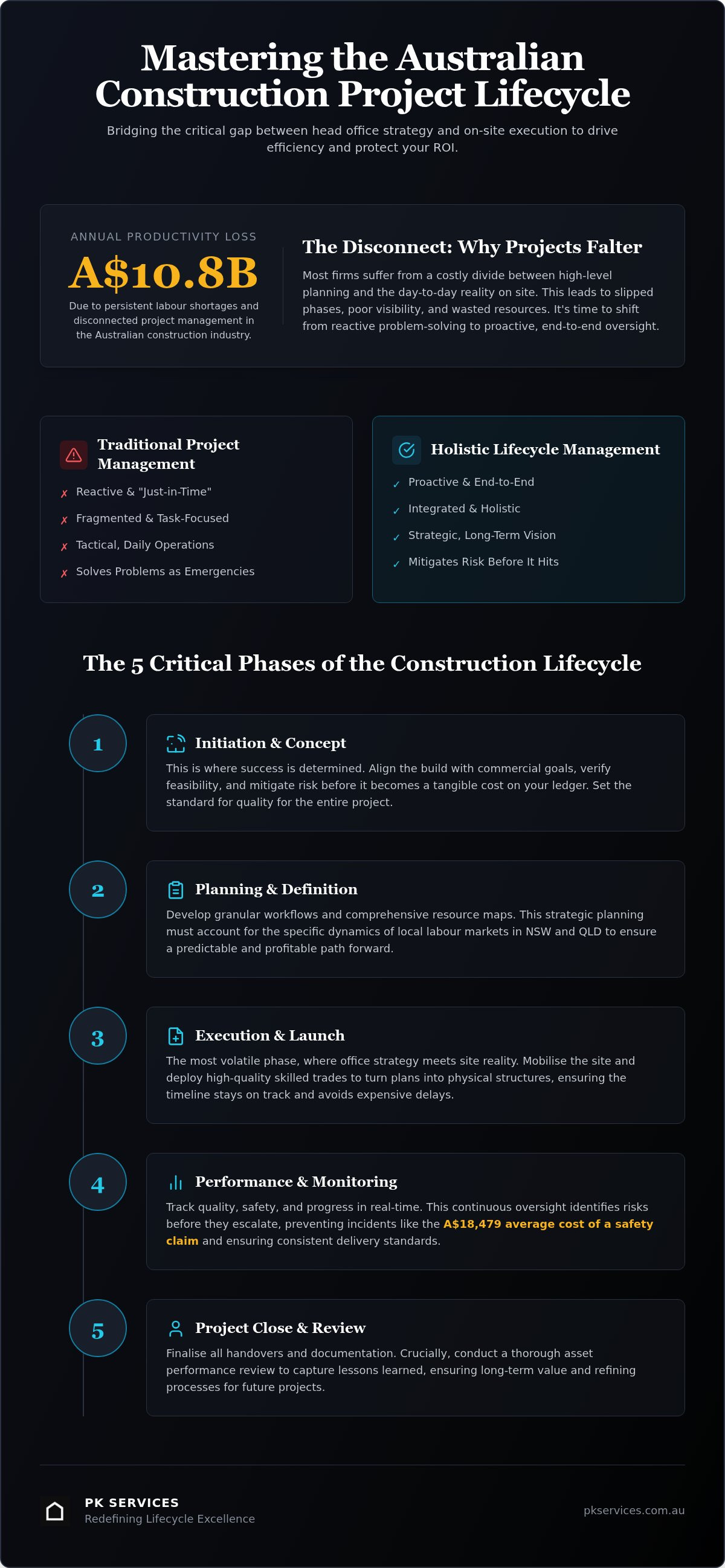
Every successful build follows a structured path. Effective construction project lifecycle management ensures that this path remains profitable and predictable. In the Australian market, these five phases are the pillars of a resilient delivery strategy. They allow you to maintain control when market variables, like the current 4.35% cash rate, put pressure on your margins. By treating these phases as an integrated system, you protect your project from the fragmentation that often plagues large-scale developments.
- Initiation and Concept: Aligning the build with your commercial goals and verifying feasibility.
- Planning and Definition: Creating granular workflows and resource maps that account for the local labour market.
- Execution and Launch: Mobilising the site and deploying skilled trades to turn plans into physical structures.
- Performance and Monitoring: Tracking quality and safety in real-time to avoid the A$18,479 average cost of a safety claim.
- Project Close: Finalising handovers and conducting an asset performance review to ensure long-term value.
Initiation: Setting the Strategic Blueprint
Success is decided before the first shovel hits the dirt. During initiation, you must evaluate project feasibility through a sophisticated advisory lens. This is the stage where you establish a "New Standard" of quality for the entire build. It is the only phase where you can mitigate risk before it transforms into a concrete cost on your ledger. By defining your success metrics early, you ensure the project remains viable regardless of external economic shifts in NSW or QLD.
Execution: Where Strategy Meets the Site
The execution phase is the most volatile part of the lifecycle. It is the moment where office-based strategy meets site-based reality. The quality of your skilled trades determines whether your timeline stays on track or slips into expensive delays. You need site leadership that understands the strategic intent behind every task. Ensuring your trade services align with your overall excellence goals is the most effective way to stabilise the project. High-calibre execution prevents the small errors that lead to major lifecycle disruptions.
Performance monitoring during the build is equally vital. It requires strict adherence to the National Construction Code 2025 and state-specific safety regulations. Real-time oversight allows you to catch quality issues before they are buried behind walls or under slabs. This constant vigilance ensures that the final handover is a seamless transition rather than a frantic rush to fix defects. When construction project lifecycle management is handled with this level of detail, the result is a project that delivers high ROI and consistent quality standards.
Bridging the Gap: Why Projects Fail Between Planning and Site
The transition from boardroom strategy to a live site is often the most volatile moment in construction project lifecycle management. We refer to this as the 'Handover Hazard.' It happens when the strategic intent of a project gets lost in translation between planning and site execution. A project that looks flawless on a screen can quickly unravel when site realities take over. This disconnect creates operational silos. The head office and the site team end up working toward different versions of the same goal.
Many firms fall into the trap of believing that software is a silver bullet. While data visibility is useful, it cannot replace the weight of experienced site management. Software merely records the delay; it doesn't fix the root cause. True project continuity requires human leadership capable of making high-stakes decisions in real-time. Without this, you're simply watching your margins disappear on a digital dashboard. Strategic business advice prevents these silos from forming by keeping every stakeholder aligned with the original vision.
Solving the Labour Void
Labour shortages are currently the primary disruptor of the project lifecycle. In NSW and QLD, the challenge isn't just finding workers. It's about securing specific trades that meet your elite quality standards. There is a fundamental difference between generic labour hire and tailored trade solutions. Tailored solutions involve integrating skilled professionals who treat your project as their own. This approach ensures that your delivery standards remain high even when the market is tight. It turns a potential weakness into a lifecycle stabiliser.
Site Leadership and Oversight
We must redefine what site excellence looks like. A traditional foreman manages the day-to-day, but strategic site leadership manages the project's future. This requires integrating quality control management services into the lifecycle as early as possible. Professional oversight ensures that every trade on-site acts as an extension of your business strategy. It transforms a collection of tasks into a high-performance environment. When site leadership is strategic, excellence becomes a consistent standard rather than a happy accident.
Practical Lifecycle Management for NSW and QLD Firms
Managing a project in Sydney is fundamentally different from managing one in Brisbane. While the core principles of construction project lifecycle management remain consistent, the regional variables change the stakes. Mid-sized builders in these hubs face unique supply chain pressures and labour market shifts that can't be ignored. You must adapt your resource planning to account for these nuances. A proactive construction business health check is the first step toward ensuring your local projects remain viable in an economy currently navigating a 4.35% cash rate. It allows you to spot inefficiencies before they drain your project's capital.
Your strategy must also account for the current labour shortage costing the industry over A$10.8 billion annually. In NSW and QLD, this isn't just a number; it's a daily reality on the site. Effective lifecycle management requires a deep understanding of how to source and retain the right trades at the right time. It involves moving beyond generic labour hire to find specialists who can uphold your delivery standards. This regional focus ensures that your high-level plans don't crumble when faced with local site realities.
Local Compliance and Quality Standards
The regulatory landscape is shifting rapidly. The NSW Building (Approvals and Practitioners) Bill 2026 is currently streamlining approvals while increasing penalties for certifiers and practitioners. Meeting these rigorous standards requires a commitment to construction excellence that starts at the concept phase. In Queensland, site logistics often revolve around environmental obligations and specific workplace health and safety standards. Vetting subcontractors within the Australian market has become a survival strategy. You need partners who understand the National Construction Code 2025 and the dual-code environment we currently inhabit. High-quality oversight ensures that every subcontractor on your site meets these evolving legal requirements.
Optimising Operational Performance
Efficiency is the only way to scale in a competitive market. You must tailor your workflows for local site conditions and weather patterns. In Sydney, this often means navigating high-density urban logistics and strict noise curfews. In Brisbane, it involves planning for seasonal weather disruptions that can halt a project for weeks. By mastering these variables, you can significantly improve construction business profitability in NSW and across the border. Scaling your business isn't about simply winning more tenders. It's about mastering the lifecycle process so that every project runs with precision. If you are ready to secure your project's future, partner with our expert team to redefine your delivery strategy.
PK Services: Redefining Lifecycle Excellence
For over 15 years, we've acted as the definitive bridge between head office strategy and site execution in Australia. We don't just provide advice; we deliver results. Our team understands that construction project lifecycle management is a continuous journey that requires constant vigilance. We move your business from merely "managing" the next task to truly "leading" the entire development. This shift is essential in a market where labour shortages and regulatory changes can easily derail a project. Our approach combines high-end professional confidence with a welcoming, grounded feel. It’s an elite tier of service that remains accessible and focused on your specific goals.
We pride ourselves on being a modern alternative to traditional consulting firms. Instead of cold, academic theories, we offer practical solutions that work on a live site in Sydney or Brisbane. We know that the success of your build depends on the details. That’s why we focus on maintaining superior standards across every single phase. By integrating our expertise, you ensure that your strategic vision is never diluted by site-level challenges. We are your reliable partners in innovation and excellence. We value the simplicity of a direct, personal connection as much as we value high-end results.
End-to-End Project Management Solutions
We manage the entire process from inception to completion. Our boutique approach is uniquely suited for local builders who need more than just a generic template. We provide a tailored experience that global consulting firms simply cannot match. By integrating full cycle project management into your firm, you gain total visibility over your operational performance. This oversight ensures that resource planning and trade mobilisation align perfectly with your commercial objectives. It’s about creating a seamless flow that protects your bottom line and ensures consistent delivery standards across every project stage.
Redefining the Standard
Excellence is our baseline. Our commitment to modern refinement means we are always looking for ways to evolve the industry standard. We specialise in filling the essential gaps on construction sites that often cause projects to stall. By providing the skilled trades and strategic oversight needed to maintain momentum, we keep your lifecycle moving forward. We help you navigate the dual-code environment of the NCC 2022 and NCC 2025 with ease. If you're ready to take the next step toward a more profitable future, partner with PK Services for your next project. Let's redefine what's possible for your business together.
Secure Your Project's Future
Mastering construction project lifecycle management is no longer optional for firms in NSW and QLD. It's the only way to protect your margins in a volatile market. We've explored how bridging the gap between head office strategy and site execution requires more than just software. It demands elite site leadership and a commitment to superior standards from the very first concept. By identifying risks early and integrating skilled trades, you turn potential disruptions into a competitive advantage.
Success comes down to the partners you choose. We bring 15+ years of industry expertise to every build. As end-to-end management specialists, we have a proven track record of delivering excellence across NSW and QLD. We help you move beyond the daily grind of task-tracking to achieve high-level operational performance. It's time to expect a higher tier of service and a more refined approach to your professional relationships. Redefine your construction project lifecycle with PK Services today. We're ready to help you lead your next project to a successful handover.
Frequently Asked Questions
What are the 5 stages of the construction project lifecycle?
The five stages are initiation, planning, execution, performance monitoring, and project close. These phases provide a structured roadmap for every build. Initiation focuses on feasibility and strategic alignment. Planning defines the workflows and resources. Execution is the mobilisation of site teams. Performance monitoring tracks quality and safety in real-time. Finally, the close phase ensures a seamless handover and asset review. Mastering these stages is the core of effective construction project lifecycle management.
How does lifecycle management improve construction business profitability?
Lifecycle management improves profitability by identifying financial risks before they become expenses. It reduces material waste through better planning and optimises labour spend across all project stages. By maintaining visibility over operational performance, you prevent the costly delays that often erode margins. This proactive approach ensures your project remains viable even when market pressures fluctuate. It transforms your delivery process into a high-performance engine for consistent ROI.
Why is the initiation phase so critical for project success?
Initiation is critical because it sets the strategic blueprint for the entire development. This is the only phase where you can mitigate major risks before they transform into physical costs on-site. It involves evaluating feasibility with an expert advisory lens to ensure the project aligns with your commercial goals. Establishing a high standard of quality here prevents fragmentation later in the build. It is the foundation of a successful delivery.
Can small to medium construction firms benefit from lifecycle management?
Small and medium firms benefit significantly from these structured frameworks. It allows boutique builders to compete with larger firms by delivering consistent quality and predictable timelines. Mastering the lifecycle process provides the scalability needed to grow without losing control of site standards. It helps mid-sized builders in Sydney and Brisbane manage resources more efficiently. This strategic oversight turns operational efficiency into a powerful tool for business growth and market resilience.
How do skilled trades impact the project lifecycle?
Skilled trades act as the primary stabilisers of the execution phase. Their quality and reliability determine whether your project stays on schedule or slips into expensive rework. Integrating experienced trades ensures that your strategic intent is actually realised on the site. They fill essential labour voids and maintain the momentum needed to reach key milestones. High-calibre trade services, including those dedicated to property enhancements such as palisadeslawnlandky.com, are the practical engine that keeps the entire lifecycle moving toward a successful handover.
What is the difference between project management and lifecycle management?
Project management is tactical and focuses on the day-to-day coordination of specific tasks. Construction project lifecycle management is strategic and holistic. It looks at the project as an integrated journey from the initial concept to post-occupancy reviews. While project management handles the "how" of a concrete pour, lifecycle management ensures that every action serves the long-term commercial vision. It is the difference between simply finishing a build and achieving true excellence.
How do NSW and QLD regulations affect lifecycle planning?
Regional regulations dictate the compliance standards you must meet at every stage. In NSW, recent legislative shifts demand greater transparency and accountability from practitioners. Queensland often requires specific focus on site logistics and environmental obligations. Effective planning involves navigating these state-level requirements to avoid penalties and delays. It requires a deep understanding of the local regulatory landscape to ensure your project remains compliant from the first approval to the final certificate.
How can I improve the transition from planning to site execution?
You can improve this transition by deploying strategic site leadership that understands the original project vision. This prevents the "Handover Hazard" where strategic intent is lost once the build begins. Integrated quality control management ensures that head office goals are translated into site-level actions. Maintaining a direct connection between your advisors and your trades is essential. It turns your planning documents into a living, breathing reality on the ground.


