

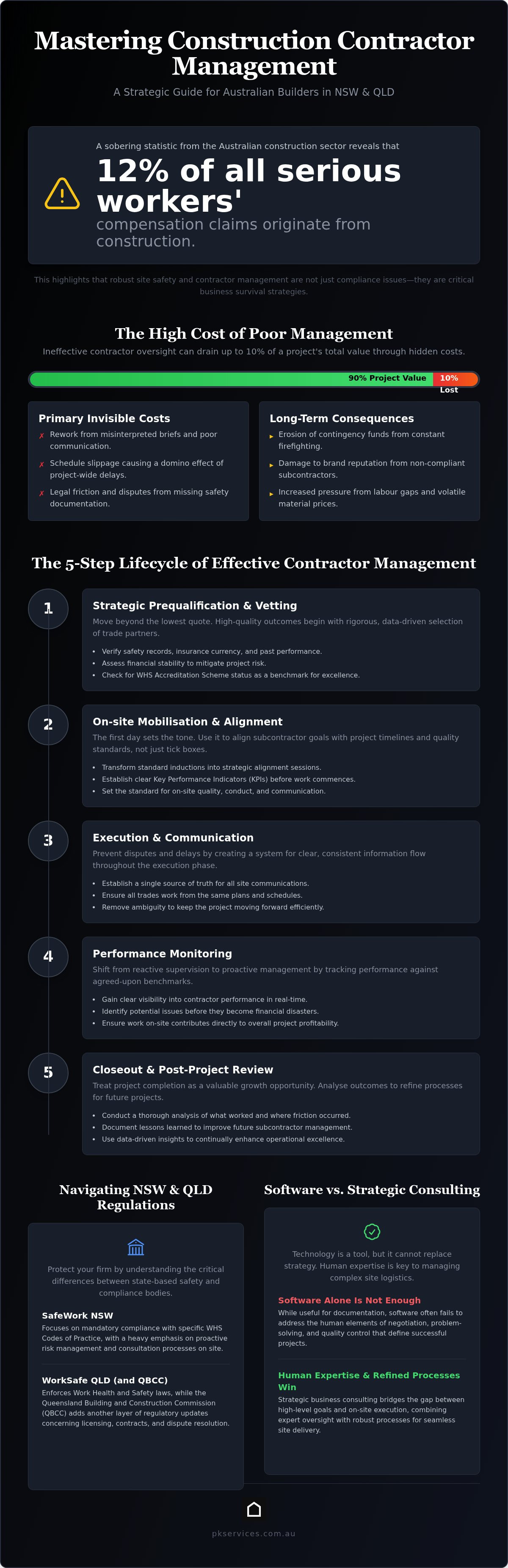
Twelve per cent of all serious workers' compensation claims in Australia stem from the construction sector. It's a sobering figure that proves site safety isn't just a box-ticking exercise; it's a critical survival strategy for your business. You likely feel the daily pressure of juggling multiple trades while trying to keep your project margins intact. Between the mandatory WHS Codes of Practice in NSW and the latest QBCC regulatory updates in Queensland, staying on top of construction contractor management can feel like an uphill battle.
We understand that communication breakdowns and unforeseen cost variations are more than just headaches; they're direct threats to your reputation. This guide will show you how to master subcontractor oversight to eliminate delays, protect your profits, and ensure every person on your site remains compliant. We'll examine the 2026 regulatory landscape, provide strategies for better trade visibility, and outline how to bridge the gap between high-level strategy and on-site execution for a more profitable project lifecycle.
Key Takeaways
- Identify the hidden costs of poor trade coordination, including rework and schedule slippage, that directly impact your project margins.
- Implement a structured 5-step framework to manage subcontractors with precision from the initial tender through to final handover.
- Master construction contractor management by combining strategic business consulting with on-site execution to ensure seamless site delivery.
- Navigate the critical differences between SafeWork NSW and WorkSafe QLD regulations to protect your firm and meet mandatory safety standards.
- Understand why human expertise and refined processes are more effective than software alone when managing complex site logistics and trade partners.
The High Cost of Poor Construction Contractor Management
Ineffective construction contractor management is the primary reason projects fail across Australia. It isn't just about missing a deadline. It's about the steady erosion of your profit margin. Most builders only notice the damage when the budget is already blown. Research suggests that poor contractor management can drain up to 10% of a project's total value. These are often invisible costs. Think of the rework required when a subcontractor misinterprets a brief. Consider the legal friction caused by missing safety documentation. Every day of schedule slippage triggers a domino effect of delays that eats into your contingency fund.
Your brand reputation in QLD and NSW depends entirely on the quality of your trades. A single non-compliant subcontractor can lead to a SafeWork NSW investigation or a QBCC dispute. In the Australian construction industry, word travels fast. Proactive oversight protects your name as much as your bank account. It moves your team away from reactive firefighting. You stop chasing problems and start preventing them before they hit the site.
Understanding the Australian Market Pressure
The labour gap in Sydney and Brisbane has changed the rules of the game. Skilled trades are currently a scarce resource. This scarcity complicates project timelines and drives up the cost of labour. Material prices also remain volatile across the East Coast. You can no longer afford the inefficiencies of traditional handshake agreements. Modern builders need rigorous documentation and clear, enforceable expectations. Efficiency is no longer optional. It's a survival requirement for any firm looking to scale in the current market.
The Shift Toward Professional Site Oversight
There is a fundamental difference between site supervision and strategic management. Supervision is about watching the work happen. Strategic management is about ensuring the work contributes to project profitability. Adopting full cycle construction project management allows you to bridge the gap between high-level strategy and site reality. This is where professional business consulting adds immense value. It helps you modernise workflows and redefine site excellence. You gain clear visibility into contractor performance long before issues become financial disasters.
The 5-Step Lifecycle of Effective Contractor Management
Successful projects aren't accidents. They're the result of a repeatable, disciplined framework. Effective construction contractor management requires looking past the contract and focusing on the people and processes. You need a system that spans from the first tender document to the final site handover. This lifecycle ensures that every trade partner understands their role, your expectations, and the standard of excellence required on your site.
Step 1: Strategic Prequalification and Vetting
Don't settle for the lowest quote. High-quality outcomes start with rigorous vetting construction subcontractors Australia. You must verify safety records, insurance currency, and past performance history. Financial stability is equally critical. A subcontractor in financial distress is a project risk you don't want to carry. For firms targeting larger projects, checking for a WHS Accreditation Scheme status is a reliable benchmark for safety excellence.
Step 2: On-site Mobilisation and Alignment
The first day on site sets the tone for the entire project duration. Standard site inductions often feel like a box-ticking exercise. Change that. Use this time to align subcontractor goals with your project timeline. Establish clear KPIs before the first hammer is swung. This is the moment to set the standard for quality and conduct. If you want a partner to assist in managing the entire process from start to finish, getting this alignment right is the most impactful step you can take.
The lifecycle continues through execution, monitoring, and closeout. During the execution phase, you must establish a single source of truth for all site communications. This prevents the "he said, she said" disputes that often derail progress. Centralised data ensures everyone is working from the same set of plans and schedules. It removes ambiguity and keeps the project moving.
Finally, never skip the post-project review. This is your most valuable growth tool. Analyse what worked and where the friction points occurred. Use these insights to refine your selection criteria for the next job. Closing the loop ensures your construction contractor management evolves with every build, turning every project into a lesson in increased profitability.
Software vs. Strategic Consulting: Choosing the Right Approach
Technology is often sold as a cure-all for site inefficiencies. While digital tools provide data, they don't provide leadership. Many Australian firms find that expensive software quickly becomes 'shelfware' because the underlying processes are fundamentally broken. Effective construction contractor management requires a human element that technology alone cannot replicate. You need strategic insight to navigate complex site logistics and trade personalities. Strategic consulting redefines your business systems, ensuring tech supports your leadership rather than replacing it. It's the difference between having a map and knowing how to drive the truck.
A tool is only as good as the person using it. If your team lacks a clear management framework, a new app will only help them make mistakes faster. True site excellence comes from a blend of high-level professional confidence and grounded, practical experience. We believe in building the strategy first. Once the process is robust, technology acts as a powerful multiplier. Without that foundation, you're just adding digital clutter to an already stressful environment.
When to Invest in Professional Advisory
Your internal systems might be reaching a breaking point if rework is rising or site morale is dropping. These are clear signs that your current approach to construction contractor management isn't scaling. Investing in specialist construction advisory services provides a high ROI by identifying blind spots you're too close to see. External consultants bring a fresh perspective to your project delivery. They turn site friction into streamlined execution. It's about building a foundation that allows your business to grow without the usual growing pains. Advisory services aren't just an expense; they're an investment in project resilience.
Bridging the Gap Between Office and Site
A common project killer is the disconnect between the office and the site. Project managers and site foremen often work from different sets of priorities. End-to-end management reduces this communication friction by creating a unified vision. In a recent NSW project, strategic oversight saved a failing residential development that was six weeks behind schedule. By implementing a professional consulting model, we realigned the on-site workflows with the master programme. The result was a seamless finish that protected the builder's reputation and margin. This level of integration ensures that every decision made at a desk translates into progress on the ground.
Compliance and Safety: Navigating NSW and QLD Regulations
Compliance isn't a static target. In 2026, the regulatory landscape across the East Coast has tightened significantly. Managing construction contractor management requires a deep understanding of the specific mandates in your state. For instance, as of July 1, 2026, NSW firms must strictly comply with approved WHS Codes of Practice. Departing from these is only allowed if you provide an equal or higher safety standard. Meanwhile, Queensland's QBCC Amendment Regulation 2026 has introduced a tougher infringement notice regime. You can't afford to get these details wrong.
Your "Duty of Care" as a head contractor is non-delegable. You are responsible for the safety of every subcontractor on your site. This includes managing psychosocial risks and hazardous substances, which are current priorities for SafeWork NSW. A digital paper trail is your best defence. Relying on physical folders is a risk. Digital records provide real-time proof of compliance and can prevent site disputes from escalating to the CTTT or QCAT. Clear documentation usually stops a legal fire before it starts.
Quality Control and Risk Mitigation
Redefining excellence on site requires more than just safety checks. Implementing construction quality control management services ensures that work meets technical standards the first time. Regular site audits are essential. You need to document findings immediately to manage variations effectively. Uncontrolled change orders are profit killers. A structured audit process keeps your budget in check and your trades accountable. If you need help managing the entire process from start to finish, professional oversight is the logical next step.
Environmental and Social Obligations
Modern projects carry heavy social and environmental weight. In urban Sydney, managing noise and waste is a high-stakes balancing act. Residents are quick to complain, and regulators are quick to fine. In Queensland, the 2026 government procurement policy emphasises local participation and sustainable practices. You must prove your project supports the local community. Green compliance is also evolving. The Industrial Chemicals Environmental Management Standard (IChEMS) now dictates how chemicals are handled on site. These obligations are no longer extras. They are core components of a successful build.
Redefining Excellence: The PK Services Management Model
Excellence is more than a target. It's a daily practice. PK Services brings 15 years of industry expertise to every site we manage. We've seen the Australian construction sector evolve through regulatory shifts and economic cycles. This history allows us to provide a level of professional confidence that newer firms simply cannot match. Our model for construction contractor management is built on the belief that site leadership must be both elite and inclusive. We bridge the gap between boardroom strategy and boots-on-the-ground execution.
Most firms focus solely on the paperwork. We focus on the performance. Our approach integrates strategic business consulting with direct on-site oversight. We don't just advise from a distance; we're in the trenches with you. This ensures every trade partner meets our superior standards and your project goals. We value the simplicity of a direct, personal connection while delivering high-end results that protect your bottom line.
Supplying Skilled Trades and Contractors
Partner with PK Services for Your Next Project
Complex projects in NSW and QLD require more than just standard oversight. They require a partner who understands the nuances of modern compliance and the latest safety mandates. We offer customised consulting solutions designed to scale with your business. Redefining your excellence begins with a clear understanding of your current performance. We suggest starting with a construction business health check. This strategic review uncovers the hidden inefficiencies eating into your margins. It provides a forward-thinking roadmap for your next project, ensuring you stay ahead of the curve in a fast-paced environment.
Site excellence is within reach. It requires a bold innovator who is also a reliable, down-to-earth partner. We're ready to help you redefine what's possible on your next build. Redefine your site excellence with PK Services today.
Mastering the Future of Site Excellence
Effective construction contractor management is the bridge between a project that barely breaks even and one that sets a new standard for profitability. We've explored how moving beyond simple supervision toward strategic oversight protects your margins and ensures site safety. By implementing a disciplined 5-step lifecycle and staying ahead of evolving NSW and QLD regulations, you turn project risks into competitive advantages. It's about combining modern processes with the right human expertise to lead your trades with confidence.
PK Services brings 15+ years of Australian industry expertise to your project. As end-to-end project management specialists, we provide a vetted supply of skilled trades for QLD and NSW firms, filling critical labour gaps while maintaining superior standards. We handle the entire process from start to finish, allowing you to focus on growth while we secure your site execution. Redefine your construction excellence with PK Services today. Your next project deserves a higher tier of professional leadership and a partner committed to your long-term success.
Frequently Asked Questions
What is the most common mistake in construction contractor management?
The most common mistake is prioritising the lowest tender price over proven performance and safety history. This approach often leads to invisible costs like rework and delays that quickly exceed any initial savings. Effective construction contractor management requires a value-based selection process. You should look for trades that align with your project’s quality standards and show a clear history of meeting deadlines without compromising site safety.
How do I ensure my subcontractors are compliant with SafeWork NSW?
You must verify that every subcontractor holds a valid White Card and has submitted a site-specific Safe Work Method Statement (SWMS). Under the 2026 NSW regulations, you are also responsible for ensuring they comply with mandatory WHS Codes of Practice. Regular site audits and digital record-keeping are essential to prove you've met your non-delegable duty of care. Don't rely on verbal assurances; check the documentation yourself.
Is it better to hire labour directly or use a trade service provider?
Using a trade service provider is often better for managing project-specific labour voids without the long-term overhead of direct employment. Trade providers handle the vetting, payroll, and compliance, allowing you to scale your workforce quickly. Direct hiring is usually reserved for your permanent core management team. For most NSW and QLD firms, a hybrid model provides the best balance of flexibility and control over site quality.
How can I reduce cost overruns caused by contractor delays?
Implementing a centralised project schedule with real-time updates is the most effective way to reduce cost overruns. You need an early warning system that flags potential delays before they impact the critical path. Clear communication and pre-agreed variations processes prevent minor issues from becoming major financial drains. Proactive construction contractor management ensures that every trade partner understands the financial consequences of schedule slippage before work begins.
What should be included in a construction contractor's KPI list?
A robust KPI list should include safety incident rates, quality of finish, and adherence to the project timeline. You should also track the rate of rework and the contractor's responsiveness to site instructions. Setting these benchmarks during the tender phase ensures that expectations are clear. Regularly reviewing these metrics allows you to address performance issues early and rewards high-performing trades with future project opportunities.
How does PK Services help with the current labour shortage in Australia?
PK Services addresses the labour gap by providing a direct supply of skilled, vetted tradespeople across New South Wales and Queensland. We bridge the gap between strategy and execution by supplying professionals who are ready to hit the ground running. This reduces your management overhead and ensures project continuity. Our 15 years of industry expertise means we only supply trades who meet our elite standards of professionalism.
What is the difference between a project manager and a site manager?
A project manager focuses on the high-level strategy, including budgeting, procurement, and stakeholder communication. In contrast, a site manager is responsible for the daily on-site execution and trade coordination. While the project manager ensures the job is profitable and on track, the site manager ensures the work is done safely and to the correct technical standard. Both roles are essential for seamless project delivery and effective site leadership.
Can professional consulting really improve my project's profitability?
Professional consulting improves profitability by identifying operational blind spots that lead to waste and rework. Consultants bring a fresh perspective and proven frameworks to streamline your internal workflows. By redefining your management model, you can reduce administrative friction and improve resource planning. This strategic approach turns site efficiency into a measurable financial gain, ensuring your project margins remain protected throughout the entire construction lifecycle.


