

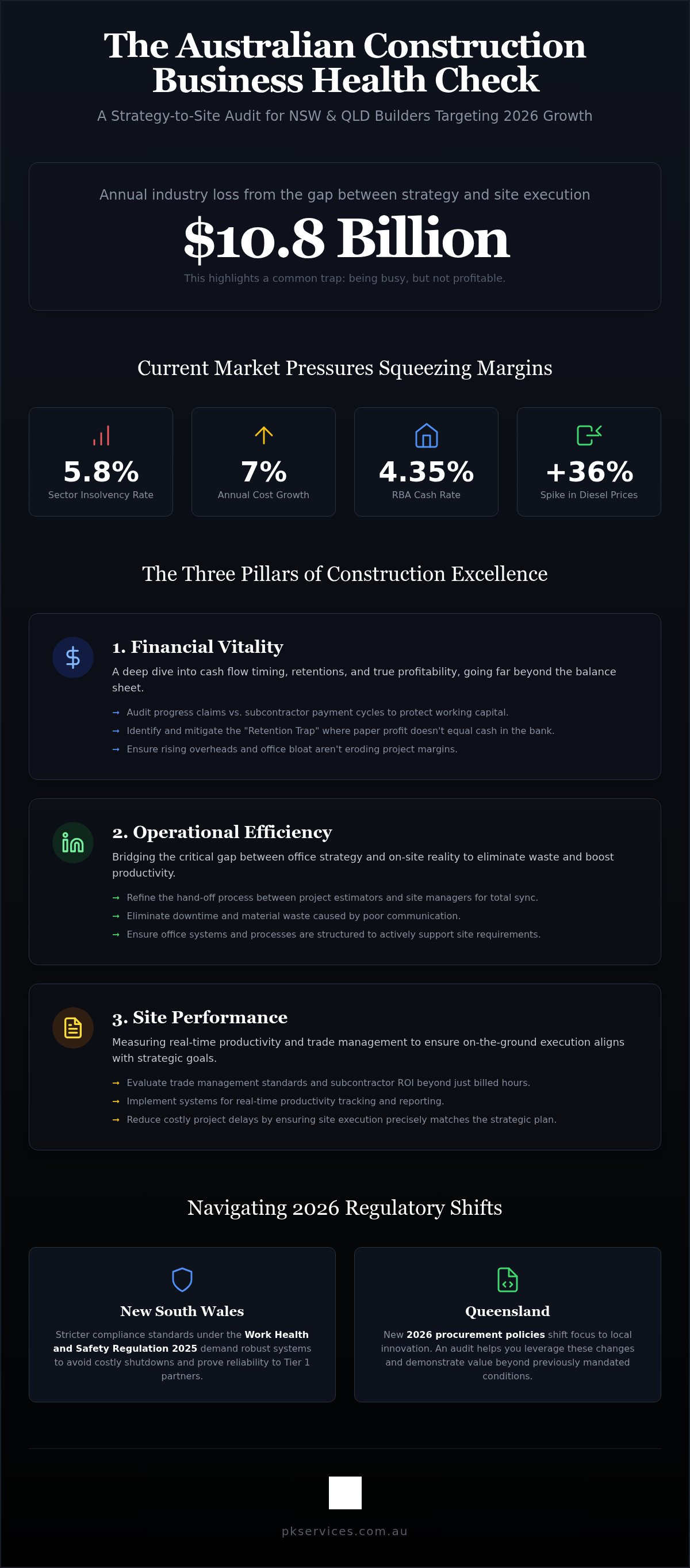
The Australian construction industry loses over $10.8 billion annually due to poor synchronisation between strategy and site execution. It's a staggering figure. For many NSW and QLD builders, it highlights a common trap: being busy but not profitable. You're likely managing high turnover while cash flow gaps and trade shortages squeeze your margins. A regular construction business health check is now essential to avoid the 5.8% insolvency rate currently impacting the sector.
We know the struggle of balancing the boardroom with the building site. This guide provides a clear roadmap to audit your firm's financial and operational performance, helping you unlock scalable growth for 2026. You'll learn how to streamline logistics, manage new regulatory shifts like the NSW Building Productivity Reforms, and bridge the gap between office strategy and on-site reality. It's time to redefine your standards and build a business that's as robust as the structures you create.
Key Takeaways
- Learn how a construction business health check identifies hidden bottlenecks by auditing the critical gap between your office strategy and on-site execution.
- Master your cash flow by evaluating the timing of progress claims against subcontractor payments to avoid capital being tied up in the retention trap.
- Improve site productivity by refining the hand-off process between project estimators and site managers to eliminate downtime and material waste.
- Protect your business from costly shutdowns by ensuring your WHS compliance and contracts align with the latest 2026 NSW and QLD regulations.
- Discover a clear roadmap for scaling your firm in the 2026 Australian market through a specialised audit of your site-based systems.
What is a Construction Business Health Check?
A construction business health check is more than a glance at your profit and loss statement. It's a comprehensive audit of a firm's financial, operational, and site-based systems. Unlike a general accounting check-up, this specialist audit examines the unique mechanics of the building industry. It bridges the gap between what's happening in the boardroom and what's actually occurring on the tools.
We define the construction health check as an integrated strategy-to-site evaluation.
The 2026 market demands a specialised approach. With annual construction cost growth reaching 7% and the RBA cash rate holding at 4.35%, margins are thinner than ever. You can't rely on old data. Builders are currently navigating 36% spikes in diesel prices and persistent labour shortages. A specialist audit identifies exactly where these external pressures are creating internal cracks before they compromise your project delivery.
The Three Pillars of Construction Excellence
Financial vitality is the first pillar. It goes beyond the balance sheet to scrutinise cash flow timing and retentions. If your capital is tied up across multiple projects while subcontractors demand payment, your growth is stalled. We look for the "Retention Trap" where profit is on paper but not in the bank.
Operational efficiency is the second pillar. It focuses on how the office supports the site, ensuring estimators and site managers are in total sync. Poor hand-offs here contribute to the $10.8 billion in lost productivity the Australian industry faces annually.
Site performance is the third pillar. It measures real-time productivity and trade management standards. We ensure site execution matches your strategic goals, reducing downtime and material waste.
Why Builders in NSW and QLD Need Regular Audits
Sydney and Brisbane are high-speed markets with specific regulatory hurdles. In NSW, the Work Health and Safety Regulation 2025 has introduced stricter compliance standards that builders must adhere to. Queensland's 2026 procurement policies now emphasise local innovation over previously mandated conditions. Regular audits help you navigate these shifts without losing momentum.
Regular checks identify profit leaks early. This level of oversight makes your business far more attractive to Tier 1 partners. It proves you have the robust systems required to handle larger, more complex contracts. By identifying bottlenecks before they become disasters, you position your firm for sustainable, scalable growth in a challenging economic climate.
The Financial Pulse: Cash Flow and Profitability
Cash flow is the oxygen of your site. Without it, even the most impressive pipeline of work won't save you from the industry's current 5.8% insolvency rate. A construction business health check must start with a deep dive into your liquidity. It's not just about how much work you have. It's about when the money actually hits your account versus when it leaves.
The timing of progress claims against subcontractor payments is a frequent failure point. If you're paying subbies before your own claims are settled, you're essentially acting as an interest-free bank for your clients. In a market where the RBA cash rate sits at 4.35%, this is a dangerous game. You need to audit these cycles to ensure your working capital remains healthy.
The 'Retention Trap' is another silent profit killer. We often see builders with significant capital tied up across multiple projects, leaving them cash-poor despite high turnover. Auditing these retentions helps you understand your true financial position. It also ensures you aren't letting office bloat and rising overheads eat into your project margins. With annual construction costs growing at 7%, every percentage point counts.
Mastering Progress Claims and Retentions
Administrative errors or late filings often cause payment delays. Auditing your claim submission process ensures every dollar is accounted for and requested on time. This is critical for maintaining the momentum of your projects in Sydney and Brisbane. You should also develop strategies to manage retentions so they don't strangle your ability to take on new work. For more on this, read our guide on improving construction business profitability NSW.
Subcontractor and Supplier Cost Analysis
Supplier agreements require constant review in the 2026 market. In QLD, the shift away from mandated conditions means you have more room to negotiate based on local participation and innovation. You need to know if your trades are delivering genuine ROI or simply billing hours. Fixed-price contracts are particularly vulnerable right now. The 36% spike in diesel prices and general inflation can quickly turn a profitable job into a loss if you aren't auditing your costs in real time.
To truly master these financial cycles, it helps to partner with experts who understand both the boardroom and the building site.
Operational Excellence: Bridging the Strategy-to-Site Gap
Operational excellence isn't found in a spreadsheet. It's found in the seamless transition between your office strategy and site execution. Many builders struggle when the estimator's vision fails to align with the site manager's reality. This friction is a primary driver of the $10.8 billion lost annually to industry inefficiencies. A construction business health check must evaluate this hand-off to ensure your projects remain profitable from inception to completion.
Effective trade management is the backbone of this process. It isn't just about having bodies on site. It's about having the right skilled trades who understand the "PK Standard" of excellence. Without this alignment, you risk material waste and costly rework. Your audit should also include a systems check. As you scale, the project management tech that worked for two sites will likely fail you at ten. You need tools that offer real-time visibility into every moving part of your operation.
Site Productivity and Trade Management
Auditing site productivity requires identifying where "dead time" occurs. Machinery sitting idle or labour waiting for materials are silent profit leaks. We look at how you organise your site logistics to keep momentum high. By refining these workflows, you ensure every hour on site contributes to your bottom line. Integrating these site-based audits is part of a full cycle construction project management approach that sets elite firms apart.
Information Flow: From Office to Site
Clear communication is your best defence against disputes. You must check the accuracy of site reporting and daily logs. If variations aren't captured and approved in real-time, you're essentially working for free. A construction business health check identifies these communication breakdowns before they lead to legal headaches. Resource planning is equally vital. Labour gaps on critical path items can derail an entire schedule. Ensuring your office team and site managers share a single source of truth prevents these bottlenecks and keeps your Brisbane or Sydney projects on track.
Risk, Compliance, and WHS Standards in 2026
Risk management isn't just about insurance premiums. It's about protecting your legacy. A thorough construction business health check ensures you aren't one site incident away from total closure. In Sydney and Brisbane, regulators are more active than ever. You need to verify that your current coverage matches your 2026 project load. Many builders are underinsured for the complexity of the work they now handle. NSW Fair Trading and the QBCC have increased their audit priorities for 2026. Staying ahead of these requirements is essential for maintaining your licence and reputation.
Contractual and Legal Safeguards
Contractual health is your first line of defence. We see too many builders signing agreements with liquidated damages that don't account for the current 7% cost growth. Reviewing force majeure clauses is also vital. They must reflect the global supply chain realities of 2026. Identifying 'toxic' clauses before you sign can save hundreds of thousands in potential disputes. You should also audit your dispute resolution processes to keep projects moving when disagreements arise. Effective risk management starts with vetting construction subcontractors Australia to ensure your partners are as compliant as you are.
WHS and Site Safety Culture
Site safety must move beyond paperwork. From January 1, 2026, mandatory audiometric testing is required for workers exposed to hazardous noise. Baseline tests must be completed within three months of starting work. By December 1, 2026, new Workplace Exposure Limits (WELs) replace the old standards for airborne contaminants. Your construction business health check must ensure your team is trained and equipped for these specific shifts. Industrial manslaughter laws now carry significant penalties across all states, making a proactive safety culture a non-negotiable business requirement.
Psychosocial hazards are also explicitly regulated in 2026. You must actively manage risks like work-related stress and harassment to meet your WHS obligations. This requires moving beyond simple checklists to a culture where site management is genuinely trained for modern compliance standards. If your safety systems feel outdated, it's time to engage a professional consulting partner to redefine your excellence.
Redefining Excellence: How PK Services Conducts a Health Check
At PK Services, we don't believe in surface-level reviews. A construction business health check is an intensive, ground-up evaluation that bridges the gap between the boardroom and the building site. We integrate 15 years of direct industry expertise with sophisticated business consulting. This allows us to see what traditional accounting firms often miss. We look at the quality of your site execution and the strength of your balance sheet simultaneously. Our unique "Strategy-to-Site" methodology ensures your high-level goals actually translate to the tools.
Most consultants leave you with a report and a list of problems. We prefer to provide the roadmap and the resources to fix them. When we identify a gap in site performance or operational flow, we have the capacity to fill it. This data becomes the essential foundation for your construction business growth strategy NSW. It turns raw audit findings into actionable momentum for the 2026 market. You gain the confidence to scale because you know your operational foundations are finally secure.
From Strategic Advice to Site Execution
We manage the entire process from inception to completion. If your audit reveals a need for more reliable site management or better trade coordination, we step in. We supply the skilled trades and contractors required to meet the "PK Standard" of excellence. It's a boutique service that offers elite professional confidence while remaining grounded and accessible. We act as your reliable partner, ensuring every audit recommendation results in measurable site-level improvement. You get the sophistication of high-end consulting with the practical grit of a seasoned builder.
Next Steps for NSW and QLD Builders
Preparing your team for an audit is straightforward. You'll need your recent project logs, financial statements, and current subcontractor agreements ready for review. We handle the heavy lifting from there. The ROI of this process is often immediate. Identifying a single profit leak or a compliance risk in your current pipeline can save your margin for the entire financial year. Redefine your standards today. Organise your consultation with PK Services and move your firm from being just busy to being truly profitable in the Sydney and Brisbane markets.
Secure Your Scalable Growth for 2026
The 2026 Australian market doesn't reward being just busy. It rewards builders who master the gap between their office strategy and site-level execution. A construction business health check is the catalyst for this transformation. By auditing your cash flow cycles, site productivity, and evolving WHS compliance, you move beyond mere survival. You build a firm capable of handling the high-speed demands of Sydney and Brisbane with total confidence.
PK Services brings 15 years of industry expertise to your audit. We provide specialised NSW and QLD local knowledge that generalist firms simply can't match. Our team manages the entire process from strategy to site. We ensure your business is robust enough to secure Tier 1 contracts and sustainable profit margins. Don't let hidden bottlenecks stifle your potential.
Redefine your excellence; organise your construction business health check with PK Services today.
It's time to stop reacting to the market and start leading it. We're ready to help you build something exceptional.
Frequently Asked Questions
What is included in a construction business health check?
A comprehensive audit covers your financial, operational, and site-based systems. We examine progress claim cycles, subcontractor agreements, and on-site productivity levels. We also review your WHS compliance and contract terms to find bottlenecks that prevent scaling. It is an integrated strategy-to-site evaluation ensuring your office and your trades work toward the same profit goals.
How often should a Sydney construction firm audit its operations?
We recommend a full audit at least once a year. High-growth firms in Sydney often benefit from quarterly reviews to stay ahead of the 7% annual cost growth currently impacting the sector. Regular oversight ensures you can pivot your strategy before a small operational leak becomes a major financial drain on your project pipeline and working capital.
Can a business health check help with cash flow issues?
Yes, it directly addresses the timing of progress claims versus subcontractor payments. We identify the "Retention Trap" where your capital is tied up across multiple projects. By auditing these cycles, we help you keep more cash in the bank. This is vital in a market with a 4.35% cash rate; we ensure you aren't acting as an interest-free bank for your clients.
Do I need a health check if my construction projects are currently profitable?
Profitability on paper doesn't always mean your business is healthy. You might be busy but inefficient, leaving significant money on the table through material waste or labour downtime. A construction business health check identifies these hidden leaks. It ensures your current success is scalable and sustainable for 2026. Don't wait for a crisis to verify your operational foundations are secure.
What is the difference between a financial audit and a construction health check?
A financial audit looks at past numbers while a construction health check looks at your future capacity. We go beyond the balance sheet to evaluate site execution and trade management. We bridge the gap between your boardroom and the building site. While an accountant focuses on tax, we focus on the operational mechanics that actually drive your daily profit and project delivery.
How long does a full construction business health check take to complete?
Most audits are completed within two to four weeks. The exact timeframe depends on the size of your firm and the complexity of your current projects. We start with a deep dive into your documentation and follow up with site-level evaluations. This brisk rhythm ensures you get actionable insights quickly. You can then begin implementing changes without losing momentum in your build schedule.
Will a health check help me scale my business in Queensland?
It provides the data needed to move from residential or small-scale jobs to Tier 1 contracts. We audit your systems to ensure they can handle increased complexity. In Queensland, we focus on local participation and innovation requirements. This prepares you to win larger tenders. You'll gain the professional confidence to grow your team and project load without compromising your standards.
What specific NSW/QLD regulations are covered in the audit?
We cover the Work Health and Safety Regulation 2025 in NSW and the latest QBCC requirements in Queensland. The audit includes checks for mandatory 2026 audiometric testing and new Workplace Exposure Limits for airborne contaminants. We also review your contracts for compliance with current industrial manslaughter laws. This ensures your business meets the highest safety and legal standards in the Australian market.


