

What if the most expensive mistake on your 2026 project isn't a design flaw, but a subcontractor who looked perfect on paper? We've all experienced the frustration of unreliable trades causing delays or the hidden costs of rework due to poor skills. In a landscape defined by the NCC 2025 and updated QBCC regulations, the margin for error is thinner than ever. Mastering the process of vetting construction subcontractors Australia wide is no longer just a compliance checkbox. It's a strategic performance filter that determines your project's profitability.
You're likely feeling the weight of stricter NSW and QLD regulations, alongside the new 12% "Payday Super" requirements starting this July. We understand that you want a stable, high-performing site crew without the heavy management overhead. This guide promises to help you master the art of vetting to secure reliable labour and protect your bottom line in the current market. We'll preview the essential 2026 compliance shifts, trade skill verification techniques, and the steps to building a partnership that redefines excellence in project delivery.
Key Takeaways
- Understand why vetting construction subcontractors Australia wide has evolved into a strategic necessity for navigating the 2026 labour shortages in Sydney and Brisbane.
- Identify the five critical pillars of subcontractor viability, focusing on updated QBCC and NSW Fair Trading compliance to safeguard your project margins.
- Learn how to transition from basic labour hire to strategic trade partnerships that prioritise total project efficiency over simple hourly rates.
- Implement a rigorous two-step auditing framework to verify legal, financial, and operational standards before a subcontractor arrives on-site.
- Discover how a managed approach to vetting bridges the gap between high-level consulting and elite trade execution for superior project delivery.
The 2026 Landscape for Vetting Construction Subcontractors in Australia
Vetting construction subcontractors Australia wide is no longer a simple administrative ritual. It is a multi-layered process of verifying a subcontractor’s legal, financial, and operational viability. At its core, this process ensures that what is a subcontractor in your contract is actually capable of delivering on the ground. In the current market, a signature and a copy of an insurance certificate are not enough. You need a deep dive into their history and capacity to protect your margins.
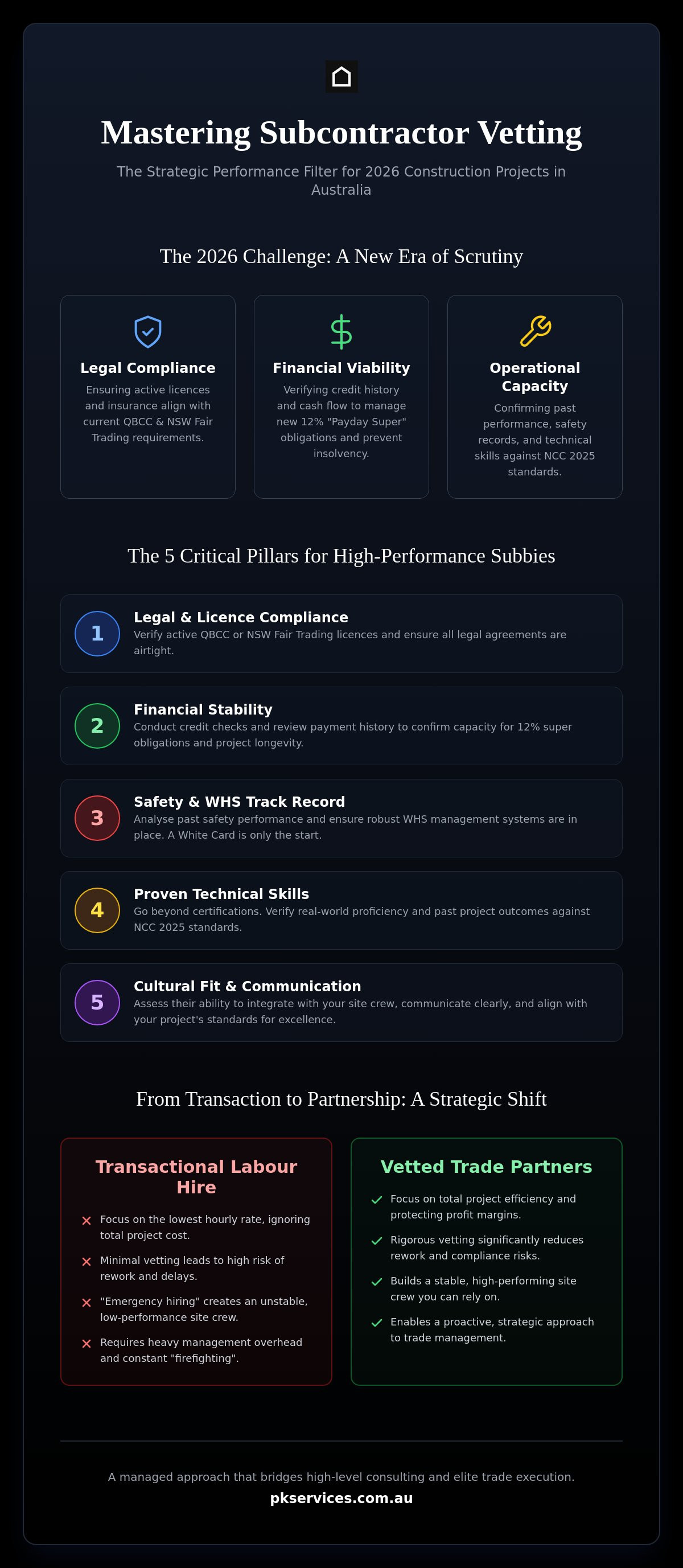
Modern vetting involves three distinct layers of scrutiny:
- Legal: Ensuring all licences and insurances are active and compliant with current NSW Fair Trading or QBCC requirements.
- Financial: Verifying credit history and payment reliability to avoid the risk of mid-project insolvency.
- Operational: Confirming past performance, safety records, and technical trade skills against the NCC 2025 standards.
The 2026 landscape is particularly challenging for high-density projects in Sydney and Brisbane. We are seeing a massive demand for skilled labour that the current market struggles to meet. A standard White Card check is the bare minimum, yet many still treat it as a gold standard. It isn't. A White Card sitting in a wallet doesn't guarantee trade proficiency or compliance with the latest energy efficiency mandates. Relying on it alone is a gamble with your project's reputation.
Smart builders are now looking at construction business consulting Australia as a primary way to mitigate these risks. Professional consulting helps you build a robust framework that filters out unreliable partners before they reach the site gate. It's about moving from a reactive "firefighting" mode to a proactive, strategic approach to trade management.
The Labour Gap in NSW and QLD: A Strategic View
Regional infrastructure projects are currently siphoning off the best talent. This creates a vacuum in the residential and commercial sectors. With the infrastructure segment projected to grow at a CAGR of 6.18% through 2031, the competition for elite labour is fierce. When the local pool of vetted tradies is stretched thin, the temptation to hire the first available crew is high. This "emergency hiring" is where most project failures begin. Without a formal vetting program, you risk bringing on subcontractors who lack the financial stability to survive the project duration. In 2026, reliability has become the most valuable currency on any site.
Why Quality Vetting Drives Operational Performance
Quality vetting is the most effective way to protect your margins. When you hire elite trades, the need for rework drops significantly. Operational vetting is the bridge between strategy and on-site execution. It ensures that the people doing the work understand the high standards required for modern project delivery. A single unvetted subbie who fails to meet compliance can cause a ripple effect of delays across the entire project schedule. High-performance sites are built on the back of high-performance vetting.
The Vetting Roundup: 5 Critical Pillars for High-Performance Subbies
Effective vetting construction subcontractors Australia wide relies on five non-negotiable pillars. These are not just boxes to tick. They are safeguards for your reputation and your profit margins. When you look at a potential partner, you are evaluating their ability to integrate into a high-pressure environment without becoming a liability. It requires a balanced look at their legal standing and their operational reality.
- Legal and Licence Compliance: Verify active licences with the QBCC or NSW Fair Trading. It is also vital to understand the formal framework of subcontracting for building services to ensure your agreements are airtight and legally sound.
- Financial Stability: Look beyond the initial quote. Perform credit checks and review their payment history with suppliers. With the mandatory 12% superannuation guarantee and "Payday Super" requirements now in effect as of July 2026, you must ensure they have the cash flow to meet these immediate obligations.
- Safety and WHS Track Record: Review past incident reports. In 2026, compliance with the updated NCC 2025 provisions for fire safety and water management is critical. Their safety plans should be active site protocols, not just dusty templates.
- Technical Competency: Confirm their specific experience with modern materials and high-density projects. Verify their portfolio against the actual quality delivered on-site.
- Cultural Fit and Communication: Evaluate their "soft" skills. A subcontractor who communicates clearly and solves problems proactively is worth their weight in gold.
Success on-site is about more than just showing up. It's about how that trade partner handles the complexities of a modern Australian build. If you want to streamline your trade management, you need a process that filters for these five pillars every single time.
Technical Mastery: Beyond the Baseline Qualification
A Certificate III is a baseline. It does not prove mastery of complex, modern building systems. For skilled trades for construction sites, you need specialists. Think about high-density waterproofing or intricate facade installations. These tasks require specific, proven expertise that goes beyond basic training. Review project portfolios for quality consistency across different sites. If a subcontractor cannot show a history of high-standard delivery on similar projects, they aren't the right fit for your crew.
Soft Skills: The Invisible Project Accelerator
Communication is a project accelerator. Site logistics in Sydney and Brisbane are increasingly complex. You need tradies who identify risks before they escalate into expensive rework. A proactive mindset means they understand the "full-cycle" project lifecycle. They don't just finish their task and leave; they ensure their work integrates perfectly with the next trade in the sequence. This level of professional maturity reduces management overhead and keeps the project moving with purpose.
Strategic Comparison: Transactional Labour Hire vs. Vetted Trade Partners
Choosing between standard labour hire and a vetted trade partner is a choice between filling a gap and building a project. The traditional "body-shop" approach focuses on volume. It provides warm bodies to meet a headcount. While this might solve a temporary shortage, it often creates long-term friction. The shift toward rigorous vetting construction subcontractors Australia wide marks a move away from these transactional models toward something more sustainable.
Total cost of ownership is the real metric of success. A low hourly rate is tempting. However, if that worker lacks the specific skills for a high-density build, the project loses money through inefficiency and rework. Vetted partners offer a higher tier of service because they are already filtered for technical mastery and financial stability. This is where construction contractor management becomes a powerful managed service. It removes the administrative burden from your site supervisors, allowing them to focus on the build rather than chasing compliance documents.
The Hidden Costs of Unvetted Labour
Unvetted labour comes with a price tag that doesn't appear on the initial invoice. When you bypass a formal process for vetting construction subcontractors Australia, you invite risks that can stall a site for weeks. These hidden costs include:
- Excessive Oversight: Site managers spending 40% of their day "babysitting" instead of supervising.
- Safety Breaches: Increased risk of incidents due to a lack of familiarity with NCC 2025 safety standards.
- High Churn: Constant turnover that destroys project momentum and forces repetitive inductions.
- Site Shutdowns: Compliance failures that lead to WorkSafe or Fair Trading interventions.
Closing these gaps requires a move toward specialised construction subcontractor services Sydney builders can rely on for consistency. Reliability is the foundation of site momentum.
The Case for Strategic Partnerships
A strategic partnership is built on the idea that every trade must be "fit for purpose." A consulting-led approach ensures that the people on your site aren't just qualified; they are the right match for the specific complexity of the job. These trades operate as part of a broader excellence-focused ecosystem. They understand how their work impacts the next trade in the sequence. This collaborative mindset is essential for full cycle construction project management. When everyone is aligned with the same standard of delivery, the management overhead drops, and the project margins are protected.
How to Vet Subcontractors for NSW and QLD Projects: A 2026 Framework
Implementing a rigorous framework is the only way to maintain site standards and protect your project margins. Vetting construction subcontractors Australia wide requires more than a casual conversation over a coffee. You need a repeatable, data-driven process that filters for both compliance and capability. This five-step framework ensures that every trade partner on your site is a strategic asset rather than a liability.
- Step 1: Initial Desktop Audit. Start by verifying the licence status through the digital portals of NSW Fair Trading or the QBCC. As of February 2026, physical QBCC licence cards are no longer required, so digital verification is your primary tool. Check for active workers' compensation and public liability insurance.
- Step 2: Financial and Reference Screening. Contact builders in Sydney or Brisbane who have worked with the subcontractor in the last six months. Don't just ask about the quality of the finish. Ask about their payment history with suppliers and their ability to meet the mandatory 12% superannuation guarantee on time.
- Step 3: Technical Interview and Site-Specific Assessment. Conduct a technical walkthrough. Test their understanding of the NCC 2025, specifically the updated fire safety and energy efficiency provisions. This ensures their technical knowledge matches the modern requirements of your project.
- Step 4: Safety Culture Alignment. Review their Safe Work Method Statements (SWMS). A generic, "off-the-shelf" document is a major red flag. You need to see site-specific safety plans that address the unique risks of high-density construction.
- Step 5: Ongoing Performance Monitoring. Vetting doesn't end at the site gate. Establish feedback loops to track performance, safety adherence, and communication throughout the project lifecycle.
A structured approach reduces the risk of project delays and rework. If you are ready to secure a high-performing site crew for your next project, our managed approach ensures every trade is fully vetted before they pick up a tool.
Navigating Regional Compliance in 2026
Compliance requirements differ significantly between states. In NSW, the Design and Building Practitioners Act 2020 continues to shape how remedial work is managed, while QLD has streamlined reporting for safety incidents under the 2026 QBCC amendments. It's critical to check local references in the Sydney and Gold Coast markets to understand how a subcontractor operates under these specific regulatory pressures. For a more localised deep dive, refer to our vetting guide for Sydney contractors to ensure your NSW projects remain fully compliant.
Safety and WHS: Non-Negotiables for Site Entry
Modern Australian site safety plans must be dynamic. A subcontractor’s documentation should reflect an active commitment to the latest WHS standards. Look for red flags such as outdated incident logs or a lack of specific PPE requirements for high-risk tasks. Professionalism also extends to the quality of gear used on-site; for instance, you can learn more about White Wear and their range of specialised trade clothing designed for the Australian climate. The site manager plays a pivotal role in enforcing these standards daily. Reliability on a site is built on safety. If a subcontractor cannot demonstrate a proactive safety culture during the vetting stage, they will likely become a risk once the build gains momentum.
Redefining Excellence: The PK Services Managed Vetting Approach
PK Services acts as the critical bridge between high-level business consulting and on-site trade execution. We don't just provide labour. We provide certainty. With over 15 years of industry expertise, we've developed a model that moves beyond the basic administrative checks. Our process for vetting construction subcontractors Australia wide is built on a "Redefined Excellence" philosophy. This means we filter for high-tier performance, technical mastery, and cultural alignment, ensuring every trade partner adds value from day one.
Outsourcing your vetting requirements to an expert partner allows your site team to focus on delivery. We understand the entire project lifecycle, from the initial strategy to the final handover. By managing the complexities of compliance and capability, we protect your margins and your reputation. We offer a modern alternative to traditional firms, combining authoritative expertise with the ease of a personal connection. It's about setting a higher tier of service for every project we touch.
Filling Essential Gaps with Vetted Talent
Critical labour voids can derail even the most well-planned project. We specialise in identifying these gaps early and filling them with elite, vetted talent. Our "full-cycle" oversight ensures that every trade is managed with precision from inception to completion. This hands-on approach reduces management overhead and maintains site momentum. We take the pressure off your internal team by handling the rigorous screening processes required in 2026. To secure your project's success and high-standard labour, organise a consultation with PK Services today.
A Partnership Built on 15 Years of Expertise
Our 15-year legacy in the NSW and QLD markets is built on a commitment to superior standards. We provide more than just trades. We offer strategic business advice that integrates seamlessly with the contractors we supply. This holistic view ensures that your project benefits from both high-end results and simplified professional relationships. We are a reliable, down-to-earth partner with a deep local presence. We understand the unique pressures of the Australian construction sector. We are here to help you redefine what excellence looks like on your site through a forward-thinking mindset and a fresh approach to professional partnerships.
Secure Your Project Legacy with Elite Trade Performance
Vetting construction subcontractors Australia wide has evolved into a high-stakes strategic operation. It's no longer about simply ticking boxes. It's about filtering for technical mastery and financial resilience to thrive in a volatile market. By shifting from transactional labour hire to strategic trade partnerships, you eliminate the hidden costs of rework and management friction. This transition is the most effective way to protect your project margins and ensure compliance with the NCC 2025 and regional regulations.
We bring 15+ years of industry experience to every partnership. Our specialist QLD and NSW labour solutions are powered by a strategic, consulting-led vetting process that identifies elite talent for your specific needs. We manage the entire lifecycle, providing you with a stable, high-performing crew that redefines site standards. This approach ensures your project benefits from both superior technical execution and simplified professional relationships.
Your next project deserves a higher tier of service and a partner who understands the ground-level reality of modern construction. Let's build something exceptional together.
Frequently Asked Questions
What is the most important step when vetting construction subcontractors in Australia?
The most important step is verifying the subcontractor’s legal and financial viability before they arrive on-site. This includes checking active licences and ensuring they have the cash flow to meet the 2026 superannuation requirements. Vetting construction subcontractors Australia wide requires this foundational check to prevent project delays and legal liabilities from the start.
How do I check a subcontractor’s licence in NSW versus QLD?
You must use the specific state-based digital portals for accurate verification. In NSW, check the Fair Trading public register for trade-specific licences. In QLD, use the QBCC licence search. As of February 2026, physical cards are no longer used in Queensland. Digital confirmation is now the only reliable method for site entry and compliance auditing.
What are the financial red flags to look for during the vetting process?
Look for inconsistent payment history with major suppliers and a lack of recent project references. Another major red flag in 2026 is a failure to comply with the "Payday Super" requirements or the 12% superannuation guarantee. These often indicate cash flow struggles that could lead to project abandonment or significant site disruption during critical phases.
Why is a White Card not enough for vetting skilled trades in 2026?
A White Card is merely a general safety induction and does not verify trade skills or technical competence. Vetting construction subcontractors Australia wide in 2026 requires checking for mastery of the NCC 2025 standards. You need to verify their ability to handle modern materials and complex building systems. A basic safety card cannot prove trade proficiency, which is why many experienced workers and skilled migrants rely on RPL support services Australia to convert their on-site experience into nationally recognised qualifications.
How can managed trade services improve my site’s operational performance?
Managed services provide a pre-filtered pool of elite labour that integrates seamlessly into your project. This reduces the administrative burden on your site supervisors and significantly lowers the risk of rework. When trades are already vetted for technical and cultural fit, your site momentum remains high. Management overhead stays low while project quality increases.
What insurance documents should I request from a new subcontractor?
You must request current Certificates of Currency for Public Liability and Workers' Compensation as a minimum. For specific trades involved in design or remedial work, Professional Indemnity insurance is also required. Ensure these documents are verified directly with the insurer. This confirms they remain active and valid throughout the entire duration of the project.
How does PK Services vet the tradies they supply to sites?
We use a multi-layered "Redefined Excellence" model that goes far beyond basic compliance. Every tradie undergoes a technical interview, a safety culture assessment, and a thorough financial audit. This ensures that the labour we supply in NSW and QLD is not only qualified but also high-performing. We focus on reliability and technical mastery for every placement.
Can strategic consulting help with subcontractor management on large-scale projects?
Strategic consulting builds the operational framework needed to manage complex trade sequences on large builds. It aligns subcontractor performance with your broader project goals and the "full-cycle" management approach. This ensures every trade partner understands the high standards required. It helps identify risks before they impact your margins or your project timeline.


