

The success of your project doesn't live in your blueprints. It lives in the hands of the trades you hire. Managing a site across Queensland or New South Wales is becoming increasingly complex. With the NSW Supply Chain Initiative and updated WHS regulations now in full effect, robust construction contractor management is no longer just a site task. It's your most vital business strategy.
You likely feel the daily strain of chasing unreliable trades or worrying if your site paperwork would hold up under a QBCC audit. It's a common frustration for builders who value high standards but find themselves bogged down by inconsistent quality and project delays. This guide will help you master the art of managing contracts and site execution. You'll learn how to maintain full compliance with NSW Fair Trading and QBCC requirements while protecting your profit margins. We'll look at modernising your systems to reduce rework and ensure your projects move with the efficiency your reputation demands.
Key Takeaways
- Understand why construction contractor management is a strategic business function that bridges the gap between project plans and site execution.
- Learn how to implement a rigorous pre-qualification process that looks beyond the quote to safety records and trade history.
- Master the 2026 compliance landscape for the QBCC and NSW Fair Trading to avoid heavy penalties and project delays.
- Evaluate different contracting models to identify which structure offers the best risk-sharing balance for your specific project.
- Discover how to shift from simple labour hire to a comprehensive management approach that improves profit margins through reduced rework.
Understanding Construction Contractor Management in the Australian Market
At its core, construction contractor management is the end-to-end oversight of external trades. It ensures every subbie on your site aligns with your project's timeline, quality standards, and safety culture. Many builders make the mistake of focusing solely on the legal document. While a solid agreement is vital, there's a world of difference between managing a "contract" and managing a "contractor". One is about compliance on paper; the other is about driving performance on-site. For a foundational look at these components, you can refer to this overview of contractor management.
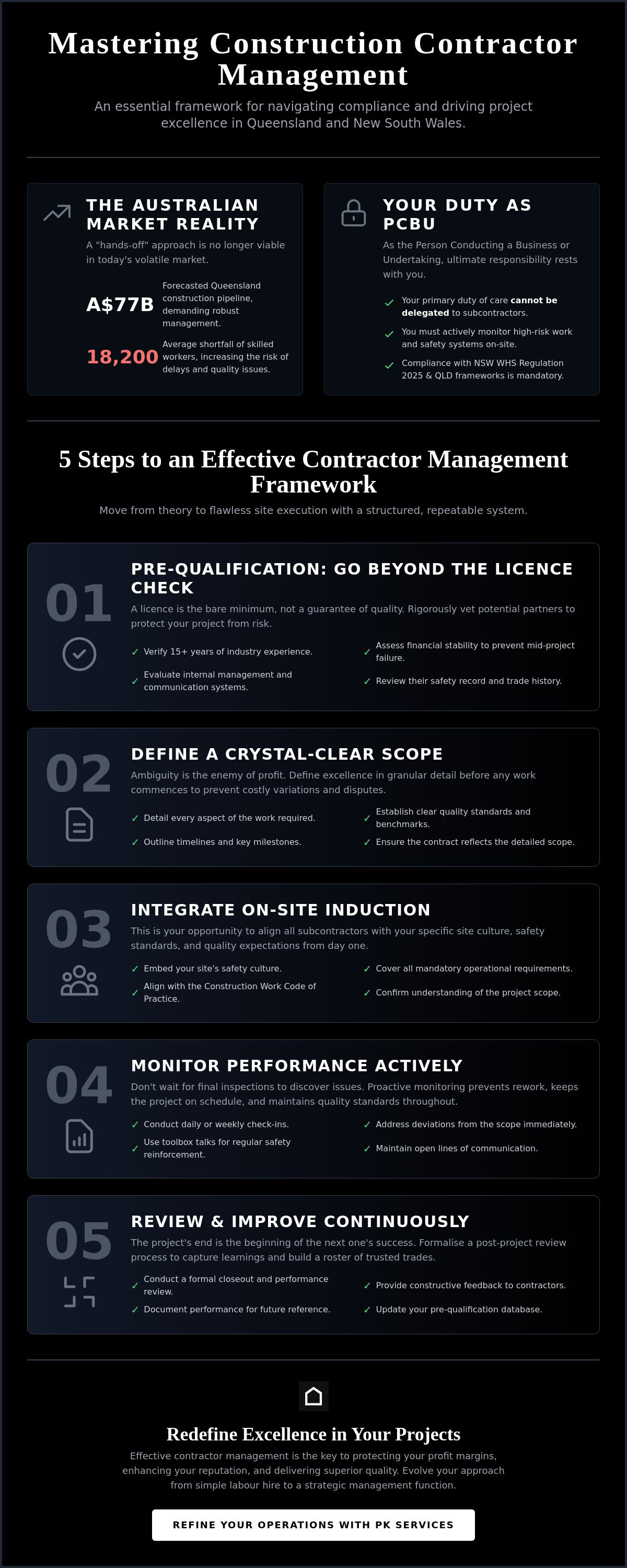
The Australian market in 2026 presents a unique set of pressures. Queensland's construction pipeline is forecast to reach A$77 billion, yet the industry faces an average shortfall of 18,200 workers over the next eight years. In this environment, a "hands-off" approach is a recipe for disaster. When labour is scarce, quality often slips and delays become the norm. You can't simply hand over the keys and hope for the best. Builders in NSW and QLD are finding that traditional models of oversight are failing because they don't account for the volatility of modern supply chains or the increased regulatory scrutiny on site safety.
The Role of the PCBU in Modern Construction
Under Australian law, you are the Person Conducting a Business or Undertaking (PCBU). This role carries significant weight. The NSW WHS Regulation 2025 and similar QLD frameworks make it clear: you cannot delegate your primary duty of care to a subcontractor. If a subbie takes a shortcut on safety, the legal and financial fallout often lands on your desk. You must actively monitor their systems and high-risk work standards. As a PCBU, you are the ultimate guardian of site safety and project performance, regardless of who is actually holding the tools.
Why Effective Management is the Key to Redefining Excellence
Superior management standards translate directly to the final quality of your build. Poor oversight doesn't just lead to messy finishes; it creates a domino effect of rework, blown budgets, and liquidated damages. When trades aren't synchronised, profit margins vanish. This is why many forward-thinking firms are turning to Business Consulting to refine their operations. By evolving your approach to construction contractor management, you move beyond mere survival. You build a reputation for reliability that attracts the best trades and the most profitable clients. It's about setting a higher tier of service that your competitors simply can't match.
5 Steps to Organising an Effective Contractor Management Framework
Moving from theory to site execution requires a structured approach. A robust framework for construction contractor management ensures that every person on your site understands their role, the quality expected, and the safety standards required. It's about building a repeatable system that protects your reputation and your bottom line. These five steps move beyond simple paperwork to create a culture of high performance.
Pre-Qualification: Beyond the License Check
Step one is rigorous pre-qualification. A valid license is the bare minimum; it's not a guarantee of quality. When assessing potential partners, look for a proven portfolio that demonstrates at least 15 years of industry experience. This longevity suggests they've survived market fluctuations and maintained consistent standards. You must also verify their financial stability. A contractor who is struggling for cash flow is a high-risk liability who might go bust mid-project, leaving you with half-finished work and legal headaches. Evaluate their internal management systems and communication styles during the tender process. If they're slow to respond now, they'll be slower when the pressure is on during the build.
Clear Scope, Induction, and Performance
Step two involves defining "excellence" before a shovel hits the ground. A vague scope leads to variations and disputes. Be specific about every detail of the work. Once the trade is selected, step three is the integrated on-site induction. This is your chance to align subbies with your specific site culture. Use the Construction Work Code of Practice to ensure your induction covers all mandatory safety and operational requirements for NSW and QLD sites.
Performance Monitoring and Toolbox Talks
Step four is active performance monitoring. Relying on a walk-through at the end of the week is too late. You need real-time data and daily accountability. Effective toolbox talks are the engine room of site performance. They shouldn't be a dry reading of a safety sheet. Instead, use them to discuss the day’s specific hazards and quality benchmarks. Maintain detailed site diaries and daily reports to track progress against the schedule. If you find your current systems are falling short, engaging in Construction Business Consulting Australia can help you refine these operational processes for better outcomes.
Finally, step five is the post-project review. Don't just move to the next job. Document what worked and what didn't. This allows you to build a database of reliable, high-performing partners for future projects. If you want to elevate your entire delivery model, consider how professional trades and contractor services can streamline this framework for you. Consistent results are the product of consistent systems.
Comparing Contractor Models: Finding the Right Fit for Your Project
The model you choose for construction contractor management dictates the success of your site. It isn't just about the price tag. It's about who carries the risk when things go wrong. Selecting the right delivery method is a strategic decision that affects your quality, timeline, and final profit margin. In the current Australian market, the traditional way of doing things is being challenged by more collaborative alternatives.
Lump Sum Contracting remains a common choice. It offers a fixed price on paper, which appeals to those seeking budget certainty. However, in a volatile market where material costs and labour rates fluctuate, this model often fails. If a contractor feels the financial squeeze, quality is the first thing to go. You risk subbies cutting corners or abandoning the site entirely to protect their own interests. This creates an adversarial environment that rarely benefits the project.
Management Contracting offers a more transparent and refined alternative. Here, the risk is shared. You pay for the actual cost of the work plus a management fee. This model is ideal for high-end projects where quality control is non-negotiable. It allows for greater flexibility and ensures the principal has a direct line of sight into every trade's performance. Early Contractor Involvement (ECI) takes this a step further. Bringing experts into the fold during the design phase prevents costly buildability issues later. It reduces long-term expenses by ensuring the plan is actually executable on the ground.
Lump Sum vs. Management Models
Risk allocation is the primary divider between these two models. In a lump sum arrangement, the contractor carries the financial risk. This sounds ideal for a principal, but it often leads to disputes. If the project hits a snag, the contractor will look for variations to protect their margin. Management models prioritise the project timeline and build quality. Because the manager is paid to oversee the trades rather than just deliver a fixed price, they can pivot quickly. This leads to fewer delays and a higher tier of finish on complex builds.
Filling the Gaps: When to Use Trade Services
Identifying labour voids before they become bottlenecks is a vital skill for any builder. A project can stall for weeks if a single specialised trade isn't available. Smart builders don't wait for the delay to happen. They use a hybrid approach to fill specific site gaps with skilled trades exactly when they're needed. Supplying skilled trades directly maintains site momentum and keeps the project on track. For many firms, managing the entire process from start to finish is the most efficient path. This holistic approach removes the friction between different contracting layers and ensures your construction contractor management strategy is a living part of your site execution.
Navigating Compliance and Performance Standards in QLD and NSW
Regulatory landscapes in Australia are shifting rapidly. By June 2026, the gap between "good enough" and "compliant" has widened significantly. Effective construction contractor management requires a granular understanding of how state-specific laws impact your site operations. Whether you're building in the Gold Coast or Greater Sydney, your documentation must be bulletproof to satisfy both the law and your insurers. High standards in paperwork are the only way to protect your business from the rising cost of non-compliance.
In Queensland, the QBCC and Other Legislation Amendment Regulation 2026 has clarified license mechanics and shifted communication primarily to digital channels. Builders should also prepare for the expected removal of dual reporting for serious safety incidents later this year. In New South Wales, the Design and Building Practitioners Act continues to set a high bar for accountability. The NSW Industrial Relations "Supply Chain Initiative," which commenced on 1 March 2026, now involves pre-contract compliance checks and audits of industrial relations obligations. Failing to vet your subbies isn't just a site risk; it's a legal liability that could cost your business dearly.
Unlicensed trades, often dubbed "Solar Cowboys," remain a persistent threat to the industry. Hiring them might save a few dollars on the quote, but it puts your own licence at risk. If a trade isn't properly insured or qualified, the QBCC or NSW Fair Trading won't look at them; they'll look at you. Documenting every interaction, qualification, and insurance certificate is the only way to protect your reputation. It's about ensuring that every person on your site carries the same commitment to excellence that you do.
State-Specific Regulatory Nuances
Brisbane and Sydney operate under distinct rules. In NSW, the penalty unit value for 2025-2026 is A$123.31, while Queensland’s unit value increases to A$172.70 from 1 July 2026. Mandatory reporting requirements also differ. In NSW, the WHS Regulation 2025 introduces strengthened provisions for psychosocial risk management that you must enforce with your contractors. Mastering local regulations is the only way to ensure your contractor management framework survives a surprise audit.
Safety as a Performance Metric
Safety compliance is a leading indicator of overall project quality. A contractor who ignores a harness requirement is likely to ignore a waterproofing detail. You need site-specific WHS plans that trades actually follow, not just folders that sit in the site shed. Robust project oversight ensures that safety isn't a checkbox; it's a culture. If you need assistance navigating these complex requirements, our professional contractor management services can ensure your projects remain fully compliant and profitable.
Redefining Excellence: The PK Services Approach to Contractor Oversight
Excellence isn't a happy accident. It's the result of deliberate, expert oversight. At PK Services, we've spent 15 years refining a model that moves beyond the limitations of traditional site supervision. We don't just provide bodies; we provide a strategic framework. This is the evolution of construction contractor management. We bridge the gap between your high-level project strategy and the raw reality of on-site execution.
Modern firms are moving away from traditional management models that leave too much to chance. They're choosing bespoke consulting because it offers a higher tier of control. We manage the entire process from start to finish, ensuring your standards never slip. This holistic approach allows you to focus on growth while we handle the complexities of trade coordination and compliance across NSW and QLD. It's a shift from simple labour hire to a strategic partnership that protects your reputation.
Expertise Driven by Experience
Our network isn't built on a database; it's built on 15 years of industry relationships. Every trade we provide is vetted by veterans who know exactly what a high-end finish looks like. This expertise allows you to scale your operations rapidly without losing quality control. We specialise in filling essential gaps on sites, ensuring that labour shortages don't become project-ending bottlenecks. Our strategic advisory services provide the clarity you need to navigate volatile markets with confidence. You get the benefit of contractors who are already aligned with a culture of superior standards.
Streamlining Your Site Operations
Project managers are often buried under a mountain of administrative paperwork. This takes them away from what they do best: building. We reduce this burden through outsourced oversight. We ensure that your high-level strategy is seamlessly integrated into daily site activities. This direct connection eliminates the friction that usually leads to rework and delays. It's about creating a site environment where everyone is aligned with your vision of excellence. Ready to elevate your site standards? Contact PK Services for a strategic consultation.
Building a Legacy of Site Excellence
Effective construction contractor management is the defining factor between a project that merely finishes and one that truly thrives. You've seen how shifting from simple oversight to a strategic framework protects your margins and your professional reputation. By mastering the evolving nuances of QLD and NSW compliance and selecting the most effective contracting model, you set a new standard for your business. Success on-site isn't just about the tools; it's about the sophisticated systems and reliable people driving the build from the ground up.
We bring over 15 years of Australian industry expertise to your projects. As specialists in QLD and NSW regulatory compliance, we maintain a proven track record in managing the entire project lifecycle with precision. We help you bridge the gap between high-level strategy and raw site execution. It's time to move beyond the daily stress of unreliable trades and heavy administrative bottlenecks. Partner with PK Services to redefine your site excellence. Your next project deserves a higher tier of service and a partner committed to your long-term growth.
Frequently Asked Questions
What is the most effective way to monitor construction contractor performance?
The most effective way to monitor performance is through integrated daily reporting and real-time site diaries. This ensures every trade remains accountable for their specific milestones. Robust construction contractor management relies on catching deviations early rather than waiting for a weekly walkthrough. Consistent site walks combined with digital tracking tools provide the visibility needed to keep projects on schedule.
How does the Design and Building Practitioners Act in NSW affect contractor management?
The Design and Building Practitioners Act in NSW requires builders to ensure all designs are compliant before construction begins. It increases the administrative burden by requiring formal declarations for "regulated work". This means you must vet your contractors’ work more strictly to ensure they are following the approved designs to the letter. It forces a higher level of documentation and accountability on every site.
Can I be held liable for a sub-contractor’s safety breach in Australia?
You can absolutely be held liable for a sub-contractor’s safety breach. As a Person Conducting a Business or Undertaking (PCBU), you have a non-delegable duty of care under Australian WHS laws. You can't simply pass the buck to a subbie. If they fail to maintain safety standards on your site, you share the legal and financial responsibility for the incident.
What should be included in a construction contractor pre-qualification checklist?
A thorough pre-qualification checklist must include current QBCC or NSW Fair Trading licences, Home Building Compensation insurance, and workers' compensation. Look for evidence of at least 15 years in the industry and a solid history of financial stability. It’s also vital to check their recent safety performance records and internal quality management systems to ensure they align with your standards.
How do I manage contractors when there is a significant labour shortage in QLD?
Managing contractors during a QLD labour shortage requires a shift toward Early Contractor Involvement (ECI). By bringing trades in during the design phase, you secure their commitment before the site even opens. You can also use specialist trade services to fill specific site gaps. This ensures project momentum doesn't stall when a single trade becomes unavailable in a tight market.
What is the difference between labour hire and specialist trade services?
Labour hire typically provides generic workers to fill headcount, whereas specialist trade services offer managed solutions with expert oversight. Specialist services focus on managing the entire process from start to finish. This approach ensures that the work isn't just done, but is delivered to a specific professional standard with significantly reduced rework and better site coordination.
How often should I conduct site audits for contractor compliance?
You should conduct informal site audits daily and formal compliance audits at least once a week. These checks should cover safety documentation, work quality, and progress against the project schedule. Regular audits prevent small issues from snowballing into major non-compliance events. Consistent oversight is the only way to ensure your site remains ready for a surprise regulator intervention.
Is it better to use a lump sum or a management contract for residential projects?
For high-end residential projects, a management contract is often superior because it prioritises transparency and quality control. Lump sum contracts can be risky in volatile markets where material costs and labour rates rise quickly. A management model allows for a more collaborative approach to construction contractor management, ensuring the final build meets elite standards without the contractor cutting corners to protect their margin.


