

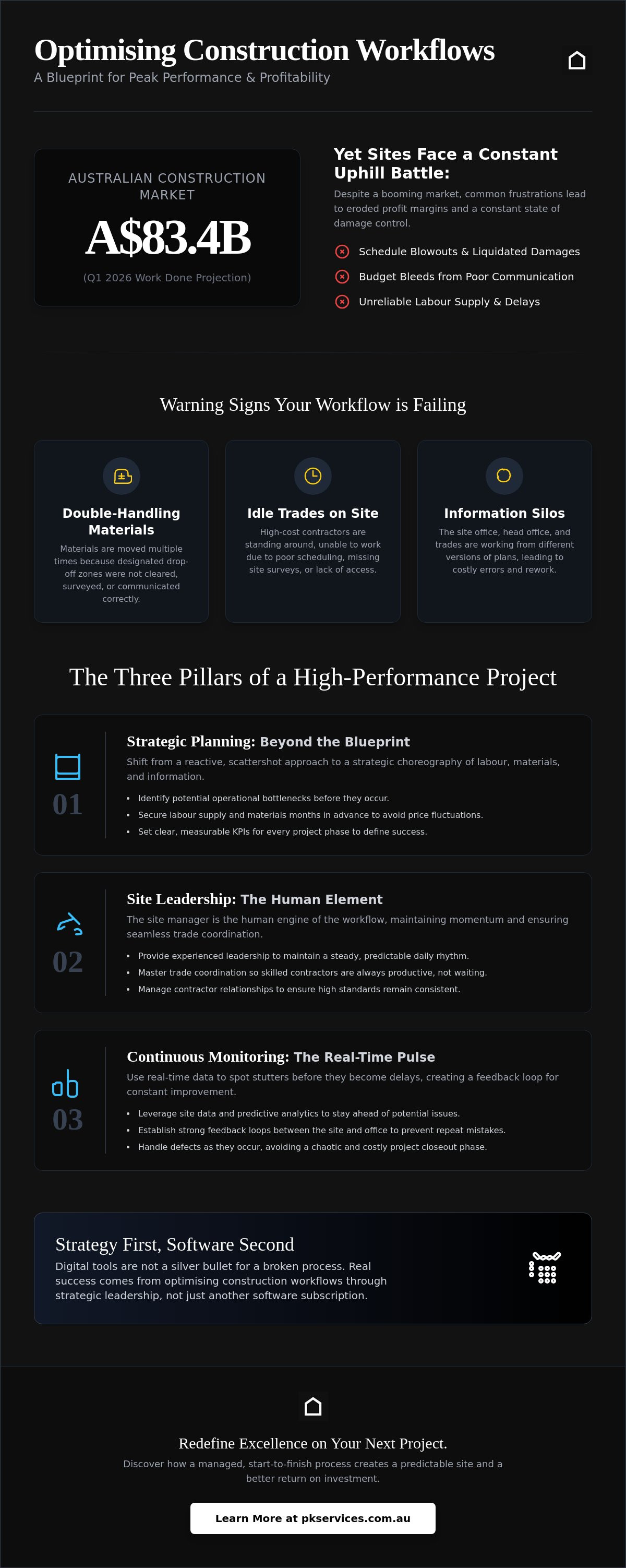
With construction work in Australia surging to A$83.4 billion in the first quarter of 2026, why does it feel like every site is still fighting an uphill battle against schedule blowouts? It’s a common frustration. You see the budget bleed because of poor communication. You deal with a labour supply that doesn’t show up. Real success comes from optimizing construction workflows through strategic leadership, rather than just adding more software. Managing site operations shouldn’t feel like a constant state of damage control.
We understand that you’re looking for a predictable site and a better ROI on your materials. You deserve a process that works as hard as you do. This guide will show you how to master the art of operational excellence. We’ll outline how to streamline your site processes for peak performance, ensuring seamless project delivery and reduced stress. From smarter resource allocation to refined communication, here is your roadmap to a more profitable 2026.
Key Takeaways
- Shift from a scattershot approach to a strategic choreography of labour, materials, and information.
- Learn why optimizing construction workflows begins with a solid strategy, not just a software subscription.
- Master the three pillars of high-performance projects to ensure seamless site leadership and trade coordination.
- Identify budget leaks through a business health check and align your labour supply with key milestones.
- Discover how a managed, start-to-finish process creates a predictable site and a better ROI on every project.
What Is a Construction Workflow and Why Does It Fail?
A construction workflow is the strategic choreography of labour, materials, and information. It isn't just a checklist or a gantt chart pinned to a trailer wall. It's the living pulse of your project. Many firms fall into the trap of a scattershot approach. They react to crises instead of following a structured path. This reactive mindset turns potential profit into a series of expensive fires to put out.
Australian sites struggle with specific, localized pressures. We face persistent labour gaps and a complex regulatory environment, especially with the adoption of NCC 2025. Fragmented communication between site trades and management often leads to total system failure. The cost of these breakdowns is steep. You see it in liquidated damages and eroded profit margins. When optimizing construction workflows, you aren't just looking for speed. You're looking for stability.
The Anatomy of an Aussie Construction Workflow
Effective Construction management depends on maintaining a steady rhythm across three critical phases. Pre-construction planning sets the tempo. It involves securing your labour supply and materials months in advance to avoid the Q1 2026 price fluctuations. Site execution is about managing the daily flow. You must coordinate trades so they aren't tripping over each other or waiting for access. Finally, project closeout is where many firms lose their grip. The final 5% of a build often consumes 50% of the effort. A disciplined workflow ensures that defects are handled as they occur, rather than piling up at the finish line.
Common Red Flags in Your Current Process
If your site feels chaotic, your workflow is likely broken. Look for these warning signs that indicate you need a new approach to optimizing construction workflows:
- Double-handling: Materials are moved multiple times because the designated drop-off zone wasn't cleared or surveyed.
- Idle trades: High-cost contractors are standing around because of poor scheduling or missing site surveys.
- Information silos: The site office and head office are working from different versions of the same set of plans.
These issues aren't just minor annoyances. They represent a fundamental lack of process. When trades don't know where to be or what information to trust, productivity dies. You cannot fix a broken process by simply working harder. You need to redefine the system from the ground up.
The Three Pillars of a High-Performance Project Lifecycle
Project success isn't just about finishing on time. It's about how you get there. Peak performance relies on three distinct pillars. Strategic planning, site leadership, and continuous monitoring must work in unison. When these pillars align, optimizing construction workflows becomes a natural outcome rather than a forced effort. If one pillar is weak, the entire project timeline begins to lean.
Strategic Planning: Beyond the Blueprint
Planning starts long before the concrete is poured. It involves integrating business consulting early to identify potential operational bottlenecks. In the current NSW and QLD labour markets, resource planning is more complex than ever. You need to account for shifting trade availability and material lead times. Setting clear KPIs for every project phase ensures everyone knows what "good" looks like. It turns a vague goal into a measurable target. This level of foresight prevents the reactive "scattershot" approach that kills profit margins.
Site Leadership: The Human Element of Workflow
Site management is the human engine of the workflow. Experienced leadership keeps momentum high. It's about more than just giving orders; it's about trade coordination. Skilled tradespeople are essential to this process. They fill gaps that automated systems often miss. Managing these contractor relationships ensures that high standards remain consistent across the board. When trades feel respected and their time is valued through tight scheduling, they perform better. Effective site leadership ensures that the daily rhythm remains steady and predictable.
The final pillar is continuous performance monitoring. You need to know what's happening on-site in real-time. This is where technology's role in construction workflows becomes vital. Predictive analytics and site data allow you to spot stutters before they become delays. Feedback loops between the site and the office prevent the same mistakes from happening twice. Continuous monitoring is the final step in optimizing construction workflows for long-term success. It isn't about micromanagement. It's about visibility. By tracking performance against your initial KPIs, you can adjust resources on the fly. This agility is what separates elite firms from those just getting by.
Excellence requires these three pillars to work as a single unit. Planning provides the direction. Leadership provides the movement. Monitoring provides the correction. Together, they create a project lifecycle that is resilient, profitable, and stress-free.
Strategy vs. Software: Why Digital Tools Aren't a Silver Bullet
Buying an app doesn't fix a broken business. It's a common trap. Many Australian firms hope a digital subscription will magically align their site teams. It won't. Software is an accelerant, but strategy is the engine. If your underlying process is flawed, technology only helps you fail faster. Optimizing construction workflows requires a firm foundation before you ever look at a screen. You can't automate chaos and expect clarity.
App fatigue is a real threat to site productivity. When trades have to log into five different platforms just to report a site survey, they simply stop using them. This leads to information gaps, resentment, and "garbage in, garbage out" data. Professional consulting is the prerequisite for any successful digital shift. You need to know exactly what you are measuring before you buy the tool to measure it. Without a clear strategy, software becomes just another overhead cost.
When Software Fails Your Site
Disconnected systems are a major drain on resources. If data doesn't flow seamlessly between your site office and head office, someone has to type it in twice. This manual entry creates errors that can lead to expensive rework. Often, features are too complex for the field. If a tool isn't intuitive enough to use with work gloves on, it stays in the pocket. This is why many contractors prefer straightforward solutions like newbuildlog.com to keep site data moving without the complexity. Digital tools also lack real-world oversight. They can track a milestone, but they can't sense the tension in a trade relationship or a subtle safety risk on the ground. A dashboard is no substitute for boots on the dirt.
Building a Process-First Culture
You must standardise operations before you digitise them. Clarity comes from the process, not the interface. Training and culture are the secret ingredients. Your team needs to buy into why the change matters for their daily rhythm. If they don't see the value, the tool becomes a burden. Tailored solutions always beat off-the-shelf fixes. Your workflow is unique to your firm. Your digital tools should reflect that reality, not dictate it. Optimizing construction workflows is about empowering people with better systems, not replacing leadership with an algorithm. Focus on the people, and the productivity will follow.
5 Practical Steps to Optimise Your Construction Workflows in 2026
Operational excellence isn't a destination. It's a series of deliberate actions. To move from a reactive site to a proactive one, you need a clear sequence of improvements. Optimizing construction workflows requires looking at the raw data of your site performance and making cold, hard adjustments. These five steps provide a framework for Australian firms to reclaim their margins and reduce operational friction.
- Conduct a comprehensive business health check to find leaks.
- Align your labour supply with project milestones early.
- Centralise communication to a single source of truth.
- Implement site-specific logistics and resource management.
- Review performance daily and adjust the strategy in real-time.
Conducting a Site Health Check
A health check is a diagnostic tool for site productivity. It allows you to identify where time is actually being lost. You might find that trades are consistently waiting for RFI approvals or that materials are being double-handled because of poor site layout. Review the ROI of your current consulting and trade partnerships. If a partner isn't contributing to a smoother workflow, they are a bottleneck. Identifying these leaks is the first step toward a leaner, more profitable project.
Labour Optimisation in NSW and QLD
The Australian labour market remains a significant challenge. With the national unemployment rate rising to 4.5% in April 2026, finding and keeping skilled hands is a constant battle. Navigating regional labour shortages in NSW and QLD requires a shift toward trusted trade services. You can't rely on last-minute hires. Ensure every contractor is ready to hit the ground running with a proper site induction. This reduces "day one" confusion and ensures safety standards are met immediately. Balancing your permanent staff with flexible contractor solutions allows you to scale for peak demand without carrying unnecessary overhead during quieter phases.
Communication must be centralised. Information silos are the primary cause of rework. By moving all site data to a single source of truth, you ensure that the site office and head office are always looking at the same version of the truth. Site-specific logistics are equally vital. Every project has unique constraints, from narrow access in Sydney's inner west to environmental regulations in Queensland. Your resource management must reflect these physical realities; for specialist maintenance of industrial equipment, visit BioKem Oil Services. Finally, don't wait for a monthly meeting to fix a problem. Review performance daily. Small, real-time adjustments prevent minor stutters from turning into major schedule blowouts.
If you are ready to identify the leaks in your process and secure a better ROI on your labour, we can help you manage the entire process from start to finish. Professional oversight ensures that these steps are not just planned, but executed with precision.
Redefining Excellence: The PK Services Approach to Workflow
PK Services acts as a dedicated partner in strategic business transformation. We don't simply offer advice; we deliver results. Our 15 years of experience in the Australian market translates into smoother site execution and more resilient business models. We understand that optimizing construction workflows is impossible if your consultant has never stepped onto a live site. We bridge the gap by combining high-level business consulting with reliable, boots-on-the-ground trade supply. This dual capability ensures that the strategies we develop are actually practical for your team to implement.
End-to-End Project Management
We take pride in managing the entire process from start to finish. This start-to-finish involvement is the only way to ensure that strategy meets execution without losing momentum. For developers, this means a significant reduction in the daily operational burden. You don't have to worry about the friction between different trades or the breakdown of communication between the office and the field. Our approach provides several key benefits:
- Single point of accountability for the entire project lifecycle.
- Seamless integration of strategic planning and site execution.
- Direct access to a vetted pool of skilled trade services.
- Real-time adjustment of logistics to prevent schedule blowouts.
We've successfully turned complex site logistics into a competitive advantage for our clients. By aligning trade schedules with real-time material availability, we've helped firms navigate the supply chain volatility of 2026. This professional oversight ensures that the operational pillars we build remain standing until the keys are handed over.
Partnering for Success in Queensland and NSW
Our local expertise is concentrated in the Sydney and Brisbane construction markets. We know these cities. We understand the regional labour shortages and the specific regulatory pressures that Australian firms face with the adoption of NCC 2025. A boutique consulting approach offers a level of tailored impact that large, generic firms can't provide. We focus on the specific leaks in your business health, providing solutions that are as unique as your projects. Whether you are working on a high-density residential build in Brisbane or a commercial project in Sydney, our approach remains grounded in real-world results. We don't believe in one-size-fits-all templates. We believe in high-end results and the simplicity of a direct, personal connection.
Excellence is about more than just finishing a build. It's about creating a process that is sustainable, profitable, and low-stress. We help you move beyond the chaos of reactive management. By optimizing construction workflows through a blend of strategy and trade expertise, we redefine what is possible for your firm. It's time to expect a higher standard of service and a more predictable project outcome.
Organise a consultation to optimise your workflows today.
Build a More Profitable Site Today
Success in 2026 requires a shift from reactive fire-fighting to proactive leadership. You've seen how strategy must act as the engine for your digital tools. By focusing on site leadership and continuous monitoring, you can eliminate the double-handling and communication gaps that erode your margins. A structured process is the only way to ensure your project stays on track and under budget.
Real change starts with a commitment to optimizing construction workflows across every project phase. PK Services offers more than just high-level advice. We provide over 15 years of Australian industry expertise to help you navigate complex site logistics. Our team specialises in the QLD and NSW markets, delivering end-to-end project management that ensures your strategy actually meets execution. We handle the details so you can focus on growth.
Don't let another project suffer from avoidable schedule blowouts or labour gaps. You deserve a partner who understands both the physical and strategic realities of the modern Australian site. Redefine your construction excellence with PK Services. It's time to take control of your operations and secure your project's future.
Frequently Asked Questions
What is the most common cause of construction workflow failure in Australia?
Fragmented communication and a lack of real-time visibility are the primary culprits. Sites often rely on outdated plans or disconnected site surveys. This causes trades to stand idle while waiting for approvals or material deliveries that haven't arrived. When the site office and head office work from different information, the rhythm of the project breaks down immediately.
How can strategic consulting help a small construction firm?
It provides a high-level perspective that small teams often lack. Consulting identifies budget leaks and operational bottlenecks before they become critical. It helps small builders move from a reactive approach to a structured, predictable site execution model. This professional oversight allows you to compete with larger firms by operating with superior efficiency and reclaimed margins.
Is software necessary for optimising construction workflows?
No; software is an accelerant, but strategy is the engine. You must define your process before you ever automate it. Optimizing construction workflows begins with standardising your operations. Software is simply the tool that helps you scale those efficiencies. Buying a digital subscription won't fix a broken business process; it will only make it fail faster.
How do I manage labour shortages while trying to maintain a workflow?
Align your labour supply with project milestones months in advance. Use trusted trade services rather than relying on last-minute hires. Balancing permanent staff with flexible contractor solutions allows you to handle peak demand without carrying unnecessary overhead. Proper site inductions also ensure that new trades hit the ground running, reducing the time lost to confusion and rework.
What are the benefits of end-to-end project management?
It ensures strategy meets execution through a single point of accountability. This approach reduces the burden on developers by managing the entire lifecycle from inception to completion. You get a more predictable ROI on materials and labour while reducing the stress of daily site fires. It turns complex site logistics into a competitive advantage for your firm.
How long does it take to see results from workflow optimisation?
Initial improvements often appear within the first month of implementation. You will notice better trade coordination and reduced double-handling almost immediately. Long-term gains, such as improved profit margins and faster project closeouts, typically manifest over a full project cycle. The speed of results depends on how quickly your team buys into the new process-first culture.
Can PK Services help with both business strategy and on-site labour?
Yes; we combine high-level business consulting with boots-on-the-ground trade supply. This unique blend ensures that our strategic advice is grounded in site reality. We manage the entire process to ensure that your business goals and site performance are perfectly aligned. Our 15 years of experience allows us to bridge the gap between the boardroom and the tool belt.
What is a construction business health check?
It is a diagnostic tool that identifies where your site is losing time and money. We review your current trade partnerships, resource allocation, and communication channels to find leaks. This health check provides the concrete data needed for optimizing construction workflows and reclaiming your project margins. It is the essential first step toward operational excellence in 2026.


