

A continuity plan is useful only when people know what to do if a site, supplier or key person becomes unavailable. Construction business continuity planning in NSW sets out how a building business can maintain essential operations during and after an unplanned disruption. Start by identifying critical work, likely risks and who is responsible for responding.
Keeping projects moving takes more than filing a plan. Clear roles, practical recovery priorities and regular reviews help keep it usable as circumstances change.
This guide explains what business continuity management covers and how to assign roles that suit your construction business. Learn how to assess disruption impacts, set recovery priorities and choose a construction continuity planner in NSW. It also explains how PK Services’ business consulting can support operational planning and tailored solutions for construction firms.
Key Takeaways
- Define who leads a disruption response, who communicates updates and who steps in when key people are unavailable.
- Use a business impact analysis to identify essential functions, dependencies and recovery priorities.
- Choose a continuity planner who understands construction operations and can shape practical plans around your business.
- Business consulting can help turn continuity priorities into an organised plan, with support for trades and contractors where needed.
What is Business Continuity Management?
Business continuity management prepares a construction business to keep essential work operating during disruption. Assigning response roles, prioritising work and arranging practical alternatives can help businesses maintain projects, sites and critical services.
-
Develop the continuity plan
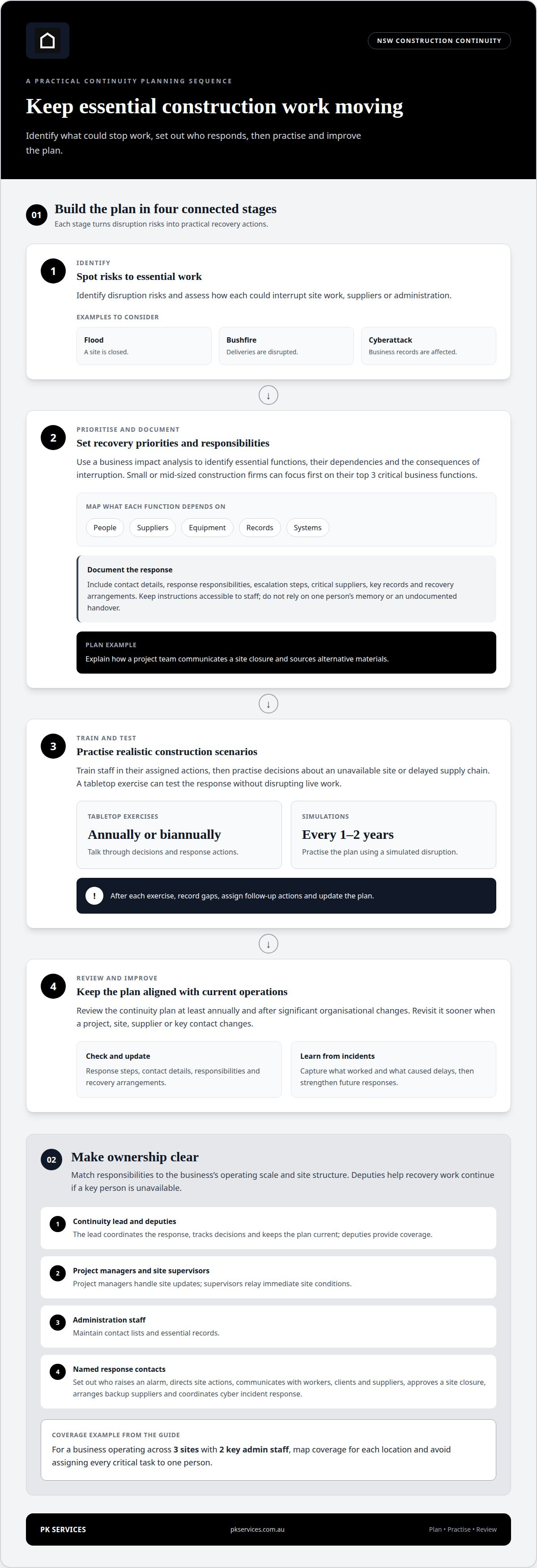
Start by identifying disruption risks, then assess how each could interrupt site work, suppliers or administration. Include examples such as a flood closing a site, a bushfire disrupting deliveries or a cyberattack affecting business records. Set response actions, recovery priorities and ways to reduce risks. NSW Health Pathology’s business continuity policy lists ISO 22313:2020 as guidance on using ISO 22301.
-
Set out plan components
Document the people, actions and resources needed to keep priority operations moving. Include contact details, response responsibilities, escalation steps, critical suppliers, key records and recovery arrangements. For example, a plan might explain how a project team communicates a site closure and sources alternative materials. Keep instructions accessible to staff, and avoid relying on one person’s memory or an undocumented handover.
-
Test, train and exercise the plan
Train staff in their assigned actions, then practise scenarios that reflect construction risks. A tabletop exercise can test decisions about an unavailable site or a delayed supply chain without disrupting live work. Tabletop exercises should occur annually or biannually; simulations should occur every one to two years. Record gaps, assign follow-up actions and update the plan after each exercise.
-
Review and improve the plan
Review the continuity plan at least annually and after significant organisational changes. Revisit it sooner when a project, site, supplier or key contact changes. Check that response steps still match current operations, then update contact details, responsibilities and recovery arrangements. After an incident, capture what worked and what caused delays. Use those lessons to strengthen future responses and maintain critical services.
Business continuity roles and responsibilities
Assigning clear owners helps construction teams coordinate decisions, staff and recovery during disruption. Match each role to the business’s operating scale and site structure.
-
Assign continuity responsibilities
Name a continuity lead to coordinate the response, track decisions and keep the plan current. Assign deputies so recovery work can continue if the lead is unavailable. Give project managers responsibility for site updates, while administration staff maintain contact lists and essential records. For a business operating across 3 sites with 2 key admin staff, map coverage for each location and avoid assigning every critical task to one person.
-
Set emergency response responsibilities
Set out who raises an alarm, directs site actions and communicates with workers, clients and suppliers. A site supervisor can relay immediate conditions, while the continuity lead coordinates decisions across projects. Define who approves a site closure and who arranges backup suppliers if deliveries stop. Assign a cyber incident contact to coordinate system access and data breach response. According to the Federal Register of Legislation, the Privacy Act 1988 requires reasonable steps to protect personal information, including incident response plans for data breaches.
-
Set HR responsibilities during disruptions
Assign a named HR contact to manage staff updates, wellbeing support and workforce availability during disruptions. Set a clear channel for employees to raise concerns, including stress or anxiety, and explain how managers will respond. Plan for flexible work arrangements or adjusted schedules if a site or office becomes inaccessible. Record who confirms staff locations, shares relevant instructions and coordinates emergency procedure training. Limit access to personal details to those who need them for their response role.
Business impact analysis
Use a business impact analysis to rank essential construction work and understand what disruption could affect. For construction business continuity planning, NSW firms can use the analysis to link operational dependencies with recovery priorities and responsibilities.
-
Identify critical functions
List the processes that keep projects, sites and business operations moving. For a small or mid-sized construction firm, focus first on its top 3 critical business functions. These might include coordinating site work, managing project payments or arranging essential materials. Identify the people, suppliers, equipment, records and systems each function depends on. A function may rely on several others, so map those links rather than assessing tasks in isolation. This gives the analysis a practical framework for prioritising recovery.
For each function, record its owner and the consequences of interruption. Consider the effects on project delivery, customers, cash flow and the ability to resume work. A disaster that blocks access to a site may immediately affect site operations, while an email outage may be tolerable for a few hours, depending on recovery priorities. Rank functions by operational importance and dependencies, not job title alone.
-
Assess business impacts
Assess what happens if each critical function stops, and record how the impact changes over time. Consider immediate operational effects, delayed project activities, missed supplier deliveries and pressure on other teams. Identify vulnerabilities, such as a process only one person can complete or materials available through a single supply route. Note which responsibilities must transfer during an outage and what information the replacement needs to act.
Use the assessment to set recovery priorities and objectives. A business impact analysis establishes recovery time objectives, the target time to resume a function, and recovery point objectives, the acceptable loss of data. NSW construction firms can use these measures to compare recovery targets with operational dependencies, available resources and the consequences of delay. The analysis should show which processes resume first, what support they need and how decision-makers will measure progress. Keep assumptions visible so reviews can account for project or supplier changes.
Choosing a construction business continuity planner
In NSW, Australian law requires work health and safety emergency planning. After a disaster, grant or financial recovery support depends on the event, affected location, business impact and eligibility criteria.
- Choose a planner who understands construction operations, not just generic continuity documents. Ask how their approach will account for active sites, project dependencies, suppliers and the people responsible for each response. A practical plan connects incident decisions with recovery actions instead of becoming a document that sits unused.
- Assess the approach before work begins. The planner should explain how they identify critical functions, rank disruption impacts and turn findings into clear responsibilities. For example, ask how the plan would address an inaccessible site while materials are delayed. Check that staff, clients and suppliers have defined communication channels.
- Look for a partner who can make the plan workable for your business’s scale and structure. Ensure the process includes reviewing assumptions, documenting actions and identifying how exercises can reveal gaps. Avoid a framework that treats every project, site and supplier as having identical risks.
- For NSW sites, work health and safety emergency planning must reflect the hazards and operations involved. Align site response arrangements with applicable Australian WHS duties and relevant SafeWork NSW information. The plan should clarify who coordinates an emergency, communicates instructions and supports recovery, without confusing continuity actions with immediate emergency response.
- For disaster recovery, build an evidence record into the plan. Document the event’s impact, affected locations, business interruption and recovery needs. These details can support an application if assistance is available for the affected event and location. Eligibility and support conditions determine what a business can access.
For practical support turning operational priorities into a continuity framework, explore construction business consulting.
Construction businesses must plan for work health and safety emergencies under Australian law. Site arrangements should reflect the hazards and operations involved and align with applicable WHS duties and relevant SafeWork NSW information.
Potential grant or financial recovery assistance depends on the disaster, affected location, business impact and eligibility conditions. Documenting the event, interruption and recovery needs can support an application if assistance is available.
PK Services: Business Consulting
PK Services provides business consulting for construction firms seeking to strengthen operational performance and plan for disruption. Turn to PK Services when continuity priorities need to connect with project demands, site operations and business processes.
PK Services offers tailored business advice to help incorporate continuity considerations into a broader operational approach. When construction projects also need skilled trades and contractors to fill essential site gaps, these services can support the wider operation. PK Services can manage the process from start to finish, keeping decisions and implementation connected.
A clear next step is to discuss your business priorities and where disruption could affect operations. Contact PK Services to talk through your construction business needs.
Make continuity part of everyday decisions
A continuity plan works best when it informs decisions before disruption begins. Build its actions into project handovers, supplier arrangements and operational changes. That way, continuity becomes part of how the business operates, not a document set aside for an emergency.
Decide where your current approach needs more structure. You might clarify responsibilities, connect recovery priorities to upcoming projects or ensure planning keeps pace as the business changes. A practical construction business continuity planning approach in NSW should fit the way your business actually works.
PK Services can help you consider how business consulting, trades and contractor services, and end-to-end process management fit your construction business needs. Start a conversation about your priorities and the next steps that make sense.
Contact PK Services to discuss your needs. A more deliberate approach today can help your business move forward with greater confidence.
Frequently Asked Questions
BCP vs Disaster Recovery: What’s the Difference?
A business continuity plan coordinates the wider business response, while disaster recovery focuses on restoring technology and data. For example, after a project management system outage, disaster recovery restores access, while continuity arrangements explain how staff handle urgent approvals in the meantime. Link the plans by naming the systems essential to each operation and the manual process teams can use until systems are restored.
What is a business continuity plan for a construction business in NSW?
A business continuity plan is a written set of arrangements for keeping priority construction work running through an unplanned disruption. It can cover who has authority to pause work, how a project team handles inaccessible records and how clients receive updates if site access changes. A useful plan reflects the firm’s projects and operating arrangements, rather than relying on generic instructions that don’t match how its teams work.
How to create a construction business continuity plan in NSW step by step?
Build the plan in a clear sequence, then connect each decision to a named owner and an accessible record.
- Map projects, essential processes and dependencies.
- Assess disruption scenarios and their business effects.
- Set recovery priorities, decision authority and communication channels.
- Document response actions, contact details and alternatives.
- Practise a realistic scenario, record gaps and revise instructions.
Keep the current version accessible to authorised staff, including when normal office systems are unavailable.
How should NSW construction businesses assess risks such as bushfires, floods, storms and heatwaves?
Assess each hazard against the specific site, project stage and dependencies, rather than treating every location alike. For a flood scenario, consider site access, stored materials, plant and delivery routes. For a bushfire, storm or heatwave, assess potential impacts on worker availability, site operations and supplier transport. Record the decisions each scenario could trigger, such as pausing work or changing delivery arrangements.
What should a construction business continuity plan cover for workers, subcontractors, suppliers and clients?
Set out practical communication and coordination arrangements for each group. Workers need clear instructions on reporting their status and receiving site updates; subcontractors need to know who confirms changes to work arrangements. Record supplier contacts and alternative delivery arrangements, and identify who updates clients about project impacts. Prepared message templates can help project managers share consistent information without disclosing details irrelevant to the recipient.
How can NSW construction businesses protect plans, contracts, payroll and project data from cyber incidents?
Restrict access to sensitive files, use strong authentication and maintain backups that can be restored. The 3-2-1 backup rule means keeping three copies of data on two media types, with one copy stored offsite. Test restoration so teams know whether essential records are usable. According to the Federal Register of Legislation, the Privacy Act 1988 requires reasonable steps to protect personal information, including incident response plans for data breaches.


