

A profitable construction project can still run short of cash. Construction project financial forecasting in Brisbane maps progress-claim income against payments for labour, materials, equipment hire and subcontractors, which may fall due before clients pay. A 13-week forecast gives a view of approximately the next three months, including the timing gaps that can put pressure on cash flow.
Comparing the contract value with the expected final cost is not enough. Progress-payment timing, retentions, variations and approval delays all affect when money reaches the business. A clear forecast brings these moving parts into view.
This guide explains why construction cash flow needs its own approach, how to budget Brisbane project costs and how to distinguish actual costs from commitments that have not yet been invoiced. It also shows how business advisory services can support stronger forecasting and informed decisions as projects progress.
Key Takeaways
- Build Brisbane project budgets around the timing of expected spending, then update them as work and costs change.
- Separate actual costs already recorded from committed costs you’re obligated to pay, so the forecast reflects upcoming liabilities as well as past spending.
- Include payroll in cash planning: according to the Australian Taxation Office, the super guarantee rate is 12% of employees’ ordinary time earnings.
- Construction business advisory can help connect project forecasts with wider operational decisions, including when trades and contractor support is needed.
Why Is Cash Flow Forecasting Different in Construction?
Financial forecasting for Brisbane construction projects needs to account for project timing and business-wide commitments. A 13-week view gives builders an outlook across approximately three months.
Project and Business Cash Flow Views
A project forecast tracks one job’s expected receipts and payments; a business forecast combines cash movements across projects and overheads. Reviewing both shows how one job affects the wider operation. A delayed claim on one project, for example, may coincide with payroll and supplier payments elsewhere, putting pressure on working capital.
Forecasting Funding Gaps
A funding gap arises when payments fall due before expected income arrives. Forecasting compares progress claims with labour, materials, equipment hire and subcontractor costs to reveal timing mismatches. It also distinguishes finance facilities from cash in the bank, giving Brisbane builders a clearer view of which commitments current cash can cover and where available finance may be relevant.
Forecasting Tools for Builders
Builders can use spreadsheets or project-accounting and construction-management software to organise schedules, expected claims and payment dates. The forecast needs regular updates as project progress changes. A 13-week view refreshed weekly can reflect delayed approvals, unexpected changes and shifting commitments, helping businesses see how working capital may move.
Financial forecasting for Brisbane construction businesses should also include payroll commitments. According to the Australian Taxation Office, the super guarantee rate is 12% of employees’ ordinary time earnings. Update the outlook when actual receipts or payment dates change.
Brisbane construction cost forecasting and budgeting
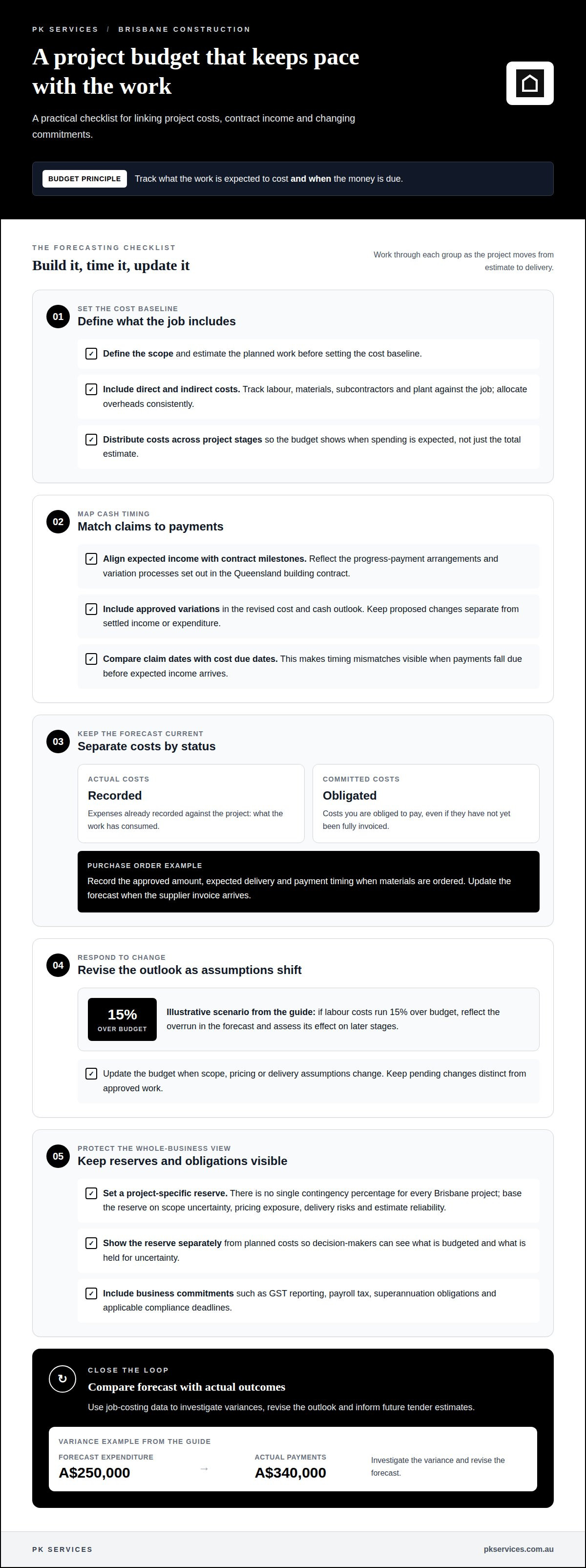
A useful budget separates project costs, work stages and payment timing. Update it whenever scope, pricing or delivery assumptions change.
Managing Budgets as Scope Changes
A revised budget records how approved scope changes affect forecast expenses and remaining funds. This matters because an unchanged baseline can hide the financial impact of variations. For example, if labour costs run 15% over budget, reflect that overrun in the forecast and assess its effect on later stages. Keep pending changes distinct from approved work, so projected spending stays accurate and decision-makers can see what has changed.
Direct and Indirect Project Costs
Direct costs relate to a specific job, while indirect costs support delivery across the business or project. A budget should account for both. Track labour, materials, subcontractors and plant against the relevant work, then allocate overheads consistently. This gives a fuller picture than a materials-and-labour estimate alone. Separate cost categories also make accounting reports more useful when actual spending differs from plan.
Construction Estimating and Budget Management
Estimating turns the scope and planned work into a cost baseline; budget management compares that baseline with actual and committed expenditure. To build a forecast, define the scope, estimate direct and indirect costs, distribute them across project stages, align expected income with contract milestones, then update the figures as work proceeds. Job-costing data supports future tender accuracy. If forecast expenditure is A$250,000 but actual payments reach A$340,000, investigate the variance and revise the outlook.
Progress Payments and Cost Variations
Queensland building contracts set out progress-payment arrangements and variation processes, so forecasts should reflect those terms. Link expected claims to the relevant milestones or intervals, and include approved variations in the revised cost and cash outlook. Don’t treat a proposed change as settled income or expenditure. This distinction keeps the forecast aligned with the contract and makes the effect of changes visible.
No single contingency percentage suits every Brisbane project. Set a reserve based on scope uncertainty, pricing exposure, delivery risks and estimate reliability, and show it separately from planned costs. Include GST reporting, payroll tax, superannuation obligations and applicable compliance deadlines in the business forecast.
What is the difference between actual and committed costs in construction?
Actual costs are expenses recorded against a project; committed costs are obligations not yet fully invoiced. Tracking both shows what the work has consumed and which payments are still ahead. For example, a supplier invoice may arrive after materials are ordered, so record the purchase order as a commitment before the expense appears in the accounts.
Brisbane forecasts need realistic labour and material assumptions, informed by local quotes, availability and project timelines. Australian construction expenses can shift by up to 12% with regional conditions and economic trends. Skilled tradespeople can increase costs by as much as 20% in some regions where demand outstrips supply. Trade disruptions have caused material-cost fluctuations of up to 15%, while Australian construction labour costs often increased 10-15% amid worker shortages.
Job costing separates project labour, materials, subcontractors and allocated overheads, then compares estimates with actual outcomes. A construction business may pay A$450,000 for labour, subcontractors, materials and plant in one month. That project outflow should remain distinct from business overheads and payroll, which affect cash available across residential and commercial jobs. Separating these categories helps show whether a project or wider operations are driving pressure.
Purchase orders show committed expenditure before supplier invoices arrive. Record the approved amount, expected delivery and payment timing, then update the forecast when invoices arrive or orders change. At the foundation stage, for example, an order for concrete and reinforcing materials is a commitment; the invoice becomes an actual cost once recorded. This distinction helps prevent unbilled orders from appearing to be unused budget.
To account for labour, material-price and subcontractor risks, forecast costs by work stage and review them against current quotes, purchase orders and delivery timelines. If a trade delay shifts the work, update the expected labour period and related subcontractor payments. These adjustments keep the forecast grounded in project progress and current site conditions.
How much does construction financial forecasting cost in Brisbane?
Construction financial forecasting in Brisbane has no single fixed price. Cost depends on the project and its requirements, including complexity, the number of active jobs, forecast detail, update frequency and reporting needs. A cash outlook for one project requires different information from a forecast covering several projects and business overheads.
Scope affects the work involved. A forecast may focus on cash timing or bring together project budgets, expected claims, payroll, supplier commitments and business expenses. More projects can mean more schedules, invoices and contract dates to coordinate. Frequent updates also require current information, so the forecast’s purpose and review cycle help define its scope.
Information quality matters too. Clear project budgets, payment schedules and current cost records make it easier to build a useful forecast. If records are spread across spreadsheets, accounting systems and site reports, reconciling them may take additional work. Agreeing on the inputs and outputs helps define the work from the outset.
Before requesting a quote, outline the decision the forecast must support. You may need to understand upcoming cash pressure, plan working capital across projects or see how a delayed claim affects commitments. Note the projects involved, forecast period, reporting detail and update frequency. These details help define a relevant scope and keep the analysis focused on the business question.
Ask for the scope and deliverables to be clear, including whether updates and scenario analysis are included. Compare the proposed work against your priorities, not just the headline price. Keep the quoted amount in Australian dollars and consider it alongside the time required from your team to provide project and accounting information. To discuss a forecast tailored to your construction business, request a forecasting quote.
PK Services
PK Services helps construction businesses connect financial planning with project delivery. Its Business Consulting supports decisions about budgets, cash flow and operational performance, while Trades & contractor services help address essential site gaps that can affect progress.
Turn to PK Services when forecasts need to inform broader business decisions, or when contractor capacity and delivery planning affect project commitments. With support managing the process from start to finish, the financial outlook can inform operational planning too.
Contact PK Services to discuss your construction business and forecasting needs.
Put your next project decision on firmer ground
A forecast is more valuable when it guides decisions, not just records financial movements. Use it to assess whether the next project fits the business’s capacity, whether planned commitments can be managed through a quieter period, and which assumptions need closer attention. This makes financial visibility part of project selection and operational planning.
For construction project financial forecasting in Brisbane, make the forecast part of regular management discussions. Consider project timing, proposed work and business priorities together. A clear view of the trade-offs can help you decide what to schedule, what to defer and where added capacity may be needed before committing.
PK Services can help connect construction business decisions with project realities. If you’re ready to apply this approach to your operation, contact PK Services to discuss your project. A considered next move starts with a clearer view of what the business can take on.
Frequently Asked Questions
How can builders prevent construction budget blowouts?
Builders can reduce budget blowouts by controlling scope changes and acting on early warning signs. Before work starts, record estimate assumptions, inclusions and exclusions, then apply a consistent approval process to proposed changes. If a client requests a different finish, for example, assess the effect on labour, materials and sequencing before adding it to the work plan. This makes cost decisions visible before commitments are made.
What should you do if the forecast shows a cash shortfall?
First, refresh the forecast with current claim dates, supplier obligations and payroll timing to identify when a shortfall may occur. Then separate essential commitments from costs that can be rescheduled, and check whether outstanding claims can be submitted under the contract process. Consider funding options in light of the facility’s terms before relying on them. A shortfall forecast is a prompt to act early, not a reason to treat available finance as cash in the bank.
What is construction project financial forecasting?
Construction project financial forecasting estimates when a project’s cash will come in and go out, showing whether funds will be available as obligations fall due. It differs from a profit estimate: a job may expect to earn a margin but still face a cash squeeze if payments arrive after supplier or payroll costs. Forecasting brings timing into the financial picture and supports decisions as project conditions change.
What financial forecasting services do Brisbane construction consultants offer?
Construction consultants can help businesses connect financial planning with project and operational decisions. PK Services offers Business Consulting, Trades & contractor services, and end-to-end project management. For a Brisbane builder, the right support depends on whether the need centres on business performance, site delivery or coordinating the wider project. The forecast should guide the decision at hand, not become a report without a clear purpose.
How can Brisbane builders compare forecast costs with actual project costs?
Use the same project categories and reporting period for both figures, then compare each forecast line with costs recorded in the accounts. Check whether a variance reflects changed scope, timing, labour use or a supplier invoice. For example, a cost coded to the wrong job can make one project appear over budget and another under budget. Correct the coding, explain the difference and revise the remaining cost outlook.
What software is used for construction financial forecasting in Australia?
Builders can use spreadsheets, project-accounting software or construction-management software to organise schedules, expected claims and payment dates.


