

Contingency can help absorb unforeseen project risks, but council or heritage changes aren’t automatically covered; the allowance and approval to use it depend on the project and its contract. For complex projects involving heritage properties, a 15-20% contingency allocation is recommended. Construction project contingency planning in NSW starts with understanding what that buffer can cover, and what needs to be resolved before work begins.
It’s easy to treat contingency as one pot for any cost that comes up. In practice, the cause of a change matters: an unforeseen site condition, incomplete design and a new planning requirement can affect the budget in different ways.
This guide explains what construction contingencies cover, how council and heritage constraints affect cost decisions, and why the right allowance depends on project complexity and design maturity. You’ll also learn how early decisions and clear documentation can reduce costly changes during construction, helping you plan with more confidence from concept to delivery.
Key Takeaways
- Separate unforeseen construction conditions from design gaps so each risk has a clear place in the budget.
- For major NSW projects, contingency controls and approval delegations are set case by case to reflect project risk.
- Resolve key design decisions early; changes made during construction can require a much larger contingency than decisions made upfront.
- For renovations, account for the project stage and the added uncertainty of existing buildings when setting the allowance.
Can contingency funds cover council-related variations or heritage constraints?
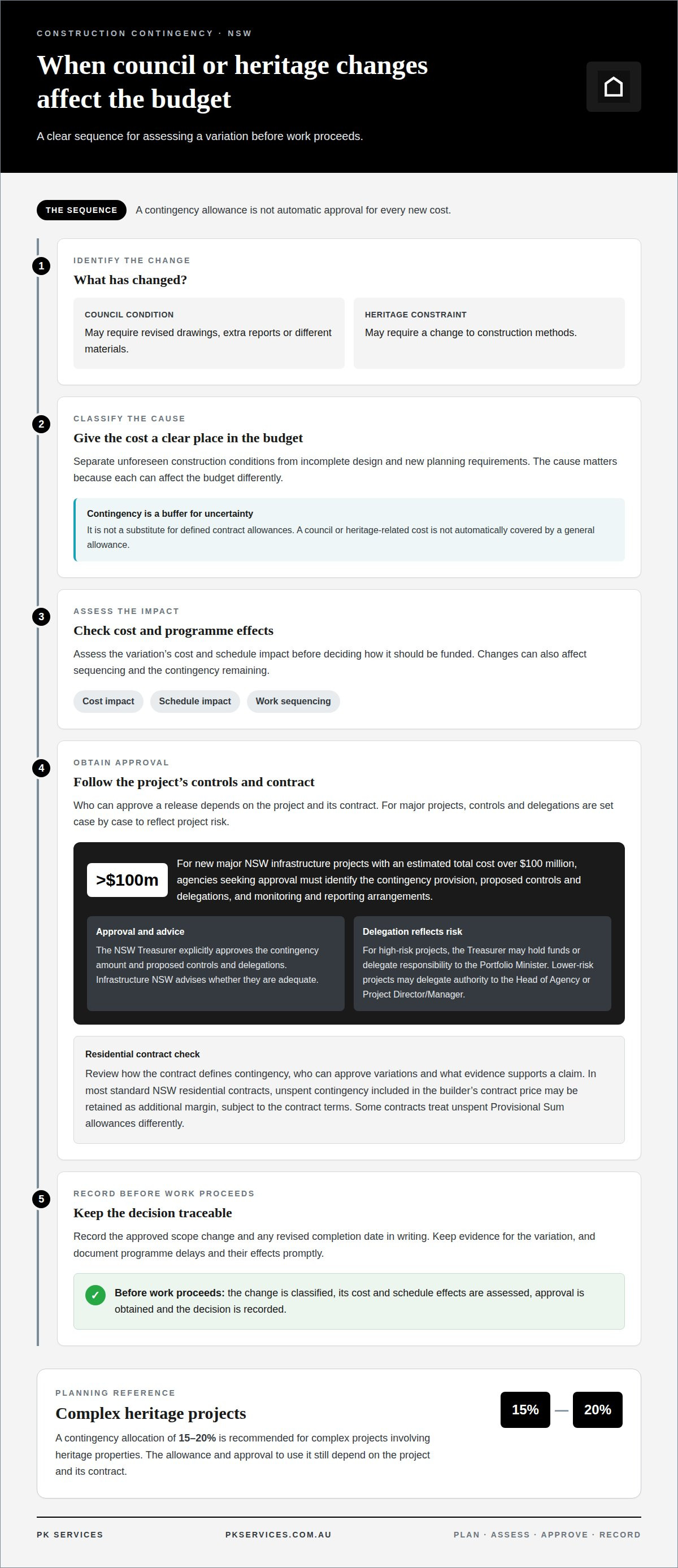
Council or heritage-related variations can use contingency only when the contract and project approval controls allow it. A council condition may require revised drawings, extra reports or different materials; a heritage constraint may change construction methods. These costs aren’t automatically covered by a general allowance. Classify the change, assess its cost and schedule impact, obtain approval, then record the decision before work proceeds.
For new major infrastructure projects with an estimated total cost over $100 million, NSW agencies seeking approval must identify the contingency provision, proposed controls and delegations, and monitoring and reporting arrangements. Amounts and release controls are approved case by case, reflecting project risk. The NSW Treasurer, as Chair of the Cabinet Standing Committee on Expenditure Review, explicitly approves the contingency amount and proposed controls and delegations. Infrastructure NSW advises whether these are adequate. For high-risk projects, the Treasurer may hold funds or delegate responsibility to the Portfolio Minister. Lower-risk projects may delegate authority to the Head of Agency or Project Director/Manager.
In most standard NSW residential contracts, unspent contingency included in the builder’s contract price may be retained as additional margin, subject to the contract terms. Review how the contract defines contingency, who can approve variations, and what evidence supports a claim. Some contracts treat unspent Provisional Sum allowances differently, returning them as a reduction in the final contract sum. Record approved scope changes and revised completion dates in writing. The Building and Construction Industry Security of Payment Act 1999 (NSW) may be relevant to payment disputes, which can involve strict processes and timeframes.
To create and maintain a plan, identify risks, assign each an allowance and approval authority, then track commitments against progress and update the forecast. Record programme delays and agreed completion-date changes in writing. For escalation and supply-chain exposure, allow for changes in material prices, availability, delivery timing and contractor capacity. Each can affect sequencing and the contingency remaining.
What are cost contingencies in architectural projects?
Contingency is a budget buffer for uncertainty, not a substitute for defined contract allowances. The amount depends on what is known about the site, existing building and project documents.
Unforeseen site and building conditions
Unforeseen conditions are physical issues discovered after work begins, despite the information available during planning. In a renovation, opening a wall may reveal concealed damage or services that differ from the drawings. On a new site, ground conditions may affect the planned work. These discoveries can add scope and disrupt sequencing. Assess these risks separately from design choices, and record their likely cost and programme effects.
Client-held and builder-held contingency
Client-held contingency sits outside the builder’s contract price, while builder-held contingency is included in the priced contract. Under a NSW lump sum contract, unspent client-held contingency remains with the client at completion. In most standard NSW residential contracts, by contrast, the builder may retain unspent contingency included in the contract price as additional margin, subject to the contract terms. This distinction affects who controls releases and keeps any unused balance.
Contingencies and contract allowances
Contingency provides a buffer for unforeseen risks; a provisional sum or prime cost allowance is a contract allowance for a defined item or work whose final cost is uncertain. The contract’s specifications and adjustment terms determine how each allowance is reconciled. Home Building Compensation cover is separate from project contingency and doesn’t set the budget for variations. Read the contract’s allowance, variation and evidence requirements before treating a cost as covered.
Identifying and prioritising project risks
Risk assessment identifies potential cost and schedule impacts, then prioritises them by likelihood, consequence and effect on other work. For a NSW project, consider concealed conditions, incomplete drawings, material availability, delivery timing, contractor capacity and sequencing. Record each risk, its owner and response, then update the register as progress reveals new information. Builders may be entitled to extensions of time for events beyond their control, so document delays and their programme effects promptly.
Avoiding design changes during construction
Late design decisions can increase contingency needs and disrupt the programme. Coordinated drawings and clear expectations help reveal gaps before construction begins.
Contingency by design and estimate stage
Design contingency covers uncertainty from incomplete design, so less developed plans need a larger allowance. For NSW projects at preliminary design stage, the recommended contingency is 10% to 15%. At design development stage, it is 7.5% to 10%. These ranges reflect how much scope, coordination and detail remain unresolved. A cost estimate should match the design stage, rather than imply certainty the drawings don’t support.
Design and construction contingency
Design contingency addresses uncertainty in the documents; construction contingency covers unforeseen events during building, even with fully documented design. Keeping them distinct helps explain why a change is needed and which allowance may apply. Major decisions made during construction can mean contingencies of 30-50%, compared with 10-15% when major decisions are made early. The timing of a decision can therefore affect both cost planning and delays.
Design coordination brings architectural, structural and building-services information together before work starts. A consultant can identify clashes, missing dimensions or conflicting specifications across drawings. For example, a services route that clashes with a structural element can be resolved on paper before it disrupts construction sequencing. Record every agreed change in the current drawing set so site teams work from consistent information.
For new homes, BASIX requirements cover water, energy and thermal performance. Coordinate these commitments with the design, specifications and selected systems before construction. A late change to glazing or building services may require related design information to be revisited. Before approving a proposed change, the project team should explain its cost and programme effects, then update the drawings and expectations together. This keeps the estimate aligned with the design being delivered.
Contingency allowances for renovations and complex projects
Renovation risk depends on the project stage, the building’s condition and the amount of structural work. A concept estimate carries more uncertainty than a fully documented, pre-tender estimate. Heritage constraints and complex approvals can add design or construction risks, so one allowance won’t suit every project.
For NSW construction projects at feasibility or concept stage, a contingency of 15% to 25% of estimated construction cost is recommended. At fully documented or pre-tender stage, the recommended range is 5% to 7.5%. The difference reflects how much scope and pricing information is available. A 2% to 3% allowance is likely insufficient for a concept-stage estimate or renovation of an older home.
For straightforward renovations with minimal structural work, 10% may suffice. Projects involving significant structural changes, heritage properties or multi-storey construction may need 15% to 20%. NSW renovation and alteration projects may also need an additional 5% to 10% on top of the applicable stage-based range. Treat these figures as planning guidance, then assess the actual risks, rather than adding ranges mechanically.
Existing buildings can conceal conditions that drawings and inspections didn’t reveal. Separate known work from uncertain work in the estimate, and record the assumptions behind each allowance. For example, a heritage property may require different materials or methods following design review. A Section 10.7 planning certificate can help identify land constraints before buying a property for a house. Check how those constraints could affect scope, approvals and programme planning.
Keep the allowance, exclusions and variation process clear in the building contract. Document what triggers a contingency release, who approves it and how the cost affects the remaining budget. This makes it easier to distinguish an unforeseen condition from a requested upgrade. For complex renovations, discuss project planning support to coordinate the work and manage delivery decisions.
PK Services
PK Services helps construction teams make clearer cost decisions and plan delivery for complex projects. Its Business Consulting supports operational planning, while Trades & contractor services address essential site gaps. When a project needs coordinated oversight, PK Services can manage the process from start to finish.
Consider this support when a renovation, heritage constraint or changing scope affects the budget, schedule and workforce plan. A joined-up view can align project risks, contingency controls and delivery requirements, keeping decisions connected to the wider programme.
Contact PK Services to discuss your project and the support that fits its needs.
Put your project plan into action
Make contingency planning part of everyday project decisions rather than leaving it in an estimate. Give each risk a clear owner, connect approvals to the right decision-makers, and keep cost and programme changes visible as work progresses. This makes construction project contingency planning in NSW a practical management tool, helping teams respond deliberately when conditions or requirements shift.
PK Services can support that work through Business Consulting, Trades & contractor services, and managing the process from start to finish. The right support depends on where your project needs clearer coordination, stronger operational planning or site delivery resources. If you’re preparing a project or working through a change, contact PK Services about your project to discuss a practical next step.
Clear decisions now help your team move forward with purpose and confidence.
Frequently Asked Questions
What happens to the contingency if it isn't used?
The contract and the location of the allowance determine who keeps unused funds. In a NSW lump sum contract, client-held contingency outside the contract price remains with the client at completion. In most standard NSW residential contracts, a builder may retain unused contingency included in the contract price as additional margin, subject to the contract terms. Check whether the allowance is client-held, builder-held or a separate contract sum adjustment.
What is a contingency allowance in construction and how much should you include?
A contingency allowance is budget set aside for uncertainty, rather than a confirmed item of work. The appropriate amount depends on design maturity, site conditions and project complexity. For example, NSW projects at concept stage have a recommended allowance of 15% to 25% of estimated construction cost; fully documented or pre-tender projects have a 5% to 7.5% range. Treat the estimate stage as a key input, not a universal percentage.
Who needs to know and/or comply with this?
Project owners, decision-makers and delivery teams need to understand how contingency is controlled and approved. For new major infrastructure projects over $100 million, NSW agencies seeking approval must identify the provision, controls, delegations, monitoring and reporting arrangements. On residential work, the written contract sets the parties’ responsibilities: work over $5,000 requires a written contract, while work over $20,000 requires the more detailed large-jobs contract.
Why are cost contingencies crucial when planning a renovation or development?
Contingencies give the budget room to respond to uncertainty without treating every emerging issue as an approved extra. In an older home, concealed conditions may change the work after demolition begins. A development may also face design coordination or approval requirements that affect scope and timing. Separating known work from risk allowances helps decision-makers judge whether a proposed change addresses an unforeseen condition or adds a new preference.
What is construction project contingency planning in NSW?
Construction project contingency planning in NSW means identifying uncertain cost and programme risks, setting an appropriate allowance and defining how it can be released. It connects the estimate to the project stage, risk ownership and approval controls. For projects with council or heritage requirements, distinguish potential design changes from unforeseen construction conditions, then track approved decisions against the remaining budget.
How much contingency should a NSW construction project budget include?
There is no single allowance suited to every NSW project. For renovations and alterations, the planning range may need an additional 5% to 10% on top of the applicable stage-based range. Complex work involving significant structural changes, heritage properties or multi-storey construction may call for 15% to 20%. Base the estimate on project stage and uncertainty, and avoid applying overlapping allowances without checking what each covers.


