

Brisbane construction productivity won’t improve just by asking crews to work faster. To understand how to improve construction site productivity in Brisbane, tighten the systems around the work: set practical milestones, coordinate labour, materials and equipment, and make responsibilities and updates clear. Consistent planning and timely communication help teams spot workflow problems before they become delays or rework.
It is understandable to focus on output from each shift, but productivity also depends on how smoothly the entire project progresses. Queensland’s construction industry productivity inquiry highlights this broader challenge and the value of examining local workflows.
This article explains how project management systems, communication, detailed planning and resource allocation can strengthen site workflows. It also draws on Queensland industry findings to explain why productivity matters beyond an individual site, and how Brisbane teams can identify friction, set useful benchmarks and improve coordination.
Key Takeaways
- Use shared project systems to track milestones, responsibilities and site updates, so emerging workflow issues are easier to spot.
- Make project goals and changes clear, and use timely reports to help teams respond to quality or safety issues before they cause further disruption.
- Plan tasks around workforce skills, materials, equipment and likely risks, then adjust schedules as project conditions change.
- Measure output against labour hours, project expenses and expected duration to identify where planning or coordination can improve.
1. Project management systems for tracking and collaboration
A project management system gives Brisbane teams one place to track milestones, deadlines and task ownership. Build the schedule around workforce size and skills, material availability and changing site demands. For example, connect each installation milestone to the work that must be completed first. If a task slips, the team can see which dependent activities need adjusting instead of relying on scattered updates.
Project management software can bring planning, field data, time records, drawing reviews and equipment organisation together. Mobile tools let crews record progress, complete checklists and report site issues as they arise. Choose tools that also support offline tasks. If connectivity drops, crews can complete a checklist and sync it when access returns, keeping records useful without relying on a stable connection throughout the site.
Brisbane construction sites can improve workforce skills, subcontractor coordination and labour utilisation by matching tasks to workers’ skills, clarifying handovers and scheduling crews around task dependencies. Record who is responsible for each activity, what needs to be ready first and when the next trade can begin. Training in equipment use, safety protocols and technology helps workers use the project system consistently.
Include procurement in the same workflow. Track material needs against upcoming milestones, then record orders, delivery status and storage locations. Organised central storage and accessible inventory records can reduce material and freight delays. Locating a required component before a crew starts, for example, avoids searching across the site or disrupting a planned handover. Protect machinery from the elements when it is not in use.
Project managers need practical procurement and coordination skills to keep these records meaningful. They must connect purchasing decisions to the schedule, recognise supply or labour constraints, and update plans as demands change. A shared system also creates opportunities for faster collaboration: supervisors can flag obstacles, managers can review progress, and subcontractors can see their responsibilities. The result is clearer accountability and a stronger basis for adjusting Australian construction workflows.
2. Clear communication and real-time reporting
State each project’s goals plainly, then connect them to milestones and performance measures. A Brisbane site might define a completed floor handover as a milestone, with clear quality criteria and a named person responsible for reporting progress. Subcontractors can then understand what “ready” means before the next trade begins, reducing confusion caused by different assumptions about the same task.
Agree on how changes and decisions will reach everyone affected. If a delivery is delayed, for example, record the impact on the work sequence and inform the supervisor and relevant subcontractors. A short daily coordination meeting can identify the current priority, access constraints and decisions needed. Keep the record in one shared channel so crews do not rely on separate messages or outdated instructions.
Real-time reporting makes site conditions visible while there is still time to respond. Use inspection forms, safety logs and task checklists to capture issues as they arise. A quality inspection could record a defect’s location, the affected work and the action required. A supervisor can assign follow-up and update the relevant team, reducing the chance that unfinished work is covered or repeated.
Make reports useful by recording what happened, where it happened, who owns the next action and whether other tasks are affected. A checklist showing incomplete preparation, for instance, can alert the incoming crew before they arrive. Review open items during handovers and close them only when the recorded action is complete. This supports accountability without relying on memory or informal conversations.
As infrastructure work and building activity increase, consistent reporting helps teams manage interfaces between trades and project stages. Keep messages specific, factual and tied to a decision or action. A shared communication process can also support remote managers when face-to-face updates aren’t practical. Teams refining their site processes can explore construction workflow coordination as part of a broader operational review.
3. Detailed project planning and resource allocation
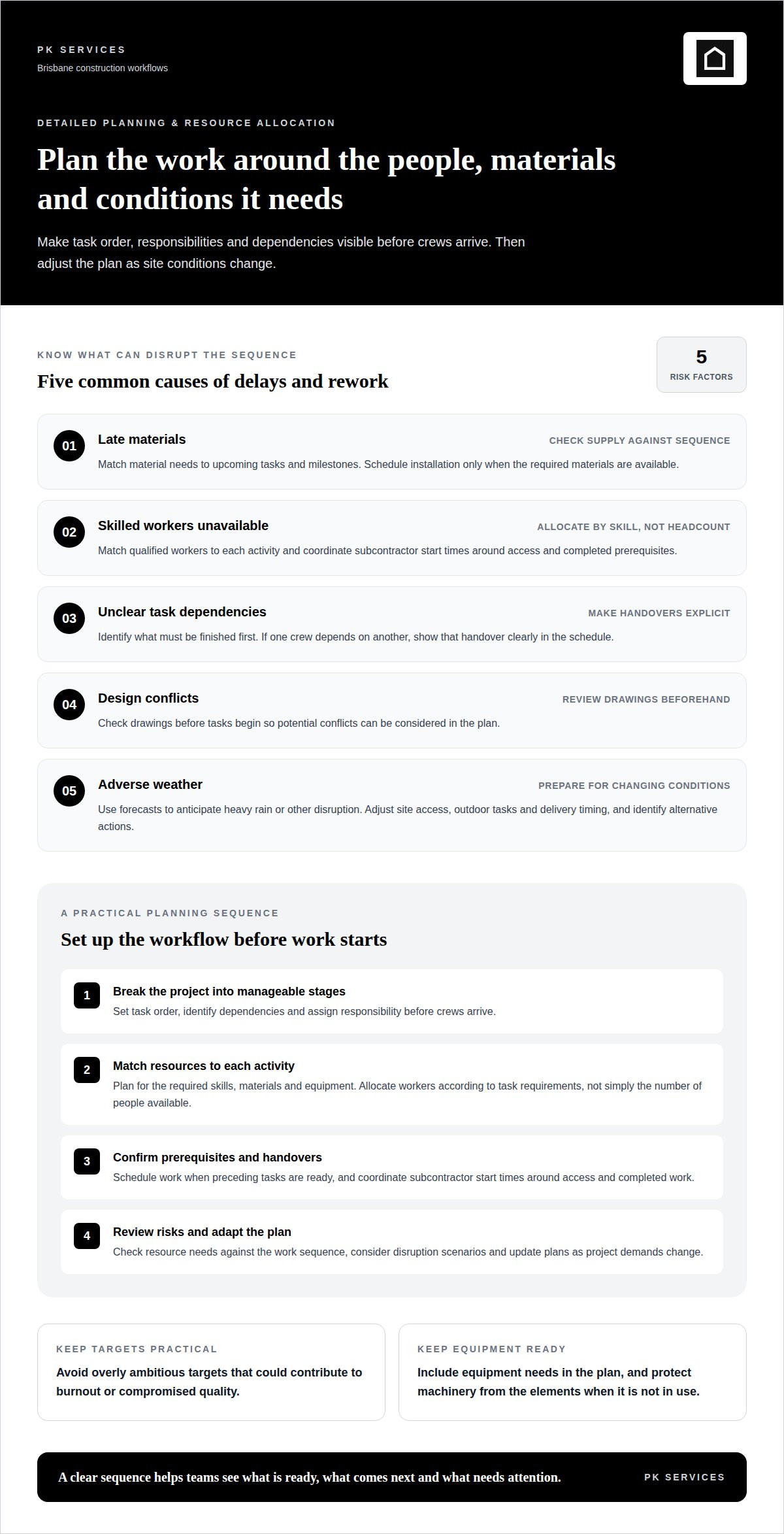
A practical project plan connects task order with the people, materials and equipment each activity needs. Break the work into manageable stages, assign responsibility and identify dependencies before crews arrive. Schedule installation only when the required materials are available and preceding work is ready. This makes the sequence visible and helps managers allocate labour where it can keep work moving.
Common causes of construction delays and rework in Brisbane include late materials, unavailable skilled workers, unclear task dependencies, design conflicts and adverse weather. Reduce the risk by checking resource needs against the work sequence, reviewing drawings before tasks begin and preparing alternative actions for disruptions.
Allocate workers according to their skills and task requirements, not simply the number of people available. Match qualified workers to activities, then coordinate subcontractor start times around access and completed prerequisites. If one crew must wait for another to finish, make that handover explicit in the schedule. Avoid overly ambitious targets that could contribute to burnout or compromised quality.
Planning also needs to account for Brisbane’s changing weather. Use forecasts to anticipate heavy rain or other disruptive conditions, then adjust site access, outdoor tasks and delivery timing. A contingency plan can identify alternative work for crews if conditions prevent the original activity. Account for equipment durability and access constraints so the response is ready to put into action rather than improvised after disruption.
Building information modelling (BIM) can support project visualisation and sequencing, helping teams identify design and planning conflicts before work reaches the site. Use model reviews to clarify how components fit together and which activities must happen first. For prefabricated components, plan delivery and installation around site readiness and lifting requirements. As project demands change, update labour, materials and task allocations together. A clear, realistic plan gives each trade a workable path while keeping quality central.
4. How can Brisbane construction companies measure site productivity and set benchmarks?
Start by defining the output for each activity, then record the labour, materials and equipment used. A completed concrete pour, installed frame or finished fit-out area can provide a measurable output if the scope remains consistent. Record inputs over the same period. This gives managers a clearer basis for assessing how efficiently resources are producing completed work.
Compare output per labour hour to assess how effectively work time translates into completed tasks. For example, track installed units against labour hours, then compare similar activities across project stages. Also compare expenses with results and actual project duration with planned duration. Each measure reveals a different pressure, so consider them together rather than treating one figure as the whole picture.
Set benchmarks using comparable work, consistent output definitions and the same recording method. A benchmark for one activity may not suit another. Note conditions such as workforce skills, material availability, design changes and weather disruptions. These factors help explain differences in results and make comparisons more useful when deciding how to improve construction site productivity in Brisbane. Update benchmarks when the task scope or working conditions change.
Queensland construction productivity has dropped by around 9 per cent since 2018. The sector’s productivity is only 5 per cent higher than in 1994-95, while market economy productivity increased by 65 per cent over the comparison period. The Queensland Productivity Commission released its final report on construction industry productivity on 21 January 2026. This context reinforces the value of consistent measurement when considering how to improve construction site productivity in Brisbane.
Use each review to identify a specific improvement opportunity. If output per labour hour falls, examine sequencing, access, rework and interruptions in the affected activity. If duration exceeds expectations, find which stage caused the variance and whether resources arrived when needed. Record the cause, assign an action and compare later results against the original method. For a structured performance review, discuss business consulting for construction.
PK Services
PK Services helps construction businesses address productivity challenges through business advice, trades and contractor services, and support managing projects from start to finish. Turn to the team when gaps in planning, coordination or site resources are affecting the way work moves between stages. The support can address the operational issue, whether that means refining business processes, filling essential site skill gaps or coordinating broader project activities.
Bring your project priorities and current workflow challenges into the conversation. These help shape a practical approach to organising and delivering construction work. Contact PK Services to discuss your project.
Make your next project a better one
Productivity gains take shape when project teams turn lessons into lasting habits. Choose one recurring source of friction to focus on at the next project review. A clear priority helps everyone understand what needs to change, while regular reflection keeps improvements grounded in site conditions.
For Brisbane construction businesses considering how to improve construction site productivity, match operational advice and project support to the challenge at hand. PK Services can help you develop a practical way forward for your construction business and project needs.
Contact PK Services to discuss your project and explore a considered next step. Stronger site productivity is built through focused decisions and steady progress, and your next improvement can start with a conversation.
Frequently Asked Questions
Why is Construction Productivity Important?
Construction productivity matters because it shows how effectively labour, materials and equipment produce completed work. For a Brisbane builder, poor productivity can mean crews spend time waiting, materials sit unused or tasks need repeating. Improving the way work flows helps businesses use resources more effectively and deliver project outcomes with greater consistency. It also matters across Queensland, where construction capacity affects the delivery of homes and infrastructure.
What are the most effective ways to improve construction site productivity in Brisbane?
Start with the recurring bottleneck that interrupts work most often. If one crew regularly waits for access, for example, review the handover between the preceding trade and that crew. Agree on a practical change, such as confirming the work area is ready before the next team mobilises, then observe whether interruptions decrease. Reviewing one operational issue at a time helps teams identify changes that suit their site.
How can construction scheduling, daily coordination and look-ahead planning reduce delays on Brisbane sites?
Use daily coordination to compare planned work with current site conditions, then use look-ahead planning to resolve upcoming constraints. If a room cannot be handed over because access is blocked, reassign nearby work rather than sending another trade into an unready area. Keep a short list of decisions, access needs and dependencies for upcoming activities. This links immediate site decisions to the broader programme.
Which construction technology and project management software improve productivity for Brisbane builders?
The most useful technology is the system that fits the project’s actual workflow. Prioritise practical functions such as drawing review, task records, time capture and field reporting over features crews will not use. A useful test is whether a supervisor can record an issue once and make its status clear to the people responsible for action. Mobile access helps when site teams need information away from the office.
How can materials procurement, deliveries and site logistics be improved on constrained Brisbane sites?
Coordinate deliveries with the work sequence and the space available for unloading and storage. On a tight site, arrange materials in the order crews need them and avoid receiving items before suitable storage is ready. Include delivery access and the receiving contact in procurement coordination. This helps reduce double handling, congestion and time spent locating supplies, while keeping work areas usable for active trades.
What Queensland workplace health and safety rules affect construction site planning and productivity?
Construction teams should plan for safety protocols, train workers to follow them, and use safety logs and checklists to report site issues promptly. The material gives no specific Queensland workplace health and safety rules.


