

Why does a project that looks flawless on a spreadsheet so often fracture the moment the first slab is poured? If you're operating in New South Wales or Queensland, you know the pressure is mounting. Between the July 2026 expansion of the Design and Building Practitioners Act and the constant search for skilled trades in a market growing at 6.9% this year, the margin for error has vanished. It's frustrating to watch your ROI get squeezed by DA delays or fragmented communication between the office and the site.
You deserve a process that works as hard as you do. By mastering full cycle construction project management, you can finally bridge the gap between high-level strategy and boots-on-the-ground execution. This guide provides a strategic framework tailored for the Australian market. We'll explore how to navigate shifting regulations, reduce project risk, and ensure your site crews and consultants are perfectly aligned from start to finish.
Key Takeaways
- Learn how full cycle construction project management eliminates the fragmentation trap by unifying consultants and site crews under one strategic vision.
- Discover the five essential phases of the project lifecycle, starting with rigorous feasibility studies to ensure every build is a viable business case.
- Navigate the distinct regulatory hurdles of New South Wales and Queensland with a framework designed to manage DA delays and complex site logistics.
- Understand why high-level advisory fails without direct site experience and how to spot operational risks before they impact your project's ROI.
- See how integrating strategic business consulting with direct trade supply creates a seamless path from initial inception to the final handover.
What is Full Cycle Construction Project Management?
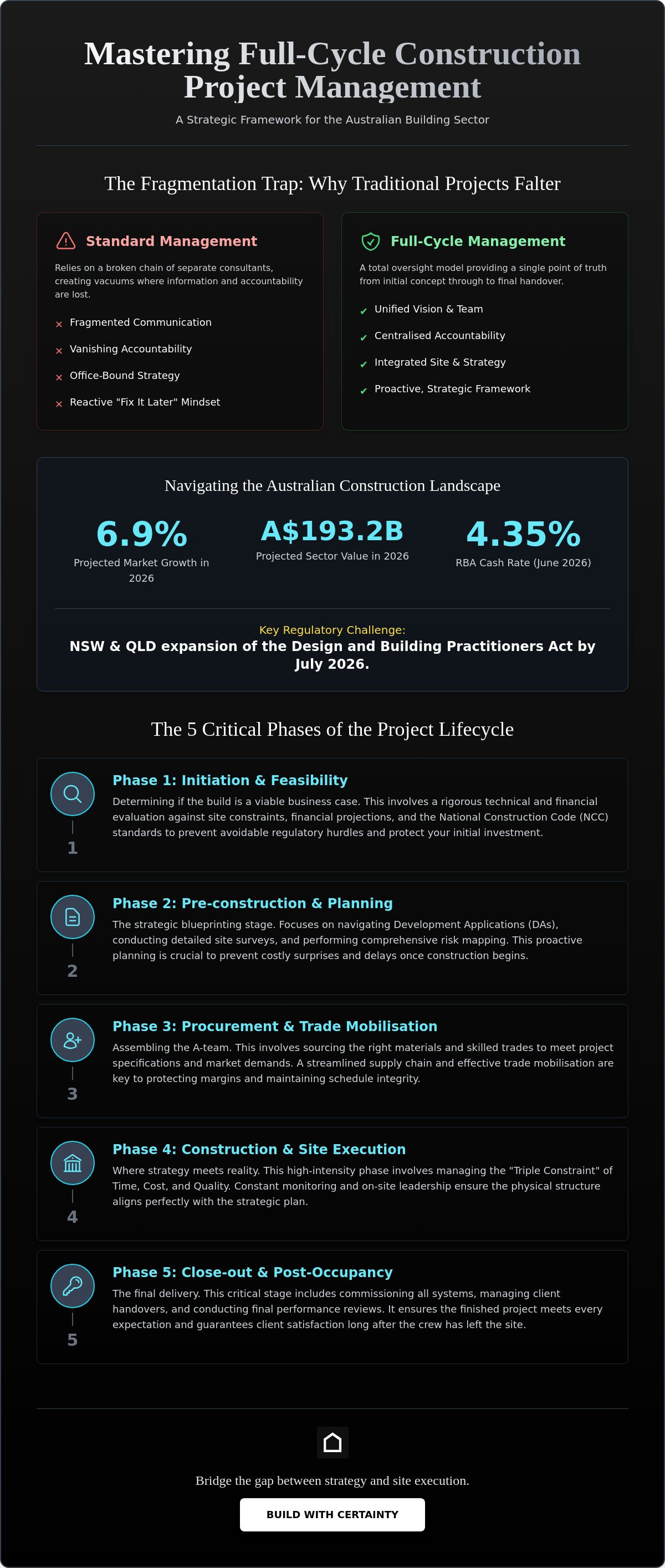
Full cycle construction project management is a total oversight model. It starts at the first spark of an idea and stays through to the final handover. Most traditional models are broken. They rely on a fragmented chain of separate consultants, architects, and builders. This "fragmentation trap" creates a vacuum where information disappears. Accountability often vanishes with it. A strategic partner changes this by owning the entire process. They provide a single point of truth. This ensures centralised accountability; cost control stays tight; and quality assurance isn't just a tick-box exercise. It's a commitment to Construction Management excellence that spans the entire project life.
The Difference Between Standard and Full Cycle Management
Standard management often feels incomplete. It usually stops at the office door. You get a beautiful plan, but the execution is left to chance. Full cycle management bridges this gap by going directly to the site. It integrates high-level business consulting with on-site trade services. This means the person designing the strategy also understands the reality of the plumbing or electrical work. It also includes rigorous pre-construction and post-construction audits. These audits catch risks early and ensure the final product actually matches the initial vision. By adopting full cycle construction project management, firms ensure that the strategic intent of the project is never lost in translation between the boardroom and the boots on the ground.
Why Australian Firms are Moving Toward End-to-End Models
The Australian market is shifting quickly. With the construction sector expected to grow by 6.9% in 2026 to reach A$193.20 billion, the stakes are higher than ever. Materials and labour costs are rising; inflation is persistent. Developers in NSW and QLD can't afford miscommunication. They need one source of truth. End-to-end models protect margins by eliminating the middleman and streamlining the supply chain. In complex multi-residential builds, this level of control is the only way to maintain ROI. Move from a reactive "fix it later" mindset to a proactive, strategic framework. This evolution in full cycle construction project management is becoming the new standard for firms that value efficiency over excuses. It's about building with certainty in an uncertain economic climate.
The 5 Critical Phases of the Construction Project Lifecycle
Success in the Australian building sector requires more than just grit. It demands a structured approach. Full cycle construction project management breaks the build into five distinct, manageable stages. This structure ensures that every decision, from the initial sketch to the final paint stroke, serves the project's bottom line. Each phase requires a specific set of skills and a shift in focus to maintain momentum.
- Phase 1: Initiation & Feasibility. Determining if the build is a viable business case by looking at site constraints and financial projections.
- Phase 2: Pre-construction & Planning. Navigating DAs, site surveys, and detailed risk mapping to prevent surprises later.
- Phase 3: Procurement & Trade Mobilisation. Sourcing the right skill sets and materials to meet the 2026 market demands.
- Phase 4: Construction & Site Execution. The high-intensity phase where strategy meets reality and the physical structure takes shape.
- Phase 5: Close-out & Post-Occupancy. Commissioning, handovers, and final performance reviews to ensure the client is satisfied. This stage often involves detailed property documentation and inventory checks, such as those provided by agepc.co.uk.
Strategic Initiation: Beyond the Business Case
Every great build begins with a cold, hard look at the data. With the RBA cash rate sitting at 4.35% as of June 2026, feasibility isn't just about the build cost; it's about the cost of capital. You must define the project scope early to prevent mid-build "scope creep" that erodes your margins. A feasibility study in the context of Australian building codes is a rigorous technical and financial evaluation that determines if a project can legally and profitably proceed under the National Construction Code (NCC) standards. Getting this right saves months of wasted effort and protects your initial investment from avoidable regulatory hurdles.
Execution and Monitoring: Managing the Site Pulse
The execution phase is where strategy meets the mud. It's the highest intensity period of the lifecycle. Managing the site pulse requires a constant eye on the "Triple Constraint" of time, cost, and quality. If one slips, the others follow. This is why academic foundations, such as those found in a UNSW Master of Construction Project Management, are so valued in the industry; they teach the rigour needed for site oversight. Efficient trade mobilisation is the secret to avoiding bottlenecks. When you have an integrated strategy and trade supply partner, the transition from planning to pouring concrete is seamless. Real-time monitoring on Sydney and Brisbane sites allows for instant adjustments, keeping the project on track despite local supply chain fluctuations. This proactive approach is the hallmark of effective full cycle construction project management.
Bridging the Gap: Why Strategy Without Site Execution Fails
Strategy is often treated as a boardroom exercise. It's clean, logical, and safe. Site execution is the opposite. It's unpredictable, loud, and often messy. The gap between high-level advisory and on-site tradespeople is where most construction budgets fail. When a consultant doesn't understand the physical reality of a trade, the project suffers. Real excellence in full cycle construction project management requires a leader who speaks both languages. You must translate a financial forecast into a concrete pour schedule without losing the project's intent. This alignment is the only way to ensure the vision survives the reality of the build.
Experience is the only bridge for this gap. Industry exposure of at least 15 years is the baseline for spotting site risks before they manifest. It's about seeing the subtle signs of a failing drainage plan or a mismatched electrical load before the walls go up. This foresight protects your ROI. Some argue that a good foreman is enough. A foreman focuses on the task. Strategic oversight focuses on the scale. To grow a firm in the current NSW and QLD markets, you need both. Integrated management ensures your consultants aren't just theorists. They are practitioners who understand the tools and the people using them.
The Value of Integrated Trade Services
Fragmentation is the enemy of quality. When you hire separate contractors, accountability often disappears in the handovers. Integrated trade services change that dynamic. By using experienced, vetted contractors, you fill essential gaps on-site. This creates a direct line of accountability. High standards are maintained because the trade teams answer to the same strategic vision as the planners. Accessing skilled trades for construction sites ensures project continuity. It prevents the labour void that stalls so many Sydney and Brisbane developments, keeping your timeline intact.
Operational Performance and Workflow Optimisation
Inefficiency is often invisible until it's too late. Poor site logistics turn into cost overruns that bleed your margin dry. Workflow optimisation starts with identifying these bottlenecks early. Better communication flows redefine construction excellence. They ensure the site crew knows exactly what the office expects, and vice versa. This isn't just about speed. It's about safety and compliance. Professional site management reduces the risk of accidents and regulatory breaches. It turns a chaotic site into a high-performance environment. This level of control is essential for any firm looking to protect its reputation and its bottom line.
Navigating Regional Complexity in NSW and Queensland
Construction in Australia is never a "one size fits all" operation. Managing a high-density site in Sydney requires a completely different tactical approach than a regional development in Queensland. Each state presents a unique set of regulatory hurdles, logistical puzzles, and environmental variables. Full cycle construction project management requires deep local knowledge to keep projects moving. Without this regional expertise, even the best strategy can get bogged down in local council red tape or supply chain bottlenecks.
The labour gap remains a significant challenge as we move through 2026. With New South Wales accounting for 40% of all construction activity in the country, the competition for reliable trades is fierce. In Queensland, the sector is growing at 5.5%, largely driven by preparations for the Olympic Games. Sourcing skilled workers requires more than just a phone call; it requires established networks and a reputation for fair, professional site management. Weather also plays a massive role. You must account for Queensland's intense storm seasons and the specific coastal conditions of New South Wales during the planning phase. Ignoring these variables is a recipe for cost overruns.
NSW Planning and Development Hurdles
New South Wales is currently tightening its compliance framework. The expansion of the Design and Building Practitioners Act 2020 to include class 3 and 9c buildings is set for 1 July 2026. This adds a new layer of complexity to the NSW Planning Portal and local council requirements. Navigating these roadblocks is where construction business consulting Australia becomes essential. Professional guidance ensures your project meets the new standards without unnecessary delays. It's about clearing the path so your site crew can focus on building rather than paperwork.
Queensland Construction Dynamics
Queensland operates under its own distinct rhythm. The QBCC framework and local licensing requirements remain central pillars of the industry. However, the new government procurement policy that took effect on 1 January 2026 has shifted the focus. It removed mandated "Best Practice Industry Conditions" and now emphasizes local participation and innovation. For developers in the booming South East Queensland corridor, this means strategic resource planning is vital. You must balance large-scale infrastructure impacts with the need for local trade availability. Managing these dynamics is a core component of effective full cycle construction project management in the Sunshine State.
Managing multiple sites across state lines is complex, but you don't have to do it alone. Contact PK Services today to secure a strategic partner for your next NSW or QLD development.
Redefining Excellence: The PK Services End-to-End Approach
PK Services doesn't just manage projects; we integrate them. We blend high-level strategic business advice with direct on-site trade supply. This approach removes the "fragmentation trap" discussed in earlier sections. Our "Start to Finish" promise is clear. We handle the complexity so you don't have to. It's a premium tier of full cycle construction project management that reduces the heavy lifting for developers and owners. You get a single point of accountability from the first feasibility study to the final key handover. This ensures that the original vision is never diluted by a lack of site-level understanding.
Sometimes, we enter a project when it's already in trouble. Failing construction assets require a specialist touch. Our project recovery service focuses on turning around distressed builds in NSW and QLD. We audit the current state, identify the fractures, and deploy a recovery team to stabilise the site. It's about protecting your capital and finishing what was started with professional precision. We look at everything from compliance issues under the Design and Building Practitioners Act to trade-level inefficiencies. We don't just point out the problems; we fix them.
A Tailored Solution for Modern Construction
We avoid the rigid, one-size-fits-all models of global firms. Every Sydney and Brisbane site has its own pulse. Redefining standards requires flexibility and local insight. You need a partner who understands the boardroom's financial pressures and the toolbelt's technical requirements. This dual perspective ensures that strategy isn't just a document. It's a reality. Our approach is designed for firms that expect more than just a task list; they expect a redefined standard of excellence. We've seen how a tailored approach can save projects that others have written off by prioritising efficiency and direct communication.
Getting Started with Full Cycle Management
The journey begins with a clear assessment. We look at your business health and specific project goals. From there, we build a custom roadmap for the entire project lifecycle. This isn't a generic plan. It's a strategic framework designed specifically for the Australian market. We focus on reducing risk and improving ROI from day one. Whether you're navigating the NSW Planning Portal or managing QLD's infrastructure booms, we provide the clarity you need. Ready to move forward? Organise a strategic consultation with PK Services today and experience a higher tier of professional partnership.
Take Control of Your Construction Future
Building in today's market requires a shift from fragmented management to a unified, strategic model. We've seen how bridging the gap between boardroom strategy and site execution protects your margins and reduces project risk. Navigating the regulatory shifts in NSW and the infrastructure boom in QLD requires more than just a plan. It requires a partner who knows the local terrain. Embracing full cycle construction project management is the most effective way to eliminate fragmentation. It ensures your vision is realised without compromise.
PK Services brings over 15 years of Australian industry expertise to your next development. We offer specialist knowledge in both NSW and QLD regulations to keep your builds compliant and on schedule. Our unique integration of strategic consulting and skilled trade supply creates a seamless path from inception to handover. It's time to move beyond traditional boundaries. Redefine your construction standards with PK Services. Your next project deserves the certainty of professional oversight and a redefined standard of excellence.
Frequently Asked Questions
What is the main advantage of full cycle construction project management?
The primary benefit is centralised accountability. By removing the gaps between separate consultants and trades, full cycle construction project management ensures your project's strategy survives the reality of the site. It eliminates the fragmentation that usually leads to budget blowouts and delays. You get a single point of contact who owns the results from the first feasibility study to the final handover.
How does PK Services handle the current skilled labour shortage in Australia?
We solve the labour gap by integrating strategic consulting with our own trade and contractor services. This gives us direct control over site mobilisation. Instead of relying on external recruitment, we use a vetted network of experienced tradespeople who understand our high standards. This internal supply chain ensures your project maintains momentum regardless of broader market shortages or competition for trades.
Can full cycle management help with a project that is already behind schedule?
Yes, our project recovery service is designed specifically for distressed assets. We conduct a rapid audit to find exactly where the fractures started. Whether the issue is regulatory non-compliance or poor trade coordination, we step in to stabilise the site. We focus on protecting your ROI and getting the build back on track with a clear, actionable roadmap for completion.
Do you provide project management services for both NSW and QLD?
We operate extensively across both New South Wales and Queensland. Our team understands the unique hurdles of each region, from the NSW Planning Portal to the QBCC licensing requirements. Whether you're building in high-density Sydney or the booming South East Queensland corridor, we provide the local expertise needed to clear regulatory roadblocks and manage complex site logistics effectively.
What is the difference between a project manager and a construction consultant?
A standard project manager focuses on task completion and daily site activities. A construction consultant provides high-level business strategy and risk advice. Full cycle construction project management merges these roles. It ensures that the person advising on your business case also understands the technical reality of the trade work on the ground, preventing a disconnect between the office and the site.
How do you ensure quality control across all phases of the project?
Quality control is built into our five-phase lifecycle model. We conduct detailed risk mapping during pre-construction and follow up with comprehensive audits after the build. This structured approach ensures every trade meets the National Construction Code standards. We maintain a constant site pulse to catch and correct deviations before they become permanent issues, ensuring the final build matches your vision.
What industries do you specialise in for full cycle management?
We specialise in residential and commercial construction, with a particular focus on multi-residential developments. Our approach is also highly effective for commercial builds that require complex site logistics and strict compliance. We tailor our framework to suit the specific needs of developers looking to scale their operations or improve performance in the current Australian economic climate.
How much does full cycle project management typically cost?
Pricing is determined by the specific scope and complexity of your development. Factors such as site location, regulatory requirements, and the level of trade integration needed all influence the final investment. We offer a tailored consultation to assess your project goals and business health. This allows us to provide an accurate, custom quote that reflects the value of end-to-end management for your build.


