

The preferred design isn’t always the best investment. For a construction project in Queensland, a business case developed with a construction consultant in QLD should compare options, define scope and support its recommendation with evidence. Queensland’s Stage 3 detailed business case examines the preferred options across economic, financial, commercial, social, environmental and sustainability considerations.
A persuasive case needs more than a compelling concept. It should explain the problem or opportunity, show how each option could deliver benefits, and make costs, risks and ongoing requirements clear enough for decision-makers to assess.
This guide explains how to build the case from the outset: define the need before choosing a solution, compare options using evidence, and develop the investment and delivery details funders expect. You’ll also learn how scope, project complexity and available evidence shape the work, and where construction business consulting can help turn a project idea into a clear, decision-ready case.
Key Takeaways
- Compare project options against the problem they solve, their benefits and their capital and operating costs.
- Set a clear scope before choosing a solution, and connect the project need to relevant priorities and evidence.
- Prepare investment information that helps approvers assess risks, ongoing costs and delivery arrangements.
- Understand how a construction consultant can help shape the business case and support project decisions.
- Consulting fees depend on the work involved, including project scope, complexity and the evidence required.
Economic, financial and commercial considerations
A strong financial case connects the project need with measurable costs, benefits and delivery choices. Forecasts should show how assumptions affect the investment over time.
Supporting documents and financial forecasts
Build the evidence file around the proposed scope. Include demand information, cost estimates, benefit assumptions, funding needs, risks and the source of each key figure. Forecasts should show expected cash flows over the project period and explain the assumptions behind them. Queensland Legislation identifies the Environmental Protection Act 1994 as relevant to environmental requirements considered during project business case development.
A proposal or business case should also set out the project objective, options, deliverables, exclusions, milestones and evidence requirements. For development assessment, the Planning Act 2016 may apply to projects involving building work, plumbing or drainage work, or reconfiguring a lot. Document applicable licensing requirements by activity, identify who is responsible, and define how the consultant’s advice relates to construction contracts and delivery responsibilities.
Financial modelling and ownership costs
Model each option using consistent assumptions so decision-makers can compare like with like. Separate capital expenditure from operating expenditure, and include maintenance and other ongoing costs. Show how changes in demand, timing or costs could affect expected benefits and affordability. Sensitivity analysis highlights the assumptions with the greatest influence, rather than hiding them in a single forecast.
Total cost of ownership extends beyond construction. For an infrastructure proposal, consider the cost of operating and maintaining the asset after completion, alongside its expected benefits over time. Record who prepared the capital cost estimates and whether they align with recognised cost-estimation guidelines. This helps reviewers understand the basis of the forecast and where uncertainty could affect the decision.
Consultant roles and project alternatives
A construction consultant can help frame the investment case, compare options and contribute specialist knowledge to commercial and economic analysis. A project manager coordinates delivery, a quantity surveyor develops and reviews cost information, and a builder carries out construction work. Because responsibilities can overlap, define each role, deliverable and decision authority in the project scope.
Compare alternatives before settling on a preferred solution. For example, assess whether staged work, refurbishment or a new facility best addresses the identified need. For each option, set out the benefits, high-level capital and operating costs, risks and constraints. This gives decision-makers a clearer basis for selecting an approach and defining the specialist input required.
Fees, savings and return on investment
Consultant fees depend on the agreed scope, project complexity, available evidence and specialist input required. The price is provided after a quote request, with the scope, deliverables and analysis shaping the fee. Define these items clearly so the commercial proposal can be assessed against the work needed.
Test potential savings and return on investment in the model rather than promising them in advance. Compare consultant fees and project costs with quantified benefits, such as lower operating expenditure or avoided rework, where evidence supports the estimates. Show the timeframe, assumptions and risks behind each benefit. A credible case also accounts for costs that continue after construction, including maintenance and operations.
Business case initiation and scope definition
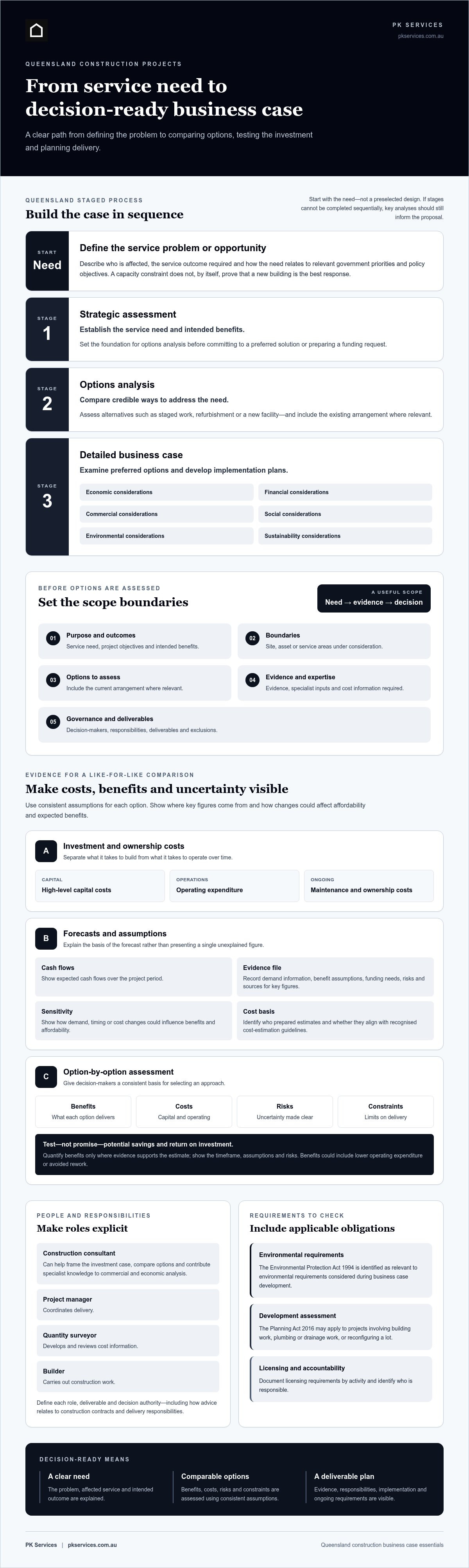
Start with the service need, not a preselected design. In Queensland, a clear scope gives infrastructure projects a sound basis for options analysis and funding decisions.
Engage a construction consultant during initiation, before committing to a preferred solution or preparing a funding request. Early input can help define the problem, identify evidence gaps and shape options before design choices narrow.
First, describe the current problem or opportunity in practical terms. For example, growing regional demand for a service may reveal capacity constraints, but it doesn’t automatically mean a new building is the best response. Record who is affected, what service outcome is needed and how the issue relates to relevant government priorities and policy objectives.
Then establish the work’s boundaries. A useful scope identifies:
- The service need, project objectives and intended benefits.
- The site, asset or service areas under consideration.
- Options to assess, including the existing arrangement where relevant.
- Evidence, specialist inputs and cost information required.
- Decision-makers, responsibilities, deliverables and exclusions.
Queensland’s staged process gives this work a clear progression. Stage 1 strategic assessment establishes the service need and benefits. Stage 2 options analysis builds on that assessment. Stage 3 detailed business case analysis examines the preferred options more comprehensively and develops implementation plans. If earlier stages cannot be completed sequentially, key analyses from those stages should still inform proposal development.
Consult Australia recommends engaging early and continuously with the senior government project sponsor supporting the case through funding approval. It also recommends agreeing on the business case narrative across the project team. This helps avoid conflicting assumptions when specialists contribute different sections. Match each consultant’s scope to the final requirements, including responsibility for the benefits realisation plan.
Keep the analysis evidence-based. Consult Australia cautions that choosing a preferred solution first can create momentum bias, leading the case to justify an existing decision. Compare alternatives against the same objectives, benefits, risks and constraints. Describe links with other projects or opportunities too, since dependencies can affect sequencing, demand or expected benefits.
Set review points as evidence develops. Revisit the original assumptions, refine the scope when findings reveal new constraints, and record the reasons for each change. A no-go decision may be appropriate if the problem analysis does not support investment. This discipline helps decision-makers distinguish a genuine need from a preferred project and keeps the detailed business case focused on evidence required for approval.
Consult Australia recommends defining problems before investment decisions, aligning with government priorities and policy objectives, securing team agreement on the narrative, and weighing options for benefits, risks and constraints. Starting with delivery can lead to poor value for money.
Funders' and approvers' assessment expectations
Queensland decision-makers need a clear, evidence-based case for investment. Stage 3 should present comprehensive evidence that lets approvers assess the preferred option, its delivery and its public value.
Build a traceable argument. Link the identified need to project objectives, expected benefits, option selection and implementation arrangements. Each recommendation should point to evidence, an assumption or a defined analysis. If an estimate changes between versions, explain what changed and why. This gives a department or funding body a clear line from the original problem to the proposed investment.
Queensland’s governance and assurance documentation helps decision-makers understand whether the right participants contributed and robust analysis informed the case. Make responsibilities visible: record who prepared key estimates, reviewed assumptions, supplied specialist evidence and escalated unresolved issues. A responsibility matrix can link each deliverable to its owner, reviewer and approval point.
Assessment also tests whether the proposal accounts for the interests affected by its options. Include public interest considerations, including the Human Rights Act 2019, alongside relevant social and environmental impacts. For example, explain how a facility option affects access to services, nearby communities and the environment. Describe the evidence used, who may experience an impact and how the project proposes to respond.
Approvers need to see risks and delivery arrangements, not just projected benefits. Present unmitigated risks, proposed controls, governance responsibilities, and the procurement and delivery strategy. Explain how that strategy connects to the operating model after completion. If construction depends on another project, show the dependency and its effect on timing, service outcomes or implementation.
A practical assessment pack can organise the evidence into clear components:
- Strategic fit: the service need, objectives and relevant policy priorities.
- Options: the preferred approach, alternatives and reasons for ranking them.
- Investment evidence: benefits, costs, demand assumptions, risks and sensitivities.
- Delivery and governance: accountabilities, procurement approach and implementation arrangements.
- Review: how outcomes will be assessed after completion.
Queensland Stage 3 analysis should be tailored to the investment’s size, scope, risk and complexity. A straightforward project may need a more focused analysis than a complex infrastructure proposal, but both need evidence proportionate to their decisions. The final business case should make the recommendation easy to locate, show how analysis supports it, and state what approval is sought. This clarity helps approvers assess the proposal without confusing supporting detail with the decision itself.
A straightforward project may require a more focused assessment, while a proposal with greater complexity should make the basis for its conclusions especially easy to follow. Across the case, keep assumptions, evidence and recommendations connected, and make uncertainty visible rather than leaving approvers to infer it. The outcome of Queensland’s Stage 3 detailed business case is a document that provides clear, comprehensive evidence for decision-makers.
A consistent account should explain why the investment is proposed, how the preferred approach was selected and what needs to happen for delivery. Keep supporting material accessible, and explain the significance of evidence when its implications may not be obvious. Decision-makers should understand not only what is recommended, but also the reasoning and conditions behind it. Tailor the depth of analysis to the proposal’s scale and complexity while retaining the evidence needed for a sound assessment.
What does a construction consultant do in Queensland?
A construction consultant helps turn a project need into defined work, evidence and decisions. In Queensland, the role can cover early planning, business case development and delivery coordination, depending on the agreed scope. For an infrastructure proposal, this could mean testing the service need before recommending a building or upgrade.
At initiation, the consultant can coordinate input from the project sponsor, asset owner and technical specialists. They help define objectives, boundaries, responsibilities and information gaps. For example, a proposed community facility may require analysis of demand evidence, site constraints and operating needs before options are compared. This gives the project team a shared brief.
During options analysis, a consultant can structure alternatives against shared criteria. These may include service benefits, cost, delivery risks, constraints and ongoing operational needs. In Queensland’s staged business case process, Stage 2 builds on the Stage 1 strategic assessment, while Stage 3 examines preferred options in greater detail. The analysis should suit the investment’s size, scope, risk and complexity.
Practical work can include coordinating or reviewing evidence, tracking assumptions and documenting how decisions were made. A consultant may help connect cost estimates, demand forecasts, risk analysis and the proposed delivery approach. For a school expansion, for example, the case could compare staged construction with a larger single project and assess how each option would affect operations during the works.
- Scope: define objectives, exclusions, deliverables and decision responsibilities.
- Evidence: identify required data and organise contributions from specialists.
- Options: compare alternatives against consistent benefits, costs and risks.
- Delivery: develop implementation, governance and management arrangements.
- Review: set an approach for assessing outcomes after completion.
These tasks are distinct from construction itself. A builder carries out contracted works, while a project manager coordinates delivery activities and a quantity surveyor provides cost expertise. A consultant’s role depends on the engagement, so the scope should explain how responsibilities connect and who owns each output.
For Queensland public projects, Stage 3 also establishes implementation, governance and management arrangements for procurement and final delivery. A consultant can help present those arrangements clearly, including project risks and the approach to post-completion review. The work is useful when a team needs structured analysis, clearer accountabilities or joined-up advice across project disciplines.
Before work begins, define the decision the analysis must support, the required outputs, the contributors and the review process. This ties the consultant’s work to actual approval or delivery needs, rather than producing material without a clear purpose.
How much do construction consultants charge in Queensland?
There’s no single fee for construction consulting in Queensland. The price is provided after a quote request, and depends on the project scope, complexity, evidence required and specialist input. A business case covering options analysis and implementation planning requires different work from a focused review of an existing proposal.
Start by defining the decision the engagement must support. For example, a project seeking funding may need analysis of options, demand, benefits, costs, risks and delivery arrangements. A narrower task might focus on refining the scope or reviewing project assumptions. Clear boundaries help define the work and reduce the risk of paying for analysis the decision doesn’t need.
Queensland’s Stage 3 detailed business case is tailored to an investment’s size, scope, risk and complexity. That makes these practical cost drivers worth setting out in a quote request:
- Project stage: explain whether the work covers initiation, options analysis or detailed case development.
- Deliverables: list reports, forecasts, workshops, reviews and implementation planning required.
- Evidence: identify existing data and any new research or specialist input needed.
- Coordination: describe the contributors, stakeholder input and review process.
- Timing and dependencies: note decision milestones and information needed from other workstreams.
Request a proposal that connects each fee component to a defined output. For example, separate the options analysis from the detailed business case, then set out review points and assumptions for each. This makes the engagement’s scope easier to assess and clarifies how changes would be handled if the project scope shifts. It also gives the project team a clearer basis for managing approvals and expenditure.
Compare proposals by scope and usefulness, not price alone. A lower fee may involve fewer deliverables or less analysis, while a more extensive proposal may include work your decision doesn’t require. Check that the proposed approach addresses the funder’s evidence needs, identifies exclusions and explains how revisions are handled. For a Queensland infrastructure project, include delivery and operating considerations when they are relevant to the decision.
To assess value, compare the fee with the decision support and outputs provided. A consultant can help test assumptions and identify risks, but projected savings or benefits should remain evidence-based rather than presented as guaranteed returns. Set out how each claimed benefit will be measured, over what period, and who will track it after approval. Discuss your construction project scope to help define the consulting work required.
PK Services: Business Consulting
PK Services provides Business Consulting to construction firms working through project decisions, operational priorities or the need for clearer direction. Turn to the team to bring business considerations and construction activity together in a practical plan.
When a project also needs skilled trades or contractors on site, PK Services offers Trades & contractor services to help fill essential gaps. The team can also manage the entire process from start to finish when coordinated oversight is needed. The right support depends on the work, from setting priorities to coordinating project activity.
Share your project needs with PK Services to discuss the next step.
Set your project up for its next decision
Turn your project priorities into a focused brief. Identify the decision you need to make, the people who need to contribute and the evidence that would help you move forward. A clear starting point makes the discussion more useful and keeps the work grounded in your project rather than assumptions.
If you’re considering a business case for a construction consultant in QLD, look for an approach that connects strategic intent with practical project needs. PK Services can discuss how its support fits, whether you’re shaping project direction or deciding what comes next. Bring your current scope, key questions and pressing constraints to start a productive conversation.
Contact PK Services to discuss your project. A clear conversation can help you define a useful next step and build momentum with confidence.
Frequently Asked Questions
What is the business case for hiring a construction consultant in Queensland?
A business case is an evidence-based argument for investing in a project and engaging expertise to shape or assess the decision. A consultant can help a business test whether proposed work addresses a real need, compare practical alternatives and prepare information for internal or funding decisions. For example, a Queensland business considering a warehouse expansion could assess staged construction against a new facility before committing to a direction.
How do Queensland construction costs and market conditions affect the business case?
Local conditions influence assumptions about project estimates, delivery timing and expected benefits. For a Queensland project, assess how location, site access, workforce availability, material sourcing and procurement timing could affect each option. Compare these assumptions with operating needs, then test how changes might alter affordability or value. Businesses planning work in Queensland and New South Wales can apply the same approach while grounding estimates in each project’s location and scope.
What are the risks of hiring a construction consultant, and how can businesses assess them?
Responsibilities can overlap with those of project managers, quantity surveyors and builders, creating uncertainty about deliverables and decision authority. Reduce this risk by defining each role, its scope and responsibilities, setting review points, and documenting how the consultant’s advice relates to construction contracts and delivery.


