

A trusted Queensland builder is more than a polished portfolio. If your search is “building a reputable construction company QLD”, start by checking that the builder holds a current QBCC licence suited to the work. In Queensland, builders carrying out residential work worth more than A$3,300 must be licensed.
Look beyond the licence, too. Clear planning, regular project updates, careful site-risk management and coordinated approvals help show how a builder will manage work from start to finish. These are practical checks when researching “building a reputable construction company QLD”.
This guide explains what to look for when assessing builders in Queensland. Learn how to review planning and communication, assess site risks and management systems, and understand approvals. You’ll also find practical checks to help you make a confident decision before signing a building contract.
Key Takeaways
- Set out the project scope, responsibilities and communication process early so stakeholders can stay aligned as work progresses.
- Use recent client feedback alongside licence status and current insurance information to build a fuller picture before signing.
- Map approval steps and authority coordination into the project plan to reduce delays caused by unclear responsibilities or missing information.
- For categories 1-7 licences, the Queensland Building and Construction Commission says its maximum revenue or net tangible asset calculator applies to maximum revenue of A$800,001 and over.
- Choose a business structure that suits your construction work, risk exposure and management needs, then organise the required registrations before trading.
Project planning, stakeholder alignment and site coordination
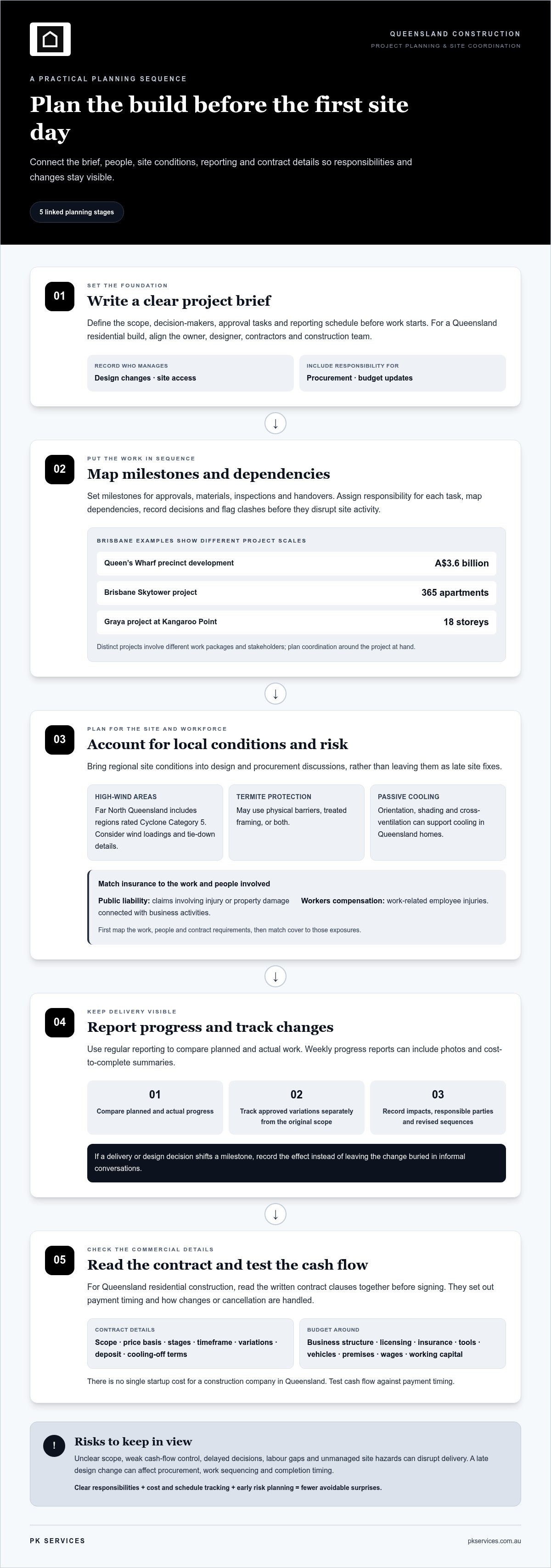
Start with a project brief that defines the scope, decision-makers, approval tasks and reporting schedule. Record who manages design changes, site access, procurement and budget updates. For a Queensland residential build, a clear scope aligns the owner, designer, contractors and construction team before work starts. Set milestones for approvals, materials, inspections and handovers, and assign responsibility for each task.
Brisbane projects show the coordination involved at different scales. Queen’s Wharf is a A$3.6 billion precinct development, while Brisbane Skytower is a 365-apartment project. Graya has an 18-storey project at Kangaroo Point. These examples involve distinct work packages and stakeholders. A practical plan maps dependencies, records decisions and flags clashes before they disrupt site activity.
Control budgets and timeframes with regular reporting. Weekly progress reports, including photos and cost-to-complete summaries, help stakeholders compare planned and actual work. Track approved variations separately from the original scope. If a delivery or design decision shifts a milestone, record the impact, responsible party and revised sequence. This makes changes visible instead of leaving them buried in informal conversations.
Regional delivery adds local site conditions to the coordination plan. Far North Queensland includes regions rated Cyclone Category 5, so wind loadings and tie-down details matter in high-wind areas. Termite protection may use physical barriers, treated framing, or both. In Queensland homes, orientation, shading and cross-ventilation can support passive cooling. Include these considerations in design and procurement discussions, not as late site fixes.
Queensland construction businesses should align insurance with their work and workforce. Public liability cover addresses claims involving injury or property damage connected with business activities; workers compensation relates to work-related employee injuries. First map the work, people and contract requirements, then match cover to those exposures.
For Queensland residential construction, the written building contract should set out the scope, price basis, stages, timeframe, variations, deposit and cooling-off terms. Read these clauses together before signing: they determine payment timing and how changes or cancellation are handled.
There is no single startup cost for a construction company in Queensland. Build a budget around the business structure, licensing, insurance, tools, vehicles, premises, wages and working capital. Then test cash flow against payment timing.
Common business risks include unclear scope, weak cash-flow control, delayed decisions, labour gaps and unmanaged site hazards. A late design change, for example, can affect procurement, work sequencing and completion timing. Set clear responsibilities, track costs and schedules, and address risks during planning to reduce avoidable disruption.
Customer recommendations and reviews
Customer feedback is most useful when it describes a project like yours. A Brisbane homeowner’s review of a bathroom renovation may reveal little about a builder’s approach to a large extension. Look for examples that match your project type, location, scale and complexity. Detailed comments on communication, changes and handover offer more context than a star rating alone.
Before signing a Queensland building contract, verify the builder’s licence status, request current insurance certificates and speak with recent clients. The QBCC licensee register can show the history of a QBCC-licensed individual or company. Consider that record alongside customer feedback, rather than treating a positive review as proof of suitability.
Ask a recent client about specific parts of the experience: how the builder communicated schedule changes, managed variations and resolved defects or unfinished work. For example, a client describing a delayed bathroom fitting can explain whether the builder provided updates, arranged the next trade and clarified any cost or timing effects. Concrete details help you assess the working relationship.
To compare Queensland construction companies on pricing, credentials and reviews, compare written quotes against the same scope. Then weigh each builder’s relevant licence, insurance information and recent client feedback. A lower quote may reflect different inclusions, allowances or assumptions, so compare what each document covers before drawing conclusions.
Look for patterns in reviews, not isolated praise or criticism. Several clients mentioning prompt updates may point to consistent communication. Repeated comments about unclear variations or missed appointments deserve attention, especially if they relate to your project. Check dates and project descriptions so older feedback or unrelated work doesn’t dominate your assessment.
Keep the evidence together in a simple comparison record. Note the project type, review details, licence findings, insurance documents and questions raised in client conversations. If a reference describes a successful handover, ask what the final inspection and defect process involved. This turns recommendations into practical evidence instead of relying on a general impression of a trusted builder.
Keep your review fair. One negative comment may not explain the full project, and a polished testimonial may not cover day-to-day delivery. Compare specific examples using the same criteria, including planning, communication and how concerns were handled. A clear record supports a balanced decision and highlights issues to discuss before signing.
Building approvals, permits and authority coordination
Approvals affect design, contractor sequencing and when work can progress on site. Review how the builder assigns each submission, decision and authority contact.
Building Approvals and Permits
Ask for an approvals plan that shows required decisions, document owners and dependencies. It should connect design information with authority submissions, contractor scheduling and site work. For renovations, make sure the proposed scope and drawings stay aligned as decisions are made. This reduces the risk of teams working from different versions.
Check who coordinates each authority and how updates reach the project team. A design-and-construct contract can provide one point of accountability for design, approvals and building, reducing the risk of gaps in scope. The contract and project plan should clearly assign responsibilities, including who records approval conditions and communicates changes to contractors.
For commercial facilities, map approval milestones against procurement and site access. A late design decision can affect equipment selection or trade sequencing. Record submitted documents, responses and resulting design changes so the team can trace why a task or specification moved.
Keep building approvals separate from warranty arrangements. Queensland builders should have paid Home Warranty Insurance, which protects clients if the builder cannot complete the work. Record the relevant cover alongside the contract and project documents, rather than treating it as an approval step.
QBCC Licence Classes and Requirements
Licence checks help establish whether a builder can undertake the proposed work. In Queensland, builders carrying out residential work worth more than A$3,300 must be licensed with the Queensland Building and Construction Commission (QBCC). Match the current licence class to the project scope, rather than relying on a company name or past project photographs.
The QBCC licensee register can show the history of a licensed individual or company. Licence records identify permitted work and may include conditions, recorded compliance activity and tribunal orders. These details help answer a key question: how do licence checks, complaints and disciplinary records affect reputation? They add context to reviews and references, particularly when a record relates to the proposed work.
Financial requirements also matter. According to the Queensland Building and Construction Commission, its maximum revenue or net tangible asset calculator applies to maximum revenue of A$800,001 and over, for categories 1-7 licences. Consider the relevant licence category and financial test when assessing a construction business.
When assessing a builder’s business readiness, distinguish licence fees from project costs, insurance and operating expenses. The relevant class and application requirements shape that assessment. Clear records make it easier to understand the builder’s authority, obligations and capacity before work begins.
What are Queensland QBCC licence classes, financial requirements and fees?
In Queensland, the QBCC licence class identifies the work a holder is permitted to carry out. Match the builder’s current class to your project scope, whether it involves a new home, an extension or another type of residential work. A business name or portfolio alone doesn’t establish that its licence covers your project.
Residential builders must hold a valid licence issued by the Queensland Building and Construction Commission (QBCC). Builders carrying out residential work worth more than A$3,300 must be licensed. Use the QBCC licensee register to review an individual’s or company’s record, then compare the recorded class and any conditions with the work proposed.
Licence records can include conditions, compliance activity and tribunal orders. Read these details in context. A condition, for example, may define the work permitted, while a recorded compliance matter can warrant closer attention to the project’s scope and responsibilities. Connect the register entry to the actual contract instead of relying on a general description of the business.
Financial requirements are another part of Queensland licensing. According to the Queensland Building and Construction Commission, the maximum revenue or net tangible asset calculator applies to maximum revenue of A$800,001 and over, for categories 1-7 licences. The calculator’s relevance depends on the licence category and the business’s maximum revenue position.
For a construction business, separate licence fees from operating expenses in the financial plan. Identify the relevant licence transaction, then refer to current QBCC fee information for that transaction. Another company’s cost is not a reliable estimate, as its application or licence circumstances may differ. Keep fee records with the business’s licensing documents.
When reviewing a builder, follow a clear sequence: identify the legal entity named in the contract, search that entity or licensee in the QBCC register, note the licence class and conditions, then compare them with the project scope. If the contract names a different entity from the one in the search, resolve the discrepancy before relying on the record.
A proposed residential project, for example, may include work beyond a builder’s recorded class. In that case, the licence record does not establish permission for every part of the scope. Define responsibilities for each part of the work and make sure the contracting arrangements match the licence information. This clarifies how the class, financial requirements and project duties relate.
This check is most useful when tied to the full project brief, not just the builder’s general description of services. Queensland clients should confirm that a builder’s current licence class matches their project scope. If the plans or agreed work change, revisit the match before proceeding so the licence class remains relevant to the work.
Queensland builders should hold a current QBCC licence covering the work they undertake. Use this principle alongside the register review and contract comparison: confirm the named builder, check the recorded class and conditions, and seek clarification if the scope and licence do not align. This keeps the decision focused on the work and current licence information.
How do I register a construction business in Queensland and choose a business structure?
Start by defining the work the business will undertake, such as residential builds, renovations or commercial projects. That scope informs the licence class, workforce, insurance and operating systems to organise. Write a short business plan covering customers, services, suppliers, cash flow and project management. These decisions provide a practical basis for choosing a structure and preparing registrations.
Compare a sole trader, partnership, company or trust in terms of ownership, decision-making, personal risk, tax administration and future growth. A sole trader operates under one owner; a partnership involves shared ownership. A company is a separate legal entity, while a trust uses a trustee to hold or manage assets for beneficiaries. Each option has distinct legal and administrative implications, so weigh them against your circumstances.
Use an orderly setup process:
- Choose the structure. Record who owns the business, who makes decisions and how responsibilities are divided.
- Settle the business identity. Decide whether to trade under a personal name or a separate business name, then handle applicable registrations through the relevant Australian register.
- Arrange business and tax records. Set up the required identifiers and a bookkeeping process that separates business transactions from personal spending.
- Prepare for Queensland construction work. Match the QBCC licence class to the residential work undertaken and organise business insurance and contract processes.
A two-person renovation business, for example, may prioritise shared control and clear responsibility for decisions. A business planning larger projects may place more weight on continuity, governance and administrative capacity. In either case, document ownership, authority to sign contracts, payment approvals and how owner disputes will be handled.
Registration is only one part of readiness. A construction business also needs systems for estimating, project records, supplier arrangements, worker coordination and cash-flow monitoring. Organise contracts, invoices, insurance documents and licence records under the same business identity. Consistent records make it easier to manage projects and explain how the business operates.
Structure and registration choices can affect liability, tax and administration. A legal or accounting professional can assess those implications for your circumstances. For help shaping the operational plan behind your setup, discuss construction business planning.
Market conditions can provide context for planning, but they do not guarantee work for a new operator. Queensland’s construction sector contributed $41.2 billion to the state economy in 2024-25, while Queensland’s overall economic growth was forecast to reach 2.5% in 2025-26. The sector employed 288,000 people as of 2025 and is valued at $67 billion. Use these indicators alongside local customer research, likely project sizes and realistic cash-flow forecasts when deciding how much capacity to build into the business.
Before accepting work, check that the construction company holds a valid Queensland Building and Construction Commission (QBCC) licence. The Queensland Building and Construction Commission published a Compliance and Enforcement Strategy covering 2026-2030, so keep licensing and compliance responsibilities visible in internal procedures. Assign someone to monitor licence conditions, maintain complete project records and flag issues early. These steps support sound operations whether the business is run by one owner or several, and help keep growth ambitions aligned with the work the business is authorised and equipped to perform.
PK Services: Business Consulting
PK Services helps construction businesses turn planning into stronger day-to-day operations. Its Business Consulting supports firms working through project delivery, coordination and operational challenges. This is a practical next step when plans, responsibilities or site processes need clearer alignment.
For projects with essential site gaps, PK Services also provides Trades & contractor services. It manages the entire process from start to finish, helping connect the work across its stages. The right support depends on the task your business needs to move forward.
To discuss your construction business needs, contact PK Services or visit pkservices.com.au.
Turn your next decision into a clear plan
Building a reputable construction company in QLD takes ongoing commitment, shaped by decisions made before work begins and as projects develop. Turn what you’ve learned into a practical priority for your business or project. Identify the issue that needs attention first, whether that’s clarifying responsibilities, strengthening project controls or organising the next stage of delivery.
Before starting a conversation, note your intended outcome, current challenge and any decision already affecting the work. A focused brief makes it easier to discuss the right support and agree on a useful way forward. Keep the goal specific to your situation, whether you’re planning a project or improving how your construction business operates.
PK Services can discuss your requirements and help you consider a suitable next step. Contact PK Services about your project and start shaping a more considered path forward.
Frequently Asked Questions
What licences are required to operate a construction company in Queensland?
For residential building work, the required QBCC licence depends on the work being undertaken. Queensland residential builders must hold a valid licence, and residential work worth more than A$3,300 requires a licensed builder. Before accepting a contract, match the licence class to the specific scope and ensure the contracting business is the entity covered by the licence. Other construction activities can have different licensing requirements.
How can a new Queensland builder build a strong reputation and win clients?
Choose a clear project focus and make it easy for clients to understand what your business delivers. Prepare proposals that define inclusions, exclusions, responsibilities and how changes will be documented. With permission, show examples of completed work that match the projects you want to win. After handover, provide clients with organised project records and invite them to share feedback or refer people seeking similar work in Queensland.


