

A commercial project management consultancy in NSW can provide the planning, coordination and oversight needed to take a project from its initial brief through delivery and handover. The right support helps owners track scope, budget, programme, risks and decisions while keeping the project team aligned.
A commercial project is a substantial commitment, and progress can be harder to manage when responsibilities are spread across several parties. This guide explains what commercial project management consultancy in NSW can involve, how the process works and what shapes the cost. It also covers how to assess a consultancy and when outside support can help organise a project from start to finish.
Key Takeaways
- Set clear decision-making roles, reporting and project priorities early to keep the owner’s interests visible throughout delivery.
- Align procurement with the project scope and risk profile, then manage tender decisions, contract records and changes consistently.
- Map key stages from the initial brief through construction and handover so decisions, responsibilities and deliverables stay connected.
- Look for relevant experience across comparable building types and project conditions, not just a broad list of sectors.
- Review design choices against the brief, buildability and cost plan as the work develops, and address changes before they affect later decisions.
Client-side project management
Client-side project management represents the owner’s interests across planning, design and construction. To engage a commercial project management consultant in NSW, define your goals, decision-making authority and required support. Then assess relevant experience, communication practices and client feedback.
Client collaboration and communication
Before engagement, agree how the consultant will work with your team. Set out who can approve scope changes, who receives reports and how urgent decisions reach the owner. A commercial fit-out, for example, may involve an owner, designer, builder and tenants. A clear responsibility map shows who provides information and who makes the final decision.
Look for practical reporting, not simply a promise to keep in touch. Progress updates should link current work to the agreed brief, programme, budget and open decisions. Ask how the consultant records meeting actions and escalates delays or design conflicts. This gives the owner a clear view of the project while preserving their decision-making authority.
Client and consultant reviews
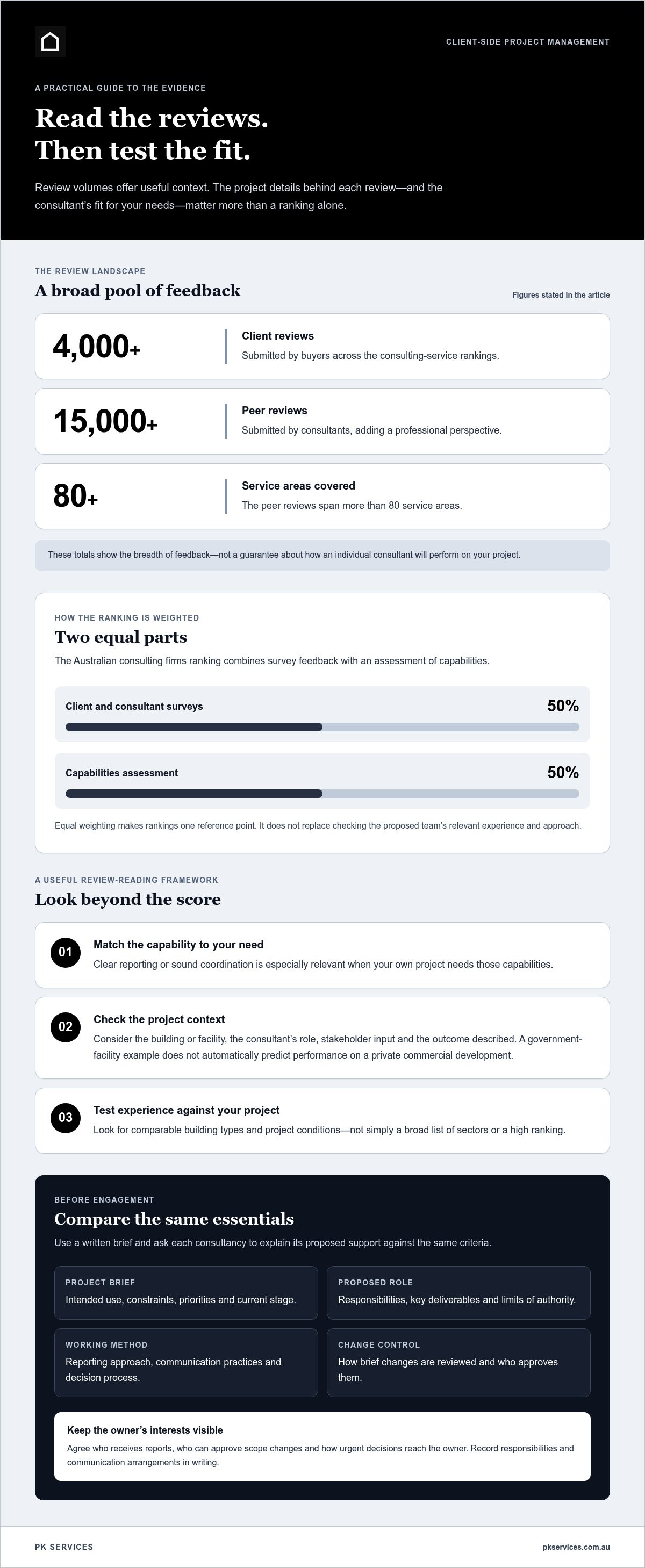
Reviews can show how clients and consultants assess professional services, but read them for detail. As of 1 January 2025, buyers had submitted more than 4,000 consulting-service client reviews across the rankings. Consultants had submitted more than 15,000 peer reviews, covering more than 80 service areas. These figures provide context for the breadth of feedback, not a guarantee about an individual project.
Compare comments with your own project needs. A review describing clear reporting or sound coordination is more useful when your project also needs those capabilities. The Australian consulting firms ranking uses client and consultant surveys and a capabilities assessment, with each factor weighted at 50%. Treat rankings as one reference point, then assess the proposed team’s relevant experience and approach.
Client testimonials can offer specific examples of communication and delivery. Consider the project context, the consultant’s role and the outcome described. A testimonial about a government facility, for example, may show how the consultant handled stakeholder input, but it does not automatically predict performance on a private commercial development.
Choosing and engaging a consultant
Start with a written brief that explains the project’s intended use, constraints, priorities and current stage. Then ask each established consultancy to describe its proposed role, key deliverables, reporting method and decision process. Compare responses against the same criteria. This makes it easier to see whether the support fits your requirements, rather than relying on broad claims about being trusted.
Discuss how the consultant will work with your internal team and other project participants. Clarify who coordinates design input, tracks decisions and communicates emerging issues. For an NSW project with several stakeholders, ask to see a sample reporting format or have the consultant explain how actions are documented. These details show how the professional services work in practice.
Before engagement, agree in writing on the scope and limits of the consultant’s authority. Confirm how changes to the brief will be reviewed and who approves them. Record the agreed responsibilities and communication arrangements so both sides have a shared reference as the project moves from planning to delivery.
Construction procurement and administration
Procurement turns an approved project brief into comparable offers, clear appointments and managed construction work. In NSW, align the procurement process with the project’s scope, risks and delivery priorities.
Consultancy services and project scope
Construction project management consultancy can cover procurement planning, tender coordination, bid comparisons, contract administration, progress monitoring and change control. Agree which tasks belong to the consultant, design team, builder and owner. For example, a consultant can assess tenders against the same scope, programme and stated assumptions, then document the reasons for the owner’s selection.
No single qualification suits every commercial project. Consider relevant construction experience, project management training and registrations where the work requires them. Ask for examples involving similar buildings or infrastructure, such as a commercial refurbishment or government facility. A capable professional services team should explain its role and how its experience applies to your project, rather than rely on broad claims of excellence.
Planning approvals, building rules and codes
The approval pathway depends on the site, proposed use, design and applicable planning controls. Identify relevant approvals and building requirements before procurement locks in the design or programme. For a commercial centre refurbishment, for example, changes to use, access or layout may affect the required documentation and specialist input.
Ask the consultant to map approval tasks, responsible parties and decision points with the relevant planning and design professionals. This helps the owner understand what needs to be resolved before construction, without assuming every NSW project follows the same pathway. Tender documents should reflect the current scope and approval conditions so bidders price a consistent package rather than make different assumptions.
WHS, compliance and project risks
Responsibility follows each party’s role and control of the work. The head contractor coordinates site controls, while trades carry out their work under agreed safe methods. The consultant tracks coordination and escalates issues through the project’s reporting process. Before site activity begins, document who records incidents, reviews changes and communicates emerging hazards.
Common risks include incomplete scope, tender gaps, late design decisions, supply disruption and unexpected conditions during refurbishment. Reduce exposure by checking tender documents for omissions, recording assumptions, maintaining a decision log and reviewing programme impacts when changes arise. On a government infrastructure project, for instance, a documented trail of approvals and changes keeps decisions visible to multiple stakeholders. An independent review can also test whether proposed changes still meet the brief.
For practical support connecting project planning with site delivery, explore construction project support for your commercial work in Australia.
EPM supports property assets through planning, building and refurbishment, and operation. It spans the stages discussed here, from early planning through ongoing operation.
Project delivery from initiation to handover
Delivery connects the initial brief, design, construction and handover through clear decisions and responsibilities. A commercial project management consultant helps the owner track progress against the agreed scope and priorities.
Project, programme and portfolio delivery
A project has its own brief, scope and completion requirements. A programme coordinates related projects, while a portfolio helps an organisation prioritise work across different business needs. For a retail group, this could mean coordinating separate fit-outs while keeping reporting and decision-making consistent across locations.
At project initiation, agree on the intended outcomes, decision-makers and reporting approach. During delivery, use a current action register to track decisions, responsibilities and dependencies. At handover, record agreed documents and outstanding items. These steps help the owner see how individual tasks connect to the wider programme.
Project values and delivery timeframes
Consultancy fees depend on scope, project complexity, duration and team input, and are provided after a quote request. A clear proposal links its fee structure to the work required, such as planning, coordination, site engagement and handover support.
Project value and duration vary with the brief, design, procurement and construction sequence. It comprises three buildings and is planned to provide 1,020 beds. This example shows why project value alone doesn’t explain the delivery workload. Staging, stakeholder needs and the number of interfaces also matter.
For an NSW project, ask how the proposed programme accounts for design decisions, approvals, procurement and construction dependencies. The consultant should identify milestones and explain what could affect each one. If a decision changes the design, document its effect on scope and sequencing before treating the previous completion date as current.
Coordinating business, IT and campus delivery
Project delivery across IT and business requires coordination between technical tasks and operational change. A commercial building upgrade, for example, may involve physical works alongside changes to business systems. An integrated programme can show dependencies, identify decision-makers and keep separate workstreams aligned.
Campus work adds another layer of coordination. At a live site, consider access, noise, deliveries and work zones alongside day-to-day activities. For a school project, agree how construction stages relate to teaching spaces and essential access. A project adviser can include these details in the programme, while progress reviews keep the path to completion visible.
The listed organisations work on project delivery across IT and business. In a coordinated plan, make links between technical tasks and operational readiness visible, with clear ownership of decisions that affect both. Review dependencies and record how changes affect sequencing so business teams can prepare for the transition as delivery work continues.
The Pimpama Medical and Lifestyle Centre project is scheduled for 2024 - Early 2026. Its timeframe is a prompt to define what must be ready at each milestone, who confirms readiness and how unresolved items will be handled before handover. Keep the schedule aligned with current decisions, and make responsibilities clear across the work involved.
Project experience across commercial and other sectors
Relevant experience depends on the project setting, the consultant’s role and the challenges they handled. Compare those details with your intended outcomes in Sydney, regional NSW or Queensland.
Experience across Sydney and New South Wales
Ask for examples that reflect your site and operating conditions. A Sydney commercial refurbishment may require carefully staged work around neighbouring businesses, while a regional NSW development may involve different access and delivery considerations. Use these as scenarios, then ask how the consultant would identify constraints and adapt the work plan to the actual site.
Assess the consultant’s contribution to each example, not just the project name. Ask who coordinated decisions, how the team managed changes and what the consultant was responsible for delivering. For a hypothetical Newcastle workplace upgrade, you might ask how design decisions, contractor sequencing and ongoing business operations would be coordinated.
Regional experience should match the location and project brief. Ask how the consultant plans site engagement, communicates with local stakeholders and coordinates project partners. An approach for a regional NSW site should explain how information and decisions will move between the owner, design team and contractors, rather than assume a Sydney-based process suits every project.
Experience across multiple sectors
Experience across sectors can help a consultant understand how building use shapes decisions. A retail project in Sydney may prioritise customer access during staged works. A school project in regional NSW may need a different plan for separating construction from daily operations. Assess the consultant’s actual role and relevant experience against your brief.
For a project involving several uses, ask how the consultant handles competing priorities. A hypothetical mixed-use development in Queensland might combine commercial space with residential areas. The team would need to coordinate future occupants’ needs, building operations and construction sequencing. Look for clear examples of how the consultant identified interfaces and supported decisions across those groups.
Use the same criteria for each case study: location, sector, project stage, consultant responsibilities and delivery challenge. Note which details match your project and which do not. This helps you assess experience without treating every building type as interchangeable. The consultant’s explanation should connect their role to practical outcomes, such as resolving a coordination issue or maintaining access during works.
Match experience to the stage where you need support. If your project is at concept stage, ask about early planning and design coordination. If it is nearing construction, focus on contractor interfaces and site delivery. For projects across NSW or Queensland, ask how the team will keep decisions and communication consistent across locations.
Design and cost management
Design decisions shape a project’s function, construction approach and budget. Connect each design review to the brief, engineering input and cost plan so changes are assessed before they affect procurement or site work.
Start by translating the owner’s requirements into a documented brief. For a commercial workplace, this could cover room uses, staff circulation, meeting areas and essential building services. The design team can then test whether the drawings meet those needs. Record agreed assumptions, exclusions and unresolved choices so the cost plan reflects the same scope as the design.
Manage costs alongside design, not after it. At each review, compare the proposed work with the current cost plan and identify changes. A revised façade detail, for example, may affect materials, installation methods and engineering coordination. The team can then consider options, such as adjusting the specification or revisiting another design element, before approving the change.
- Brief review: confirm the design addresses the owner’s stated priorities.
- Design coordination: check drawings and engineering information for gaps or clashes.
- Cost review: identify scope changes and their effect on the current plan.
- Decision record: document the selected option, approval and next action.
Use these steps at each design milestone. Review each drawing issue against the previous version and identify changes clearly. If a layout shift affects services or access, coordinate with the relevant design partners before treating the drawings as ready for tender. This helps bidders price a consistent scope and reduces reliance on different assumptions.
Make responsibility for design and cost decisions clear. The consultant can coordinate information, flag differences and explain how options relate to the brief. The owner decides priorities, while designers and engineering specialists advise within their roles. For a residential or commercial project, this distinction helps ensure a cost-saving suggestion does not override essential use requirements without informed approval.
The cost of management services depends on the project’s scope, complexity, duration and required team input, and is provided after a quote request. Clarify which design reviews, cost updates and change assessments the proposed work includes. This lets you compare the support with the decisions your project needs.
Need a clearer link between project requirements and delivery resources? Discuss your construction project needs.
PK Services: Business Consulting
PK Services can help when a construction project needs clearer business direction alongside practical site support. Its Business Consulting supports construction firms seeking tailored ways to improve operational performance, while Trades & contractor services can fill essential gaps on site.
If your project needs coordinated support rather than separate tasks managed in isolation, PK Services can manage the entire process from start to finish. This can suit construction businesses balancing operational priorities with project delivery. Start with a clear conversation about your project’s needs, current challenges and required support.
To discuss your construction project, contact PK Services or visit pkservices.com.au.
Turn your project priorities into a clear next step
The next decision is how much coordination your project needs and where focused support will make the biggest difference. Before engaging a commercial project management consultancy in NSW, write down the outcomes you need, the decisions ahead and the responsibilities your team wants help coordinating. This gives your first conversation a practical starting point.
PK Services offers Business Consulting and Trades & contractor services, and can manage the entire process from start to finish. These services support construction businesses seeking operational guidance or practical contractor support for project needs.
Share your project priorities and discuss a suitable way forward with PK Services. A considered first step can help you move ahead with greater clarity and purpose.
Frequently Asked Questions
What are the stages of commercial project management in NSW, from planning to handover?
Commercial project management typically moves from defining the brief to planning, design, procurement, construction and handover. At each stage, the owner confirms the decisions needed for the next. Before ordering specialist equipment, for example, check its dimensions and service requirements against the design. Near completion, prepare a handover record covering operating information, outstanding work and follow-up responsibilities.
What are typical timelines and costs for commercial construction projects in NSW?
Timelines depend on project scope, design development, the approval pathway, procurement and construction sequencing. A staged refurbishment, for example, may need to coordinate works with ongoing business operations. Consultancy costs depend on scope, complexity, duration and required team input, and are provided after a quote request. Compare proposals by included work, deliverables and level of support, rather than relying on a broad price or timeframe alone.
Which commercial project management consultancies operate in Sydney and regional NSW?
Consultancy directories and rankings can help build a shortlist, but their lists are not exhaustive. Compare firms by relevant project experience, their role and how their work fits your location and needs. PK Services serves New South Wales and Queensland, supporting construction businesses through business consulting, trades and contractor services, and end-to-end project management.
How do NSW commercial project management consultancies compare by experience, services and fees?
Compare consultancies by experience with similar buildings or infrastructure, proposed services and deliverables, reporting and communication practices, and how fees relate to the required work. Give each consultancy the same written brief and assessment criteria.


