

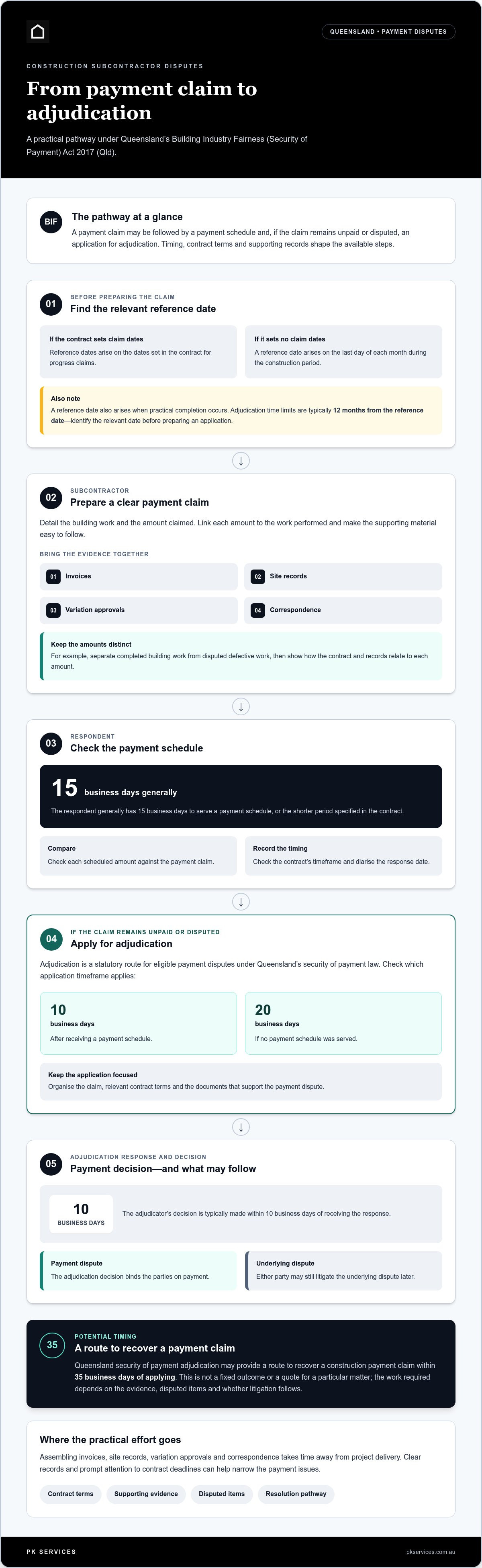
A construction subcontractor dispute in Brisbane has no single predictable cost; the amount depends on the contract, the claims and how the disagreement is resolved. Managing construction subcontractor disputes in Brisbane starts with identifying the issue and the relevant contract terms. Queensland payment disputes may be dealt with under the Building Industry Fairness (Security of Payment) Act 2017 (Qld), and adjudication may provide a route to recover a payment claim within 35 business days of applying.
It’s understandable to focus on legal costs, but the wider commercial impact can include delayed payments, disrupted work and unresolved variations. The contract, project records and timing of notices all affect the options available.
This guide explains what affects dispute costs and how payment claims, contract terms, delays, variations and defects shape a practical commercial strategy. It also compares negotiation, adjudication and other resolution pathways, and explains when business consulting or project support can help keep the process organised.
Key Takeaways
- Dispute costs depend on the contract, the evidence and the resolution pathway, so identify these factors before settling on a strategy.
- According to Queensland Government, construction payment disputes in Queensland may be dealt with under the Building Industry Fairness (Security of Payment) Act 2017 (Qld).
- Keep clear records of agreed work, variations, delays and notices to support your position if a claim is challenged.
- Separate payment issues from scope, defect or termination disputes; each calls for a response shaped by the contract and the facts.
- Review the dispute resolution process in your contract and act promptly, as missed notice requirements or time limits can affect your options.
What does a construction dispute cost?
There’s no fixed cost for a construction dispute in Brisbane. The amount depends on the claim, the contract records and the resolution pathway.
Payment claims and schedules
Queensland construction payment disputes may be dealt with under the Building Industry Fairness (Security of Payment) Act 2017 (Qld), according to Queensland Government. A subcontractor’s payment claim should clearly detail the building work and amount claimed. The respondent generally has 15 business days, or the shorter period specified in the contract, to serve a payment schedule, according to Queensland Government. Check the contract’s timeframes and compare each scheduled amount with the claim.
Adjudication under security of payment law
If a payment claim remains unpaid or disputed, adjudication under Queensland’s BIF Act offers a statutory route. The process is often described as “pay now, argue later”: an adjudication decision binds the parties on payment, while either party may still litigate the underlying dispute. An application is due within 10 business days after receiving a payment schedule, or within 20 business days if none was served. The adjudicator’s decision is typically made within 10 business days of receiving the response.
Timing matters. Under the BIF Act, reference dates arise on dates set in the contract for progress claims, or on the last day of each month during the construction period if the contract sets no dates. A reference date also arises when practical completion occurs. Adjudication time limits are typically 12 months from the reference date, so identify the relevant date before preparing an application.
For a subcontractor, the practical cost goes beyond professional fees. Assembling invoices, site records, variation approvals and correspondence takes time away from project delivery. A detailed payment claim and clear response can narrow the issues. For example, separate completed building work from disputed defective work, then show how the contract and supporting records relate to each amount.
The resolution method also affects costs. Those figures are not a quote for your matter. The work required depends on the evidence, the number of disputed items and whether the issue proceeds to adjudication or later litigation.
To control avoidable costs, organise the claim before deadlines approach: match each amount to work performed, attach relevant records, note the contract’s payment schedule period and diarise the response date. If adjudication follows, focus the application on the payment dispute and the documents that support it. Queensland security of payment adjudication may recover a construction payment claim within 35 business days of applying, but the underlying dispute can continue through litigation later.
Contract interpretation, negotiation and alleged breaches
Builders and subcontractors can compare the alleged breach with the signed contract, then negotiate an outcome or follow the contract’s mediation process. For payment disputes, Queensland’s security of payment adjudication offers a statutory route. Contract terms and notice requirements help determine the appropriate next step.
Reviewing contract terms and notices
Start with the signed construction contract and identify the clause relevant to the dispute. Check the scope, payment terms, risk allocation, notice method and deadline. Then compare those terms with project records, such as instructions, meeting notes and site diaries. Clear contract terms and consistent records help show what each party agreed to do, and when.
Queensland building and construction uses forms including ABIC, QBCC, HIA and Master Builders Association Queensland contracts. Each form has its own clauses, so don’t assume a notice process from one contract applies to another. Section 40 of Schedule 1B requires a building contractor to give the building owner a copy of a variation in writing. Identify who the contract requires to receive notices.
Negotiation, mediation and adjudication
Begin negotiations with a written summary of the disputed clause, the alleged breach and the outcome sought. Keep discussions focused on evidence, such as an approved instruction or a dated record of access delays. If direct talks stall, follow the contract’s dispute resolution procedure, which may provide for mediation before further steps.
Adjudication is a statutory option for eligible payment disputes under Queensland’s security of payment law. Unlike mediation, where parties work towards an agreed outcome, an adjudicator makes a decision on the payment dispute. Check the contract’s dispute clause and the nature of the claim before choosing a pathway.
Preparing the contract is also a form of risk management. Before work starts, define the subcontractor’s scope, how changes are approved, who coordinates sequencing, and how completion or defects are recorded. If a builder alleges incomplete work, for example, a clear scope and dated inspection records can help establish which tasks were included and what remains outstanding. Follow any written process set out in the contract rather than relying on informal assumptions.
For an alleged breach, set out the relevant clause, the action or omission in question, and the records supporting your position. Separate agreed facts from disputed points. Negotiations can then address practical remedies, such as completing specified work or agreeing how to handle a variation. Record any resolution in writing, including responsibilities and timing, so the next project stage has a clear basis.
Keep communication direct and documented. Poor communication between builders, contractors and subcontractors can make issues harder to resolve. If site delivery and contractor coordination are part of the pressure, trades and contractor services can support construction work alongside a considered contract process.
Project delays, extensions of time and variation claims
A delay, variation or defect can affect both payment and the project’s completion. The contract’s notice clauses, dated records and the cause of the issue help shape the claim and response.
For an extension of time, identify the event that affected progress, when it happened and which activities it delayed. Compare site diaries, programme updates, instructions and correspondence with the contract’s notice process. Submit the extension of time notice and claim as required by the contract. A late notice may complicate a claim, even when project records show the delay occurred.
Variations need a clear record of the changed work, approval and effect on the programme or payment claim. Subcontractors should issue variation notices at the right time during the project, rather than waiting until final accounts. Section 41 of Schedule 1B of the Queensland Building and Construction Commission Act 1991 (Qld) defines what a written variation notice must include. Keep the notice and response with the relevant site instruction.
For a payment claim involving delay or variation, adjudication time limits matter. Under the BIF Act, the application deadline is typically 12 months from the reference date. An adjudicator’s decision is typically made within 10 business days after receiving the adjudication response. These statutory steps run alongside the contract’s notice requirements, so record the reference date and each notice date before deciding what to pursue.
Claims about defective or incomplete work need a different evidence trail. Record the location, observed condition, relevant scope and any direction to rectify. In Queensland, the QBCC can direct a builder to fix defective or incomplete building work. It may also investigate or help resolve some disputes arising during a project. Keep evidence of defects separate from delay records, even when both concern the same work area.
Residential defect complaint periods depend on the defect category and applicable process. QBCC complaints for completed residential work must typically be lodged within 3 years for structural defects and 6 years for other defects covered by Home Warranty Insurance. Separate QBCC guidance states structural defects can be identified within six years and six months after completion, and non-structural defects within 12 months. These periods describe different complaint and identification rules, so classify the defect carefully.
A negligence claim follows a separate limitation framework: generally 3 years from when the claimant knew, or ought to have known, of the damage, subject to a 12-year longstop. A defect allegation may also raise a contract breach or warranty issue. Organise expert findings, completion records and repair correspondence, then seek legal advice early if litigation is being considered. Clear evidence helps distinguish a workmanship defect from damage linked to delay or changed work.
Scope, variation, delay, defect and termination disputes
Disagreements about scope often overlap with claims involving variations, delays, defective work or termination. Identify the contract clause and project records connected to each issue before choosing a dispute resolution pathway.
QBCC dispute resolution and defect complaints
The Queensland Building and Construction Commission (QBCC) may investigate or help resolve some issues arising during a building project. For a workmanship complaint, organise photographs, inspection notes and a list of incomplete items. Separate defective work from completion delays, then link each issue to the relevant scope or instruction. The QBCC can direct a builder to fix defective or incomplete building work.
Payment or contract issues can also be reported to the QBCC, which may assist with some disputes. Keep the complaint focused by identifying the building work, the alleged problem and the resolution sought. A subcontractor’s records should distinguish its own work from work by other trades so responsibility can be assessed against the agreed scope.
Retention money and defects liability
The subcontract terms govern retention money and the defects liability period. Check the clause for the amount retained, the release trigger, the defect notification process and any required rectification. For example, compare the completion record with the contract’s release condition before treating retention as overdue. Keep notices and responses together, as they may show whether a defect was raised through the agreed process.
A retention dispute can involve both payment and workmanship allegations. Itemise the retained amount separately from disputed repair costs, then identify which clause permits each deduction. A defect allegation does not automatically settle a retention claim: the contract wording and evidence determine how the issues relate.
Taking disputes to QCAT or court
Section 77 of the Queensland Building and Construction Commission Act provides for a person involved in a building dispute to apply to QCAT, subject to the stated dispute-resolution process. QCAT has jurisdiction for residential building disputes up to A$50,000, and in some cases higher. A subcontractor should first identify whether the dispute fits that process or requires another forum.
A Queensland court may be relevant where the claim falls outside the available tribunal pathway or requires litigation. Contract claims generally have a 6-year limitation period from the breach. Check the contract’s dispute clause, the type of claim and the relevant dates before starting proceedings. Construction lawyers can advise on those choices and the evidence needed.
Risks of stopping work or withholding payment
Stopping work, withholding payment or terminating a subcontract may itself amount to an alleged breach if the contract or applicable process does not permit that step. Before acting, identify the clause you rely on, give any required notice and record your reason. An abrupt stoppage may also disrupt sequencing and make responsibility for completion or defects harder to establish.
In Brisbane, the QBCC may provide initial assistance with some building and contract issues. QCAT is another formal pathway for disputes within its jurisdiction. If an adjudication decision is not followed, consequences may include suspension of works and direct payment rights against the principal. Match the next step to the dispute, and seek legal advice before terminating a subcontract or withholding payment.
Commercial dispute strategy
A Brisbane head contractor should preserve project records, identify the relevant contract clause and claim, then respond within applicable notice periods. The first fortnight can be decisive: map the commercial exposure, protect progress and choose a resolution pathway before positions harden.
Responding to a subcontractor dispute
Start with a dated issue log covering the subcontractor’s claim, the impact on the site and the outcome sought. Compare the claim with the contract, progress records, instructions and correspondence. Then acknowledge the dispute in writing and set out the points agreed and contested. If payment is involved, assess the security of payment process promptly. Missing a statutory step can affect payment rights and project cash flow.
Keep owners informed with a concise account of the issue, likely programme effects and decisions needed. Separate the immediate site response from the underlying contractual argument. For example, arrange safe sequencing around disputed work while preserving records about responsibility. Poor communication between owners, builders, contractors and subcontractors can make resolution harder, so provide consistent updates and record decisions.
Choosing a commercial dispute strategy
An effective plan for managing construction subcontractor disputes Brisbane projects encounter starts with the commercial impact, not just the amount claimed. Weigh the evidence, effects on progress payments, disruption costs and whether the working relationship remains viable. Focused negotiation may suit a clear scope disagreement, while mediation can help parties explore a practical settlement. Brisbane negotiation or mediation can take weeks or months, depending on the issue and method.
For unpaid progress payments, Queensland’s BIF Act adjudication offers a statutory route, while later litigation may still address the underlying dispute. Managing construction subcontractor disputes Brisbane head contractors face also means matching the pathway to the issue. A small variation dispute may suit a documented agreement; a wider delay or termination dispute may call for a formal process and early legal advice. Set a decision point and assign one person to coordinate records and communication.
Timeframes can shape commercial choices. A straightforward Queensland construction dispute may take 12-18 months from filing to trial; a complex matter may take 3-5 years. Adjudication runs to a statutory timetable measured in weeks, but decides payment rather than ending every dispute. If a party fails to comply with an adjudication decision, consequences may include suspension of works and direct payment rights against the principal.
Use a strategy record to list disputed issues, supporting documents, deadlines, project consequences and the preferred outcome. Review it as new information arrives, including programme impacts or defect evidence. Seek professional help early if the disagreement is escalating. For practical coordination of site delivery and contractor needs, discuss construction project support and align the next steps with your commercial plan.
PK Services: Business Consulting
PK Services helps construction businesses align commercial planning with site delivery. Its Business Consulting can support operational decisions when a subcontractor dispute affects project coordination or progress. Trades & contractor services can help address essential site gaps, while Managing the entire process from start to finish supports a more organised project approach.
This support complements, but does not replace, legal advice on contract rights, adjudication or court proceedings. It may suit businesses that need to coordinate practical delivery while working through a commercial disagreement. The next step is to speak with PK Services about your project needs and the support that fits.
Contact PK Services to discuss your construction project.
Choose the next step with purpose
A dispute can demand attention long after the original issue arises. Make your next move deliberate. Decide what needs to change for work to progress, who needs to be involved, and how to keep project communication constructive. This gives the commercial discussion a practical direction without losing sight of your position.
For managing construction subcontractor disputes in Brisbane, turn the disagreement into a clear plan: identify the outcome you’re seeking, assign responsibility for follow-up, and keep the project team aligned as discussions continue. A calm, organised approach can help move the parties from competing accounts towards decisions that support delivery.
PK Services can discuss how Business Consulting, Trades & contractor services, or managing the process from start to finish may fit your construction needs. Contact PK Services about your dispute and take the next step with a clear plan.
Frequently Asked Questions
What is a Building Dispute?
A building dispute is a disagreement connected with building work, such as its scope, quality, timing or payment. For example, a subcontractor may claim an approved variation remains unpaid, while the head contractor disputes its approval. Start by identifying the parties, the work involved and the outcome each seeks. Then separate agreed facts from contested ones, such as whether an instruction changed the subcontractor’s original scope.
Can my builder increase the price on a fixed-price contract?
A fixed price does not automatically determine whether a later increase is payable. Read the contract for clauses covering variations, allowances, provisional sums and changes to the agreed scope. Compare the claimed increase with the original price and any written instructions or approvals. If extra work was requested, for example, establish what changed, who approved it and how the contract says its cost should be assessed.
Do you act for owners as well as builders?
PK Services provides Business Consulting and Trades & contractor services, and manages projects from start to finish. These are practical construction business and project services, not legal representation for either side in a dispute. Owners and builders may both need project support, while legal advice or representation is a separate matter. Identify whether your priority is project delivery, business decisions or a legal position before choosing support.
How do I handle a payment dispute?
Separate the amount everyone agrees is payable from the disputed balance. Match each amount to the contract, work completed, invoices and written approvals, then set out the disagreement clearly in correspondence. Keep proof of when claims and responses were sent. If the dispute concerns progress payments, Queensland’s Building Industry Fairness (Security of Payment) Act 2017 (Qld) may provide a statutory process, including adjudication.
How does adjudication work?
Adjudication is a process for deciding a construction payment dispute under Queensland’s security of payment legislation. The claimant prepares an application addressing the payment claim and dispute, and the respondent can provide a response. The adjudicator decides the payment issue based on the material submitted. The decision binds the parties on payment, but either party can still litigate the underlying dispute later.
What do I do if I have not been paid?
Gather the subcontract, payment claim, payment schedule, invoices and records of completed work. Check the contract’s notice requirements and the applicable statutory deadlines before deciding your next step. Under the Queensland BIF Act process, an adjudication application is due within 10 business days after receiving a payment schedule, or within 20 business days if no schedule was served. Keep evidence of delivery and dates.
What are the most common causes of construction subcontractor disputes in Brisbane?
Common flashpoints include unclear scope, disputed variations, delays, alleged defects, termination and unpaid progress claims. Poor communication can make each harder to resolve, particularly when site instructions and approvals aren’t recorded. Poor contract management is described as the NUMBER ONE cause of lost money for subcontractors. A practical way to reduce confusion is to keep a dated record linking each instruction, claim or alleged defect to the relevant work.
How do subcontract payment claims and payment schedules work under Queensland’s Building Industry Fairness Act?
A subcontractor submits a payment claim for construction work or related goods and services. The respondent answers with a payment schedule stating the amount proposed for payment and, where it differs from the claim, the scheduled amount. Queensland Government says the respondent generally has 15 business days, or the shorter period specified in the contract, to serve that schedule. Keep the claim, schedule and service dates together because they affect the next steps.


