

What if the subcontractor who fills a trade gap fastest is also the one who puts your programme under pressure? A construction subcontractor vetting process Sydney builders can apply needs to look beyond a tidy document pack. It should show whether a trade is capable, available and prepared for the work ahead.
Licences, insurance and safety documents matter before mobilisation, but paperwork alone won’t show whether a subcontractor has the people, capacity and coordination to deliver on your site. A clear sequence of checks helps you make a proportionate decision while keeping project demands in view.
This guide takes you from shortlist to site mobilisation, with practical checks for capability, capacity, compliance and delivery readiness. You’ll learn how to match evidence requirements to the work and carry vetting decisions into site planning. PK Services brings more than 15 years of construction industry experience across NSW and Queensland, with project management from inception to completion and experienced trades and contractors to address site gaps.
Key Takeaways
- Use a construction subcontractor vetting process Sydney builders can scale to the trade, project complexity and site conditions.
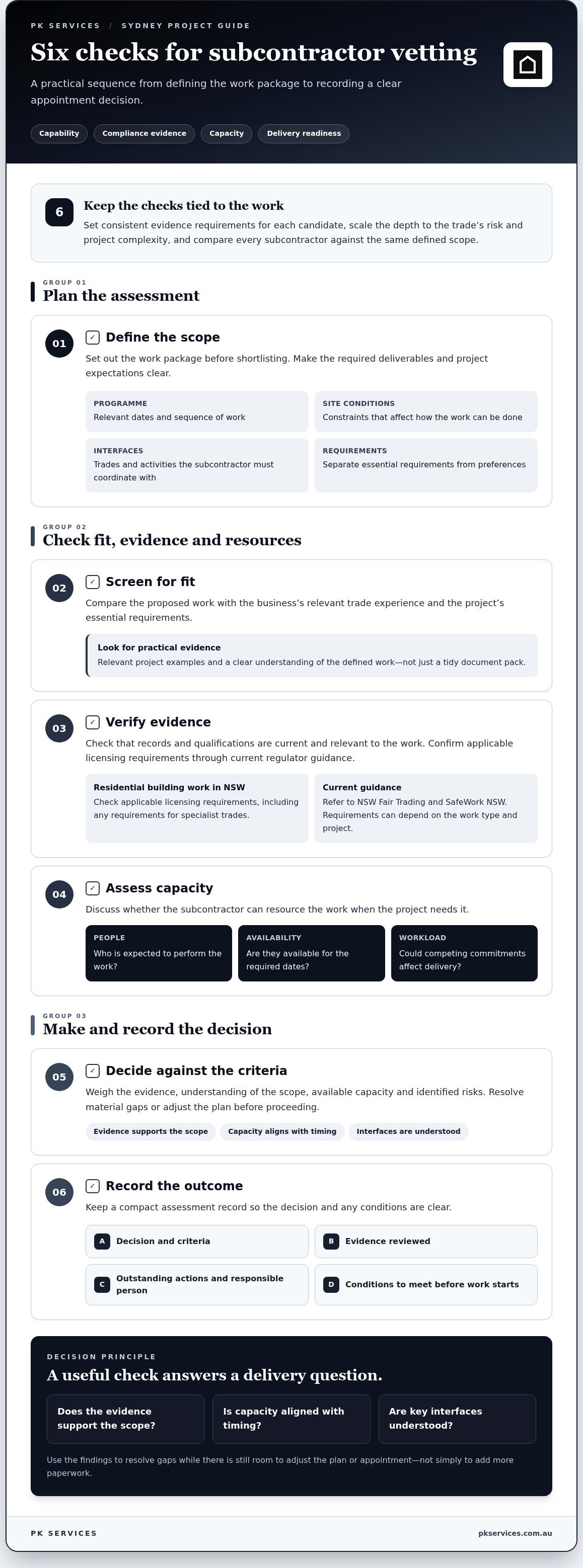
- Follow a clear sequence: define the scope, screen candidates, check readiness, make a decision and record it.
- Compare documents with practical evidence, such as relevant project examples and a clear understanding of the work.
- Turn approval into a coordinated handover by setting out scope ownership, programme interfaces, communication channels and escalation points.
- Connect subcontractor readiness with delivery planning, so vetting supports the work on site rather than ending with paperwork.
Why a Sydney construction subcontractor vetting process starts before appointment
Subcontractor vetting is a staged assessment of whether a business is suitable, properly evidenced, ready and able to deliver a defined scope safely and in coordination with the project. It starts before appointment because checks should reflect the work, not just the documents a business can provide. A clear construction subcontractor vetting process Sydney teams can use links early screening with project-specific approval and mobilisation planning.
What does subcontractor vetting cover on a Sydney project?
Verifying a business is different from assessing its fit for a particular job. Verification establishes who the business is and reviews relevant evidence. Suitability considers whether its experience, workforce, capacity and work approach match the trade scope, programme and site conditions. For a general introduction to the role, see What is a Subcontractor?
Assessment commonly covers capability, compliance evidence, capacity, safety and coordination. The depth depends on the work. On a Sydney residential project involving a specialist trade, focus closely on the defined scope and its interfaces. On a commercial project with trades working in sequence, also assess access, timing and how work areas will be handed over.
Keep three decisions distinct. Prequalification identifies businesses that may suit upcoming work. Appointment approval confirms the preferred business for a specific scope. Mobilisation readiness checks that agreed arrangements, people and site coordination are in place before work starts. Passing one stage doesn’t automatically settle the next.
Why a document-only check can miss delivery risks
Current records are useful evidence, but they don’t prove that a subcontractor has delivered a comparable scope or can resource your programme. A document may show that a business has a process, but it won’t necessarily show how its team will manage a tight work area or coordinate with trades completing adjoining tasks.
Test the practical fit early. Map the work sequence, identify dependencies and discuss relevant site constraints, such as access, operating hours or limited laydown space. For example, a trade may be capable but need access before another activity can finish. If that interface is missed during selection, the issue may surface after the programme is committed.
Use findings to shape the next stage, not to create a larger paperwork pile. Match each check to a delivery question: does the evidence support the scope, is capacity aligned with timing, and are key interfaces understood? This helps expose gaps while there’s still room to adjust the plan or appointment.
For broader Australian context, the Australia-wide subcontractor vetting guide explores why vetting matters beyond a single project. In Sydney, start by defining the work and site conditions, then set the evidence and readiness checks the appointment requires.
How to vet construction subcontractors in Sydney, step by step
A reliable construction subcontractor vetting process Sydney project teams can apply follows a consistent sequence. Scale each check to the trade’s risk, project complexity and number of interfaces with other work. The aim is a clear, recorded decision, not paperwork for its own sake.
Set the scope and evidence requirements before shortlisting
Start with a defined work package. Set out what the subcontractor will deliver, relevant programme dates, site conditions and the trades or activities it must coordinate with. Then establish consistent evidence requirements for every candidate. Separate essential requirements from preferences so comparisons stay fair and a useful preference doesn’t become an unexplained pass-or-fail test.
Verify capability, compliance evidence and available capacity
Review relevant work examples, qualifications and current documents against the actual scope. Establish who is expected to perform the work, whether they are available for the required dates and whether competing commitments could affect delivery. Record gaps clearly, assign an action and resolve it before appointment or mobilisation. For NSW licensing and safety obligations, check current guidance from NSW Fair Trading and SafeWork NSW. Requirements can depend on the work type and project, so don’t rely on an old checklist.
Use this sequence to move from initial screening to a documented decision:
- Define the scope. Confirm deliverables, programme needs, site constraints and interfaces.
- Screen for fit. Compare the proposed work with the business’s relevant trade experience and essential project requirements.
- Verify evidence. Check that records and qualifications are current and relevant to the work. For residential building work in NSW, confirm applicable licensing requirements through current regulator guidance, including any requirements for specialist trades.
- Assess capacity. Discuss the proposed work team, availability, workload and ability to meet the project sequence.
- Decide against the criteria. Weigh the evidence, scope understanding, capacity and identified risks. Resolve material gaps or adjust the plan before proceeding.
- Record the outcome. Note the decision, evidence reviewed, outstanding actions, responsible person and any conditions to meet before work starts.
A compact assessment record keeps the process practical. Use the same checklist for each candidate, then tailor its detail to the trade and project rather than requesting the same volume of paperwork from every business.
- Scope and timing: deliverables, key dates, site conditions and interfaces.
- Evidence reviewed: relevant examples, qualifications and current documents.
- Capacity: proposed personnel, availability and known commitments.
- Open items: evidence gaps, follow-up action, owner and due point.
- Decision: outcome, rationale and any pre-start conditions.
For teams linking contractor decisions with broader project planning, PK Services’ construction consulting and project management brings a delivery-focused perspective, supported by more than 15 years of construction industry experience.
Compare subcontractor evidence by risk, not by paperwork volume
A complete file can look reassuring, but it doesn’t prove reliable delivery by itself. Evidence is useful when it answers a project question: can this business perform the defined scope with the available team, under your site conditions and programme? A construction subcontractor vetting process Sydney teams can rely on weighs records alongside relevant examples, practical conversations and the subcontractor’s understanding of the work.
What strong subcontractor evidence looks like
Look for evidence that is current, relevant and attributable to the business or people proposed for the job. A project reference is more useful when it identifies the work completed and who delivered it. Compare examples with the trade, scale and conditions of your package. If details are missing or inconsistent, record the gap and its effect on the appointment decision. A thick file is not proof of fit.
Evidence type
What it demonstrates
Limitation
Follow-up action
Current business and compliance records
Provides verifiable details relevant to the business and proposed work.
Doesn’t establish project-specific performance or team availability.
Check the record’s relevance to the scope and note anything outstanding.
Project examples and references
Shows experience with comparable trade work or conditions.
A similar project may have had a different scale, team or level of complexity.
Clarify the subcontractor’s role, the work delivered and who was involved.
Scope discussion
Reveals how the business understands deliverables, sequencing and interfaces.
A confident conversation alone doesn’t verify records or capacity.
Explore dependencies, site constraints and how issues would be raised.
Workforce and availability details
Indicates whether the proposed team and timing align with the programme.
Plans can change, and stated availability doesn’t remove delivery dependencies.
Discuss concurrent commitments and record any assumptions or conditions.
How to assess capacity, coordination and site fit
Assess workforce availability alongside programme dependencies and concurrent commitments. A team may appear capable on paper but still be a poor fit if its work depends on an access window or a preceding trade that hasn’t been planned. Discuss communication channels, who will coordinate day-to-day interfaces and how issues will be escalated.
Use a simple risk rating, such as low, moderate or high, and write down the reason for each assessment. Note what evidence supports the rating, what remains uncertain and what action could reduce the concern. For example, limited experience with a comparable project may call for a closer scope discussion or a defined coordination check, rather than automatic rejection. Keep the judgement proportionate to the package’s complexity and consequences. There’s no universal pass mark for every trade and project.
Prepare a Sydney subcontractor for mobilisation and ongoing review
Approval is a decision, not the finish line. A clear handover turns the vetting outcome into practical instructions for the subcontractor and project team. It gives everyone a shared reference for what must be ready before work starts and how delivery will be monitored.
Turn vetting findings into a clear appointment handover
Transfer the agreed scope, responsibilities, programme milestones and trade interfaces into the project records. Make ownership clear: who coordinates the subcontractor, who manages each interface and who receives updates or escalations. Carry forward any conditions or evidence gaps, with a named owner and due point. Don’t leave an action as a general reminder with no one responsible for closing it.
Before the first day on site, align the appointment with the project’s access and safety arrangements. Confirm which site-entry steps apply and which records or actions remain outstanding. Requirements can vary with the work and site, so check NSW-specific licensing and safety obligations against current regulator guidance, including SafeWork NSW, and the project’s own site processes. A generic checklist is not a substitute for checking what applies.
A practical handover record can cover:
- Scope and ownership: agreed deliverables, responsibilities and the person managing the package.
- Programme and interfaces: milestones, dependencies, access arrangements and coordination points with other trades.
- Communication: day-to-day contacts, update expectations and escalation pathways.
- Pre-start actions: outstanding items, action owners and when each must be resolved.
Review delivery against the original assessment
Set review points to suit the package. Early check-ins can compare progress with agreed milestones and surface coordination questions before they affect dependent work. As delivery continues, review workmanship against the agreed scope, communication, responsiveness and management of interfaces. The purpose is to identify emerging issues and agree a response, not to assume a problem will occur.
Keep records consistent. Note what was observed, its effect on the work, who owns the follow-up and whether the action was resolved. If a variation changes the scope, programme or site interface, update the relevant project records so the original assessment remains useful context rather than a stale snapshot.
At package close, capture practical lessons for future planning. Record which assumptions held, where coordination needed adjustment and what evidence proved most useful. This helps refine later scope briefs and informs future subcontractor decisions. A construction subcontractor vetting process Sydney teams can sustain links the initial assessment to real delivery observations.
For project coordination that carries decisions from planning through delivery, PK Services’ construction project management connects project requirements with delivery.
How PK Services connects subcontractor readiness with project delivery
A vetting decision matters most when it supports the work that follows. PK Services brings construction consulting, project management and experienced trades and contractors together to help address site resource gaps and connect project planning with delivery. With more than 15 years of construction industry experience across NSW and Queensland, the team looks beyond documents to how each trade package fits the wider project.
Bring trade capability and project oversight together
Trade support and project oversight address different parts of the same challenge. Experienced trades and contractors can help fill site resource gaps. End-to-end project management connects requirements across project stages, from early planning and coordination through to delivery. This keeps trade needs, programme expectations and work interfaces in view as the project progresses.
For Sydney construction firms, vetting findings can inform practical project decisions: define the package, identify the capability needed, consider how it fits the programme, then carry relevant findings into coordination. Vetting works best as part of delivery planning, not as a separate administrative task. PK Services’ guide to full-cycle construction project management explores how oversight can span the project lifecycle.
PK Services provides construction consulting, project coordination and experienced trade support for site gaps. The right mix depends on the scope and where the project needs practical input, keeping the focus on delivery requirements rather than a generic service package.
Plan the next step for your Sydney construction project
Before discussing support, bring together a few useful details. A clear brief helps identify pressure points and the coordination the project needs.
- Project stage: where the work stands, from early planning to active delivery.
- Trade or resource gap: the scope that needs attention and the capability required.
- Programme context: key timing considerations and dependencies with other work.
- Site considerations: relevant access, sequencing or coordination constraints.
- Current priorities: the decisions or delivery challenges that need attention first.
These details provide a practical starting point for tailored consulting and project management. They also connect the construction subcontractor vetting process Sydney teams use with the wider delivery plan, so readiness is assessed alongside real site needs.
Explore PK Services’ construction project support to see how consulting and project management fit into delivery planning.
Set your next project up for confident delivery
Make subcontractor decisions before a trade gap becomes an urgent programme problem. Bring the scope, timing and known site constraints into view early, then use them to guide the support and coordination the project needs. A construction subcontractor vetting process Sydney teams can sustain should evolve with each package, using practical delivery lessons to sharpen future planning.
If you’re preparing a project or working through a resource challenge, a focused discussion can clarify where construction consulting, project management or trade support fits. PK Services shapes its support around project needs, considering delivery from planning through to completion.
Discuss your construction project with PK Services to plan the next step.
Frequently Asked Questions
Can a subcontractor start work while some vetting checks are still outstanding?
Not automatically. Assess each outstanding item against the work, its risks and the controls in place. A minor administrative follow-up differs from missing evidence needed to establish safe, compliant mobilisation. For example, an incomplete contact record may be manageable, while unresolved trade-specific requirements may not be. Verify applicable NSW obligations for the particular work, document any approval conditions and owners, and don’t treat conditional approval as clearance to proceed.
How often should a construction subcontractor’s details and documents be reviewed?
Set review timing to suit the project’s duration, risk, scope and document expiry dates. A short package may need a different schedule from work continuing across several stages. Record review dates in a register, then update details if the scope changes, key personnel or arrangements shift, or a relevant document expires. Don’t assume one interval suits every job or is legally required. Check current NSW sources before making claims about mandatory review frequency.
What should a builder do if a subcontractor’s scope changes after appointment?
Assess the revised work before it proceeds. Check whether the subcontractor has the capability and capacity for the added or altered tasks, and whether new interfaces or site conditions affect delivery. For instance, an added work area may change access coordination with another trade. Record the variation, responsibilities and approval in project records. A material change may call for updated safety or compliance checks; verify obligations for the specific trade and project.
Does a sole trader need the same subcontractor assessment as a larger business?
Assess the same project risks, but match the evidence to the business structure and work package. A sole trader may provide direct examples of their own work and explain how they’ll manage availability and communication. A larger business may need to identify the team assigned to the job. Neither structure makes a subcontractor automatically lower risk or exempt from requirements. Verify any relevant legal distinctions, then assess capability, capacity and applicable evidence against the scope.
How can a Sydney builder assess a new subcontractor with limited project references?
Limited references are an evidence gap, not an automatic reason to reject a subcontractor. Consider relevant work samples, qualifications, a practical discussion of the scope and referees who can speak to comparable work. Ask the subcontractor to explain how they’d approach a key interface or site constraint. Record how the available evidence supports the decision, what remains uncertain and whether proportionate additional oversight is appropriate for the package’s risk.
What is the difference between subcontractor vetting and site induction?
Vetting assesses whether a subcontractor is suitable for a work package before appointment. A site induction communicates site-specific information before work begins, such as relevant site arrangements and how to raise an issue. They serve different purposes: completing an induction doesn’t establish trade suitability, and vetting doesn’t communicate site-specific information. Check current NSW work health and safety sources before describing any induction content as mandatory for a particular project.


