

A payment dispute can escalate quickly when a notice is missed or the project record is incomplete. In Queensland, the right next step depends on the issue, the contract and the available evidence. Construction contract administration services QLD can help keep decisions grounded in clear records and disciplined processes.
If you’re unsure whether to keep talking, seek a formal determination or raise a complaint, you’re not alone. Gaps in correspondence, variation records or payment documents can make it harder to explain your position.
This guide explains common Queensland dispute pathways and how they differ, from direct negotiation to payment adjudication under the Building Industry Fairness (Security of Payment) Act 2017, and QBCC or QCAT processes for certain building disputes. You’ll also learn which contract steps and project records to organise, and when tailored commercial or legal advice may be valuable. Strong contract administration won’t guarantee a particular result, but it can support clearer communication and more proportionate decisions. PK Services provides construction consulting and project management, connecting commercial processes with on-site delivery.
Key Takeaways
- Classify the issue early: identify whether it concerns scope, time, payment or performance before deciding how to respond.
- Compare negotiation, mediation, adjudication and formal proceedings by who makes the decision, how structured each pathway is and where its limits apply.
- Organise the contract, approved variations, programme updates, payment claims and correspondence so the project record is clear.
- Use construction contract administration services QLD to support consistent records, clear responsibilities and coordinated project delivery.
- Check contract notice requirements and seek tailored commercial or legal advice when the issue’s complexity or potential impact calls for it.
Construction contract disputes in Queensland: spot the issue before it escalates
A construction contract dispute is a disagreement about what the parties must do, the agreed scope, timing, payment or standard of performance. It might concern whether a variation was approved, who is responsible for a delay, whether work meets the agreed requirements or what payment is due. The contract and project facts matter. A disagreement alone doesn’t establish that either party has breached its obligations.
Early contract administration means documenting project obligations, decisions and changes as work progresses. This gives the people involved a clearer basis for discussing concerns before positions harden. Construction contract administration services QLD can support this discipline by connecting project oversight with clear commercial processes.
The project setting shapes the details. On a residential project, a homeowner and builder might disagree about a variation or incomplete work. On a commercial build, the issue may involve subcontractor responsibilities, programme changes or payment claims. An infrastructure project can involve multiple contracts, staged approvals and dependencies between work packages. Assess each issue in light of the applicable contract, the parties and the facts.
What commonly triggers a construction contract dispute?
Scope changes, defects, delays and payment disagreements can all lead to competing interpretations. For example, one party may treat extra work as an approved variation while the other sees it as part of the original scope. A delay may appear in a programme update, while the parties disagree about its cause or effect. The Queensland Building and Construction Commission (QBCC) is Queensland’s building and construction regulator and has a role in dispute resolution for certain matters.
Unclear responsibilities make these situations harder to untangle. Missing approvals, undocumented instructions, inconsistent progress reports and gaps in site records can add to the confusion. Focus on the evidence: what the contract says, what happened, when it happened and how the parties responded. Avoid labelling every disagreement a breach before considering the relevant terms and project history.
When does a project issue become a dispute?
A developing issue may still be something the parties can clarify through a site discussion or written update. It moves towards a dispute when they take opposing positions about contractual rights, responsibilities or available remedies and can’t resolve the difference through routine project communication. The precise definition can depend on the contract and the law that applies.
Record concerns promptly, even if the cause or impact isn’t yet clear. Note the date, work area, people involved, relevant instruction and supporting documents. Then check the contract for notice steps, response periods and required communication methods. Requirements vary, so classify the issue early to help the project team decide what to investigate, what to raise and whether tailored commercial or legal advice is needed.
Queensland construction dispute resolution pathways, explained
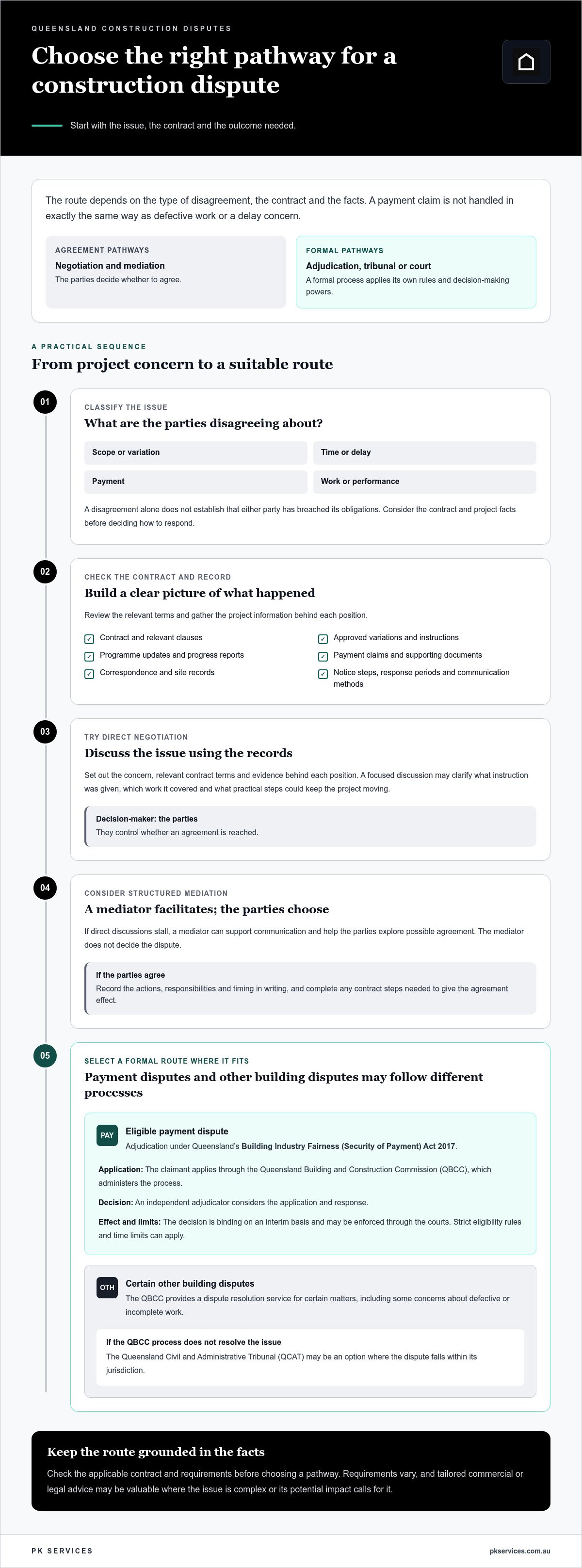
The right pathway depends on the type of disagreement, the contract and the outcome each party needs. A payment claim isn’t handled in exactly the same way as a concern about defective work or a disagreement over delay. Start by identifying the issue, then check whether the contract sets out steps for raising or resolving it.
Negotiation and mediation help parties work towards an agreement; adjudication, tribunal and court processes can produce a decision through a formal process. The distinction matters. In a facilitated discussion, the parties decide whether to agree. A formal process follows its own rules and decision-making powers.
How negotiation and mediation can help project parties
Direct negotiation can be a practical first step when the parties are willing to engage. Set out the issue, relevant contract terms and records behind each position. A focused discussion might clarify whether an instruction was given, which work it covered and what practical steps could keep the project moving.
If direct discussions stall, structured mediation may help. A mediator facilitates communication and supports the parties to explore possible agreement, but doesn’t decide the dispute. If they reach an agreement, record the actions, responsibilities and timing in writing, and complete any contract steps needed to give it effect.
Where adjudication, tribunals and courts fit
For eligible payment disputes, adjudication under Queensland’s Building Industry Fairness (Security of Payment) Act 2017 offers a statutory pathway. The claimant applies through the Queensland Building and Construction Commission (QBCC), which administers the process. An independent adjudicator considers the application and response. The decision is binding on an interim basis and may be enforced through the courts. Strict eligibility rules and time limits can apply.
Other building disputes may follow a different route. The QBCC provides a dispute resolution service for certain matters, including some concerns about defective or incomplete work. If that process doesn’t resolve the issue, the Queensland Civil and Administrative Tribunal (QCAT) may be an option where the dispute falls within its jurisdiction. Tribunal and court proceedings are formal, and their procedures, powers and areas of jurisdiction differ. One forum won’t suit every dispute.
Before taking a formal step, check current eligibility, forms, procedures and time limits using official Queensland sources, including QBCC guidance, QCAT information and the legislation. Don’t rely on a general summary to calculate a deadline. The applicable contract and the precise history of notices and responses can affect what happens next.
Good project records can make it easier to explain the issue, whichever pathway is considered. Construction contract administration services QLD can support organised commercial processes and coordinated delivery, while tailored legal advice can help clarify rights, deadlines and procedural choices. PK Services’ construction consulting and project management helps connect project responsibilities with on-site execution as work progresses.
Compare construction dispute resolution options before choosing a pathway
No single process suits every construction dispute. Compare the issue, contract wording, project type and available pathways before deciding what to do. A payment disagreement may have a statutory adjudication option, while a defect concern may follow a different route. The pathway also affects who controls the outcome: the parties may reach agreement themselves, or a formal decision-maker may determine it.
| Option | Who facilitates or decides? | Formality and potential fit | Key limitation |
|---|---|---|---|
| Negotiation | The parties discuss the issue directly. | Informal. May suit a disagreement where communication is open and the parties can explore practical solutions. | Either party can decline to agree, and discussions may not resolve a fundamental difference. |
| Mediation | An independent mediator facilitates discussion but doesn’t decide the dispute. | Structured, with scope for the parties to explore an agreed outcome. | Agreement depends on the parties. Check contract requirements and how any resolution will be recorded. |
| Adjudication | An independent adjudicator decides an eligible payment dispute under the relevant statutory process. | Formal and potentially time-sensitive. May suit a payment claim that meets statutory requirements. | Eligibility, required documents and strict deadlines apply. It isn’t a general pathway for every construction disagreement. |
| Tribunal or court proceedings | A tribunal member or court makes a formal decision within its jurisdiction. | Formal processes for disputes the relevant body has power to hear. | Jurisdiction, procedure and available outcomes differ. The process may not suit every issue or project. |
Which factors should guide the comparison?
Start with urgency, the subject of the dispute and the outcome you need. Consider whether the project is continuing, whether the parties need to preserve a working relationship and whether the issue mainly concerns payment, defective work, delay or contract interpretation. Negotiation and mediation aim to facilitate agreement. Adjudication, tribunal and court processes can determine an outcome under their rules. Don’t assume one route is always faster or cheaper: cost and timeframe depend on the evidence, contract and steps required.
Why residential and commercial disputes may follow different routes
Queensland residential building matters can engage specific QBCC complaint and dispute processes. QCAT’s jurisdiction also differs by dispute type. QCAT can hear commercial building disputes up to A$50,000, or above that amount if both parties consent in writing; domestic building disputes have no monetary limit. Confirm current jurisdiction and eligibility with official sources before relying on these thresholds.
Commercial payment disagreements may instead raise the question of eligibility for adjudication under the Building Industry Fairness (Security of Payment) Act 2017. Contract terms, project type and the nature of the claim all matter. For broader context on keeping oversight connected across project stages, explore full-cycle construction project management. Construction contract administration services QLD can help maintain clear project records, while tailored advice can help you choose an appropriate formal pathway.
A practical Queensland checklist for managing a contract dispute
A clear sequence helps turn a tense disagreement into a set of issues you can assess. Keep the process grounded in the contract and project evidence, rather than assumptions about fault. Work through these steps in order, and seek tailored legal advice if rights, liability or formal proceedings are in question.
- Review the contract. Find the terms relevant to the issue, including scope, payment, variations, programme obligations, defect processes and dispute steps. Check who has authority to approve changes and how the contract requires notices to be given.
- Record the facts. Set out what happened, when, where and who was involved. Separate what you know from what remains uncertain, and link each point to a supporting record where possible.
- Check notices and deadlines. Identify any contract notice requirements and whether a statutory process could apply. Payment adjudication under Queensland’s Building Industry Fairness (Security of Payment) Act 2017 has eligibility rules and strict time limits. Verify current requirements with official sources, such as QBCC guidance, before acting. Don’t use a general checklist to calculate a deadline.
- Communicate clearly. Set out the issue, relevant facts and the response or action you’re seeking. Use the communication method required by the contract, and keep a copy of what you send and receive.
- Assess the next option. Once you’ve reviewed the records and contract steps, consider whether further discussion is practical or whether a formal pathway or professional advice is needed.
Organise the contract record and timeline
Build a dated chronology of instructions, decisions, site events and communications. Gather the signed contract and scope, approved variations, programme updates, payment claims and schedules, inspection notes, progress records, photographs and relevant correspondence. Match each disputed point to the contract clause and project evidence that relates to it. Keep records complete and factual. Preserve original documents and messages; don’t rewrite or edit historical evidence to make the timeline appear more favourable.
For a workmanship or defect issue, link observations to the affected area, date and available inspection evidence. Practical guidance on construction quality control management can help put quality concerns in the context of project controls and documented checks.
Communicate, escalate and protect project continuity
Use concise written communication to distinguish agreed facts from disputed interpretations. For example, confirm the work completed and the date it was observed, then identify the specific point still in disagreement. Propose a clear next step, such as exchanging supporting records or arranging a discussion, without suggesting that the proposal changes contractual rights.
Keep project responsibilities and immediate work requirements clear while the issue is being assessed. Construction contract administration services QLD can support disciplined oversight and coordinated project delivery, but advice on liability, formal notices or proceedings should be tailored to the contract and circumstances. If your project needs structured oversight from planning through delivery, PK Services provides project management.
How PK Services supports better contract administration and project delivery
Strong contract administration works best when commercial decisions stay connected to what’s happening on site. PK Services brings construction consulting, project management and trades and contractor services together across project delivery, supporting work from planning through completion. With more than 15 years of construction industry experience, the team understands how clear responsibilities and coordinated execution can help keep project information useful and current.
This joined-up view matters when a decision affects several parts of a job. A variation, for example, may influence scope, programme information, trade sequencing and cost records. If those details are managed separately, people can end up working from different assumptions. Coordinated oversight connects decisions to the people responsible for carrying them out and to the project records that explain what was agreed.
Bring commercial processes and site delivery together
Project oversight can create a practical link between contract requirements and daily work. This includes keeping roles clear, tracking decisions through to site execution and aligning programme updates with the information the project team uses. It also gives the team a clearer way to identify where an instruction, approval or responsibility needs attention before it creates confusion.
Where a project has a trade or contractor resource gap, experienced trades and contractor services can support delivery as part of the broader project picture. The aim is to coordinate the work, responsibilities and relevant information, not to promise a particular dispute result. For a wider view of how business strategy can connect with on-site delivery, explore construction business consulting in Australia.
Consistent project records also make handovers and decisions easier to follow. Keep the current scope, approvals, programme information and communication aligned, so the people doing the work and those overseeing it can refer to the same project position. This won’t remove every disagreement, but it can make emerging issues easier to understand and discuss.
Make the next step clear and proportionate
Every project has its own pressures. Start with a clear conversation about the project stage, the issue affecting delivery and the support needed. Construction contract administration services QLD can form part of a broader approach that joins commercial processes with project management and site coordination. Consulting can help organise project responsibilities and information, while legal advice should guide questions about rights, liability, formal notices or proceedings.
Acting early can help prevent an unresolved issue from creating further uncertainty across the project. If you’re looking for practical support tailored to your project context, discuss your Queensland construction project with PK Services.
Take the next step with clarity
A disagreement doesn’t need to define the rest of a project. Choose a proportionate next step, keep decisions connected to the work and get the right input before uncertainty spreads. Sometimes that means clarifying responsibilities and records. If contractual rights, liability or formal notices are in question, tailored legal advice can help you understand your position.
Strong construction contract administration services QLD can support clearer project decisions and more coordinated delivery. The goal isn’t to promise a dispute-free outcome. It’s to give your project a considered way forward, with the right people focused on practical actions and the work ahead.
PK Services brings construction consulting, project management and trade support together for projects from planning through delivery. With more than 15 years of construction industry experience, the team can help you consider the project context and the support that fits your needs.
Discuss your Queensland construction project with PK Services to take a practical next step.
Frequently Asked Questions
What is construction contract administration?
Construction contract administration is the practical oversight of contract requirements as a project moves forward. It helps the parties track decisions, responsibilities, approvals and changes against the agreed terms. For example, if a site instruction changes the sequence of work, the project record can show who issued it and how the team responded. Construction contract administration services QLD can support this coordination, but they aren’t a substitute for legal advice on contractual rights.
Can construction contract disputes in Queensland be resolved without going to court?
Yes. Depending on the issue and contract, parties may resolve a disagreement through direct negotiation, mediation, a QBCC dispute resolution process or eligible payment adjudication. These options work differently: negotiation and mediation rely on agreement, while adjudication can result in an interim binding decision. Check the contract and relevant Queensland process requirements before choosing a route, particularly if a formal notice or deadline may apply.
Is adjudication available for every Queensland construction dispute?
No. Queensland adjudication under the Building Industry Fairness (Security of Payment) Act 2017 is a statutory process for eligible payment disputes, not a general forum for every disagreement about construction work. A claim about defects or responsibility for delay may need a different route. Eligibility and time limits depend on the circumstances and statutory requirements, so check current QBCC guidance and the legislation before preparing or lodging an application.
What records should I keep when a construction contract dispute arises?
Keep original files and preserve a clear audit trail. Save emails with attachments, dated site photographs, meeting notes and versions of drawings or schedules that show what information applied at the time. Record who created each item and when, where practical. If a conversation leads to a decision, send a concise written confirmation. Avoid overwriting earlier versions or adding comments that could make it difficult to distinguish original evidence from later explanations.
How do I choose between mediation and adjudication?
Consider whether the dispute concerns an eligible payment claim and whether you’re seeking a binding interim decision. Adjudication may be relevant only if statutory requirements are met and deadlines can be satisfied. Mediation may suit parties who want a facilitated discussion and are prepared to explore a shared outcome. It doesn’t impose a decision. Review the contract, the issue and the consequences of each process before deciding, and seek tailored advice if you’re uncertain.
When should I get legal advice about a construction contract dispute?
Seek legal advice early if a formal notice is due, a statutory deadline may be running, the amount or project impact is substantial, or the parties disagree about liability or termination rights. Advice can also help before signing a settlement or responding to an adjudication application. Bring the contract, relevant correspondence and a dated account of events. Early legal input can clarify your options, but it can’t guarantee a particular outcome.


