

Risks that derail a Brisbane build rarely arrive one at a time. A procurement delay can squeeze the programme, disrupt trade coordination and force decisions about cost or sequencing. A practical approach to construction project risk management Brisbane teams can use from early planning helps reveal these connections before site pressures compound.
If you’re unsure who owns each risk, or concerned that delays and site issues could escalate, you’re not alone. Risks are easier to manage when they’re visible, responsibilities are clear and decisions keep pace with changing project conditions.
This guide explains how to identify, assess and manage construction risks from early planning through site delivery. You’ll learn how to prioritise risks, assign owners, review changes and coordinate contractors and trades. With more than 15 years of construction industry experience, PK Services connects project advice with practical delivery through consulting, end-to-end project management and trades and contractor services.
Key Takeaways
- Use a clear, project-specific process to rate risks and decide which ones need attention first.
- See how preventive, detective and corrective controls can help limit exposure at different stages of a build.
- Keep the risk plan current by reviewing it when milestones, design, procurement or site conditions change.
- Effective construction project risk management Brisbane connects planning decisions with practical delivery.
- PK Services’ end-to-end project management and more than 15 years of industry experience support coordinated project delivery.
Why construction project risk management matters on Brisbane projects
A risk register is useful, but it won’t manage a project on its own. Construction project risk management involves spotting uncertainty, assessing its possible effects, choosing a response and checking whether that response is still effective. It should continue from early planning through site delivery, because designs, suppliers, work sequences and site conditions can change.
One uncertainty can affect several parts of a build. A design gap may create safety concerns, rework and schedule pressure. A delayed delivery can disrupt trade sequencing and affect quality if work is rushed. A Project risk management overview explains the broader principles; on a construction project, the value comes from applying them to real decisions, responsibilities and site work.
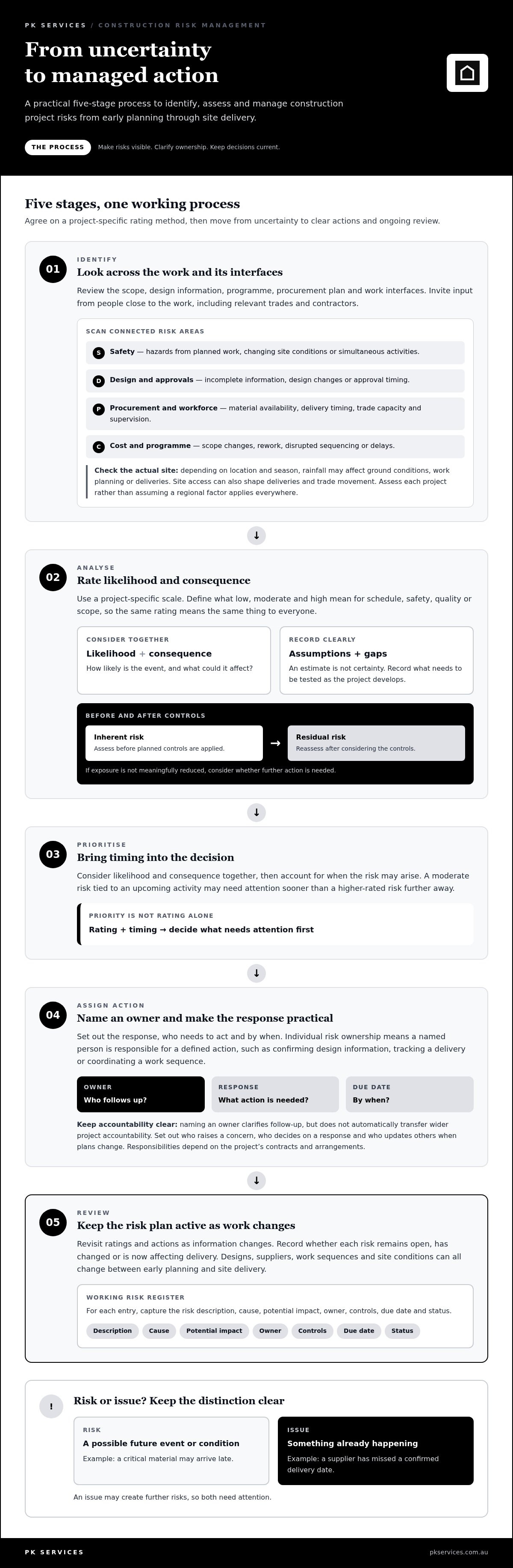
Keep the distinction clear: a risk is a possible future event or condition that could affect delivery. An issue is already happening. For example, the possibility that a critical material may arrive late is a risk. Once a supplier misses a confirmed delivery date, it’s an issue. That issue may create further risks, so both need attention.
Which risks can disrupt a Brisbane construction project?
Consider risks across connected categories, rather than treating each one in isolation:
- Safety: hazards linked to planned work, changing site conditions or activities happening at the same time.
- Design and approvals: incomplete information, design changes or approval timing that affects what can proceed.
- Procurement and workforce: material availability, delivery timing, trade capacity and supervision.
- Cost and programme: scope changes, rework, disrupted sequencing or delays that affect commercial outcomes.
Brisbane projects don’t all face the same conditions. Assess the actual site and programme. Depending on location and season, rainfall may affect ground conditions, work planning or deliveries. Site access constraints can also shape when materials arrive and how trades move through the work area. Check relevant site and project information rather than assuming a regional factor applies everywhere. The same principle applies to projects across Queensland and New South Wales: assess the conditions of each site.
Pay close attention to interfaces. If one trade’s work must be completed before another can start, unclear handover points can leave gaps, trigger rework or compress the next activity. Map dependencies and name who coordinates each handover.
Who owns construction project risk?
Project-level accountability means ensuring risks are considered, monitored and acted on across the project. Individual risk ownership is more specific: a named person is responsible for a defined action, such as confirming design information, tracking a delivery or coordinating a work sequence. Naming an owner makes follow-up clearer, but it doesn’t automatically transfer wider accountability.
Responsibilities between the client, designer, contractor and trades depend on the project’s contracts and arrangements. Set them out plainly, including who raises a new concern, who decides on a response and who updates others when plans change. Strong construction project risk management Brisbane projects need this coordination at interfaces, where a decision in one area can affect the next. PK Services brings construction consulting, end-to-end project management and trades and contractor services together, drawing on more than 15 years of industry experience.
How to identify, assess and prioritise construction project risks
A useful risk assessment turns uncertainty into decisions. Keep the process straightforward enough to use in project meetings, but specific enough that people know what to do next. For construction project risk management Brisbane teams can apply consistently, agree on the rating method before comparing risks. A “high” rating should mean the same thing to everyone involved.
- Identify: Review the scope, design information, programme, procurement plan and work interfaces. Invite input from people close to the work, including relevant trades and contractors.
- Analyse: Rate each risk’s likelihood and consequence using a project-specific scale. Define what each level means, such as the type of schedule, safety, quality or scope effect that would count as low, moderate or high.
- Prioritise: Consider likelihood and consequence together, then account for timing. A moderate risk due to arise during an upcoming activity may need action sooner than a higher-rated risk further away.
- Assign action: Name an owner and set out a practical response, who needs to act and by when.
- Review: Revisit ratings and actions as information changes. Record whether the risk remains open, has changed or is now affecting delivery.
Rate inherent risk before planned controls are applied, then assess residual risk after considering those controls. This shows whether the proposed response meaningfully reduces exposure or whether further action is needed. Don’t present an estimate as certainty. Record assumptions and information gaps so the team can test them as the project develops.
Build a useful construction project risk register
A risk register is a working record of potential events, their effects, owners and responses. It helps guide decisions as a project changes. For each entry, capture the risk description, cause, potential impact, owner, controls, due date and status. Be precise: “late delivery of specified structural components could delay the next scheduled work” gives the team more to assess than “delays may occur”. Keep the register proportionate to the project’s size, complexity and stage. A small project may need a lean record; complex work may require more detail and regular coordination.
Prioritise risks by likelihood, impact and timing
Agree on rating definitions before scoring. For example, describe likelihood in plain language, from unlikely to likely, and consequence by the scale of effect on safety, scope, programme or quality. Define what those terms mean for this project, rather than relying on labels alone. Then consider timing: identify the activity or decision point when exposure could emerge, and whether there’s time to act first.
If a rating depends on missing design details, supplier information or an untested assumption, record that in the register. Assign an action to close the gap and revisit the rating when better information is available. For strategic advice connected with practical project coordination, see PK Services’ construction consulting.
What risk controls work best across Brisbane project planning and delivery?
The strongest controls address a risk’s cause before it reaches site, then help the team spot and respond to problems if conditions change. For construction project risk management Brisbane projects need controls suited to the actual design, work sequence, site and contractor arrangements. Each control should be practical, assigned to an owner and supported by evidence that it’s in place.
A control measure reduces the chance or impact of a risk; a contingency response sets out what the team will do if the risk occurs. For example, confirming a supplier’s delivery plan and identifying an alternative sequence are controls. Rearranging work after a delivery is missed is a contingency response.
Match controls to the project risk
Choose controls to address the cause or consequence recorded in the risk plan. If incomplete design coordination could create clashes, review relevant drawings and resolve interfaces before work starts. If deliveries could disrupt site progress, coordinate procurement dates with the programme and confirm where materials can be received and stored. If work at height presents a fall risk, plan the work and select suitable controls before the activity begins.
Queensland’s current work health and safety requirements should inform site controls. From 1 October 2026, high-risk construction work involving a risk of a fall must be managed under Regulation 79 of the Work Health and Safety (General) Regulations 2022, which covers a fall that could cause injury regardless of height. Build the relevant control into work planning, communicate it to the people carrying out the task and review it if conditions change.
Make controls specific enough to check. Record who is responsible, what evidence will show the action is complete and when it will be reviewed. Evidence might include an approved design change, a documented delivery plan or a site inspection record. A control without an owner can be missed; one without a review point can become outdated.
Manage contractor and trade interfaces
Map how work areas, dependencies and handovers connect. Identify when one trade must finish before another begins, who confirms the area is ready and how changes to the sequence are communicated. This helps reveal clashes, gaps in responsibility and pressure points before they cause rework or disrupt the programme.
Make coordination and escalation responsibilities explicit in project processes. Contractors and trades need a shared understanding of work boundaries, handover requirements and who raises an emerging concern. A structured approach to vetting construction subcontractors in Australia can support planning for contractor interfaces and delivery needs.
Review controls at design decisions, procurement milestones and before key site activities. If a design changes or a delivery shifts, check whether the original control still addresses the cause. PK Services’ construction consulting and project management connect planning decisions with site delivery, keeping controls relevant as work progresses.
How to keep the construction risk plan active as work changes
A risk plan only helps if it keeps pace with the project. Set review points at key milestones, such as design sign-off, procurement decisions and the start of major site activities. Add a review whenever scope, assumptions or site conditions change. For construction project risk management Brisbane teams can rely on, make reviews part of ordinary project discussions, not a separate document exercise.
Use project reviews to spot changing exposure
Bring open high-priority risks to reviews alongside programme updates, procurement status and site coordination. Ask what’s changed, whether planned controls are working and what decision or action is now needed. A revised delivery date, for instance, may change the timing of a risk or expose a dependency that wasn’t urgent before.
- Escalate when a control is missed: If a required check or action hasn’t happened, assess whether exposure has increased and who needs to respond.
- Revisit changed assumptions: If a risk relies on a design detail, delivery date or work sequence that has shifted, reassess its rating and response.
- Record new impacts: Raise a concern when it could affect scope, schedule, quality or site delivery beyond the owner’s authority to resolve.
Record why a rating changed, who owns the follow-up and when it’s due. Keep completed actions distinct from active risks. Closing an action doesn’t necessarily close the risk: a control may be in place while the underlying exposure still needs monitoring. Close a risk only when the team has a clear reason to do so, and retain the decision and supporting evidence where the project team can find them.
Connect risk reviews with wider project management
Risk actions should inform decisions across scope, schedule, quality and delivery. If a design change introduces a new dependency, update the programme and coordinate affected work. If procurement information changes, assess the impact on sequencing and communicate decisions to the people who rely on that delivery. This keeps risk management connected to the work, rather than isolated in a register.
A concise dashboard or register summary can show priority risks, overdue actions, owners and decisions needed. Use the project discussion to test assumptions, understand trade-offs and agree next steps. A summary supports that conversation, but can’t replace it.
PK Services manages construction projects from start to finish, connecting project coordination with delivery. Discuss construction project management with PK Services to bring risk actions into a coordinated project approach.
How PK Services connects construction risk planning with project delivery
Risk planning works best when it informs decisions throughout a build, not just at the start. PK Services connects construction consulting with end-to-end project management, linking early project choices with the coordination required on site. With more than 15 years of construction industry experience, the team brings strategic advice and practical delivery into the same project conversation.
A risk action can affect several parts of the work. A design decision may shape procurement, sequencing and quality checks. A programme change may alter trade coordination or when a site activity can proceed. By considering these links across the project lifecycle, teams can keep actions and responsibilities visible as plans develop. Construction project risk management Brisbane projects can use should connect planning with site activity while recognising each project’s requirements.
Bring strategic advice closer to site execution
Lifecycle oversight carries decisions from inception through to completion. The project team can connect early planning and design coordination with procurement, programme and site delivery, so a change in one area prompts consideration of related actions. Clear responsibilities help people understand who needs to follow up, communicate a change or coordinate a handover.
PK Services supplies experienced tradespeople and contractors to support site delivery, including where workforce and work sequencing need coordination. Quality considerations also connect with risk planning: construction quality control management services relate to maintaining visibility of requirements and checks as work progresses. The aim is a joined-up approach, not a promise that every uncertainty can be removed.
Choose practical next steps for a Brisbane project
A useful first conversation starts with a clear picture of the project. You don’t need a perfect risk plan. Bring the information you have, identify what needs a decision and note where assumptions remain. PK Services tailors consulting and project management to project needs, connecting advice with coordination and delivery from start to finish.
- Project stage: Explain whether the work is in early planning, design, procurement or site delivery.
- Major constraints: Note the key scope, programme, access, procurement or coordination factors shaping the work.
- Known risks: Share current concerns, controls already in place and any actions still outstanding.
- Immediate decisions: Highlight what needs attention next and who is involved in that decision.
These details help frame practical priorities and where project coordination can add value. For construction consulting and end-to-end project management shaped around your project, discuss your construction project with PK Services.
Set your next project decision up for success
Choose a decision or upcoming project milestone where uncertainty could affect what happens next. Bring together the latest information, the people responsible and any assumptions that still need testing. That gives your team a useful starting point for construction project risk management Brisbane, without waiting for every detail to be settled.
PK Services connects construction consulting, project decisions and site delivery around the needs of your build. Its services include end-to-end project management and experienced trades and contractors, bringing planning closer to the work being carried out. The focus is clear coordination and informed decisions, not a promise that every risk can be removed.
Whether your project is taking shape or already underway, a focused discussion can help clarify priorities and practical next steps. Discuss your construction project with PK Services and take the next step with greater clarity.
Frequently Asked Questions
What does construction project risk management include?
It includes identifying uncertainty, understanding potential effects, selecting responses and checking whether those responses remain suitable. For example, teams might assess how a late design decision could affect a services installation, then coordinate information, trade sequencing and inspection points. The process covers more than safety or a register. Construction project risk management Brisbane projects use should connect decisions across planning and delivery while reflecting the site, scope and people involved.
When should construction project risks be identified?
Start during feasibility and early planning, before key scope, design or procurement decisions limit your options. Continue identifying risks as the project develops. A design coordination meeting, for example, may reveal a clash that wasn’t visible in the initial brief. Reviewing upcoming work packages before commitments are made gives the team more room to adjust plans than waiting until an issue reaches site.
How often should a construction risk register be reviewed?
Set a review rhythm that fits the project’s pace, then add reviews when something changes. A team might check priority risks at regular project meetings and revisit relevant entries before a major procurement commitment or work package begins. Review promptly after a design revision, missed delivery or changed site condition. The right cadence catches new exposure early enough for the team to make a useful decision.
What is the difference between a construction risk and an issue?
A risk is a possible future event; an issue is a problem already affecting the project. If access restrictions might prevent a delivery, that’s a risk. If the delivery vehicle arrives and can’t enter the site, it’s an issue. Record and manage the issue as an active matter, then consider whether it creates further risks, such as disruption to another trade or a change to the planned work sequence.
Who is responsible for managing construction project risks?
Responsibility depends on the project’s contracts and working arrangements. Project-level accountability means ensuring risks are considered and decisions are coordinated. Individual actions should also have named owners, such as the person responsible for resolving a design query or tracking a delivery. Clear roles help avoid gaps, but assigning an action doesn’t automatically transfer contractual responsibilities or remove the need for relevant parties to communicate.
What should a construction project risk register contain?
Include enough detail for someone who wasn’t in the original discussion to understand the risk and what happens next. Alongside the cause, possible impact, owner, controls, due date and status, record when it was last reviewed and where supporting evidence sits. For example, link a procurement risk to the affected work package and relevant delivery information. Keep entries current, readable and proportionate to the project.
What construction risks are specific to Brisbane?
No single risk applies to every Brisbane site. Exposure depends on the project’s location, design, access and delivery plan. Assess whether local rainfall or storm conditions could affect site activities, and consider drainage, material storage, vehicle access and neighbouring work where relevant. Check current site information and applicable approval requirements for the actual project rather than relying on assumptions about Brisbane as a whole.
Can project management help reduce construction project risks?
Yes. Coordinated project management can help teams identify dependencies, bring decisions forward and connect design, procurement, scheduling and site activity. For example, tracking a design approval alongside the programme can make its effect on a planned work package visible sooner. Project management supports better-informed responses, but it can’t remove all uncertainty. Its value lies in keeping decisions, responsibilities and delivery aligned as circumstances change.


