

What if the trade gap slowing your construction site isn’t just about having too few workers, but about when each crew arrives and how their work connects? The right skilled trades for construction sites can keep work fronts moving. A missed handover or capability gap, however, can disrupt the wider schedule. Coordinating trades across project stages and locations takes careful planning.
This guide explains which trade categories your project may need and when their work typically fits into the build. You’ll also learn how to plan trade interfaces, reduce avoidable delays and match skills to the project scope. From early site works through to finishing tasks, the focus is on sequencing work, not simply listing occupations.
For construction projects in Queensland and New South Wales, PK Services draws on over 15 years of industry experience to provide experienced tradespeople and contractors for essential site gaps. By connecting on-site trade execution with project management from inception to completion, PK Services can align support with your project requirements and wider delivery needs.
Key Takeaways
- Match skilled trades for construction sites to the project stage, scope and work front, rather than planning from an occupation list alone.
- Identify how early works, structural tasks, services and finishes call for different trade capabilities and handovers.
- Compare direct coordination, subcontracted packages and specialist trade services against scope clarity, timing and your team’s capacity to manage interfaces.
- Use a clear sequence to confirm scope, map dependencies, prepare work areas, coordinate crews and review progress.
- PK Services draws on over 15 years of construction industry experience to provide trade and contractor support for essential site gaps.
Why skilled trades matter on construction sites in Queensland and New South Wales
A project needs the right capability at the right stage. If a trade arrives before its work area is ready, time and coordination can be wasted. If a key trade is missing when other work depends on it, the programme may stall or crews may need to revisit completed areas. Plan trade coverage around the work, its sequence and the handovers between teams.
Skilled trade work applies specialist practical knowledge to a defined construction task; general construction labour supports site activities without necessarily carrying out that specialist work. Both have a place on site. Distinguishing between them helps project teams specify the capability they need instead of treating every site role as interchangeable.
What counts as a skilled trade on a construction site?
The Australian Bureau of Statistics’ construction trades classification is a useful reference for understanding occupational groups, but it is not a project checklist. Examples include carpentry, bricklaying, plumbing, plastering, tiling and painting. For a broad overview of skilled tradespeople in construction, see the general account of construction work and roles.
The project scope determines which capabilities matter. A refurbishment may need different trade input from a new build, while specialist finishes or services can add requirements that aren’t obvious from the project type alone. Before deciding what trade coverage is relevant, define the tasks, locations and expected handovers.
Why trade coverage matters across QLD and NSW projects
Location, scale and the work programme all shape trade requirements. A project with several active work fronts may need tasks divided and sequenced differently from a smaller site with a single construction zone. Urban and regional delivery conditions can also differ, including how crews, materials and work areas are coordinated. Plan for the project’s actual conditions rather than making assumptions based on a postcode.
Trade availability affects more than whether a task gets done. Consider a fit-out where services need to be installed before walls are closed and finishes are applied. If the sequence or handover is unclear, teams may compete for access or work may need to be revisited. Aligning trade capability with the work programme makes dependencies visible and gives the project team a clearer basis for coordinating progress.
Quality also depends on matching the right skill to the task and its interfaces. For example, a tiler needs a prepared area and clear coordination with preceding work. The wider site team needs to know when that area is available and what follows. Plan skilled trades for construction sites around scope and stage, not simply as names on a list.
In Queensland and New South Wales, project teams also need to account for state-specific requirements that may apply to particular trades and site work. Confirm the current requirements for the project before work begins. Clear trade scopes, practical sequencing and planned handovers give each crew a better-defined role in delivery.
Which skilled trades are needed at each construction project stage?
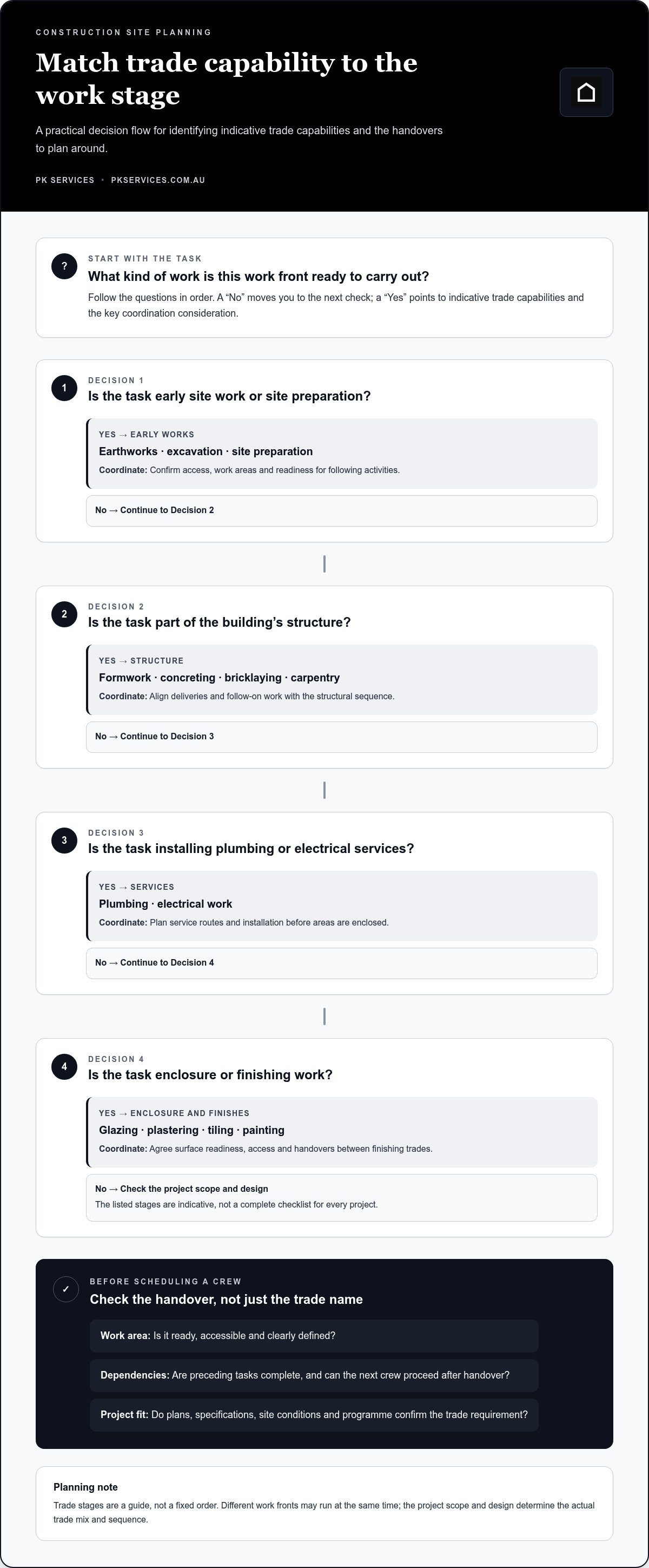
The trade mix follows the work, not a standard checklist. Plans, specifications, site conditions and programme shape which capabilities are needed and when. Trades may also work on different fronts at the same time, so treat the stages below as a planning guide, not a fixed order or a list that applies to every build.
| Project stage | Indicative trade capabilities | Key coordination consideration |
|---|---|---|
| Early works | Earthworks, excavation and site preparation | Confirm access, work areas and readiness for following activities. |
| Structure | Formwork, concreting, bricklaying and carpentry | Align deliveries and follow-on work with the structural sequence. |
| Services | Plumbing and electrical work | Coordinate service routes and installation before areas are enclosed. |
| Enclosure and finishes | Glazing, plastering, tiling and painting | Agree surface readiness, access and handovers between finishing trades. |
These examples are indicative. The project scope and design determine the actual trade requirements and sequence.
Trades commonly involved in early and structural works
Early works may involve earthworks and site preparation, while structural tasks can call for formwork, concreting, bricklaying or carpentry. The design and construction method determine which trades are required. Before scheduling a crew, check whether the work area is ready, preceding tasks are complete and the next crew can proceed after handover. Not every project follows the same sequence.
Trades commonly involved in services and finishes
Plumbing and electrical work may need to be coordinated with structural and enclosure tasks so services can be installed at the right point in the programme. Later work may involve plastering, glazing, tiling and painting. TAFE NSW course information offers a view of construction training areas, but course categories aren’t a project specification. Use the design and scope to define actual site needs.
Trade interfaces deserve close attention. A finishing crew, for example, may depend on services being complete and the work area being ready. If the handover is unclear, access can become difficult or work may need to be revisited. Map dependencies by area as well as by stage, particularly when multiple work fronts are active.
For project teams, planning skilled trades for construction sites means translating drawings and programme milestones into clear work packages. Identify the task, location, preceding work and next handover. This gives each trade a defined place in delivery while leaving room to adapt the mix as project needs become clearer. PK Services provides construction trade and contractor support tailored to project requirements and essential site gaps.
Matching trade coverage to scope, timing and delivery
The right way to organise trade coverage depends on the project’s needs and the delivery team’s capacity. A clear, contained scope may suit one arrangement, while complex or connected work packages may call for another. Compare options against four factors: how well the scope is defined, when capability is needed, how many trade interfaces must be managed and how much coordination capacity the project team has.
- Direct trade coordination: The project team coordinates trades and their work directly. This can suit a team with clear scopes, established site processes and enough time to manage scheduling, access and handovers. It gives the team direct oversight, but also adds coordination demands.
- Subcontracted trade packages: Related tasks are grouped into packages for delivery. This can help when work has clear boundaries and interfaces can be defined in advance. The team still needs to coordinate package timing, access and dependencies with the wider programme.
- Specialist trade services: A specialist capability can address a defined task or a gap in the project’s existing skills. This may suit a focused scope, but the work still needs to align with other trades, site access and the agreed programme.
There is no universal answer. Project size, complexity and the experience available within the delivery team all matter. If you’re assessing subcontractor arrangements, this guide to vetting construction subcontractors in Australia can help frame that decision.
What to align before trade work begins
Start with the current drawings and specifications. Define each trade’s scope, work area, access requirements and expected timing, then map dependencies across shared work fronts. Identify which tasks must finish before another crew can enter or close up an area. Set out responsibilities, communication points and the handover information each team needs. This gives everyone a clearer basis for planning and helps surface clashes before they affect delivery.
When integrated trade and project support can help
Joined-up support can be useful when a project has a capability gap or several linked work packages that need to fit the wider programme. Connecting trade execution with project oversight keeps the task, timing and handover in view together. PK Services provides experienced tradespeople and contractors for essential site gaps, drawing on over 15 years of construction industry experience across Queensland and New South Wales.
For project teams balancing trade requirements with broader delivery needs, PK Services’ construction support can form part of a tailored approach to the work.
How to plan and coordinate skilled trades on a live site
Good coordination turns the programme into clear, workable tasks. For skilled trades for construction sites, that means more than setting dates. The team needs to know what each trade is responsible for, which work must happen first and whether the work area is ready. Use a repeatable sequence, then review it as site conditions and priorities change.
- Confirm the scope. Check the trade task against current drawings, specifications and programme information. Clarify the work area, boundaries and expected outputs so crews aren’t working from different assumptions.
- Map dependencies. Identify which tasks must be completed before another trade can start and where teams may share access or space. Make these connections visible in the look-ahead plan.
- Prepare the work area. Align access, relevant information, materials and preceding work before scheduling a trade into the area. Readiness depends on the task and site, so don’t treat a programme date as proof that a work front is ready.
- Coordinate the work. Use regular check-ins to discuss progress, access constraints, sequence changes and interfaces with other crews. Update the people whose work may be affected.
- Review and adjust. Compare actual progress with the plan, record blockers and agree on next actions. Update the sequence when a change affects following tasks or another work front.
Prepare work fronts before trades arrive
A planned start can lose value if the area isn’t ready. Before a crew arrives, check that it can access the work zone, has current information and can proceed after preceding tasks. Look for gaps between drawings, specifications and site conditions. Conflicting details or incomplete work can leave trades waiting, working around unresolved interfaces or needing to revisit an area. Resolve what you can and make outstanding issues visible to the team.
Projects in Queensland and New South Wales differ in location, scale and site conditions. Apply the same coordination discipline while tailoring work-front planning to the specific project. For teams that need a wider view of delivery from planning through completion, the guide to full-cycle construction project management provides broader lifecycle context.
Keep trade handovers and quality visible
Make each handover explicit. The outgoing trade should communicate what’s complete, what remains open and any issue that could affect the next crew. Agree on practical completion checks for the task and work area, then record defects, questions or constraints promptly and in enough detail to support follow-up. A clear record helps the team track responsibility and avoid relying on memory during a busy shift. For related guidance, explore construction quality control management services.
Consistent oversight connects trade activity with the wider programme. Explore PK Services’ construction support for a tailored approach to trade requirements and project delivery.
How PK Services connects skilled trades with project delivery
Trade coverage works best when it reflects the work in front of you. PK Services provides experienced tradespeople and contractors to help address essential gaps on construction sites in Queensland and New South Wales. Support is shaped around project requirements, connecting practical trade capability with the work that needs to be delivered.
A gap can affect more than one task. A work package may depend on a particular skill, a prepared area or a clear handover with another crew. Matching trade support to the project’s scope and site needs helps it fit the wider delivery plan rather than sit apart from it.
Trade support shaped around project requirements
Each project brings its own mix of work, timing and site conditions. PK Services provides tradespeople and contractors for essential site gaps with those requirements in view. This project-focused approach connects the capability needed on site with the tasks and work fronts in the delivery plan. PK Services brings over 15 years of construction industry experience.
This support can be relevant when a project team is balancing linked work packages or responding to a gap that affects planned site activity. Start with a clear picture of the work required, where it sits in the programme and how it connects to other tasks. Trade support can then be considered as part of the project’s broader requirements.
From strategy to on-site execution
Project management is most useful when planning and delivery stay connected. PK Services manages projects from inception to completion, bringing strategic advice together with on-site execution. This wider view keeps project objectives and practical trade requirements in the same conversation, from early planning through active delivery and completion.
For teams arranging skilled trades for construction sites, that connection helps bring trade needs into discussions about programme priorities, work areas and interfaces. It also lets project teams consider trade support within the full lifecycle, rather than treating each site gap as an isolated requirement. The right approach depends on the project, its scope and its delivery needs.
Queensland and New South Wales project teams can discuss their construction requirements with PK Services. Discuss your construction project with PK Services.
Set your next project up for stronger delivery
Start with a clear view of the work ahead. Before confirming trade coverage, identify the project pressure point that needs attention, whether it’s a capability gap, a shifting programme or connected work packages that need closer oversight. This gives your delivery team a practical starting point for aligning skilled trades for construction sites with the project’s wider needs.
PK Services brings over 15 years of construction industry experience, providing trade and contractor services connected with project lifecycle management. Linking project direction with on-site execution helps keep trade requirements in view as work progresses from inception to completion.
For construction businesses in Queensland and New South Wales, a considered plan can turn a site gap into a clear next action. Plan your construction project with PK Services and take the next step with confidence.
Frequently Asked Questions
What are skilled trades in construction?
Skilled trades in construction are specialist occupations that apply practical training and experience to particular building tasks. A carpenter, for example, may interpret plans and measure, cut and install components to suit the specified work. The trade needed depends on the design and scope. Defining the task helps distinguish specialist capability from general support work and makes it easier to plan responsibility for each part of the job.
Which trades are commonly needed on a construction site?
Common examples include carpenters, bricklayers, concreters, plumbers, electricians, plasterers, glaziers, tilers and painters. A project may use only some of these or require other specialist capabilities, depending on its design and work packages. A fit-out, for example, may need several finishing trades but little structural work. Use the drawings and specifications to identify actual tasks rather than assuming a standard trade list applies to every site.
How do construction trades differ from general labourers?
Tradespeople carry out specialist work within their area of capability, while general labourers typically support broader site activities. A labourer might help move materials or keep a work area clear; a tradesperson may install or finish a particular building element. The division depends on the task and site arrangements. Clear role boundaries help teams allocate work appropriately and avoid relying on general support for tasks that call for specific trade capability.
Can trade requirements change during a construction project?
Yes. A design revision, unexpected site condition or programme change can alter which capabilities are needed and when. For instance, an issue discovered in an existing building may introduce repair work that wasn’t part of the original scope. Review trade requirements when plans or conditions change, and update affected work packages and handovers so later tasks reflect the revised project information.
What qualifications or licences do construction trades need in Queensland and New South Wales?
Requirements depend on the trade, work type, value and state. In Queensland, a QBCC contractor licence is generally required for building work over A$3,300; plumbing and electrical work require licensing regardless of value. Electrical contractors also need an Electrical Safety Office licence to perform electrical work for profit. In NSW, residential building work over A$5,000 requires a licence, as do plumbing, draining, gasfitting and electrical work regardless of value. Confirm the current rules for the specific work.
How can trade coordination affect construction project timelines?
Trade coordination affects whether crews can start in the right work area and complete tasks in sequence. If plumbing or electrical work isn’t completed before a wall is closed, later work may need to pause or the area may need to be reopened. Clear scheduling, access arrangements and handover updates help project teams spot clashes and adjust before they affect connected tasks.
What should be ready before a trade contractor starts work on site?
Have a defined scope, current drawings and specifications, access to the work area, and any required preceding work or materials in place. Make sure the contractor understands the work location, relevant site-entry arrangements, who to contact and how completed work will be handed over. If information is incomplete or the area isn’t ready, flag the issue early so the team can resolve it before it disrupts planned work.


