

What if taking on the next project isn’t the problem, but the way your business absorbs it? The most useful construction company growing pains solutions NSW builders can use start by identifying the constraint, not by adding complexity.
More projects can stretch management time, expose process gaps and tie up cash before revenue arrives. If trade availability or site capacity is inconsistent, delivery can come under pressure too. There’s no single fix for every business, and growing faster won’t help if the underlying bottleneck remains.
This guide will help you identify what’s holding your construction business back and compare practical responses, from improving processes and project management to addressing site capacity. You’ll also learn how to turn those choices into a clear action plan that connects business strategy with day-to-day delivery. PK Services brings business advice, project management and trades support together, drawing on more than 15 years of construction industry experience to match support to the challenge facing your NSW business.
Key Takeaways
- Look for patterns across recent projects to find whether delays, rework or cost variation point to a recurring business constraint.
- Match the response to the bottleneck: improve processes for repeated workflow issues, strengthen project oversight where coordination is strained, or address site-capacity gaps with trade support.
- Compare construction company growing pains solutions NSW builders can apply before changing systems or taking on more work.
- Turn the diagnosis into a staged action plan with a clear priority, owner and agreed review points.
- Connect business advice with project and site delivery so strategic changes carry through into day-to-day work.
Construction company growing pains in NSW: recognise the real constraint
More contracts can look like clear progress. But each project adds decisions, coordination and commitments, and complexity can rise faster than business performance. A busier pipeline may leave managers stretched, cash tied up and work harder to deliver consistently. The first step is to work out whether the pressure is temporary or a sign that the business has outgrown the way it operates.
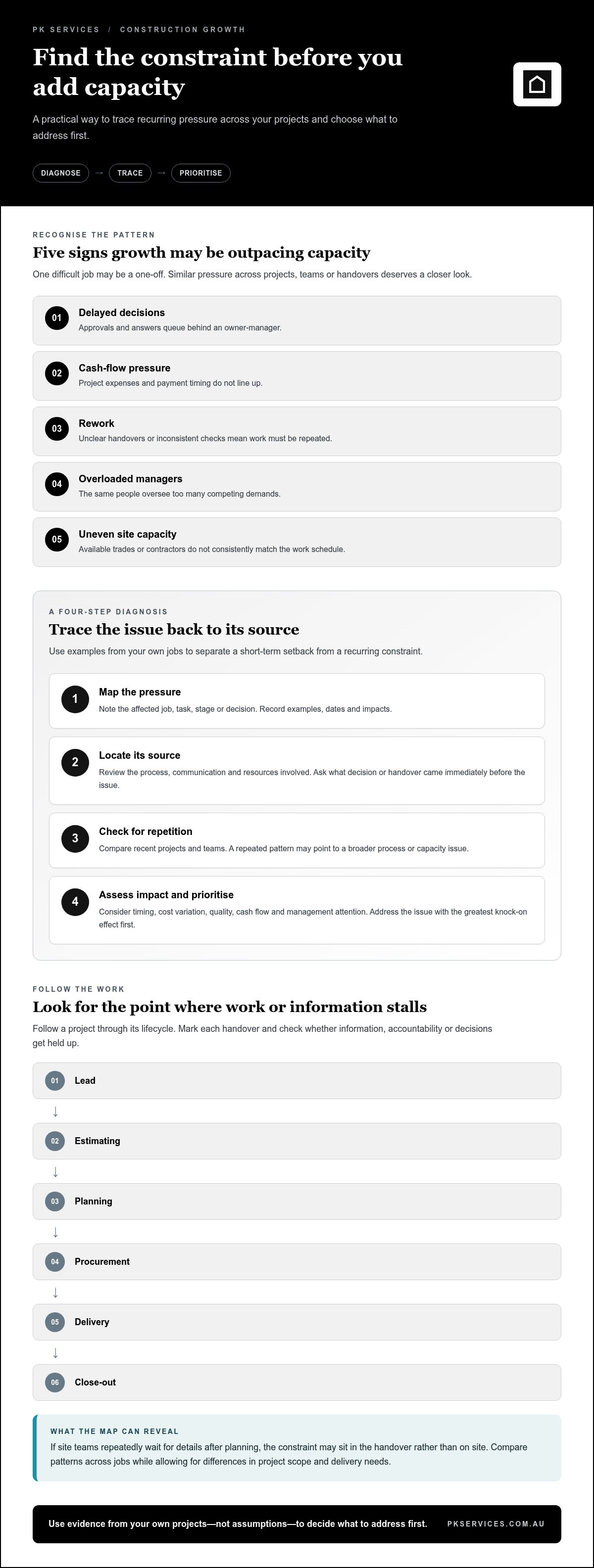
Look for recurring patterns: decisions waiting on one person, cash-flow strain when project costs fall due before payments arrive, rework, overloaded managers and uneven site capacity. A delay on one job may be a one-off disruption. Similar delays across projects, teams or handovers deserve closer attention. These clues can help you choose construction company growing pains solutions NSW businesses can put into practice, rather than adding capacity or changing processes without a clear reason.
Construction-business growing pains are recurring strains that arise when growth outpaces a company’s capacity to manage its work, people and resources.
- Delayed decisions: approvals and answers queue behind an owner-manager.
- Cash-flow pressure: project expenses and payment timing don’t line up.
- Rework: unclear handovers or inconsistent checks lead to work being repeated.
- Overloaded managers: the same people oversee too many competing demands.
- Uneven site capacity: available trades or contractors don’t consistently match the work schedule.
Construction businesses in NSW don’t all face the same pressures. Constraints can vary with project type, location, delivery model and the mix of work underway. Focus your diagnosis on what’s happening in your own jobs, rather than assuming a challenge elsewhere in the sector applies to your business. Construction management principles offer useful context for how planning, coordination and control fit together across a project.
Which growing pains are affecting your construction company?
Cash-flow pressure can emerge when labour, materials or other project commitments need to be covered before related payments arrive. Processes that rely on individual habits can also make estimating, handovers and oversight difficult to repeat as the workload grows. An owner-manager may become a bottleneck when routine decisions, approvals or issue resolution across several jobs keep returning to them, slowing teams that could otherwise move forward.
How to tell a symptom from its underlying cause
Trace a visible issue back through the chain of events. If a project is delayed, ask what decision or handover came first, whether the process was clear and whether the people or resources needed were available. A single supplier disruption may be isolated; the same type of delay recurring across projects suggests a broader process or capacity issue. Record examples, dates and impacts before choosing a response.
- Map the pressure: note the affected job, task or decision.
- Locate its source: review the process, communication and resources involved.
- Check for repetition: compare examples across recent projects and teams.
- Assess the impact: capture effects on timing, cost variation, quality and management attention.
This evidence trail helps separate a short-term setback from a recurring constraint. It also gives you a sound starting point for deciding what to address first.
Diagnose the growth bottleneck before changing systems or adding capacity
Before investing in a new system or increasing site capacity, find out where the pressure starts and what it affects. A useful diagnosis follows four steps: map the pressure, locate its source, assess its impact, then prioritise. This keeps the response grounded in evidence from your own jobs rather than assumptions about what a growing construction business needs.
Use recent project and financial records to establish a baseline. Compare projects with your own past work, not an assumed industry benchmark. Look for repeated delays, cost variation, rework and management escalation. Note where these occur in the workflow, which jobs or teams are affected, and whether the pattern is growing or limited to a particular project. The aim is to identify a recurring constraint, not treat every variation as a business-wide problem.
- Map the pressure: identify the affected stage, task or decision.
- Locate its source: trace what happened immediately before the issue.
- Assess its impact: consider delivery, cash flow, quality and leadership time.
- Prioritise: address the issue with the greatest knock-on effect first.
Map pressure across the business and project lifecycle
Follow a project from lead and estimating through planning, procurement, delivery and close-out. Mark each handover, then check whether information, accountability or decisions stall at a particular point. For example, if site teams repeatedly wait for details after planning, the constraint may sit in the handover rather than on site. Compare patterns across jobs while allowing for differences in project scope and delivery needs.
This map helps distinguish three kinds of constraint. A recurring weakness in estimating, planning or information flow points to a business-process capability gap. Confusion over responsibilities or sequencing on a particular job may be a project-coordination issue. A shortfall in available trades or contractors at a work stage is a site-capacity gap. Choose a response that fits the evidence.
Prioritise the constraint with the greatest knock-on effect
Rank issues by how they affect delivery, cash flow, quality and leadership capacity. An urgent trade gap may need immediate attention to protect a scheduled stage, while a repeated estimating or handover problem calls for a longer-term process response. If safety or compliance concerns arise, include them in the assessment and verify the current NSW requirements relevant to the work before deciding what action is needed.
Write a one-sentence problem statement before choosing a fix: “Because cause, impact is affecting part of the business.” For example: “Because project handovers lack consistent information, site teams are seeking repeated clarifications and managers are losing time across active jobs.” This makes the cause, consequence and scope clear, giving your team a practical starting point for selecting construction company growing pains solutions NSW businesses can apply. If you need to connect a business diagnosis to project delivery, PK Services’ construction consulting can help.
Compare construction growth solutions: process improvement, project management or trade support
Once you’ve identified the main constraint, choose a response that addresses its source. Adding trades to one job won’t usually solve a process issue, and extra project oversight won’t necessarily fix a recurring weakness in estimating or handovers. Use the pattern you’ve observed to decide what kind of support fits.
| Constraint | Suitable response | Likely scope | Decision trigger |
|---|---|---|---|
| Recurring workflow or performance issues | Business consulting and process improvement | Reviewing business processes, identifying friction and setting practical next steps | The same workflow problems recur across projects or teams |
| Coordination pressure across a project | Project management | Managing project activity from inception through completion | Responsibilities, timing or decisions are difficult to coordinate across stages |
| Insufficient site capacity for planned work | Trades and contractor services | Addressing a specific gap in the trades or contractor capacity needed on site | Planned work is constrained by an identified site-capacity shortfall |
These options address different levels of the business. Business advice and process management focus on recurring operational patterns. Project management focuses on coordination across a project lifecycle. Trade and contractor services address site delivery capacity. A business may need more than one response, but diagnose each need rather than treating growth itself as a reason to add support.
When business consulting and process management fit
Business consulting can help examine how work moves through the company, where responsibilities sit and which operational issues keep recurring. If estimating or handovers rely on individual workarounds, another temporary fix may leave the underlying pattern untouched. A useful improvement plan turns recommendations into accountable next steps, connecting strategic advice with changes in everyday work.
This is the stronger fit when the same performance issue appears across multiple projects, rather than when one site has a short-term shortage. PK Services provides construction business and process advice, drawing on over 15 years of construction industry experience. The focus is on making recommendations relevant to the company’s circumstances and linking them to delivery, rather than treating advice as an end in itself.
When project management or trade support fits
Choose project management when coordination across stages is the pressure point, such as when decisions, responsibilities or work sequencing need clearer oversight from project inception through completion. Choose trade or contractor support when the diagnosis points to a specific site-capacity gap. PK Services provides both end-to-end project management and trades and contractor services, addressing distinct constraints rather than assuming one response suits every growth challenge.
For construction company growing pains solutions NSW businesses can use effectively, keep the decision tied to evidence: recurring workflow problems point towards a process response; lifecycle coordination issues point towards project management; and a defined site-capacity gap points towards trade support. The right response depends on the diagnosed constraint. None is a guaranteed fix for pressures with a different cause.
Build a practical growth action plan for your NSW construction business
A useful growth plan turns the diagnosed constraint into owned work. Keep the first stage focused: select one priority, assign someone to lead it, define an action and set an agreed review date. Trying to change several systems while active projects are under way can add pressure instead of easing it.
Separate immediate stabilisation from longer-term improvement. If a current project has a confirmed site-capacity gap, the immediate action may be to address the trade or contractor requirement for that stage. A recurring issue with planning or project oversight needs a broader response, sequenced to avoid disrupting work already in progress. The first action protects delivery; the longer-term work addresses the pattern behind the pressure.
Turn the diagnosis into clear actions and ownership
Write each action so the team knows who is responsible, what it should achieve and when it will be reviewed. For example, a project manager might own a revised handover process, with the aim of giving site teams the information they need before work starts. Record the current position using existing project and business records, then note what evidence will show whether the response is helping.
Sequence dependent changes carefully. If a workflow change affects estimating, procurement and site teams, establish responsibilities and communicate the new steps before applying them across active work. Where practical, start with a suitable project or process, then use what the team learns to refine the approach. Keep the plan proportionate to the constraint, rather than adding administration for its own sake.
- Choose one priority: state the specific constraint the action will address.
- Assign an owner: name the responsible role and who needs to contribute.
- Define the action: describe the next practical step and intended result.
- Set a review date: agree when the team will assess progress.
- Record the baseline: use current project and financial records as the comparison point.
Review progress without losing sight of delivery
At each agreed review, look at the same indicators used to identify the pressure. These may include project delays, rework, workload pressure and cash-flow timing. Compare like with like where possible, and avoid setting improvement targets without a sound basis in your own records. Discuss exceptions with the people closest to project and site delivery. They can explain whether a change is workable or has shifted pressure elsewhere.
Keep the plan flexible. A change in project scope, workload or business priorities can alter which constraint matters most. If the original issue eases but another pressure emerges, update the priority, owner and next action instead of continuing with a plan that no longer fits. For NSW projects, verify the safety, licensing and other obligations that apply to the specific work and workforce before implementing changes.
A steady review rhythm connects business decisions to delivery on site. To turn a diagnosed constraint into practical business advice and project-level action, work with PK Services on your construction growth plan.
How PK Services connects construction business advice with project and site delivery
A growth constraint rarely sits in one place. A process issue can affect project planning; a coordination gap can put pressure on site delivery. PK Services brings construction business advice together with project management and trades and contractor services, matching support to the constraint you’ve identified. With over 15 years of construction industry experience, the team works with construction clients in New South Wales and Queensland.
The starting point is the nature of the pressure, not a standard package of fixes. Recurring workflow issues may call for business consulting and process advice. A project that needs closer coordination may benefit from end-to-end project management. Where planned work is held back by a site-capacity gap, experienced tradespeople and contractors can provide a different kind of support. Each response addresses a different need.
- Business performance: examine processes and operational priorities, then connect advice to practical actions.
- Project coordination: manage activity from inception through completion, supporting continuity across the project lifecycle.
- Site capacity: address an identified need for trades or contractor services on site.
Connect strategy to delivery across the project lifecycle
Business advice is most useful when it informs what happens next. A recommendation about a recurring workflow, for instance, can be translated into clear responsibilities and considered alongside the needs of current projects. Project management provides oversight across stages, helping maintain a connected view from inception to completion rather than treating each handover as a separate exercise.
This link between strategy and execution matters when a business needs to change how it works without losing sight of project delivery. For more on lifecycle planning, explore the full-cycle construction project management guide.
Choose the next conversation around your growth constraint
Bring a clear example of the pressure you’ve identified: a process that keeps breaking down, project coordination that’s becoming difficult to manage, or a trade-capacity gap affecting planned work. That gives the discussion a practical focus and helps distinguish a business-level issue from a project or site need. PK Services works with construction clients across NSW and Queensland, shaping support around the business and its delivery requirements.
For construction company growing pains solutions NSW builders can apply with purpose, connect the diagnosis to the right kind of support. Discuss a tailored consulting, project-management or trade-services response with PK Services.
Make your next stage of growth more deliberate
Growth doesn’t have to mean carrying every new pressure yourself. Choose one constraint worth addressing and decide what support would help move it forward. A clear priority makes it easier to turn construction company growing pains solutions NSW into practical action, rather than another set of good intentions.
PK Services brings over 15 years of construction industry experience to business consulting, full-cycle project management and trade services. This range connects business-level decisions with project oversight and site delivery, shaped around the pressure your business has identified.
You don’t need every answer before starting a conversation. Share what’s affecting your workload, project coordination or site capacity, and discuss a response that fits your business and its next stage.
Talk with PK Services about your construction business growth challenges and take the next step with greater clarity.
Frequently Asked Questions
What are the common growing pains for a construction company?
Common growing pains include strain on the decisions and routines that keep projects moving. Estimators may use different assumptions, supervisors may receive information in different formats, or invoices may be delayed while staff resolve missing details. These issues can emerge as a business takes on more work, even if individual projects are progressing. Look for friction in the everyday tasks between winning a job and closing it out.
How can a construction company grow without losing control of project quality?
A construction company can protect quality by making expected standards clear at the points where work is planned, checked and handed over. Set out who reviews key work, what records need to be kept and how defects or changes are communicated. For instance, a supervisor should know which inspection or approval is needed before the next trade starts. Consistent checks help teams spot variation early without relying on the owner to inspect everything personally.
Can a construction business solve growing pains by turning down work?
Yes. Declining or deferring a project can be sensible if accepting it would stretch delivery capacity or create commitments the business can’t manage responsibly. It’s one decision, not a complete growth plan. Before deciding, consider the project’s fit with current capability, timing, payment terms and competing jobs. A business might also negotiate a later start or staged delivery. Compare those options against the pressure they would place on existing work.
How do I know if my construction business needs outside support?
Outside support may be useful when a clearly identified issue keeps recurring and your internal team lacks the time or perspective to address it while delivering current projects. Be specific about the gap: a process problem may call for business consulting, lifecycle coordination may need project management, and a site shortfall may need trades or contractor services. Construction company growing pains solutions NSW builders use should match support to the issue, with clear agreement on what work it covers.
Is adding more tradespeople enough to manage construction business growth?
Not always. More tradespeople can help when the constraint is a genuine shortage of site capacity, but they won’t automatically resolve unclear sequencing, incomplete job information or slow approvals. Before adding trade support, check whether the work is ready, materials and instructions are coordinated, and someone is managing interfaces between trades. Otherwise, added capacity may have little effect on the original bottleneck. The answer depends on whether the limitation is people, planning or coordination.
What should a NSW construction business review before expanding into more projects?
Review the work already committed, upcoming project start dates, cash-flow timing, available management attention and the capacity required at each stage. Check whether current estimating and handover practices can support another job without creating avoidable clashes. In NSW, consider the project type and workforce involved, then verify the safety, licensing and other obligations that apply to that specific work. If you also operate in Queensland, assess the relevant requirements for those projects separately.


