

A full-time project manager isn’t always the right answer. For a NSW project with changing demands, outsourced construction project management NSW can provide experienced oversight without adding a permanent management layer.
Part-time involvement works best when accountability is clear. If decisions, responsibilities and site follow-through aren’t defined, gaps can open between the plan and the work on the ground. The right arrangement depends on what your project needs and when it needs it.
This article compares part-time management with other project management arrangements to help you choose the right level of support. You’ll see which responsibilities and decision rights to define, how to set a practical management cadence, and how to connect strategic oversight with site execution.
PK Services brings over 15 years of construction industry experience and manages project processes from inception through completion. Its project management, consulting and trades and contractor services connect planning with practical delivery across NSW.
Key Takeaways
- Match project management input to changing workload peaks rather than assuming a permanent role is the only option.
- Separate project coordination and oversight from trade work and specialist technical responsibilities to reduce scope gaps.
- Compare part-time, full-time and broader outsourced construction project management NSW by continuity, flexibility and the workload retained in-house.
- Scope support by identifying delivery risks, team capacity and decisions that need clear ownership.
- Set a review cadence that responds to project demands, then connect strategic oversight with practical site delivery.
Why NSW construction businesses consider outsourced part-time project management
Project demands rarely stay level from planning to handover. A business may have enough capacity for routine work, then face a sharp increase in coordination when approvals, procurement, contractor sequencing or site decisions converge. Maintaining a full-time project manager for every workload peak may not suit the project. Leaving the extra work with an already stretched team can lead to delays, missed follow-ups and uncertainty about who owns the next decision.
That’s why some businesses consider outsourced construction project management NSW. The value isn’t simply having another person available. It’s assigning clear responsibility for the management tasks that need experienced oversight while keeping the existing team involved in delivery.
When a NSW project may need part-time management input
Part-time input can suit a project with a defined coordination gap or a workload that intensifies at particular points. For example, a business might manage day-to-day operations internally but need structured oversight while several contractors work to a shared programme. A project can also benefit when decisions are delayed because no one has time to track actions, bring the right people together or escalate issues.
The arrangement should complement the people already involved. An owner may retain commercial decisions, while a site lead coordinates daily activity and a project manager oversees agreed milestones, communication and follow-through. The right balance depends on project complexity and team capacity. If the work needs continuous on-site management, scope the role and level of involvement accordingly.
What part-time management is - and is not
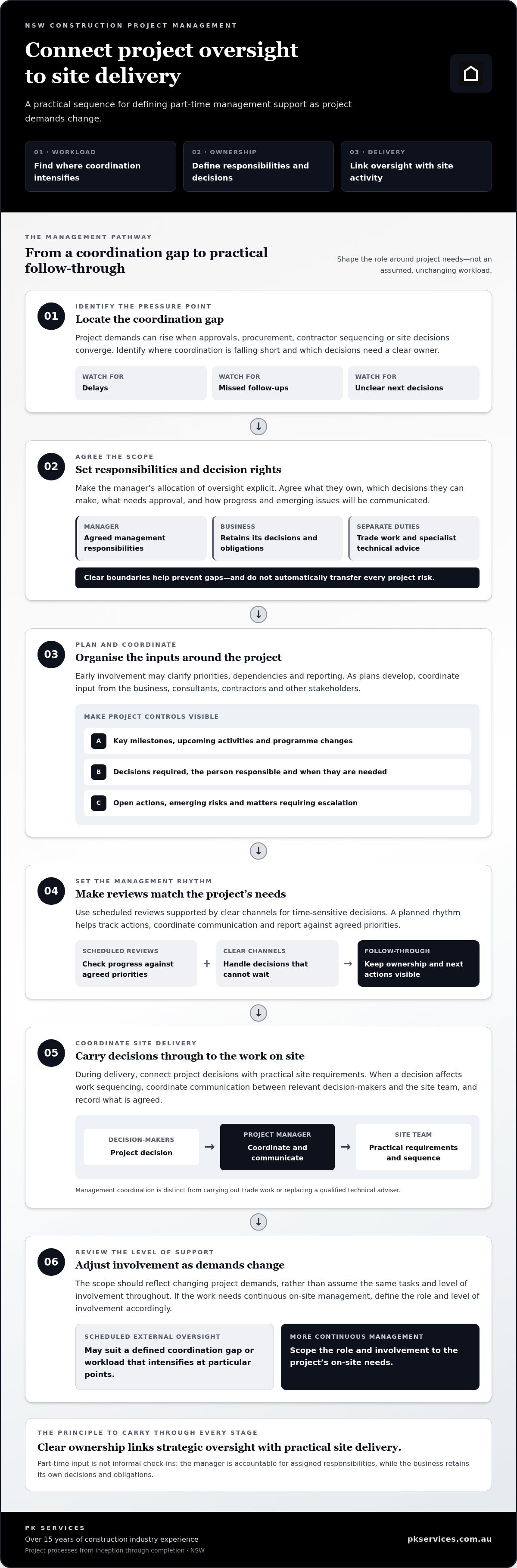
Outsourced part-time project management is an agreed allocation of project oversight, delivered by an external manager with defined responsibilities and a planned level of involvement. The scope should identify what the manager owns, which decisions they can make, what needs approval, and how progress and emerging issues are communicated. The broader Construction management function can span planning, coordination and delivery, but a part-time arrangement needs to specify which responsibilities are included.
It’s more than occasional advice or informal check-ins. A useful arrangement gives the manager a defined role in tracking actions, coordinating communication and reporting against agreed priorities. Set a practical rhythm, such as scheduled reviews supported by clear channels for time-sensitive decisions. Without that structure, everyone may assume someone else is following up.
Part-time does not mean low accountability. The manager is accountable for the responsibilities assigned to them, while the business retains its own decisions and obligations. Appointing a manager does not automatically transfer every project risk. Trade work, specialist technical advice and business approvals remain distinct responsibilities. Clear boundaries help the manager connect strategic oversight with site activity without blurring who is responsible for each task.
Before choosing an arrangement, identify where coordination is falling short and which decisions need a clear owner. Then assess whether scheduled external oversight can close the gap or whether the project needs more continuous management capacity.
What a part-time construction project manager can oversee across the NSW project lifecycle
The work changes as a project moves from an initial brief to site delivery and close-out. Early involvement may focus on clarifying priorities and coordinating inputs. As construction progresses, the emphasis can shift to programme updates, communication and making sure decisions reach the people who need them. A part-time scope should reflect those changing demands rather than assume the same tasks and level of involvement throughout.
Scope is the agreed set of project responsibilities, decision-making authority and reporting arrangements assigned to the manager. This definition separates management coordination from trade work and specialist technical duties. A manager can coordinate information and track actions without carrying out construction work or replacing a qualified technical adviser.
Planning, coordination and project controls
In early planning, the manager can help organise project priorities, identify dependencies and establish how progress and issues will be reported. As plans develop, they can coordinate inputs from the business, consultants, contractors and other stakeholders. This makes it clearer which decisions are needed and who needs to provide them.
Useful project controls make the work visible, not just documented. A regular update might show:
- Key milestones, upcoming activities and changes to the programme.
- Decisions required, the person responsible and the date they’re needed.
- Open actions, emerging risks and matters requiring escalation.
NSW Government project services resources can offer examples of how project services and responsibilities may be described. They’re a reference point, not a universal rule for private projects. Shape the scope around the project’s own arrangements, stakeholders and reporting needs.
Site delivery and the link to trades
During delivery, the manager can connect project decisions with practical site requirements. If a decision affects the sequence of work, for instance, the manager can coordinate communication between the relevant decision-makers and site team, record the agreed action and follow up on outstanding dependencies. This helps prevent a plan being updated in one place while site expectations remain unchanged.
Management oversight doesn’t replace the work of experienced trades and contractors. Their work is distinct from coordinating the programme, tracking agreed actions or escalating a decision that could affect delivery. Define the boundary clearly, especially where specialist technical judgement or approval is needed. That way, the manager can coordinate the right people without taking on responsibilities outside the agreed scope.
Close-out also needs a defined place in the plan. Where included in the scope, the manager’s role may cover coordinating remaining actions, tracking outstanding items and bringing project records and handover steps together. The level of involvement can change as work moves between phases. For more on how responsibilities connect across the full lifecycle, explore full-cycle construction project management.
For a project that needs experienced coordination alongside practical site capability, PK Services’ construction project management connects consulting, lifecycle management and trades and contractor services. Its scope is tailored to the project’s needs.
Part-time, full-time or outsourced project management: compare the NSW options
The right arrangement depends on the workload, how often decisions need to be made and how much management capacity your existing team can provide. A part-time manager can cover a defined gap. A full-time internal appointment offers ongoing attention. Broader outsourced management can take responsibility across more of the project lifecycle. The best fit depends on the project.
| Arrangement | Scope | Continuity | Flexibility | Internal workload |
|---|---|---|---|---|
| Part-time outsourced input | Agreed management tasks or project phases | Set through planned reviews and communication | Can be shaped around changing project needs | Internal staff retain tasks outside the agreed scope |
| Full-time internal appointment | Ongoing management within the role’s responsibilities | Consistent presence in the business | Capacity is dedicated, even when project demand varies | Requires the business to support and direct the role |
| Broader outsourced management | Wider lifecycle responsibility, as agreed | Can coordinate activity across project stages | Scope can be tailored to the project | Some coordination may shift outside the internal team |
Part-time versus full-time project management
A full-time appointment may suit sustained workloads with frequent decisions, ongoing coordination and enough work to keep the role consistently engaged. Part-time input may suit periods when management needs rise around particular milestones while the existing team can manage routine activity. In either model, document responsibilities, decision authority and reporting lines. The title alone doesn’t establish who can approve a change or resolve a delivery issue.
Part-time support versus end-to-end outsourced management
Part-time support usually addresses a defined need, such as programme coordination or progress reporting. End-to-end outsourced management can cover broader responsibilities from early planning through delivery and close-out. A wider scope can help when the business needs strategy connected closely to site execution rather than coordinating separate pieces internally. For related strategic considerations, see construction business consulting in Australia.
For a practical comparison, map each arrangement against the decisions and tasks your project generates. Identify where the work will sit: with an internal lead, a part-time manager or a broader external management scope. Consider continuity too. If site issues require quick decisions between scheduled reviews, the arrangement needs a clear route for raising and resolving them.
Exact cost comparisons require project-specific information, including scope, duration, expected involvement and assigned responsibilities. Avoid comparing a part-time scope with a full-time role or end-to-end management as though they cover identical work. First define what each option must deliver, then compare the arrangements on an equivalent basis.
For businesses weighing outsourced construction project management NSW, PK Services connects construction consulting and project lifecycle management with experienced trades and contractors. Start by outlining the management gap and the level of coordination your project needs, then review construction project management support.
How to scope a part-time construction project manager for your NSW project
A clear scope starts with the project’s pressure points, not a generic list of management tasks. Identify where delivery could be disrupted, what your current team can realistically manage and which decisions need a clear owner. This gives you a practical basis for deciding what an external manager should handle and how often they need to be involved.
A clear scope makes project decisions accountable by defining who owns each action, who has authority to decide and how progress is reported. Use this sequence to shape a part-time arrangement around your project.
- Identify delivery risks. Note the issues most likely to affect coordination, timing or site progress. These might include dependencies between work packages, decisions awaiting approval or information that needs to reach several stakeholders. Focus on risks the manager can help track or coordinate.
- Map team capacity. List the management tasks already handled by the owner, internal project lead and site team. Mark what’s being delayed, missed or carried by someone without enough time. This shows where support can complement the team rather than duplicate existing roles.
- Assign responsibilities. Describe the activities and outcomes the manager owns. These could include maintaining an action register, coordinating project updates or tracking agreed milestones. Separate those duties from trade work and specialist technical decisions so the scope doesn’t blur who is responsible for delivery or professional advice.
- Set decision rights. Record which decisions the manager can make within the agreed scope, which changes require business approval and who makes the final call when priorities conflict. Define how urgent issues are escalated, including who receives them and what information they need. Clear authority prevents a manager from being accountable for actions they can’t control.
- Agree reporting and records. Decide what the business needs to see: progress against milestones, upcoming decisions, open actions, risks and changes. Specify how decisions are recorded and shared with relevant people. Set reporting frequency according to project activity and decision needs, rather than applying the same schedule to every job.
- Set the working cadence. Agree how site attendance, team meetings and progress reviews will fit the work. A quieter planning period may need a different rhythm from a phase with active trade coordination. Where subcontractor coordination is part of the scope, construction subcontractor vetting guidance can inform the questions and coordination points your team considers.
- Review the arrangement. Revisit the scope when project phases, delivery risks or team workload materially change. Check whether the manager’s responsibilities, authority and review cadence still match what the project needs. Adjust the agreement if the work has shifted rather than allowing expectations to drift.
This framework turns outsourced construction project management NSW from a broad idea into a defined working arrangement. The project scope can set out the responsibilities, decision rights and management cadence your team needs. Explore construction project scope planning with PK Services.
How PK Services connects outsourced project management with NSW site delivery
Once you’ve identified the management gap and the level of support your project needs, the next step is to connect strategic oversight with what’s happening on site. PK Services provides construction consulting, end-to-end project management and experienced trades and contractors for construction sites. This combination links project priorities with practical delivery, with responsibilities shaped around the work and the support your team needs.
A connected approach from strategy to site
Project needs shift across the lifecycle. Early work may call for business and construction consulting to clarify priorities and organise the path ahead. As delivery progresses, project management coordinates activity from inception through completion, keeping attention on the agreed scope, decisions and communication between the business and site team.
Where site requirements call for trade or contractor capability, those services can sit alongside management coordination. The distinction matters: project management aligns the work and communication, while trades and contractors carry out their respective work. A project-specific scope makes clear how these responsibilities connect, who makes decisions and how site needs are raised and followed up.
PK Services brings over 15 years of construction industry experience. That experience informs a practical approach to coordinating project processes and connecting strategic advice with site execution. The level of involvement can be tailored to the project, whether the priority is a defined management gap or broader coordination across the lifecycle.
For businesses considering outsourced construction project management NSW, the useful question isn’t simply whether to outsource. It’s what needs to be managed, where internal capacity is stretched and how oversight should connect with delivery. A clearly defined role keeps the arrangement focused on those project needs.
Plan the next conversation around your project
A short project brief makes an initial discussion more productive. Note the current stage, who is managing the work today, where capacity is tight and which decisions or site requirements need attention. Include immediate priorities and upcoming milestones that will affect coordination. You don’t need a polished document; a clear outline is a practical starting point.
From there, the discussion can focus on the responsibilities that suit your project, the management input required and how it should work alongside your existing team and site activity. The scope should fit the project, without adding unnecessary layers or leaving ownership unclear.
If your NSW project needs experienced oversight connected to practical site delivery, discuss your construction project management needs with PK Services.
Make your next project decision with confidence
The best management arrangement is one that can adapt as the work takes shape. Treat the initial scope as a practical starting point, then agree how you’ll recognise when the project’s needs have shifted. That gives your team a clear basis for adjusting oversight without letting responsibilities drift.
Before your next conversation, note the project’s current stage, the decisions coming up and where your team needs more capacity. A straightforward brief is enough to begin shaping a discussion about outsourced construction project management NSW and the right level of involvement.
PK Services brings construction consulting, project management from inception through completion, and experienced trades and contractors for site requirements. Discuss your NSW construction project with PK Services and explore a scope shaped around your priorities.
Frequently Asked Questions
Is a part-time construction project manager suitable for a small NSW project?
Suitability depends on complexity, duration, delivery risks and your team’s capacity, not project size alone. A small refurbishment with several contractors and decisions to coordinate may need more oversight than a straightforward job managed comfortably in-house. Before deciding, list the decisions that need an owner and the coordination gaps affecting progress. This helps establish whether part-time input would address a real need.
How much does outsourced construction project management cost in NSW?
The cost of outsourced construction project management NSW depends on the project phase, agreed responsibilities, deliverables and level of management input required. A defined planning scope will differ from one covering active site coordination or broader lifecycle management. To discuss a project-specific arrangement, outline what the manager is expected to deliver, how progress will be reported and which decisions sit within their authority.
Can an outsourced project manager work alongside my existing construction team?
Yes. The arrangement can complement an existing team rather than replace it. For example, an internal site lead might continue coordinating daily activity while the project manager tracks cross-project actions and communicates decisions between stakeholders. Agree who has authority to approve changes, who makes other key decisions and how actions are recorded. This keeps responsibilities visible and helps avoid duplicate effort or missed follow-up.
What happens if the project workload changes after a part-time manager is engaged?
Schedule scope reviews to address changes in project phase, risk or workload. A new work package, for example, may create extra coordination between site teams or require different reporting. Review the manager’s responsibilities, decision authority and meeting or reporting cadence together. Agree any change to the arrangement rather than assuming it as project demands shift.
Are NSW Government project management templates required for private construction projects?
NSW Government project management templates are not a universal rule for every private construction project. Government resources provide templates for engaging private-sector project managers within a government procurement context, so private businesses can use them as a reference when shaping their own documents. Check the current requirements that apply to your procurement and project, particularly if the work has specific contractual or approval conditions.
Can project management support include coordination with construction trades?
Yes. A project manager can coordinate communication between project planning, site requirements and trades when those duties are included in the agreed scope. This may involve tracking work dependencies or ensuring decisions are shared with the relevant people. PK Services provides experienced trades and contractors for construction site requirements alongside project management. Its work across NSW and Queensland connects management needs with practical site capability.


