

Taking on more projects won’t fix operational chaos if the office plan and site reality keep drifting apart. Construction operations consulting Sydney builders can use helps connect business decisions with the work happening on site.
If you’re firefighting schedule changes, chasing subcontractor accountability or carrying the load of compliance and site administration, you’re not alone. Unapproved variations and rework can put pressure on project margins, while daily crises leave little room for business development.
A repeatable operating framework can bring structure to project delivery in 2026. This article covers how to coordinate trade resourcing, build quality checks into the process from the start and strengthen oversight at each project stage. With more than 15 years of construction industry experience across NSW and Queensland, PK Services combines strategic business advice with specialised trade resourcing. The aim is to connect business strategy with site execution, helping projects stay on track and owners spend less time firefighting.
Key Takeaways
- Spot early signs of operational bottlenecks before they affect project margins or site progress.
- See how construction operations consulting Sydney can align commercial planning with work on site.
- Compare in-house management, digital tools and external consulting against your business needs.
- Use a practical framework to review workflows, improve project communication and clarify trade accountability.
- Learn how integrated business advice and contractor resourcing can support projects from planning through completion.
The Operational Bottlenecks Draining Sydney Builders and How to Spot Them
Operational problems rarely begin with one major failure. More often, they start with small gaps between the programme, procurement and what trades can complete on site. A handover slips, a material delivery misses its window, and the next crew arrives before the area is ready. Even when each issue seems manageable, the combined effect is lost time, disrupted sequencing and pressure on the margin.
Construction management principles bring together the planning and coordination of building work. Day-to-day performance also depends on clear communication and timely decisions between project managers, supervisors and trades.
Symptoms of Operational Friction Across Sydney Workplaces
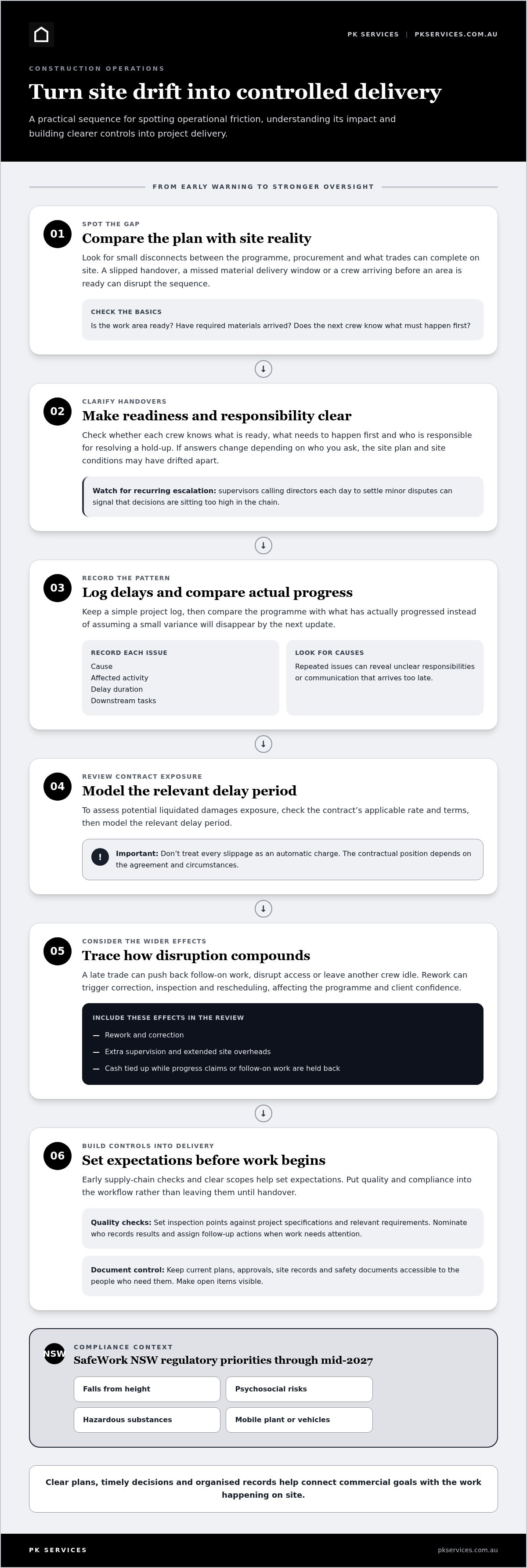
Look for recurring friction, not just one-off delays. Unclear handovers can leave trades competing for the same work area or waiting for an earlier task to finish. Check whether each crew knows what is ready, what must happen first and who is responsible for resolving a hold-up. If the answers vary depending on who you ask, the site plan and site conditions may have drifted apart.
Frequent escalation is another warning sign. If supervisors call directors each day to settle minor disputes, decisions may be sitting too high in the chain. Record recurring issues, their causes and the decisions needed. The pattern can reveal unclear responsibilities or communication that arrives too late.
Document control matters as well. If current plans, approvals, site records or safety documents are hard to find, teams can lose time confirming what applies and showing how work is being managed. SafeWork NSW has identified falls from height, psychosocial risks, hazardous substances and mobile plant or vehicles as regulatory priorities through mid-2027. Organised records and clear site processes help teams respond more confidently to scrutiny.
The Compounding Cost of Site Delays and Rework
A delay can affect more than the hours lost. A late trade may push back follow-on work, disrupt access or leave another crew idle. Keep a simple project log of the cause, affected activity, delay duration and downstream tasks. Then compare the programme with actual progress instead of assuming a small variance will disappear by the next update.
To assess potential liquidated damages exposure, check the contract’s applicable rate and terms, then model the relevant delay period. Don’t treat every slippage as an automatic charge: the contractual position depends on the agreement and circumstances. Include wider effects in the review, such as rework, extra supervision, extended site overheads and cash tied up while progress claims or follow-on work are held back. For a broader view of construction business profitability in NSW, consider how delivery issues affect cash flow.
Poorly matched trade labour can create a similar chain reaction. Work that misses the agreed standard may need correction, inspection and rescheduling, affecting both the programme and client confidence. Early supply-chain checks and clear scopes help set expectations before work begins. If these issues repeatedly take up leadership time, construction operations consulting Sydney businesses use can help identify the process gaps behind the firefighting, rather than treating each incident as a one-off.
What Construction Operations Consulting Delivers for Modern Building Firms
Construction operations consulting connects a project’s commercial goals with the work required to deliver it. It is neither strategy that stops at the boardroom nor software expected to solve site problems on its own. Instead, it brings planning, people, trade coordination and delivery processes into one practical operating framework.
For a mid-sized builder, this could mean turning a target completion date into clear work packages, confirming dependencies before trades are booked and deciding who can resolve a delay without escalating every decision to a director. Strong construction operations consulting Sydney can apply this thinking across governance, procurement and site logistics, tailoring the approach to each project’s scope and stage.
Bridging Strategic Planning and Practical Site Execution
Commercial targets need to translate into tasks teams can act on. A project manager can break milestones into upcoming deliverables, confirm the people and materials needed, then review progress against the programme at an agreed cadence. This makes it easier to spot a blocked task early and assign the next action. For broader context on connecting business direction with delivery, explore construction business consulting in Australia.
Consistent governance also gives managers a clearer view across projects. Use a small set of shared measures, such as planned versus completed work, critical-path activities achieved, open decisions, trade attendance and recorded safety actions. Review them regularly and note the reason for any variance. The aim is not to produce more reports, but to give managers reliable information they can act on before a minor issue disrupts the wider programme.
Establishing Robust Quality Control and Compliance Standards
Quality and compliance processes work best as part of the workflow, not as a scramble before handover. Set inspection points against project specifications and relevant requirements, nominate who records the results, and assign follow-up actions when work needs attention. Keep current documents accessible to the people who need them, and make open items visible. This supports consistent oversight without assuming one checklist suits every project.
For example, a staged inspection before work is covered can help teams identify visible issues while the area is accessible. A close-out register can track outstanding items, responsibility and completion evidence before formal client inspections. These steps do not guarantee defect-free work, but they clarify quality expectations and give teams a structured way to address issues earlier. Related construction quality control guidance can help inform a more consistent approach.
Clear routines can also reduce administrative drag. When project updates, approvals and responsibilities follow a predictable pattern, leaders spend less time chasing basic information and more time making considered decisions. PK Services brings strategic business advice, full-cycle project management and specialised trade resourcing together across NSW and Queensland. Explore integrated business consulting and project management to see how these services can connect planning with delivery.
Evaluating Solutions: In-House Management, Software, and Operations Consulting
There is no single fix for every builder. Promoting an experienced supervisor, introducing a digital platform and engaging an operations adviser each address different needs. The right option depends on where work is getting stuck, how much time your team can commit and whether the solution can support your project pipeline.
Use the comparison below as a starting point. The ratings are indicative, not guarantees. Outcomes depend on the people, processes and leadership behind each approach.
Internal promotion can preserve site knowledge and keep decisions close to the work. But it also adds responsibility to someone who may already be managing delivery. Results can take time if they are expected to redesign processes while running active jobs. Software can improve visibility and record-keeping, but it needs setup, training and consistent use. External advice brings an independent view and structured attention to operating issues, while still requiring leadership involvement to embed changes.
Why Software Alone Cannot Rectify Disconnected Job Sites
A new app will not resolve unclear responsibilities or late decisions. If crews receive conflicting instructions, digital tools can simply capture the confusion in more places. Trades also need a clear reason to use a system and leaders who reinforce the agreed process. Define the workflow first: where instructions are kept, who updates progress and how changes are approved. Then choose technology that supports those habits.
Selecting a Boutique Construction Partner Versus Generalist Firms
Construction experience matters because advice needs to account for real sequencing, trade interfaces and procurement constraints. A specialist partner should connect process changes with what supervisors and contractors can apply on site, rather than offering only a high-level plan. Consider whether the work can address both operating structure and practical delivery needs, including trade resourcing.
For Sydney builders, construction operations consulting Sydney is most useful when it combines commercial perspective with practical site understanding. PK Services brings more than 15 years of construction industry experience across NSW and Queensland, alongside business advice, full-cycle project management and specialised trade resourcing. This integrated approach helps firms assess what needs to change and carry improvements through project delivery.
A 4-Step Framework to Systemise and Optimise Your Construction Operations
Systemising operations does not mean adding layers of paperwork. It means setting a practical rhythm for decisions, trade coordination and progress checks, then using it consistently across projects. This four-step framework gives your team a clear place to start.
Phase 1: Auditing Workflows and Realigning Trade Resources
Start with the current picture, not an idealised process map. Compare planned milestones with actual progress across active jobs. Trace recurring slippage to its cause: late approvals, unclear scopes, procurement gaps or unavailable trades. Review contracts and handover points to identify where responsibilities or quality expectations need to be clearer. In subcontractor agreements, make the scope, programme, quality benchmarks and payment conditions clear and consistent.
- Audit workflows and bottlenecks. Map how decisions, instructions, materials and work move from planning to site. Record recurring delays and their causes across projects. Separate one-off disruptions from repeated process issues, then prioritise constraints affecting critical activities.
- Set communication and accountability routines. Establish brief daily site check-ins and regular project reviews. Confirm planned work, access or material constraints, decisions required and the person responsible for each action. Track commitments through to completion so accountability is visible without turning every update into a lengthy report.
Plan trade availability against the work ahead. Identify upcoming labour requirements early, especially where sequencing, access or specialised skills could constrain progress. Build relationships with dependable trade service providers and match resourcing to project needs. For high-risk activities, coordinate people, work areas and prerequisites before the scheduled start instead of relying on last-minute fixes.
Phase 2: Standardising Reporting and Maintaining Delivery Momentum
- Align procurement and trade resourcing. Compare upcoming work packages with confirmed materials, subcontractor commitments and site readiness. If there is a gap, assign an owner and a decision date. This gives project leads time to address labour gaps or sequencing conflicts before they affect the next milestone.
- Review milestones, quality and cash flow. At each agreed review point, compare completed work with the programme, inspect relevant quality records and capture outstanding decisions. Use contract terms to guide milestone sign-offs and payment administration. Where a contract incorporates AS 4000, follow its applicable provisions alongside the project specifications and other relevant requirements.
Keep reporting concise. A useful milestone review answers three questions: What was completed? What is holding up the next activity? What action is needed now? Recording decisions and close-out items gives a clearer view of delivery and supports timely financial administration. Full-cycle construction project management connects these reviews across a project’s lifecycle, from planning through completion.
Construction operations consulting Sydney builders use can help turn this framework into consistent practice by connecting business priorities with trade coordination and project controls. Explore PK Services’ business consulting and project management to learn how these services can support your projects.
Partnering with PK Services: Integrated Advisory and Field-Ready Delivery
Operational improvements need to work in two places: in business decisions and on the ground. PK Services brings strategic business advice together with specialised trade resourcing and full-cycle project management. For builders, that means a connected view of project priorities, delivery processes and the people needed to carry out the work.
With more than 15 years of construction industry experience across NSW and Queensland, PK Services provides practical advice shaped by project demands. The focus is not change for its own sake. It is to create a clearer operating structure, strengthen project oversight and give business owners more room to plan for growth instead of being drawn into every delivery issue.
Over 15 Years of Strategic Advice and On-Site Capability
Business advice is more useful when it connects directly to site delivery. PK Services combines operational guidance with trades and contractor services, helping align management priorities with the work required on site. This integration can help builders address resource gaps, clarify responsibilities and keep project decisions connected to practical delivery needs.
End-to-end project management provides oversight from initial planning through completion. Responsibilities, progress and emerging issues can be considered across the project lifecycle rather than in isolated stages. A more structured view can help owners delegate aspects of project coordination and focus more attention on business development, client relationships and future work. It will not remove every challenge, but it can reduce the pressure of carrying each operational decision alone.
For builders working across Sydney and Queensland, a consistent approach matters as teams and projects change. Clear expectations and joined-up oversight help keep work aligned with project requirements and support the reputation built through each delivery.
Initiating Your Operational Transformation Across NSW Sites
Start by looking across active projects and identifying where management processes, trade resourcing or milestone controls need more structure. Consider how information moves between office and site, where decisions stall and which resource gaps could affect upcoming work. This gives the improvement effort a clear focus instead of adding procedures without a defined purpose.
Next, shape priorities into a tailored roadmap. It might include clearer project communication, more consistent progress reviews, defined responsibilities or closer alignment between planned work and trade resourcing. The right sequence depends on the business and its projects. Changes should fit the way work is delivered and be reviewed as projects move from planning to execution and completion.
For builders exploring construction operations consulting Sydney, an integrated partner can connect strategic advice with practical project oversight. PK Services brings business consulting, contractor services and lifecycle management together, with experience across NSW and Queensland. To take the next step towards a more structured approach to project delivery, get in touch with PK Services.
Build a Stronger Operating Rhythm for Your Next Project
Lasting improvement starts with a clear choice: identify one recurring pressure point and make it the first process your team strengthens. A more dependable way to plan, communicate and resolve decisions can create room to take on growth without letting day-to-day delivery dictate every priority.
The next step is to shape that change around your projects, people and business goals. With construction operations consulting Sydney, builders can connect practical site needs with a more deliberate operating approach, then build on that foundation as the business evolves.
PK Services brings construction advice and project delivery together, with a focus on workable systems that support teams from planning through completion. Speak with PK Services about a practical next step for your construction operations.
Frequently Asked Questions
What is the role of a construction operations consultant in Sydney?
A construction operations consultant helps a building business understand how its work is organised and where practical changes could improve delivery. For example, they might map how a design decision moves from the office to a supervisor, then identify where delays or unclear approvals interrupt that process. Construction operations consulting Sydney firms can tailor advice to local project conditions while considering how processes apply across a builder’s NSW and Queensland operations.
How does operations consulting help prevent construction business owner burnout?
Operations consulting can reduce the number of routine decisions that depend on the owner by clarifying who handles common issues and when they need to be escalated. For instance, a site supervisor could resolve a defined type of sequencing question using an agreed process, rather than calling a director each time. The owner still sets direction, but clearer responsibilities and reporting can help protect time for leadership and business development.
How is construction operations consulting different from standard project management?
Project management focuses on planning and delivering a particular project, including its scope, programme and coordination. Operations consulting looks more broadly at how the business manages work across projects. It may examine decision pathways, role clarity and how lessons from one job carry into the next. The two can complement each other: stronger business processes support project delivery, while project experience can reveal where operating practices need refinement.
Can operations consulting resolve ongoing skilled trade shortages on my sites?
Consulting cannot remove a wider shortage of skilled workers, but it can help address specific resourcing gaps affecting your sites. A review may clarify which skills are needed, when they are required and whether work sequencing is making existing resources harder to use effectively. PK Services also provides trades and contractor services, helping construction businesses address site-level labour needs across NSW and Queensland. This does not resolve industry-wide shortages.
How quickly can a building firm expect measurable results from an operational audit?
There is no reliable fixed timeframe for results. An audit can establish a baseline, but measurable change depends on the issues identified, the size of the business and how consistently teams apply agreed actions. Start by tracking a few relevant indicators, such as decision turnaround, unresolved actions or planned work completed. Review those measures regularly against the baseline rather than expecting an audit alone to change performance.
Will bringing in an operational consultant disrupt our active construction schedules?
A well-planned review takes account of active projects and site team workloads. Keep the work focused: gather existing documents first, schedule discussions around key project commitments and avoid duplicating established reporting. A consultant can examine current processes without asking crews to pause delivery. Stage any proposed change, explain it to affected staff and set clear responsibilities so it supports the programme instead of adding unnecessary administration.
What qualifications and industry background should I look for in a construction advisor?
Look for relevant construction experience and an understanding of both business decisions and live site delivery. Ask how the advisor would approach a practical issue, such as recurring approval delays or unclear subcontractor scopes, and whether their recommendations account for project stages and trade interfaces. Check that their experience is relevant to work across NSW or Queensland. Practical examples, clear reasoning and respectful engagement with site teams are useful indicators.


