

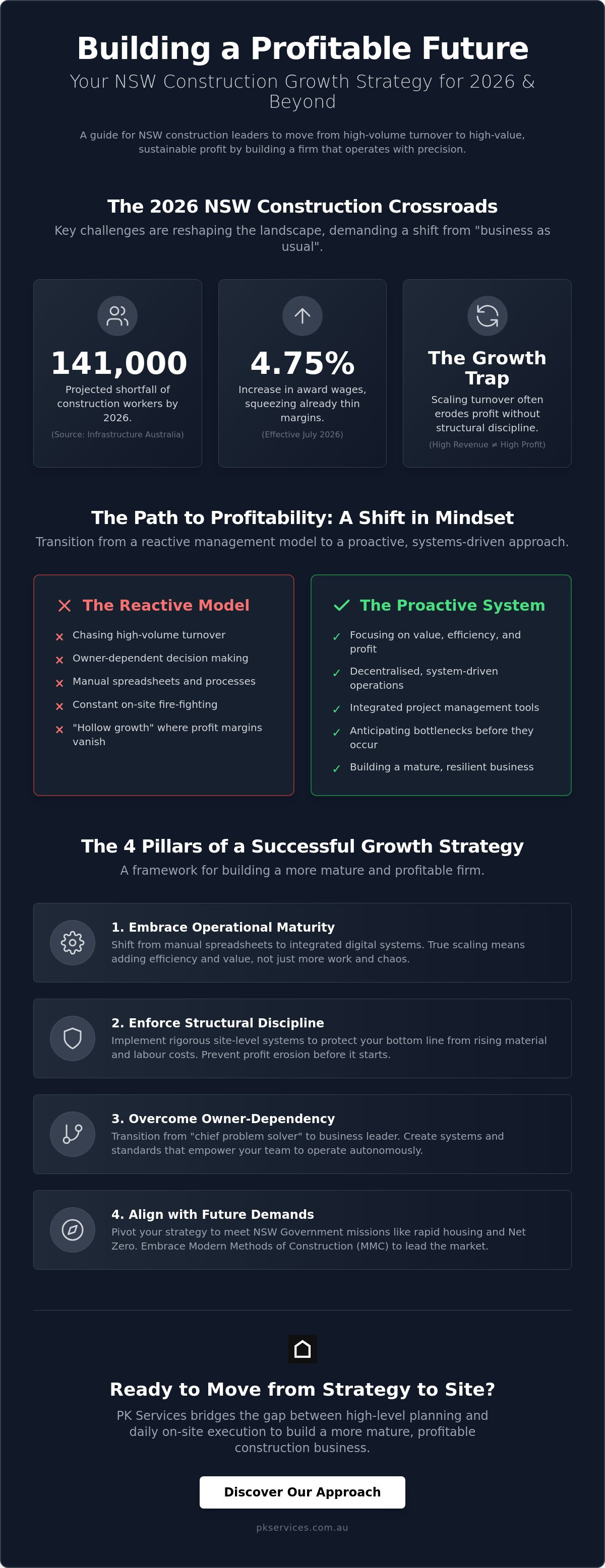
With Infrastructure Australia reporting a shortfall of 141,000 construction workers in 2026, why are so many NSW firms still chasing high-volume turnover that yields almost no profit? It is a frustrating cycle. You are winning tenders, yet your margins are constantly eroded by rising material costs and the recent 4.75 per cent increase in award wages. You likely feel like the business cannot breathe without you on-site to make every minor decision.
We understand that true success is not about working harder. It is about building a firm that operates with precision. This guide delivers a construction business growth strategy NSW leaders can use to bridge the gap between high-level planning and daily site execution. You will discover how to scale your profit, not just your workload, while creating systems that let you step back from the tools for good.
We will preview the impact of the Building Bill 2026 and show you how to capitalise on the current infrastructure boom. From navigating "payday super" to mastering Modern Methods of Construction (MMC), this is your roadmap to a more mature, profitable business.
Key Takeaways
- Shift from reactive site management to proactive systems to successfully navigate the evolving 2026 regulatory landscape.
- Identify why scaling turnover often erodes margins and how to implement structural discipline to protect your bottom line.
- Develop a construction business growth strategy NSW builders can use to move from manual spreadsheets to integrated project management.
- Learn how to conduct a business health check to identify operational bottlenecks and define your ideal project profile.
- Discover an end-to-end consulting model that bridges the gap between high-level strategy and daily on-site execution.
The 2026 NSW Construction Landscape: Why Growth Requires Transformation
The NSW construction sector is currently navigating a period of intense evolution. While traditional growth was once measured by the size of a firm's fleet or the number of active sites, the 2026 reality is different. Transformation today means moving from reactive management to proactive systems. It's no longer enough to simply chase the next tender. A robust construction business growth strategy NSW leaders can rely on depends on the ability to anticipate regulatory shifts and operational bottlenecks before they halt progress on-site.
The Economy of New South Wales remains the nation's primary industrial engine. The construction sector has seen a 29 per cent growth in services over the last decade, yet "business as usual" is a dangerous mindset. The NSW Trade and Investment Strategy 2035 has shifted the goalposts, favouring firms that demonstrate high levels of digital integration and supply chain transparency. Growth corridors like the Western Sydney Aerotropolis and regional infrastructure hubs in the Illawarra and Hunter regions offer immense opportunity. These projects demand more than just labour; they require sophisticated operational maturity.
The Shift from Revenue to Operational Maturity
Chasing turnover is a common pitfall. In 2026, high revenue without structural discipline leads to "hollow growth" where profit margins vanish. Scaling means adding capacity, like more workers or machines. Growing means adding value and efficiency. Real resilience in the Australian market comes from building a business that can withstand economic shifts without the owner needing to micromanage every concrete pour. It's about maturing your internal processes so that increased volume doesn't lead to increased chaos. This maturity is the cornerstone of a successful construction business growth strategy NSW.
NSW Government Missions: Housing and Net Zero
State-funded missions are now heavily focused on rapid housing delivery and the transition to Net Zero. Aligning your business strategy with these missions provides long-term stability. The government's push for local manufacturing and Modern Methods of Construction (MMC) creates a massive opening for specialist trades who can deliver sustainable, high-quality results. Winning government-adjacent contracts now requires a clear commitment to sustainable practices and local supply chains. If your firm isn't pivoting toward these standards, you risk being sidelined in the state's most lucrative development pipelines. Efficiency and sustainability are no longer optional extras; they are the new standard for excellence.
The NSW Growth Trap: Why Scaling Often Erodes Profitability
Many NSW builders believe that a bigger team and a fuller pipeline naturally lead to success. It often doesn't. If your overheads grow faster than your efficiency, you aren't scaling; you're simply inviting more risk. This is the "growth trap." Without a precise construction business growth strategy NSW firms often find that high turnover hides dangerously thin margins. Scaling is about increasing your capacity to deliver profit, not just your capacity to do work.
Structural discipline is the missing link for many local firms. In an Australian context, this means having rigorous site-level systems that prevent friction. With Infrastructure Australia estimating a shortfall of 141,000 construction workers in 2026, the competition for reliable trades is fierce. You aren't just fighting for jobs; you're fighting for the hands to build them. This shortage, combined with the 4.75 per cent award wage increase that took effect in July 2026, means your project margins are under constant attack. If you don't have the systems to manage these costs, your growth will eventually cannibalise your profit.
The Hidden Costs of Owner-Dependency
If the site stops moving when you leave, you don't have a scalable business. You have a very high-pressure job. Being the "chief problem solver" feels productive, but it's actually a bottleneck that kills scaling efforts. To grow, you must decentralise decision-making. This requires a mental shift from master-builder to business-leader. It's about setting the standard once so your team can meet it every time without your direct supervision. If you're finding it difficult to step away from daily site decisions, exploring professional business consulting can help you install the operational framework needed for true autonomy.
Risk Management in a High-Growth Market
The term "growing broke" is a genuine threat in the current NSW market. Rapid expansion requires significant upfront capital for materials and labour, yet progress payments often lag. This cash flow gap is where many firms stumble. Financial forecasting is your survival guide. You must manage the risks of rapid contractor expansion with extreme care. Bringing on new trades too quickly without vetting their quality often leads to costly rework. Structural discipline means having the courage to say no to a project that doesn't fit your ideal financial profile, even when the turnover looks tempting.
The 4 Pillars of a Successful Construction Growth Strategy
Sustainable expansion isn't a result of luck. It's the product of a structured construction business growth strategy NSW firms use to stabilise their operations before pushing for higher volume. Without these four foundational pillars, your business remains vulnerable to the site-level friction that erodes profit. You must move from being a reactive builder to a proactive business operator.
- Pillar 1: Systematised Operations — Stop relying on memory or messy spreadsheets. Transitioning to integrated project management software ensures every stakeholder has a single source of truth.
- Pillar 2: Strategic Resource Planning — In a market where the worker shortfall is projected to reach 300,000 by mid-2027, you cannot rely on last-minute labour hire. You need reliable trade partnerships built on mutual respect and clear standards.
- Pillar 3: Financial Discipline — Focus on the bottom line. Every job must be vetted to ensure it contributes to net profit, not just top-line revenue. This involves rigorous cost tracking and real-time reporting.
- Pillar 4: Site Leadership — Strategy is worthless without execution. Professional site management ensures that the standards you set in the office are actually met on the ground.
Solving the Labour Gap with Skilled Trades
Traditional labour hire is often a band-aid solution. To scale effectively, you need strategic trade partnerships. These are long-term relationships with contractors who understand your quality benchmarks and safety protocols. Attracting high-quality contractors in a competitive NSW market requires more than just competitive pay; it requires clear communication and organised sites. Integrating skilled trades for construction sites into your long-term planning allows you to bid on larger projects with the confidence that you have the hands to finish them. You're building a reliable ecosystem, not just a list of phone numbers.
Systematising for Scale
From Strategy to Site: Operationalising Your Growth Plan
Strategy is often lost at the site gate. You can have the most sophisticated boardroom plans, but if they don't translate to the ground, your construction business growth strategy NSW will stall. Operationalising growth means turning high-level goals into repeatable site-level actions. It's about moving away from "putting out fires" and moving toward a culture of planned excellence. When your office and site are in sync, profit margins are protected.
To bridge this gap, follow these five essential steps:
- Step 1: Conduct a construction business health check. This identifies the specific operational friction points that are currently draining your resources.
- Step 2: Define your "Ideal Project Profile." Stop chasing low-margin distractions. Focus only on the projects that align with your team's strengths and your financial goals.
- Step 3: Implement full cycle construction project management. This ensures that every phase, from the first tender to the final completion approval, is handled with consistent rigour.
- Step 4: Establish clear KPIs for site productivity and safety. With the Building Bill 2026 replacing construction certificates with "building approvals," your documentation must be flawless to avoid delays.
- Step 5: Review and refine. Create a continuous feedback loop where your trades can report site-level inefficiencies back to management without fear of friction.
Bridging the Strategy-to-Execution Gap
Most growth plans fail because the vision isn't communicated effectively to the crew. Your site team is naturally focused on the next 10 hours, while you're focused on the next 10 years. Professional site management is the bridge. It translates your long-term vision into daily milestones. By decentralising decision-making and empowering your site leads, you maintain project momentum even when you aren't physically present. This ensures that the quality on-site matches the sophistication of your strategy.
Optimising On-Site Productivity
Wasted hours are the primary cause of margin erosion in the current NSW market. Analysing your site logistics can reveal significant opportunities to reduce material loss and idle time. Strong site leadership ensures that subcontractors perform to your specific standards, reducing the need for costly rework. Many firms use construction business consulting Australia to identify these hidden site efficiencies. It's about working smarter, not just harder.
Ready to take the next step in your business evolution? Our expert team can help you manage the entire process from start to finish, ensuring your strategy actually works on-site.
Redefining Excellence: The PK Services Approach to NSW Growth
For 15 years, PK Services has redefined what it means to achieve excellence in the Australian construction sector. We operate with a clear purpose across NSW and Queensland. We understand that a construction business growth strategy NSW firms can actually rely on must be grounded in the grit of site reality. We aren't just theorists or remote consultants. Our model is built on bridging the gap between high-level boardroom strategy and the daily challenges of project execution. We provide the elite standards your business deserves with the accessibility of a reliable partner.
Our end-to-end consulting model is unique. While many firms offer generic advice, we provide a boutique advisory service that values "boots on the ground" experience. We don't just hand you a roadmap; we provide the strategic guidance and the skilled trades needed to make that roadmap a reality. We specialise in managing the entire process from start to finish. This ensures your vision is never lost in translation between the office and the site gate. It is a fresh, redefined approach to professional relationships in an industry that often feels stuck in the past.
Strategic Advisory for Modern Builders
We design tailored business transformation plans that focus specifically on construction business profitability. Scaling is easy; scaling profitably is the real challenge. We help you move beyond the "Growth Trap" by installing structured operational support that protects your margins. Our past partnerships with NSW firms have shown that growth doesn't have to mean more stress. By refining your internal systems and focusing on high-value projects, we help you build a resilient business that thrives in any economic climate. We've helped local builders increase their efficiency by identifying the exact bottlenecks that stall their progress.
The PK Services Difference: Strategy and Site Execution
What truly sets us apart is our dual expertise in both business consulting and trade services. We understand the numbers, but we also understand the tools. This perspective allows us to help you build a business that works even when you aren't on-site 24/7. True growth is achieved when your systems are strong enough to maintain quality without your constant supervision. You can finally step back from the daily fire-fighting and focus on long-term evolution. If you're ready to move toward a more sophisticated standard of operation, the next step is simple. Book a strategy session with our team today and let's redefine your firm's future together.
Mastering Your Construction Business Evolution
The path to sustainable expansion in 2026 requires more than just a full pipeline. It demands a shift from reactive site management to a sophisticated, systems-led approach. By implementing a robust construction business growth strategy NSW firms can protect their margins against rising costs and labour shortages. You've seen how structural discipline and decentralised decision-making turn a high-pressure job into a scalable asset. Closing the gap between high-level strategy and site reality is the final step in securing your firm's legacy.
With over 15 years of industry-leading expertise across the NSW and Queensland markets, we understand the grit required to succeed. Our unique end-to-end strategy-to-site consulting model ensures your vision is executed with precision on the ground. It's time to stop working for your business and start making your business work for you. We provide the professional roadmap and the operational support needed to redefine your standard of excellence.
Redefine your construction excellence; book a strategy session with PK Services today.
The future of the NSW construction landscape is bright for those ready to evolve. We look forward to building that future with you.
Frequently Asked Questions
What is construction business transformation in the NSW context?
Transformation is the deliberate shift from reactive site management to proactive, systemised operations. In NSW, this means aligning your internal processes with the Building Bill 2026 and adopting Modern Methods of Construction (MMC). It's about ensuring your business maturity matches the state's evolving regulatory standards. You're moving from a model that relies on the owner's constant presence to one driven by repeatable systems.
How do I know if my construction business is ready to scale?
You're ready to scale when your business can operate autonomously without your daily intervention on-site. Readiness is defined by structural discipline and stable profit margins. If your team can make high-quality decisions based on your documented workflows, you have the foundation to grow. You must also have a clear "Ideal Project Profile" to ensure you're only bidding on profitable work.
What are the biggest risks for construction firms growing in NSW in 2026?
The primary risk is "hollow growth," where increasing turnover leads to decreasing profit. Rising award wages and material costs can quickly erode margins if they aren't tracked in real time. Expanding your contractor base too rapidly without vetting quality also creates a high risk of costly rework. Managing the cash flow gap between project commencements and progress payments is essential for survival.
How can I improve my construction site productivity without hiring more staff?
Focus on eliminating site-level rework through better planning and "operational excellence." Use digital tools for site diaries and material tracking to reduce the administrative burden on your supervisors. A robust construction business growth strategy NSW relies on optimising your existing logistics. By reducing idle time and material loss, you increase your output without the overhead of additional permanent staff.
What is the difference between a business consultant and a construction advisory service?
General business consultants often focus on broad theories that don't always translate to a job site. A construction advisory service, like PK Services, provides "boots on the ground" expertise. We bridge the gap between high-level strategy and site reality. We offer both the strategic roadmap for growth and the practical knowledge of trade execution. It's a more integrated, industry-specific approach.
How does the NSW Trade and Investment Strategy 2035 affect small to medium builders?
The strategy prioritises firms that demonstrate digital integration and supply chain transparency. It encourages a shift toward local manufacturing and sustainable building practices. Small to medium builders who align their operations with these state-funded missions gain a competitive edge. You'll be better positioned to win government-adjacent contracts by showing a commitment to the state's long-term economic and environmental goals.
Can I scale my business without being on-site every day?
Why is Western Sydney a focal point for construction growth strategy?
Western Sydney is home to massive infrastructure projects like the Aerotropolis, creating a long-term pipeline of high-value work. This region is a primary growth corridor that demands sophisticated operational maturity from contractors. Success in this market requires a construction business growth strategy NSW that can handle complex, large-scale requirements. It offers a unique opportunity for firms ready to scale their operations and professional standards.


