

In a market where material costs have climbed by 10% in a single year, your profit margin isn't just a figure on a spreadsheet. It's a moving target. Relying on outdated safety nets won't keep a project viable in this climate. Effective construction project risk management QLD has evolved from a back-office chore into your most powerful tool for operational excellence.
You likely feel the pressure of the 18,200-worker shortfall and the rising complexity of QBCC compliance. It's a constant battle to balance site safety with the need for speed, especially when a single infringement notice now costs $154 per penalty unit. Protecting your business means more than just avoiding mistakes. It's about building resilience into every stage of the build.
This guide provides the local frameworks needed to identify and mitigate risks before they erode your earnings. We'll preview the essential 2026 updates to WHS standards, strategies for managing supply chain volatility, and the steps to ensure seamless compliance with Queensland's evolving building codes. Let's redefine how you protect your bottom line.
Key Takeaways
- Learn to turn project uncertainty into a competitive advantage with a redefined approach to local site variables.
- Protect your bottom line by mastering the four pillars of construction project risk management QLD, focusing on financial and operational stability.
- Shift from reactive "firefighting" to a proactive strategy to significantly improve your project's long-term performance.
- Master a practical 5-step framework to identify and mitigate "showstoppers" before they impact your schedule or margins.
- Ensure success by bridging the gap between high-level strategy and on-site execution through integrated project management.
Why Construction Project Risk Management in QLD Demands a Redefined Approach
Success in the 2026 building sector isn't just about the quality of the finish. It's about how you handle the unexpected. At its core, construction project risk management QLD is the systematic process of identifying and responding to project uncertainties. It isn't a passive exercise. It's a deliberate strategy to protect your cash flow and your reputation before a single shovel hits the dirt.
The Queensland market currently faces a unique set of pressures. With the state's record 119.242 billion dollar capital program in full swing, the competition for resources is fierce. The Queensland Building and Construction Commission (QBCC) continues to evolve its standards, making compliance a moving target for many firms. Traditional reactive problem-solving is no longer enough. You need proactive strategic foresight to stay ahead.
Modern Project risk management ensures that every variable, from supply chain hiccups to regulatory shifts, is accounted for in your initial planning. It transforms your operation from a "firefighter" mentality to one of controlled, predictable delivery. This shift is essential for any contractor looking to scale in a volatile environment.
The High Cost of Poor Risk Oversight
Unmanaged risks are the fastest way to erode a healthy margin. Recent Master Builders Queensland surveys show project costs have risen by 6-10% due to material price increases alone. Without a framework to absorb these shocks, your profit disappears. In Queensland's tight-knit industry, the damage goes beyond the bank account. A single failed project can tarnish your reputation for years. Achieving "risk maturity" means your firm doesn't just survive these challenges; it anticipates them to maintain a competitive edge.
Queensland-Specific Risk Factors in 2026
The South East Queensland infrastructure boom is currently supporting roughly 71,500 jobs, creating an unprecedented drain on skilled labour and equipment. This demand makes resource availability your primary operational hurdle. Weather also remains a critical factor. Cyclone season and extreme heat protocols aren't just safety concerns; they're scheduling bottlenecks that require precise planning. Statutory risk in Queensland refers to the potential for legal or financial penalties arising from non-compliance with the QBCC Act 1991 or the Work Health and Safety Act 2011. Managing these local variables is the difference between a project that thrives and one that stalls.
Part of managing these physical variables involves ensuring your site vehicles are fit for purpose. For contractors operating in rugged conditions, Precision Offroad 4x4 provides the essential wheel arch protection and upgrades needed to maintain fleet integrity on unsealed site roads.
Identifying the Four Pillars of Construction Risk
To master construction project risk management QLD, you must look beyond the immediate build. Risk isn't a single obstacle; it's a complex foundation built on four distinct pillars. Understanding these categories allows you to isolate threats and apply the right mitigation strategies before they compromise your delivery. In the current climate, these pillars represent the difference between a profitable handover and a financial drain.
- Financial Risks: This includes fluctuating material costs, shifting interest rates, and the critical management of cash flow.
- Operational Risks: These stem from labour shortages, equipment failure, and general inefficiencies in project management for construction firms.
- Regulatory Risks: Keeping pace with changes to the National Construction Code (NCC) and maintaining QLD-specific licensing. For example, ensuring your SC1 or SC2 revenue limits align with current QBCC fees, which start at $748.62 for a $200,000 revenue cap.
- Environmental Risks: Managing site contamination, unpredictable weather events, and the increasing demand for sustainability compliance.
Financial and Economic Volatility
The 2026 economic landscape is unforgiving for those with static contracts. With manufacturers forecasting price hikes of up to 50% across key building products, your margins are under constant siege. PVC and polyethylene pipes have already seen 30% increases, making "escalation clauses" a non-negotiable part of your agreements. These clauses allow you to adjust for price spikes, sharing the burden of inflation rather than absorbing it entirely.
Rigorous cost-to-complete reporting is your best defence. It provides a real-time view of where your money is going and how much is left to cross the finish line. Maintaining liquidity during long-term builds requires a disciplined approach to progress claims and debt management. If you're looking to tighten these processes, redefining your project strategy with professional oversight can provide the clarity you need to stay liquid.
Operational and Site-Level Uncertainties
Queensland's skilled trades gap is reaching a critical point. With an estimated shortfall of 18,200 workers, the risk of "labour churn" is high. When workers move between sites for marginally better pay, your productivity takes a hit. Managing this requires more than just hiring; it requires a culture that retains talent through better site management and clear communication.
Inefficiency on-site often stems from poor planning rather than a lack of effort. Utilising the Project Risk Management and Contingency Development Process Manual provides a structured way to build buffers into your schedule. For firms aiming to scale, Construction Business Consulting Australia offers a path to refining these operational standards from the boardroom to the boots on the ground.
Proactive vs. Reactive: Redefining Operational Performance
Many firms view construction project risk management QLD as a secondary concern. In reality, your management philosophy is the single biggest predictor of your project's health. You're either a "Firefighter" or a "Strategist." One reacts to chaos; the other designs resilience into the workflow. Moving from a reactive to a proactive stance doesn't just save money. It redefines your entire operational performance.
A proactive approach relies on real-time data and transparent reporting. In the 2026 market, waiting for end-of-month figures is a recipe for failure. Modern sites use live tracking to monitor labour efficiency and material burn rates. This level of insight allows you to pivot instantly. High-level consulting isn't just a boardroom concept. It provides the clarity that ensures your team on the tools is working toward a predictable outcome.
The Reactive "Firefighter" Trap
The "Firefighter" only solves problems when they halt progress. This mindset is characterised by constant crisis management and a reliance on luck. If a delivery is late or a subcontractor doesn't show, the whole schedule collapses. The results are predictable: high stress, eroded margins, and frequent disputes over variations. It's a cycle that drains energy and profit.
Reactive management also alienates your most valuable assets. Skilled trades and subcontractors want to work on sites that respect their time. A chaotic site leads to increased "labour churn," as professionals seek out more stable environments. When your site is in a permanent state of emergency, you lose the trust of the very people you need to finish the job. This instability makes it harder to secure top-tier talent for future builds.
The Proactive PK Services Standard
We believe in a higher standard of service. The "Strategist" identifies potential "showstoppers" months in advance. This involves early contingency planning and clear, consistent communication across all levels of the project. By anticipating shifts in the local market, you ensure that your delivery remains seamless despite external volatility. It's about being prepared, not just being busy.
This proactive model creates a sense of confidence and superior standards. It turns project management from a burden into a competitive advantage. To see how this philosophy scales across every phase of a build, review our strategic guide on Full Cycle Construction Project Management. Redefining excellence starts with a plan that accounts for the unexpected before it happens.
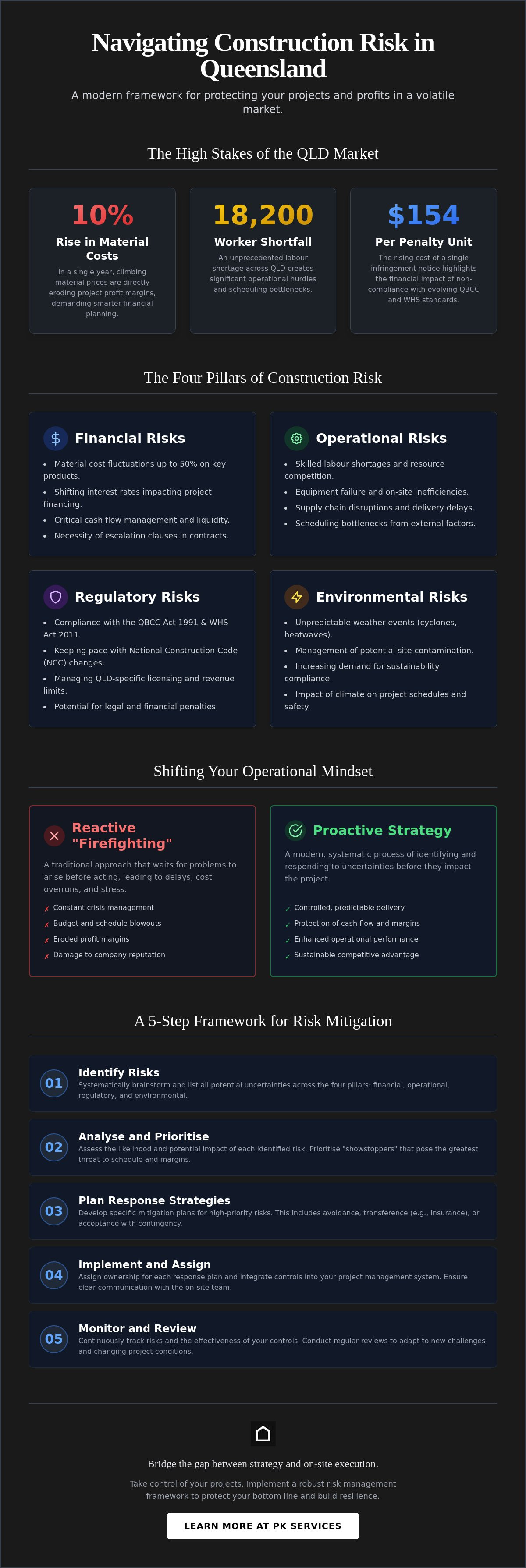
A 5-Step Framework for Managing Project Risks on QLD Sites
Theory is only useful if it works on-site. Implementing a robust construction project risk management QLD framework requires a disciplined, five-step approach. This process ensures that uncertainties are quantified rather than feared. It moves your project from a state of chance to a state of control. By following a structured method, you build a culture of accountability that protects your bottom line.
- Step 1: Context Establishment. Define your specific QLD site constraints and project goals. A high-density build in Brisbane faces different logistical hurdles than a regional civil project.
- Step 2: Risk Identification. Spot potential "showstoppers" early. This is where local knowledge and historical data pay dividends.
- Step 3: Qualitative and Quantitative Analysis. Prioritise risks based on likelihood and impact. Focus your energy on the variables that could truly derail your margin, such as the 30% price hikes seen in critical materials.
- Step 4: Mitigation Strategy. Decide your response. You can avoid, transfer, mitigate, or accept the risk based on your firm's appetite for uncertainty.
- Step 5: Continuous Monitoring. Update your risk register regularly. A risk plan is a living document, not a shelf-filler.
Step 2: Leveraging Local Expertise for Identification
Site-level failures often start with a lack of communication. Involving experienced tradespeople in the risk process is vital. They understand the practical realities of QLD soil, climate, and local supply chains. Using data from previous local builds allows you to predict issues before they surface. A pre-mortem involves imagining the project has already failed and working backward to identify the specific causes that led to that hypothetical disaster. This mental exercise exposes blind spots that a simple spreadsheet might miss.
Step 4: Practical Mitigation Tactics
Your response to risk defines your resilience. Transferring risk is often achieved through robust insurance policies and tight subcontracting agreements. This shifts the financial burden away from your primary margin. Mitigating risk requires superior project management and rigorous site oversight. It's about reducing the probability of an event or lessening its impact through better planning. For a look at how this works in practice, our case study on Turnkey Construction Project Management Sydney illustrates the power of seamless delivery across complex sites. If you want to protect your next build, engage our team to manage your entire process from start to finish.
Bridging the Gap: From Strategic Advice to On-Site Execution
A sophisticated risk strategy is only as strong as the person holding the tools. Even the most detailed framework for construction project risk management QLD will fail if it remains trapped in a boardroom folder. True resilience is found in the transition from high-level consulting to daily site activity. When strategy and execution are siloed, gaps emerge. These gaps are where margins disappear and safety incidents occur.
Integrated project management is the solution. It ensures that the proactive "Strategist" mindset we discussed earlier filters down to every subcontractor and labourer. This requires a leadership style that values transparency and immediate feedback. Site leaders must maintain a "risk-aware" culture where identifying a potential issue is seen as a contribution to the project's success, not a delay. It's about ensuring the vision for the build matches the reality of the work.
The Role of Skilled Trades in Risk Mitigation
Experienced contractors are your first line of defence against physical site risks. They spot the unstable trench or the incorrect material grade long before it leads to an accident or a costly rework. Reducing quality-related risks is impossible without superior trade standards. When a job is done right the first time, you eliminate the "hidden" costs of return visits and defect rectification. These small efficiencies protect your final profit margin.
Reliability is the currency of the 2026 market. With 15 years of industry expertise, we understand that selecting the right labour is a strategic decision. It isn't just about filling a spot on a roster. It's about finding professionals who understand the specific constraints of Queensland sites. High-calibre tradespeople don't just follow instructions; they actively contribute to the project's safety and efficiency through their technical proficiency.
Seamless Integration: The PK Services Advantage
We redefine excellence by removing the friction between planning and doing. By managing the entire process from start to finish, we eliminate the communication silos that often plague large-scale builds. Our approach combines high-level business consulting with direct trade services, ensuring your internal processes are optimised for total risk control. This dual capability allows us to pivot quickly when local conditions change, keeping your project on track and your margins secure.
Effective risk management isn't a one-off task. It's a commitment to superior standards at every stage of the lifecycle. Whether you need strategic oversight or reliable trades to fill essential gaps, we provide the expertise to ensure a seamless delivery. Don't leave your project's success to chance. Partner with PK Services to redefine your project excellence and protect your bottom line in the evolving Queensland market.
Future-Proof Your Construction Margins
Mastering construction project risk management QLD is no longer optional. It's the foundation of a resilient business. Shifting from reactive firefighting to a proactive strategy protects your cash flow and your reputation. A structured framework and the right on-site leadership turn market volatility into a competitive edge. The gap between a high-level plan and site execution is where excellence is truly defined.
Success requires a partner who understands both the boardroom and the boots on the ground. We bring over 15 years of Australian industry expertise to every project. Our approach integrates professional consulting with skilled trades to manage the entire project lifecycle. We eliminate silos and focus on results. It's time to elevate your standards and secure your next build.
Redefine your construction excellence with PK Services. Let's build a more certain future together.
Frequently Asked Questions
What are the most common construction risks in Queensland?
The most common risks in the current Queensland market include volatile material costs, chronic labour shortages, and the intense demand for resources driven by the state's record infrastructure boom. These factors create a high-pressure environment where supply chain delays and price hikes of up to 50% for certain products can quickly erode your planned profit margins.
How does QBCC regulation affect project risk management?
QBCC regulations set the mandatory financial and licensing standards you must meet to operate legally in Queensland. These rules ensure contractors maintain enough liquidity to finish projects, which directly impacts how you manage financial risk. Staying compliant is essential to avoid heavy penalties, as infringement notices now cost $154 per penalty unit.
What is the difference between a risk register and a safety plan?
A risk register is a broad business tool that tracks all potential threats to a project's success, including financial, legal, and operational uncertainties. In contrast, a safety plan focuses exclusively on preventing physical injury and ensuring workplace health and safety compliance on-site. One protects your business viability; the other protects your people.
Can small construction firms afford professional risk management consulting?
Small firms can't afford to ignore professional risk management, as a single project failure can lead to insolvency. Investing in expert consulting prevents the costly variations and delays that typically erode small-business margins. Professional oversight often pays for itself by identifying "showstoppers" long before they become expensive site-level disasters.
How often should a construction risk assessment be updated?
A construction risk assessment should be updated at every major project milestone or whenever local market conditions shift significantly. It isn't a "set and forget" document. Regular reviews ensure your mitigation strategies remain relevant as the build progresses from excavation through to final fit-out.
What role do subcontractors play in a project risk management strategy?
Subcontractors are your eyes and ears on the ground, providing the technical expertise needed to spot site-level hazards early. Their reliability and commitment to your risk-aware culture determine whether your strategy succeeds or fails on the tools. Selecting high-calibre trades is a critical part of reducing operational uncertainties.
How does weather impact construction risk in QLD specifically?
Weather in Queensland presents unique challenges like cyclone season and mandatory extreme heat protocols. These events aren't just safety concerns; they trigger work stoppages that can derail a tight timeline. Successful construction project risk management QLD requires building specific weather-related buffers into your initial project schedule to account for these local variables.
Why is proactive risk management better for project ROI?
Proactive construction project risk management QLD improves ROI by stopping problems before they require expensive fixes or rework. It reduces the likelihood of liquidated damages and ensures your resources are always used efficiently. By designing resilience into your workflow, you maintain control over your margins rather than simply reacting to external shocks.


