

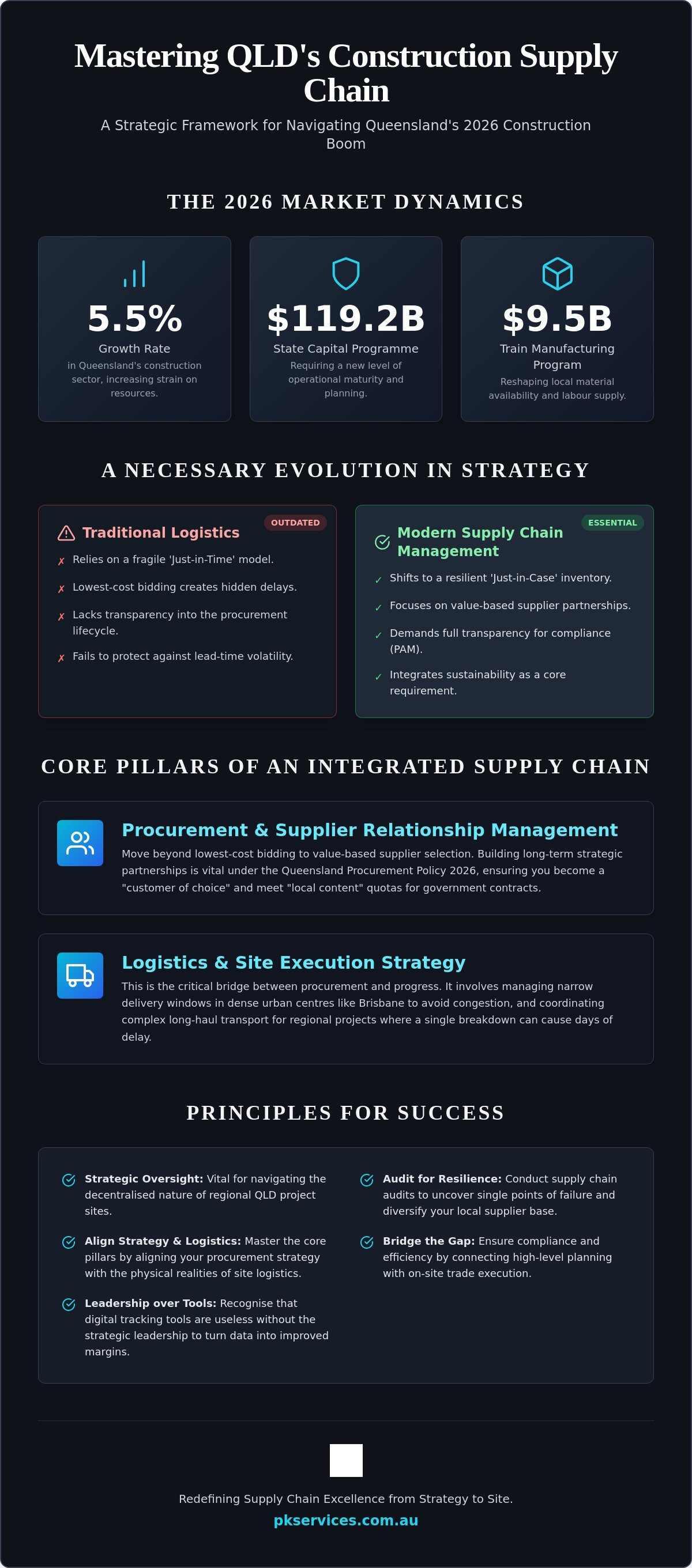
In 2026, a high-performing site isn't defined by the size of your crane; it's defined by the resilience of your procurement strategy. With Queensland's construction sector hitting a 5.5% growth rate, you're likely feeling the strain of unpredictable material lead times and a tightening labour market. It's frustrating when complex requirements or trade shortages stall your momentum. Mastering construction supply chain management QLD is now the only way to keep your projects on track and your schedules predictable.
We understand that the pressure to deliver on the state's record $119.2 billion capital programme requires a new level of operational maturity. This guide provides a strategic framework to help you achieve seamless integration of materials and labour while ensuring full compliance with the new Queensland Procurement Policy 2026. We'll show you how to refine your site execution, navigate the Procurement Assurance Model, and protect your operational margins through 2026 and beyond.
Key Takeaways
- Understand why strategic oversight of materials and labour is vital for navigating the decentralised nature of regional Queensland project sites.
- Master the core pillars of construction supply chain management QLD by aligning your procurement strategy with the physical realities of site logistics.
- Learn to distinguish between digital tracking tools and the strategic leadership required to turn data into improved operational margins.
- Identify how to conduct a comprehensive supply chain audit to uncover single points of failure and diversify your local supplier base.
- Discover how bridging the gap between high-level planning and on-site trade execution ensures compliance with the latest government procurement policies.
What is Construction Supply Chain Management in the QLD Context?
Effective construction supply chain management QLD is the invisible engine driving every successful build in our state. It isn't just about moving bricks from a warehouse to a site. It is the sophisticated oversight of materials, digital information, and skilled labour. When we look at the broader question of What is Supply Chain Management? we see it's the coordination of every moving part from the raw resource to the final fit-out. In Queensland, this requires a deep understanding of our decentralised geography. Managing a project in the Brisbane CBD is a different beast compared to a regional build in Townsville or the Far North.
This strategic framework ensures that the right resources arrive exactly when they're needed. It's about maintaining site momentum. If your steel is stuck in a staging yard and your trades are standing around, your margins are evaporating. For modern Australian firms, SCM has become the backbone of operational excellence. It's the difference between a project that stays in the black and one that gets buried under the weight of its own delays.
The QLD Landscape: 2026 Market Dynamics
The $9.5 billion Queensland Train Manufacturing Program is currently reshaping local material availability across the state. This massive investment means the government is prioritising local content, often tightening the supply of specialised steel and manufacturing labour for private builders. You're competing for resources in a high-demand environment.
Logistics in the 'Golden Corridor' between Brisbane and the Gold Coast have also reached a tipping point. With the 2026-27 State Budget allocating $29.6 billion for capital works, the pressure on transport networks is immense. Successful construction supply chain management QLD now requires builders to secure supply windows months in advance. You can't rely on last-minute orders when the state's infrastructure demand is this aggressive.
Why Traditional Logistics No Longer Suffice
The old 'just-in-time' model is dead. It's too fragile for the current climate. Forward-thinking firms have shifted to 'just-in-case' inventory strategies. This involves holding critical buffers of essential materials to protect against lead-time volatility. It's a safer, more resilient way to build.
Transparency is also no longer optional. Tier-1 contractors now demand full visibility into the procurement lifecycle. This isn't just for efficiency; it's about compliance with the new Procurement Assurance Model (PAM). You need to prove where your materials come from and how much waste you're generating. Integrating sustainability into your procurement isn't just good for the planet. It's a core requirement for winning government contracts in 2026. Modern SCM is about being clean, lean, and completely transparent.
Core Pillars of an Integrated Construction Supply Chain
To truly master construction supply chain management QLD, you must look beyond the purchase order. Integration is the new standard. It demands a shift from reactive buying to proactive orchestration across four specific pillars. When these pillars align, your site moves with a rhythm that protects both your schedule and your bottom line. It's about creating a system where materials, data, and people work in total synchronisation.
Procurement and Supplier Relationship Management
Lowest-cost bidding is a dangerous trap. It often leads to hidden delays that cost far more than the initial "saving" on paper. In 2026, sophisticated builders are moving toward value-based supplier selection. This is particularly vital under the Queensland Procurement Policy 2026, which prioritises local impact and small business participation. You need partners who don't just deliver goods but understand your project values and the specific "local content" quotas required for government contracts. Building long-term strategic partnerships ensures you aren't at the back of the queue when global material allocations get tight. It's about being a "customer of choice" in a competitive market.
Logistics and Site Execution Strategy
Site logistics is the bridge between procurement and physical progress. In dense urban centres like Brisbane, this means managing narrow delivery windows to avoid site congestion and council fines. You can't have three semi-trailers turning up at once on a restricted city street. Conversely, regional Queensland projects face the challenge of long-haul logistics. You're coordinating transport across vast distances where a single transport breakdown can stall a site for days. Effective construction supply chain management QLD requires a logistics plan that accounts for these geographic extremes, ensuring the flow of goods never interrupts the flow of work.
Labour as a Supply Chain Component
Most firms make the mistake of treating labour as a separate HR issue. In reality, labour is a critical supply chain component. A pallet of bricks is useless without the bricklayer. Identifying gaps in your trade schedule early prevents the most common project bottlenecks. This is why securing reliable construction trade services is just as critical as ordering your structural steel. When skilled labour is treated as a vital "supply" that must be managed and scheduled with the same precision as materials, the entire project lifecycle stabilises. This integrated view is exactly what defines a refined approach to project management in the modern era.
Information Flow and Real-Time Data
Data is the glue that holds these pillars together. Real-time information sharing between architects, suppliers, and site managers is no longer a luxury. If a design change occurs on-site, your supplier needs to know before the custom components are manufactured. Seamless information flow reduces rework and ensures that every stakeholder is working from the same "source of truth". It eliminates the guesswork that usually leads to costly site delays.
Software vs. Strategy: Choosing Your Management Approach
Technology is a tool, not a strategy. You can spend hundreds of thousands on high-end ERP systems and still face site delays. Why? Because software only reports on the status quo. It doesn't navigate the complexities of construction supply chain management QLD. Real results come from combining robust systems with expert human insight. Software tracks problems; it doesn't solve them. For effective site execution, you need a brain behind the dashboard. Digital tools are essential for visibility, but they cannot replace the intuition of an experienced project leader.
The Limits of Automated SCM Systems
Automated systems are great for tracking. They fail when things go wrong. A software package cannot negotiate with a supplier during a global shortage. It lacks the personal relationships that secure priority material allocations when local demand spikes. Furthermore, software can't manage the "soft" factors of a project. Trade culture, site morale, and communication flow are human variables. If your site team isn't engaged, no amount of digital tracking will keep the project on schedule. Data accuracy is also a major risk. If site supervisors don't enter data correctly, your ERP becomes a liability. You need human oversight to keep the digital records honest. Garbage in, garbage out is a reality that tech alone can't fix.
The Value of Strategic Advisory in 2026
Bespoke strategy is the antidote to the "software trap." Expert advisors identify the hidden bottlenecks that an algorithm ignores. This is the core of construction business consulting Australia. It's about redefining excellence from the boardroom to the site gate. Strategic advisory is particularly essential for navigating the Procurement Assurance Model (PAM) introduced in January 2026. Software can't help you build the capability and accountability required by this new regime. Advisors do. They help you document your processes and prove your compliance. This keeps you eligible for the record $29.6 billion allocated for capital works in the 2026-27 State Budget. Strategy protects your access to these massive government opportunities. It ensures your construction supply chain management QLD is as dynamic as the market itself.
The most successful firms in 2026 use a hybrid model. They invest in capable software to handle the heavy lifting of data entry and logistics tracking. However, they also partner with consultants to interpret that data. This combination ensures that when the ERP flags a delay, you have a strategic plan ready to mitigate the impact. It's about having the best of both worlds: digital speed and human wisdom. Don't let your tech investment become a substitute for leadership. Use it as the foundation for a more sophisticated, human-led strategy.
Practical Steps to Optimise Your QLD Supply Chain
Optimisation begins with a cold, hard look at your current vulnerabilities. Conduct a comprehensive supply chain audit today. You need to identify every single point of failure in your procurement line. If you rely on one quarry or a single steel fabricator, you're one mechanical breakdown away from a site shutdown. Effective construction supply chain management QLD requires a diversified supplier base that can absorb regional shocks. Don't wait for a crisis to find out your chain is too brittle. Build redundancy into your material flow now.
Risk Management and Resilience Planning
Queensland's climate is a constant variable. Cyclones in the north and flash flooding in the south-east can sever transport links overnight. Develop contingency plans that treat weather disruptions as a certainty, not a possibility. For critical path items like structural steel or specialised plant, secure your materials at least 6 months in advance to bypass lead-time volatility. Diversifying your risk profile ensures that a single transport failure or factory closure won't liquidate your project's profit margins.
Local Content and Regulatory Compliance
The "Buy Queensland" approach is the cornerstone of state-funded work. Under the Queensland Procurement Policy 2026, government agencies now use the Procurement Assurance Model (PAM) to evaluate your local impact. This model focuses on capability building and accountability. You must document exactly how your project contributes to the local economy. This involves more than just hiring local trades; it's about sourcing materials from QLD-based manufacturers where possible—for instance, you can visit QLD Shade to source high-quality outdoor shutters from a local specialist. Leveraging local trade networks helps you satisfy community engagement requirements and builds a more resilient project ecosystem. It's about showing that your project leaves a positive footprint on the community.
Quality control is the final piece of the puzzle. Rigorous construction site supervision Sydney standards provide a blueprint for the high-level oversight we implement on QLD sites. High standards ensure that the materials you've fought to procure are installed correctly the first time. This eliminates rework and protects your margins. If you're ready to harden your project against market volatility, optimise your supply chain strategy with expert guidance from partners who understand the local landscape.
PK Services: Redefining Supply Chain Excellence from Strategy to Site
Excellence in construction supply chain management QLD is not a theoretical concept. It is a practical result of aligning high-level planning with grit on the ground. At PK Services, we bridge the gap between the boardroom and the site gate. With 15 years of industry expertise across the Queensland and New South Wales construction sectors, we've seen every challenge the market can throw at a project. We don't just offer advice. We offer a redefined standard of service that combines business consulting with direct trade execution. Our approach moves beyond generic implementations to focus on the people and processes that actually build our state.
End-to-End Project Lifecycle Management
We manage the entire process from start to finish. This inception-to-completion model is rare in a fragmented industry. Most firms offer either strategy or labour; we provide both. By integrating strategic advisory with reliable contractor services, we ensure that your procurement plans aren't just good on paper. They are executable on-site. This holistic management style ensures seamless transitions between material orders and site deliveries. It removes the traditional silos that cause delays and cost overruns. When one team manages the entire chain, accountability is absolute and communication is instant. You get a streamlined workflow that protects your project's momentum from day one.
Partner with PK Services for Your Next Project
The skilled labour shortage remains a significant hurdle for builders in 2026. We address this by treating our tradespeople as a strategic asset. Our approach ensures you have the right people on-site to maintain momentum, regardless of market volatility. You experience the personal touch of a boutique consulting firm while benefiting from elite, high-level standards. Our leadership team remains accessible and involved. We provide bespoke construction supply chain management QLD solutions tailored to your unique operational goals. We are a modern alternative to traditional firms. We value results, simplicity, and direct personal connection above all else.
Don't settle for generic advice or disconnected trade services. Experience a partnership that values your margins as much as you do. Our commitment to evolution and quality ensures your project stands out in a crowded market. If you're ready to secure your project's future and navigate the complexities of the 2026 landscape, it's time to talk. Organise a strategic consultation with PK Services today and let's redefine what's possible on your next site.
Securing Your Project Momentum in 2026
The landscape of construction supply chain management QLD has fundamentally shifted. It's no longer enough to react to disruptions as they happen; you must build a strategy that actively anticipates them. We've explored how strategic procurement, integrated labour, and the new Procurement Assurance Model now define project success in this competitive market. Achieving your desired operational margins requires a precise balance of digital visibility and veteran human insight. Strategy is the engine, but skilled execution is the fuel.
Don't let fragmented logistics or trade shortages stall your site's progress. With 15+ years of Australian construction expertise, PK Services specialises in managing the entire project lifecycle across QLD and NSW. We offer a unique blend of elite consulting and skilled trade services to help you protect your margins and maintain momentum. It's time to move beyond the traditional firm and embrace a partner who understands both the grit of the site and the complexity of the strategy. Redefine your construction standards with PK Services today. Let's build a more resilient future for your business together.
Frequently Asked Questions
What is the primary challenge for construction supply chains in QLD?
The primary challenge is the decentralised geography combined with extreme weather volatility. Queensland's vast distances mean regional sites are often isolated, making them vulnerable to transport disruptions during cyclone or flood seasons. Builders must manage these long-haul logistics while competing for resources in a high-demand market. It's a complex environment that requires constant oversight.
How does the 'Buy Queensland' policy affect construction procurement?
The 'Buy Queensland' policy mandates that government agencies prioritise local suppliers and small businesses to drive regional economic growth. This means you must document your local content and social impact to remain competitive for state-funded projects. It shifts the focus from the lowest price to the greatest local value. Compliance is now a core requirement for winning major contracts.
Can strategic consulting replace the need for supply chain software?
Strategic consulting doesn't replace software; it gives you the insight to use that software effectively. While an ERP system tracks data, a consultant helps you interpret those numbers to identify hidden risks and opportunities. You need the digital tools for visibility and the strategic leadership to act on that information. It's about combining digital speed with human wisdom.
What is the difference between logistics and supply chain management in construction?
Logistics focuses on the physical movement and storage of goods, while supply chain management is the broader strategic oversight of the entire lifecycle. Logistics is about getting the bricks to the site on time. SCM includes procurement, information flow, and labour integration to ensure the project remains profitable and compliant. One is a subset of the other.
How do I secure skilled trades for a project in regional Queensland?
Securing trades in regional areas requires building long-term partnerships and offering clear, reliable site schedules. You can't rely on the spot market in remote locations. Engaging a firm that manages both construction supply chain management QLD and trade services ensures you have a consistent labour supply regardless of the project's location. Planning ahead is the only way to avoid bottlenecks.
What are the key components of a construction supply chain audit?
A comprehensive audit includes evaluating supplier financial health, identifying single points of failure, and assessing lead-time accuracy. You should also review your compliance with the Procurement Assurance Model (PAM). The goal of construction supply chain management QLD audits is to uncover hidden vulnerabilities before they turn into site delays. It's a proactive health check for your project.
How can I reduce material waste through better supply chain management?
Waste reduction is achieved through precise procurement timing and improved site supervision. By ensuring materials arrive only when needed, you reduce the risk of on-site damage and theft. Better communication between the site and suppliers ensures that order quantities match the actual design requirements. This prevents over-ordering and keeps your margins protected.
Is it better to use local or national suppliers for QLD projects?
It's often better to use local suppliers to satisfy government content requirements and reduce transport risks. Local partners have a better understanding of regional logistics and can respond faster to site changes. However, a balanced approach that uses national suppliers for bulk commodities can provide additional price stability. The right mix depends on your specific project location and scale.


