

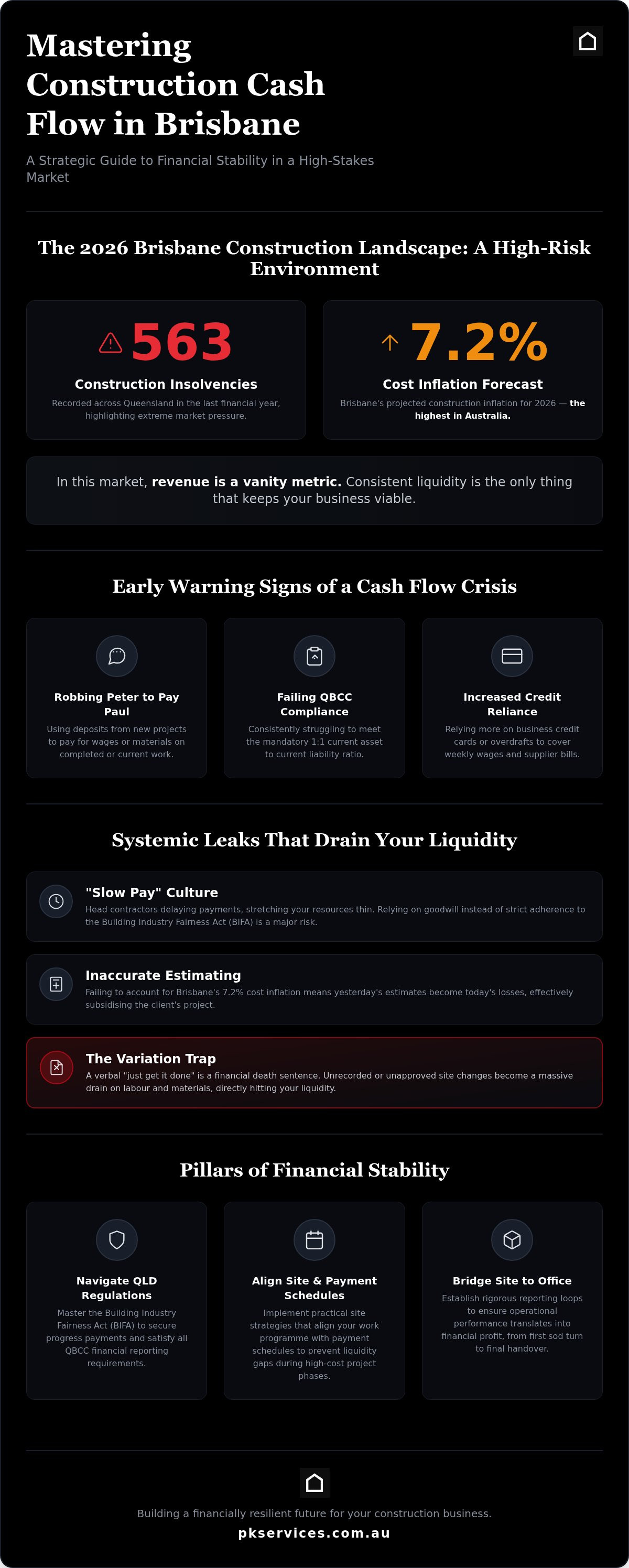
With 563 construction insolvencies across Queensland in the last financial year, the margin for error has never been thinner. Brisbane's construction cost inflation has climbed to 7.2 per cent in 2026, the highest in Australia. It's a high stakes environment where a single delayed progress payment can stall a major project. Effectively managing construction cash flow problems Brisbane businesses encounter requires more than just basic bookkeeping. It demands a tactical approach to site to office execution.
You likely feel the pressure of meeting the QBCC's strict 1:1 current ratio while labour costs continue to rise. It's exhausting to chase head contractors for payment while trying to keep your subbies on side. We understand the stress of navigating the Building Industry Fairness Act while maintaining project momentum. This guide promises to help you master the local regulatory landscape and implement operational strategies that ensure consistent liquidity. We will break down compliance requirements, simplify variation management, and show you how to turn your operational performance into a financial fortress.
Key Takeaways
- Identify the specific 2026 market pressures and why managing construction cash flow problems Brisbane firms encounter is the key to surviving record inflation.
- Navigate the complexities of the Building Industry Fairness Act (BIFA) to secure your progress payments and satisfy QBCC financial reporting requirements.
- Implement site strategies that align your work programme with payment schedules to prevent liquidity gaps during high-cost project phases.
- Bridge the gap between high-level strategy and site execution to ensure your business remains profitable from the first sod turn to the final handover.
The Brisbane Construction Landscape: Why Cash Flow is King in 2026
Brisbane's construction sector is currently a paradox. While the pipeline for the 2032 Olympics and massive health infrastructure projects is full, the financial pressure on local builders has reached a breaking point. Forecasts show Brisbane's construction cost inflation hitting 7.2 per cent in 2026. This is the highest rate in Australia. In this environment, revenue is a vanity metric. Liquidity is the only thing that keeps the gates open.
Many local firms fall into the "paper profits" trap. Your books might show a healthy margin; however, if that money is tied up in unapproved variations or delayed progress claims, your business is at risk. Regional economic shifts in Queensland, specifically the surge in data centre and defence projects, have pulled skilled labour away from residential and commercial sites. This competition drives up costs and stretches payment cycles. Effectively managing construction cash flow problems Brisbane contractors face means looking beyond the balance sheet to the actual timing of cash movements.
Legal frameworks like Security of Payment legislation provide a safety net. Yet, many builders fail to use these tools until it's too late. When building material costs rise 38.3 per cent over a few years, your estimating must be flawless. If it's not, your cash flow will vanish before the project reaches lock-up.
The High Stakes of Liquidity in SEQ
In South East Queensland, the ripple effect of a single delayed payment is devastating. If a head contractor holds back funds, you can't pay your subbies. They walk off the job. Project momentum dies. This site-level failure creates a vicious cycle that erodes your reputation and your bank balance. Brisbane firms are particularly vulnerable to supply chain volatility because our local market is currently competing with global-scale infrastructure demands. Poor liquidity management doesn't just cost money. It costs you your best people.
Identifying Your Early Warning Signs
Recognising trouble before it becomes a crisis is vital. Watch for these red flags:
- Using deposits from new projects to pay for completed work.
- Struggling to meet the QBCC 1:1 current ratio requirement.
- Increasing reliance on credit to cover weekly wages.
Over-trading is a common killer on large-scale Brisbane developments. Taking on more work than your working capital can support leads to a sudden collapse. If you're constantly robbing Peter to pay Paul, seek professional construction business consulting in Queensland. It's better to stabilise your current projects than to chase new ones with a broken financial engine.
Common Causes of Construction Cash Flow Problems
Cash flow doesn't just evaporate. It's usually bled out through small, systemic leaks. In Brisbane, the "slow pay" culture is a primary offender. Head contractors often sit on funds, stretching your liquidity to its limit. If you aren't strictly following the Building Industry Fairness (Security of Payment) Act, you're leaving your bank balance to chance. Relying on goodwill rather than strict payment schedules is a recipe for disaster.
Inaccurate estimating is another silent killer. With Brisbane's construction cost inflation forecast at 7.2 per cent for 2026, yesterday's estimates are today's losses. Failing to account for this price creep means you're effectively subsidising the client's project. High overheads and idle plant equipment further drain resources. Every day a machine sits unused or a labour gap prevents a milestone, you risk liquidated damages. These penalties eat your margin and stall your cash flow. Effectively managing construction cash flow problems Brisbane firms experience requires a ruthless look at these operational inefficiencies.
The Variation Trap
Brisbane builders lose thousands on unrecorded site changes. A verbal "just get it done" is a financial death sentence. Without immediate documentation and signed agreement, variations become a massive drain on your labour and materials. Your site team must realise that every unapproved change is a direct hit to the company's liquidity. Establishing a rigorous site to office reporting loop is the best way to stop this bleed. If you need help tightening these processes, professional project management support can bridge the gap between site reality and office strategy.
Forecasting vs. Reality
A budget is a plan; a cash flow forecast is a reality check. Many firms mistake the two. A budget tells you what you should spend. A forecast tells you when the money actually leaves your account. Managing construction cash flow problems Brisbane businesses face requires building a buffer into every project lifecycle. This accounts for the 5 to 10 per cent usually held in retention sums or bank guarantees. If you don't plan for that missing cash, you'll find yourself short when the BAS or payroll is due. Accurate forecasting ensures you have the liquidity to survive the inevitable delays of a complex build.
Navigating Queensland Regulations: BIFA and Security of Payment
Queensland's regulatory framework is unforgiving. By August 2026, the Building Industry Fairness (Security of Payment) Act 2017 (BIFA) remains the primary mechanism for ensuring cash flow. It isn't optional. If you miss a deadline or issue an invalid claim, your liquidity suffers. Respondents must provide a payment schedule within 15 business days of receiving a claim. If they don't, you have a legal right to the full amount. This is a powerful tool for any builder facing a "slow pay" culture.
Effectively managing construction cash flow problems Brisbane firms face often comes down to precise timing. Remember that "business days" exclude the Christmas break from 22 December to 10 January. Plan your claims accordingly to avoid a January dry spell. Beyond timing, the quality of your team is vital. Properly vetting construction subcontractors in Australia ensures you aren't carrying the financial weight of underperforming partners who trigger payment disputes.
The QBCC Minimum Financial Requirements (MFR) are equally strict. You must maintain a current ratio of at least 1:1 at all times. For SC1 licensees with turnover up to $800,000, your Net Tangible Assets (NTA) must be at least $12,000. For SC2 licensees, that figure rises to $46,000. These aren't just annual reporting hurdles. They are daily operational benchmarks. If your liquidity dips below these thresholds, you risk losing your licence and your livelihood.
Making Valid Payment Claims
A BIFA-compliant invoice must be clear and technically correct. It must identify the work, state the amount, and clearly request payment. Missing even a minor detail can render the entire claim invalid. This gives head contractors an easy excuse to withhold funds. We see many Brisbane builders lose momentum simply because their paperwork doesn't meet the legal standard. Consistency in your invoicing process is your best defence against cash flow gaps.
Project Trust Accounts
Strategy in the boardroom means nothing if it isn't executed on the slab. Effective site management is the cornerstone of managing construction cash flow problems Brisbane firms encounter. You must align your work programme with your payment schedule. If you spend $100,000 on materials but can't claim for them for six weeks, you've created a self-inflicted crisis. Front-loading claims where contractually possible and ethical helps cover these initial outlays. It's about ensuring the project's financial engine stays fuelled.
Maintaining momentum is the only way to stay ahead of rising fixed costs. Implementing full cycle construction project management allows you to spot bottlenecks before they stall your site. Daily site reporting must feed directly into your office systems. If a variation occurs at 10:00 am, your office should know by 4:00 pm. This speed is essential for managing construction cash flow problems Brisbane contractors face in 2026. Waiting until the end of the month to tally costs is a strategy for failure.
Labour and Trade Coordination
Labour availability is the primary driver of cost escalation in 2026. A gap in your trade schedule does more than just delay the build. It creates "dead time" where your overheads continue but progress stops. Accessing reliable skilled trades for construction sites is critical to hitting your milestones on time. Balancing your internal team with flexible contractors allows you to scale without the permanent weight of a massive payroll during quiet weeks.
Procurement and Inventory Control
Inventory is simply cash sitting on the ground. In a volatile market, the choice between just-in-time delivery and bulk buying is a delicate balancing act. Bulk buying can lock in prices against the 7.2 per cent inflation rate, but it also ties up your liquidity. You should negotiate better terms with local Brisbane suppliers to keep your cash moving. Reducing site waste is the simplest way to protect your margins. Every skipped bin of wasted material is money that should have stayed in your pocket. If you're ready to tighten your operational performance, partner with experts who manage the entire process from start to finish.
Redefining Excellence: How PK Services Stabilises Your Business
PK Services doesn't just offer advice. We provide a bridge between the high level strategy of the boardroom and the gritty reality of the Brisbane building site. Our approach to construction business consulting Australia is designed to turn operational chaos into financial stability. We understand that managing construction cash flow problems Brisbane builders face requires more than just a spreadsheet. It requires a partner who understands the local trade market and the strict QBCC regulatory environment.
Our tailored solutions are built on over 15 years of Australian industry experience. We focus on the specific levers that improve construction business profitability in NSW and QLD. By managing the entire process from start to finish, we remove the friction that usually leads to liquidity gaps. This end to end project management takes the pressure off business owners. You can focus on growth while we handle the operational performance that keeps the cash moving. We bridge the gap between strategy and execution, ensuring that your financial targets aren't just goals, but realities.
Strategic Advisory and Process Management
A construction business health check is our starting point. We look at your internal workflows to identify where progress claims are stalling. If your site to office communication is slow, your cash flow will be too. We redefine your standards for operational excellence by ensuring every variation is captured and every milestone is hit. This isn't just about compliance; it's about building a resilient, high tier business that stands out in the competitive Brisbane market. We help you implement systems that make managing construction cash flow problems Brisbane businesses face a predictable part of your routine rather than a constant crisis.
Your Partner from Start to Finish
We go beyond traditional consulting by supplying the skilled trades you need to maintain project momentum. This direct involvement ensures that labour shortages, the primary driver of cost escalation in 2026, don't become financial bottlenecks. We manage the entire lifecycle of your projects to ensure seamless execution from the first sod turn to the final handover. This is a fresh, redefined approach to professional relationships that values both high end results and personal connection. Take the first step toward a more stable future. Book a strategic dialogue with our team today to discuss how we can stabilise your operations and ensure consistent liquidity.
Build a Resilient Future for Your Brisbane Firm
Stabilising your liquidity requires a shift from reactive firefighting to proactive site execution. We've explored how BIFA compliance and precise site-to-office reporting create a financial safety net. You now have the tools to align your work programme with your payment schedule and avoid the variation trap. Successfully managing construction cash flow problems Brisbane firms experience is about mastering these operational details before they become crises.
Our team brings 15+ years of strategic construction expertise to your projects. We are specialists in the Queensland and NSW markets, offering end-to-end management from strategy to site. We don't just advise; we partner with you to supply the trades and processes that maintain momentum. It's time to move beyond survival and start scaling with confidence in a volatile market.
Redefine your construction standards with PK Services and ensure your business remains liquid, compliant, and profitable. You've built the foundation; let's secure the structure together.
Frequently Asked Questions
What is the most common cause of construction business failure in Brisbane?
The most common cause is over-trading where businesses take on more work than their working capital can support. In the 2025-26 financial year, Queensland saw 563 construction insolvencies, often triggered by a single failed progress payment. When firms rely on deposits from new projects to pay for previous work, they create a fragile cycle. This lack of liquidity makes them vulnerable to Brisbane's 7.2 per cent inflation rate, leading to rapid collapse.
How does the Building Industry Fairness Act (BIFA) protect my cash flow?
BIFA protects your cash flow by providing a statutory right to progress payments and enforcing strict response timelines. A respondent must provide a payment schedule within 15 business days of receiving your claim. If they fail to do so, they become liable for the full amount. This legislation reduces the "slow pay" culture by giving contractors a clear legal path to recover debt without lengthy court battles, ensuring consistent liquidity on Brisbane sites.
Can I use a Project Bank Account for all my Brisbane construction projects?
No, Project Trust Accounts, formerly known as Project Bank Accounts, are mandatory only for specific project types and values under Queensland law. Currently, they apply to most government and private sector projects valued over $1 million. These accounts ensure that funds for subcontractors are held in trust, protecting them from being used for the head contractor's general business expenses. Managing construction cash flow problems Brisbane builders face requires understanding if your specific contract triggers these requirements.
What is the difference between cash flow and profitability in construction?
Profitability is the theoretical margin left after all project costs are deducted from the contract value; however, cash flow is the actual movement of money in and out of your bank. You can be profitable on paper while being insolvent in reality. If your capital is tied up in retentions or unapproved variations, you won't have the liquidity to pay wages. Managing construction cash flow problems Brisbane firms encounter means prioritising the timing of payments over paper profits.
How can I speed up payments from head contractors in Queensland?
To speed up payments, ensure every invoice is fully BIFA-compliant and submitted exactly as the contract requires. Accuracy is your best tool. If your claim is technically flawed, the head contractor has a legal excuse to delay. You should also maintain a rigorous site to office reporting loop. This ensures that variations are documented and signed off immediately, preventing the long delays often associated with disputed final accounts at the end of a project.
Does PK Services provide trades to help hit project milestones?
Yes, PK Services provides skilled trades to ensure your project maintains momentum and hits critical milestones. We understand that labour shortages are the primary driver of cost escalation in 2026. By supplying reliable personnel, we help you avoid the "dead time" that causes cash flow bottlenecks. This service is part of our end to end management approach, bridging the gap between high level strategy and the daily execution required on Brisbane sites.
What should I do if a client refuses to pay a variation on a Brisbane site?
If a client refuses to pay a variation, you should immediately review your contract's dispute resolution clause and the BIFA adjudication process. Never continue variation work without written authorisation. If the work is already complete, you can include the variation in your next payment claim. If they still don't pay, BIFA allows you to apply for an independent adjudicator to make a binding decision, providing a faster alternative to traditional litigation in Queensland.
How often should I update my construction cash flow forecast?
You should update your cash flow forecast at least once a week to reflect site reality. In a market where material costs can shift rapidly, a monthly update is often too slow to catch emerging problems. Regular updates allow you to spot potential shortfalls before they occur. This gives you time to negotiate with suppliers or accelerate claims, ensuring you always meet the QBCC's 1:1 current ratio requirement for financial reporting.


