

What if the fixed-price safety net you're leaning on is actually the very thing strangling your project's ROI? In the 2026 market, many NSW developers find that the "cheapest" quote often leads to the most expensive headaches once DBP Act requirements kick in. You've likely felt the sting of hidden costs or the confusion over who truly carries the risk for site safety and defects. It's a high-stakes environment where a single oversight can derail months of planning and lead to significant productivity losses.
Deciding between a general contractor vs construction manager NSW is no longer just a matter of preference; it's a strategic move to protect your capital. We'll show you how to navigate these two distinct paths so you can secure a partner who manages the entire lifecycle from strategy to site. This guide explores how each model handles modern regulatory pressures, ensures compliance with shifting building standards, and determines who remains accountable when the boots hit the ground. You'll gain a clear roadmap to choosing the right structure for your next build while maintaining total transparency over your investment.
Key Takeaways
- Understand how a general contractor offers price certainty through lump-sum models, effectively transferring site safety and defect risks.
- Explore the construction manager approach for open-book accounting and strategic flexibility during the early planning stages.
- Evaluate the general contractor vs construction manager NSW debate based on your project's scale, complexity, and desired level of control.
- Ensure your 2026 project meets strict NSW building standards and DBP Act requirements with a robust compliance strategy.
- Learn how to protect your ROI by partnering with an expert who manages the entire process from initial strategy to on-site execution.
Defining the Roles: General Contractor vs Construction Manager in NSW
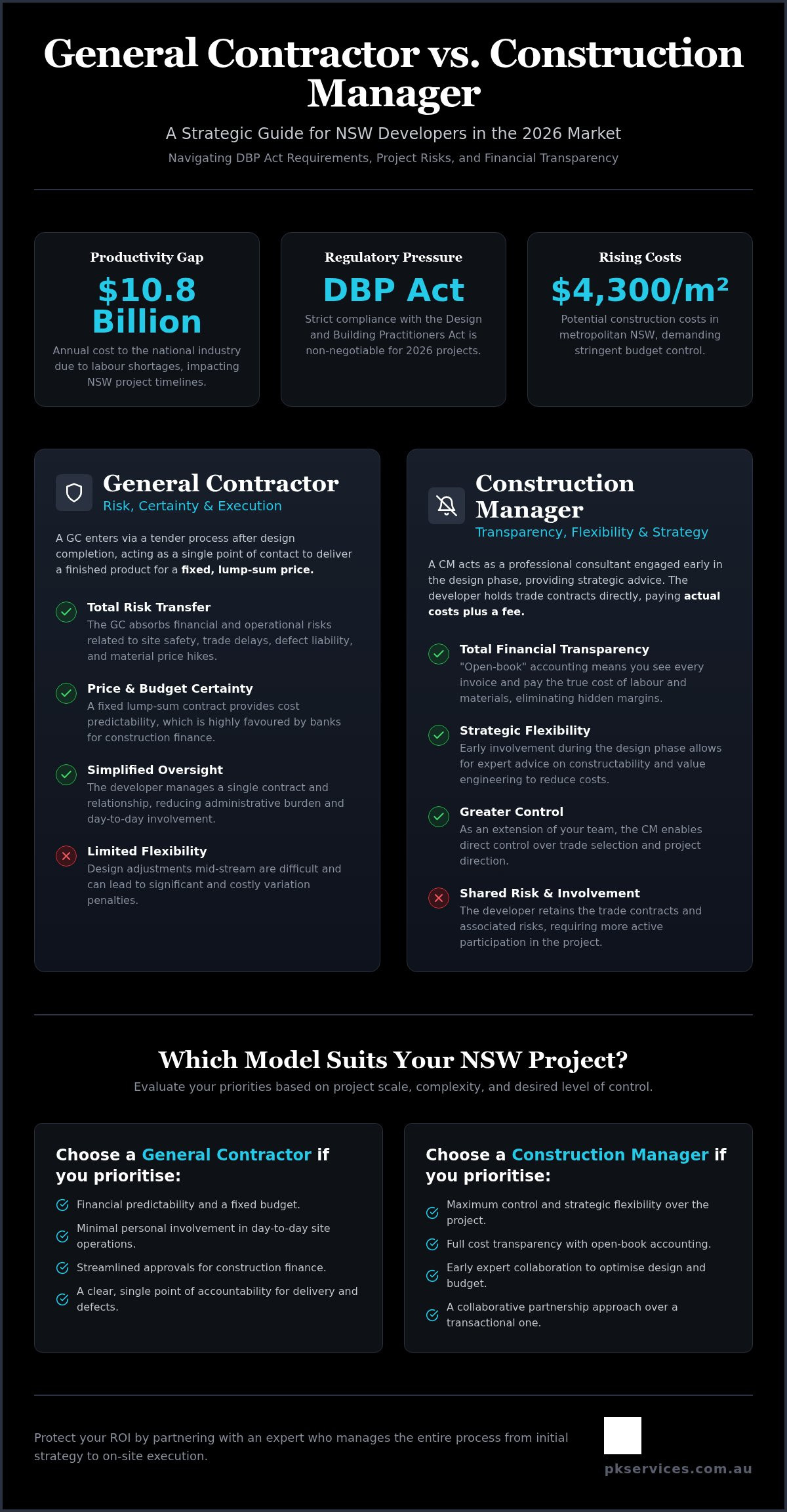
Choosing between a General Contractor and a Construction Manager is the most significant decision you'll make before the first shovel hits the dirt. In New South Wales, this choice defines how you handle the $10.8 billion productivity gap currently caused by national labour shortages. It's not just about who hires the trades; it's about who carries the weight of the DBP Act and the financial risk of every variation. Understanding the general contractor vs construction manager NSW dynamic is essential for any developer aiming for a seamless project delivery in 2026.
The General Contractor Model
A General Contractor (GC) typically enters the fold through a competitive tender process once your design phase is 100% complete. They act as the single point of contact, assuming full responsibility for the physical build. When you sign a lump-sum contract, you're essentially buying a finished product for a fixed price. The GC hires, manages, and pays all subcontractors directly under their own risk profile. This model provides a clear boundary between the owner and the site activities.
- Single Accountability: You have one contract and one person to call when things go wrong.
- Risk Transfer: The GC absorbs the impact of material price hikes or trade delays within the agreed scope.
- Execution Focus: Their primary goal is delivering the specified build on time and on budget.
The Construction Manager Model
The Construction Manager (CM) operates as a professional consultant and an extension of your own team. Unlike the GC, they're often engaged during the design phase to provide strategic advice on constructability and cost-saving measures. They don't work for a profit margin on the trades; instead, they charge a fixed fee or a percentage of the total project cost. In this model, you usually hold the individual contracts with the trades, providing total transparency over where every dollar goes.
- Early Involvement: Influence the project lifecycle before costs are locked in.
- Financial Transparency: You see every invoice and pay the actual cost of the work.
- Flexibility: It's easier to make design adjustments mid-stream without heavy variation penalties.
Selecting the right general contractor vs construction manager NSW partner dictates the entire project rhythm. A GC offers the comfort of a fixed price but less control over the process. A CM offers total visibility but requires you to be more involved in the risk-sharing process. For NSW projects facing 2026's complex regulatory environment, the right partner must bridge the gap between high-level strategy and gritty site execution.
The General Contractor: Risk, Certainty, and Execution
Developers in Sydney often prioritise financial predictability above all else. The lump sum model offered by a General Contractor (GC) provides exactly that. Banks typically prefer this structure because it locks in a total cost, making construction finance approvals far more straightforward. When you engage a GC, you're essentially paying for the peace of mind that your budget won't balloon due to market volatility or unexpected trade price hikes. In a state where metropolitan construction costs can reach $4,300 per square metre, this certainty is a powerful tool for protecting your ROI.
This model transfers the heavy lifting of risk. The GC becomes legally responsible for site safety, trade coordination, and defect liability. If a specific trade fails to show up or if material costs spike, the GC absorbs that blow. The Australian Constructors Association often highlights how this transfer of performance risk remains a cornerstone of the traditional building industry. In 2026, with labour shortages costing the national industry over $10.8 billion annually, having a partner who manages these logistical hurdles under a single contract is a massive operational advantage.
Advantages of the GC Model in NSW
The most significant benefit is the transfer of performance risk. You aren't responsible for the day-to-day management of individual trades or the granular details of site compliance. This simplifies your role as the principal.
- Simplified Oversight: You manage one contract and one relationship, rather than fifty.
- Fixed Completion Dates: Liquidated damages clauses provide a financial safety net if the project runs over schedule.
- Execution Speed: When the scope is perfectly defined, a GC can drive the project forward with singular focus.
Potential Drawbacks for Principals
The GC model can occasionally become adversarial. Because the contractor's profit is the difference between your payment and their actual costs, there's a natural incentive to protect those margins. This often leads to a lack of transparency regarding what you're actually paying for on the ground.
- Margin Secrecy: You rarely see the true cost of materials or the margins applied to trade packages.
- Variation Friction: Any design change after the contract is signed can trigger expensive variation claims and delays.
- Quality Control: If a GC is squeezed by rising costs, they might look for ways to reduce expenses on-site to maintain their bottom line.
Deciding on a general contractor vs construction manager NSW partner requires you to weigh this price certainty against the need for transparency. If your project is straightforward and your design is locked, the GC model is a robust choice. For those who need more control, engaging a partner for specialised trade and contractor services can offer a different path to quality execution.
The Construction Manager: Transparency and Strategic Flexibility
Transparency is the hallmark of the Construction Manager (CM) model. Unlike the GC approach, where costs are often obscured behind a single lump-sum figure, construction management relies on open-book accounting. You see exactly where every dollar of your budget goes. This level of visibility is vital in the 2026 NSW market, where metropolitan build costs can fluctuate between $2,100 and $4,300 per square metre. By seeing the raw costs of labour and materials, you can make informed decisions about where to invest and where to trim.
Strategic flexibility is another core advantage. Engaging a CM early in the design phase allows for real-time cost feedback. They provide a reality check on architectural ambitions before you're locked into a contract. This early involvement can save significant capital by identifying constructability issues early. When considering the general contractor vs construction manager NSW choice, this proactive approach often outweighs the perceived safety of a fixed price.
A CM also acts as a critical filter for quality. They take charge of vetting construction subcontractors across Australia to ensure your site is staffed by reliable professionals. With labour shortages currently costing the industry $10.8 billion annually in lost productivity, having an expert who can secure and manage a specialised trade network is a massive competitive edge.
Why CMs are Becoming the Standard for Complex NSW Projects
The CM model aligns interests. Because the manager is paid a fixed fee or percentage, they aren't incentivised to cut corners to protect a profit margin. Their goal is to protect your interests. This model is particularly effective for fast-track projects where design and construction overlap. You can start the early works while finalising the interior details, keeping the project moving without the friction of constant variation claims.
Risks Associated with the CM Model
Choosing the right path isn't just about the budget. It's about your tolerance for uncertainty and your desire for involvement. In the current market, the Design and Building Practitioners (DBP) Act has rewritten the rules for compliance. Every decision must now be documented with surgical precision to meet 2026 standards. Your choice between a general contractor vs construction manager NSW hinges on who you want leading that regulatory charge and who carries the ultimate burden of proof.
Your risk appetite determines the structure. If you're looking for price certainty to satisfy a lender, a fixed-price contract with a general contractor is often the path of least resistance. However, if you value process control and want to avoid the "hidden" margins often baked into lump-sum quotes, the construction management route offers the transparency you need. It's a trade-off between the comfort of a locked-in price and the potential savings of an open-book model.
In-house capability is the final piece of the puzzle. Managing a construction manager requires more of your time. You'll be reviewing trade tenders and signing off on individual progress claims. If your schedule is already at capacity, a general contractor provides a "hands-off" experience that keeps the project moving without requiring your daily input. Conversely, if you have the resources to be an active participant, the rewards of a managed project are substantial.
Choosing a General Contractor If...
This model is the gold standard for traditional builds where the scope is unlikely to shift. When you have a fully defined design and a set timeline, a general contractor can drive the programme with singular focus. It's the ideal choice for developers who need to meet strict external financing requirements. By choosing a general contractor vs construction manager NSW for simpler projects, you transfer the headache of site safety and trade coordination to a single entity.
- Your design is 100% complete and unlikely to change.
- You require a fixed price for bank valuations.
- You prefer a single point of accountability for the entire build.
Choosing a Construction Manager If...
A Construction Manager is the superior choice for high-stakes, evolving projects. If you're building a bespoke luxury residence or a complex commercial hub, you need the ability to pivot as market conditions or design requirements shift. This model allows you to leverage strategic business advice for construction to ensure your project remains viable. You gain a partner who scrutinises every trade invoice and ensures every dollar is spent efficiently.
- The project is complex and requires early strategic input.
- You want total transparency on trade costs and procurement.
- You want to play an active role in selecting the best trades for each specific task.
Ready to secure your project's future with a partner who understands the local landscape? Explore our trades and contractor services to find the perfect fit for your site.
Bridging the Gap: How PK Services Redefines Project Excellence
Deciding between a general contractor vs construction manager NSW requires a partner who understands the gritty reality of the Sydney site. At PK Services, we've spent over 15 years refining a model that combines high-level strategic consulting with direct on-site trade expertise. We don't just advise from a boardroom. We manage the entire process from the first strategy session to the final site handover. This end-to-end involvement ensures that the vision you start with is the result you actually get.
The Australian construction industry currently faces a $10.8 billion productivity loss due to labour shortages. Global firms often struggle with these local bottlenecks because they lack deep-rooted trade connections. We fill this gap through our specialised trade and contractor supply network. By acting as a boutique advisory partner, we offer a level of agility and local insight that larger firms simply cannot match. Whether you need the risk transfer of a GC or the transparency of a CM, our team ensures your project remains compliant and profitable.
Our Full Cycle Project Management Solution
We're redefining excellence by integrating business consulting with direct project delivery. This approach eliminates the friction often found when moving from a planning phase to active construction. We ensure every regulatory requirement is met without sacrificing speed or quality. You can discover more about our full cycle construction project management services to see how we streamline the build lifecycle.
- Seamless transitions between strategic planning and on-site execution.
- Direct access to a vetted network of skilled trades.
- Integrated compliance management for the 2026 regulatory environment.
Strategic Advisory for Modern Firms
The 2026 regulatory environment in New South Wales demands a sophisticated approach to compliance. We help firms navigate the complexities of the DBP Act while optimising their operational performance. Our tailored systems and processes ensure that your project isn't just finished, but delivered to a superior standard. If you're ready to secure a partner who understands the general contractor vs construction manager NSW landscape, Contact PK Services today to discuss your next project.
Lead Your Next NSW Project with Confidence
Navigating the 2026 building landscape requires more than just a set of plans. It demands a strategic choice between the risk transfer of a general contractor and the total transparency of a construction manager. Whether you prioritise the price certainty of a lump sum or the flexibility of an open-book model, your decision defines your project's resilience against regulatory shifts and labour shortages. There is no one-size-fits-all answer; only the right fit for your specific capital requirements and risk tolerance.
The general contractor vs construction manager NSW debate ultimately comes down to finding a partner who understands both the boardroom strategy and the site reality. At PK Services, we bring over 15 years of Sydney construction expertise to every build. Our specialist trade supply network and end-to-end project lifecycle management ensure that your vision isn't just planned, but perfectly executed. We bridge the gap between high-level consulting and on-site trade performance, protecting your capital and your timeline.
Ready to elevate your project standards? Redefine your construction project excellence with PK Services. Let's build something exceptional together.
Frequently Asked Questions
Is a construction manager the same as a project manager in NSW?
No. A project manager oversees the entire development from feasibility and planning through to final completion. A construction manager specifically focuses on the site execution and trade coordination. While their roles overlap, the construction manager is more "boots on the ground" during the build phase. They manage the physical delivery while the project manager handles broader stakeholder interests and planning approvals. This distinction is vital for proper resource allocation.
Who is liable for building defects in a construction management contract?
Liability usually rests with the individual trade contractors who performed the work. Because the principal holds direct contracts with these trades, they must pursue them for rectifications. However, the construction manager may be liable for professional negligence if they failed to supervise the work adequately. This differs from a general contractor model where the GC carries total responsibility for all defects on site. Clear contractual definitions are essential to protect your interests.
Can a general contractor also act as a construction manager?
Yes, many firms offer both delivery methods depending on the client's risk appetite. A firm might operate as a general contractor for a fixed-price warehouse build but act as a construction manager for a complex residential renovation. It's essential to clarify the contract structure early. The choice between a general contractor vs construction manager NSW often depends on whether the client wants a consultant or a head contractor to lead the build.
Which model is typically more expensive for a Sydney residential project?
The construction manager model often appears cheaper initially because there is no head contractor margin. However, the final cost depends on trade performance and market fluctuations. General contractors include a risk premium in their lump-sum price to cover potential cost increases. For complex Sydney builds where designs evolve, a construction manager might save money through early strategic input and open-book procurement, while a GC provides the comfort of price certainty.
How does the NSW Design and Building Practitioners Act affect the choice of contractor?
The DBP Act increases the compliance burden for both models, requiring strict documentation of "regulated designs." A general contractor assumes the risk for ensuring all subcontractors meet these standards under their head contract. In a construction management setup, the principal must ensure their manager has the expertise to coordinate these declarations. This regulatory pressure makes choosing a partner with deep local legislative knowledge more critical than ever for 2026 projects.
What insurance is required for a construction manager in NSW?
A construction manager typically needs Professional Indemnity insurance to cover their advisory services and Public Liability insurance for site activities. Since the principal often holds the trade contracts, they may also need a comprehensive Principal Arranged Insurance policy. This ensures the entire site is covered for property damage and injury. Always verify that your partner's coverage aligns with the specific risks of your NSW project to avoid costly gaps in protection.
Do I need a separate licence to be a construction manager in Australia?
In NSW, you generally need a contractor licence issued by Fair Trading to contract for residential building work over $5,000. While "construction management" is a delivery method, the individual or firm must still hold the appropriate builder licence categories. As of July 2026, licence fees have increased by approximately 4.4 per cent. Ensure your partner holds a valid licence that matches the scale and type of your specific building project.
How can I ensure trade quality when using a construction manager?
Quality is maintained through a rigorous vetting process and active on-site supervision. A skilled construction manager uses their industry connections to source proven trades rather than just the cheapest quote. They perform regular inspections and ensure all work meets the National Construction Code. By choosing a partner with a specialist trade supply network, you gain access to skilled professionals who have a track record of delivering high-end results in Sydney.


