

In 2026, a construction project risk assessment in NSW isn't just a box-ticking exercise; it's your most effective profit-protection tool. We know the pressure is mounting. Between the tightening grip of the WHS Act 2011 and the surging costs of labour and insurance, managing a site often feels like walking a tightrope. It's exhausting to stay ahead of SafeWork NSW while trying to keep your project on schedule and under budget. You deserve a system that works as hard as you do, turning compliance from a burden into a clear competitive advantage.
This guide will show you how to master these complexities with a strategic framework designed to safeguard both your people and your bottom line. We'll explore the 2026 checklist for full compliance, reduced project downtime, and the kind of site excellence that secures better insurance premiums. From high-level strategy to on-site execution, we're here to help you redefine how you handle risk. You'll gain the clarity needed to protect your reputation and ensure your business remains resilient in an evolving regulatory landscape.
Key Takeaways
- Stay ahead of the 2026 regulatory evolution to avoid SafeWork NSW penalties and costly project delays.
- Protect your bottom line by integrating financial risk management directly into your standard site safety protocols.
- Master a construction project risk assessment NSW that addresses the 'Big Three' hazards with site-specific precision rather than generic templates.
- Learn how to bridge the gap between high-level strategy and site execution through proactive leadership and professional management.
- Achieve full compliance with the WHS Act 2011 while enhancing your reputation for excellence and securing better insurance premiums.
Navigating the NSW Construction Risk Landscape in 2026
The NSW construction sector has undergone a massive transformation. By 2026, the regulatory environment has moved far beyond simple site inspections. It's now a data-driven, high-stakes arena where compliance is synonymous with commercial viability. NSW remains the most rigorous jurisdiction in Australia for WHS standards. This is because the state has prioritised a "zero-harm" culture through aggressive legislative updates and strict enforcement. For modern builders, a construction project risk assessment NSW is no longer just a document you file away in a dusty folder. It's a living strategy that dictates your project's success. It's the difference between a profitable handover and a legal nightmare.
The Role of SafeWork NSW in 2026
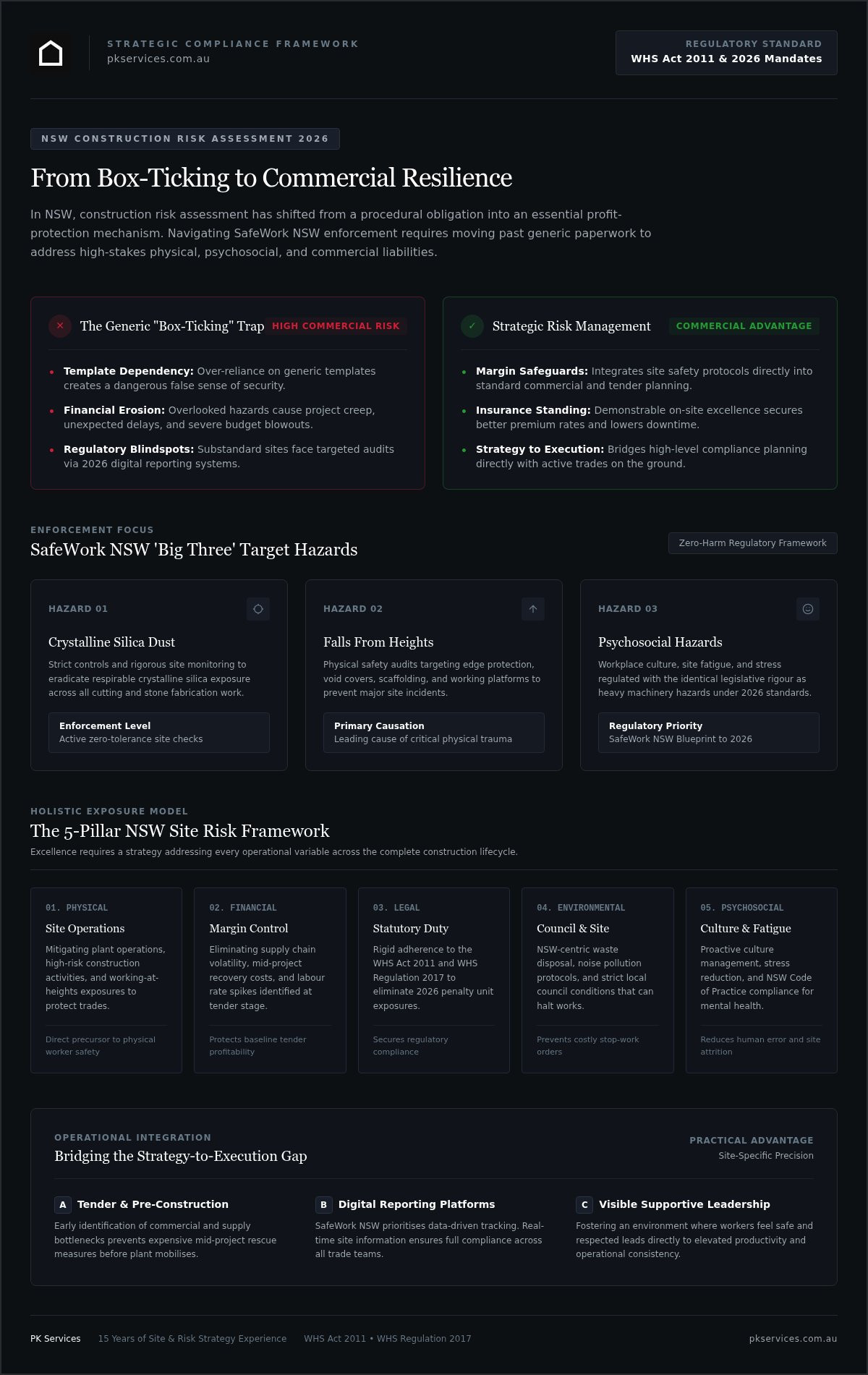
SafeWork NSW has sharpened its focus. Inspectors now prioritise three critical areas: crystalline silica dust management, falls from heights, and psychosocial hazards. This third pillar represents a major shift. Mental health and workplace culture are now regulated with the same intensity as physical safety. Digital reporting platforms have also changed the game. Real-time data allows for targeted inspections. This makes it nearly impossible for substandard sites to fly under the radar. With the 2026 penalty units reflecting the high cost of negligence, the financial risk of a single oversight is higher than ever. You aren't just protecting workers; you're protecting your company's future.
Why 'Box-Ticking' is Your Biggest Business Risk
Relying on generic templates is a dangerous gamble. Many firms treat safety as a hurdle to clear rather than a core component of project risk management. This "box-ticking" mindset creates a false sense of security. It hides the true threats to your margin. When risks aren't properly identified at the start, you face project creep, unforeseen delays, and budget blowouts. Mastering a construction project risk assessment NSW requires moving past the paperwork and focusing on site-specific hazards and genuine accountability. At PK Services, we've seen how redefining excellence through proactive risk management protects profits. It's about bridging the gap between high-level strategy and the actual trades on the ground. True site excellence starts with a refusal to settle for the bare minimum. It requires a forward-thinking mindset that values people as much as the bottom line.
The Comprehensive 5-Pillar Risk Framework for NSW Sites
Excellence in construction isn't a happy accident. It's the result of a robust framework that accounts for every variable. A modern construction project risk assessment NSW must extend beyond physical safety to protect your commercial interests. We categorise these into five essential pillars: physical, financial, legal, environmental, and psychosocial. Ignoring any one of these creates a weak link in your project lifecycle. Physical risks like working at heights and plant operation remain the primary cause of site incidents. However, legal risks are just as sharp. Aligning your site with the WHS Regulation 2017 is non-negotiable. Environmental risks, specifically NSW-centric waste and noise management, can halt a project overnight if local council requirements aren't met. You need a strategy that covers all bases.
Managing Psychosocial Hazards in Construction
The SafeWork NSW Building and Construction WHS Blueprint to 2026 makes it clear: mental health is now a regulatory priority. High-pressure sites often breed fatigue and stress. These psychosocial hazards aren't just HR issues. They are direct precursors to physical accidents. Implementing the NSW Code of Practice for psychosocial hazards ensures you identify these triggers before they lead to site errors. It's about creating a culture where site leadership is visible and supportive. When workers feel safe and respected, site productivity naturally increases. It's a fundamental shift in how we define a safe work environment.
Financial Risk Mitigation in a Volatile Market
Margins are tighter than ever. Supply chain disruptions and labour volatility can turn a profitable job into a loss-maker. Strategic resource planning is the only way to avoid these project stalls. By focusing on improving construction business profitability NSW, you move from reactive fire-fighting to proactive control. End-to-end oversight prevents expensive mid-project recovery by identifying financial bottlenecks during the tender phase. Our 15 years of experience shows that bridging the gap between strategy and execution is the key to resilience. If you need a partner capable of managing the entire process from start to finish, we can help you integrate these pillars into your next build. This integrated approach ensures your project remains viable despite market fluctuations.
High-Risk Construction Work (HRCW) Checklist for NSW
High-risk construction work is where the most significant site incidents occur. The 'Big Three' hazards on NSW sites are non-negotiable priorities. Falls from heights, mobile plant incidents, and crystalline silica exposure represent the highest risk to your workforce and your legal standing. Conducting a construction project risk assessment NSW demands a granular focus on these high-stakes activities. You must identify every instance of high-risk construction work requiring a SWMS before any boots hit the ground. Real-time verification of trade qualifications and White Cards is essential. It's not enough to trust a photocopied licence from three years ago. You need digital systems or rigorous manual checks that confirm competency on the day. This level of detail protects your people and shields your business from the massive fines associated with unlicensed work.
The SWMS Audit: Quality Control for Site Safety
Generic SWMS templates are a massive business liability. SafeWork NSW inspectors can spot a 'copy-paste' safety plan in seconds. If your documentation doesn't reflect the unique topography, specific machinery, or live-site constraints of your project, it's worthless. High-quality construction quality control management services prioritise the accuracy and relevance of these statements. Every SWMS must be a living document. It should be reviewed and signed off by the people actually performing the work. This ensures the hazards identified are real, not theoretical. When safety documentation is tailored to the specific task, it becomes a tool for efficiency rather than a hurdle for the crew. It transforms compliance from a paperwork exercise into a practical site guide.
Subcontractor Vetting and Risk Transfer
You cannot delegate your primary duty of care in NSW. While you might hire specialists, the legal responsibility for site safety remains firmly with the principal contractor. Effective vetting construction subcontractors Australia involves more than checking insurance papers and public liability certificates. It requires ensuring their internal safety culture aligns with your own high standards. Organising site inductions that actually stick is the first step in this alignment. Don't just read from a pre-printed script. Engage your subcontractors in the risk management process to ensure they understand the specific site constraints. This proactive approach turns subcontractors into partners in site excellence. It creates a unified front that minimises the risk of unforeseen incidents and ensures everyone is working toward the same standard of safety.
Integrating Risk Assessment into Your Project Lifecycle
Risk management isn't a static task. It's a continuous loop that evolves with your build. A successful construction project risk assessment NSW starts long before the first excavator arrives. During pre-construction, the focus is on "Safety in Design" and identifying risks during the tender stage. This prevents expensive mid-project corrections that eat into your margins. Site mobilisation then sets the tone for leadership. This is where you establish a culture of accountability and clear site protocols. Once construction begins, the focus shifts to dynamic risk assessments and daily toolboxes. These are not just routine talks; they are real-time adjustments to shifting site conditions. Finally, completion allows for a post-project review and data capture. This step is vital for refining your future strategies and proving a track record of excellence to insurers.
Strategic Project Management as a Risk Mitigator
Many firms suffer from a disconnect between the boardroom and the tool belt. Adopting full cycle construction project management eliminates this 'strategy-to-site' gap. Professional site management ensures that high-level safety protocols aren't lost in translation. It provides a single point of truth for compliance, budget, and progress. When one team oversees the entire lifecycle, there's no room for "passing the buck." This oversight keeps standards high and ensures that every safety measure is backed by operational reality. It transforms risk from a threat into a manageable variable.
Leveraging Skilled Trades to Reduce Operational Risk
A 'labour void' is one of the most dangerous risks on a complex NSW site. Unskilled or transient labour often misses the subtle cues of a developing hazard. This leads to accidents and rework. In contrast, experienced tradespeople naturally identify and mitigate risks as part of their daily workflow. They understand the nuances of plant operation and site-specific hazards. Redefining excellence means prioritising high-calibre execution over the cheapest quote. By integrating skilled trades with strategic oversight, you create a site that is inherently safer and more efficient. If you want to secure your site with an expert team, we specialise in managing the entire process from start to finish. This combination of strategy and skilled execution is the ultimate risk reducer for any modern build.
Redefining Excellence: How PK Services Manages Project Risk
PK Services has spent over 15 years refining a unique approach to site management. We don't just advise from a distance. We bridge the critical gap between high-level strategy and the actual execution on your site. This legacy of excellence in NSW and QLD is built on a simple truth: compliance is the floor, not the ceiling. While others focus solely on avoiding fines, we focus on protecting your reputation and your profits. A robust construction project risk assessment NSW should be the foundation of every decision you make. Our end-to-end solutions ensure that the strategic goals set in the boardroom are actually met by the trades on the ground. We provide the strategic oversight needed to keep your project moving safely and efficiently.
Boutique Strategy with Large-Scale Execution
Sydney firms often face a choice between generic large-scale firms or disconnected consultants. PK Services offers a third way. We provide boutique, tailored construction business consulting Australia that scales to meet the demands of complex project oversight. Every site has its own set of variables. We don't believe in one-size-fits-all checklists. Instead, we develop risk frameworks that reflect your specific operational reality. This precision reduces project downtime and improves your standing with insurers. It's about creating a site environment where excellence is the standard, not the exception. Our team specialises in managing the entire process from start to finish. This ensures that no detail is lost during the transition from design to mobilisation.
Your Next Step Toward a Risk-Resilient Project
The regulatory landscape of 2026 demands a new level of diligence. A construction business health check is the most effective way to identify hidden vulnerabilities in your current process. This isn't about finding fault. It's about finding opportunities for a more resilient construction business growth strategy NSW. We invite you to start a direct dialogue with us. Let's discuss how we can redefine your site standards together. Whether you need a full-cycle partner or strategic intervention for a high-risk phase, we are ready to help. Protecting your people and your bottom line starts with a single conversation. Reach out to see how we can support your next project. We are committed to delivering results that exceed the traditional firm's approach.
Secure Your Site's Future
Mastering a construction project risk assessment NSW is no longer about simple compliance; it's about building a resilient, profitable business. We've explored how a comprehensive 5-pillar framework protects your margins and your people from the evolving pressures of 2026. By integrating high-level strategy with precise on-site execution, you eliminate the voids that lead to delays and SafeWork interventions. True site excellence is achieved when every subcontractor and trade is aligned with a single, uncompromising standard of safety and quality.
With 15 years of strategic construction expertise, we specialise in bridging the gap between the boardroom and the tool belt. As NSW and QLD local market specialists, we provide the end-to-end oversight necessary to safeguard your reputation in a high-stakes environment. Don't leave your project's success to chance or generic templates. Redefine your site excellence with PK Services' strategic project management. We're here to help you lead with confidence and ensure every build is a testament to your high standards.
Frequently Asked Questions
What are the mandatory requirements for a construction project risk assessment in NSW?
Mandatory requirements in NSW are governed by the WHS Act 2011 and the WHS Regulation 2017. You must systematically identify foreseeable hazards, assess their risk levels, and implement control measures following the hierarchy of controls. For any high-risk construction work, a written Safe Work Method Statement is a strict legal necessity. These documents must be site-specific and accessible to all workers involved in the task to ensure genuine on-site safety.
How often should a construction risk assessment be updated?
Your construction project risk assessment NSW should be a living document rather than a one-off task. It requires an update whenever there is a change to the work environment, machinery, or substances used on site. You must also review it after any incident or near-miss to ensure current controls are still effective. Regular scheduled reviews, such as before new project phases, help maintain a high standard of site excellence and compliance.
What is the difference between a general risk assessment and a SWMS?
A general risk assessment covers broader site hazards like traffic management, amenities, or environmental factors. In contrast, a Safe Work Method Statement (SWMS) is a highly specific document required for high-risk construction work. It breaks down a particular task into logical steps, identifies hazards for each step, and details the exact control measures to be used. While general assessments provide a safety foundation, the SWMS offers granular guidance for dangerous activities on site.
Who is legally responsible for risk assessment on a NSW construction site?
The primary legal responsibility lies with the Person Conducting a Business or Undertaking (PCBU), which is usually the principal contractor. However, every employer and subcontractor on site carries a duty of care for their specific workers. You cannot contract out of these legal obligations. While you can engage experts to manage the process, the ultimate accountability for site safety and regulatory compliance remains with the leadership of the firm and its directors.
How do psychosocial risks impact construction project management in 2026?
By 2026, psychosocial risks are regulated with the same intensity as physical hazards on NSW sites. These risks include work-related stress, fatigue, and workplace culture. Poor psychosocial management often leads to decreased concentration, which results in physical site accidents. Modern project management must include strategies to identify these invisible hazards. Addressing them involves fostering a supportive site culture and ensuring realistic workloads to prevent burnout and maintain high productivity levels across the project.
Can a consultant help reduce my project's risk profile for insurance purposes?
Engaging a strategic consultant can significantly improve your project's risk profile. Insurers look for evidence of robust, proactive systems rather than just basic compliance. By demonstrating a history of thorough construction project risk assessment NSW and professional site oversight, you prove your business is a lower risk. This often leads to more competitive premiums and better coverage terms. It shows you are committed to high standards and long-term operational resilience in a volatile market.
What are the penalties for failing to conduct a proper HRCW risk assessment in NSW?
Failing to conduct a proper HRCW risk assessment carries severe consequences in NSW. SafeWork NSW can issue immediate stop-work orders, which lead to massive project delays and budget blowouts. Financial penalties are substantial and can apply to both the corporation and individual directors under the WHS Act. Beyond the fines, a serious breach can lead to the loss of your reputation and potential exclusion from future government tenders. It is a commercial risk no firm should take.
How does PK Services integrate risk management into the project lifecycle?
PK Services integrates risk management through our "Strategy to Site" framework. We don't just provide advice; we manage the entire process from start to finish. With 15 years of industry expertise, we bridge the gap between high-level planning and on-site trade execution. By supplying skilled trades and professional oversight, we ensure that safety standards are maintained daily. This end-to-end approach ensures that risk mitigation is built into every phase of the project lifecycle, from tender to completion.


