

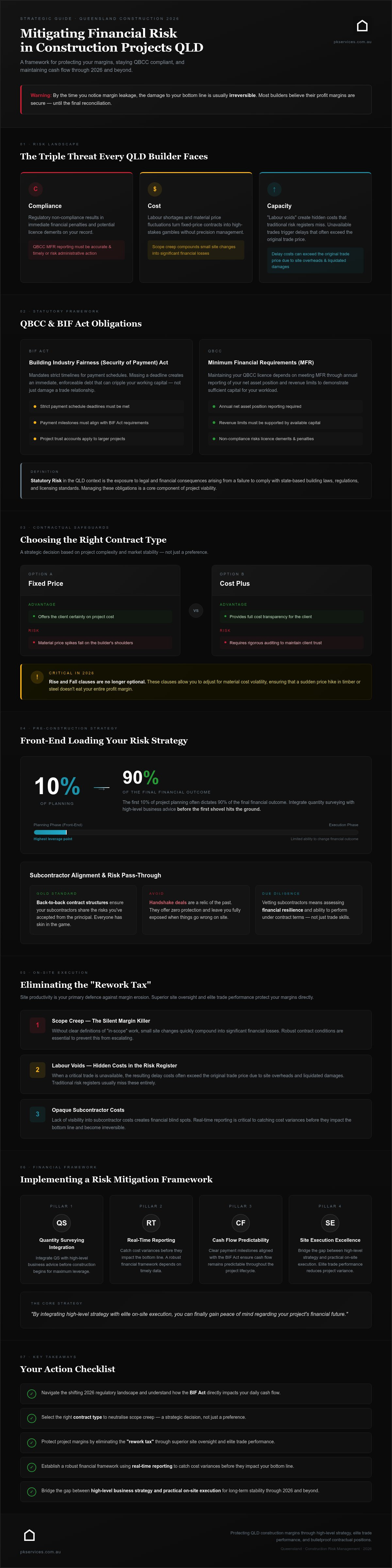
Most builders believe their profit margins are secure until the final reconciliation. The reality is often far more precarious. Effectively mitigating financial risk in construction projects QLD requires more than just a basic spreadsheet. It demands a proactive approach to the unique pressures of our local market. By the time you notice the leakage, the damage to your bottom line is usually irreversible.
You know the stress of opaque subcontractor costs and the constant weight of QBCC compliance. It’s an environment where unpredictable labour availability and scope creep can turn a healthy project into a financial liability overnight. We understand that the pressure to maintain standards while protecting your capital is relentless. You deserve a strategy that works as hard as you do on site.
This strategic guide provides the frameworks needed to protect your margins through 2026 and beyond. You'll learn how to implement local strategies that ensure long-term business stability. We'll preview the methods for achieving bulletproof contractual positions, reliable trade performance, and lowered project variance. By integrating high-level strategy with elite on-site execution, you can finally gain peace of mind regarding your project's financial future.
Key Takeaways
- Navigate the shifting 2026 regulatory landscape and understand how the BIF Act directly impacts your daily cash flow.
- Discover why mitigating financial risk in construction projects QLD starts with selecting the right contract type to neutralise scope creep.
- Protect your project margins by eliminating the "rework tax" through superior site oversight and elite trade performance.
- Establish a robust financial framework using real-time reporting to catch cost variances before they impact your bottom line.
- Learn how to bridge the gap between high-level business strategy and practical on-site execution for long-term stability.
Understanding the QLD Construction Risk Landscape in 2026
Financial risk in the Queensland construction sector is the potential for unforeseen events to erode project margins or threaten business solvency. In 2026, this isn't just about overspending. It's about the friction between rigid regulatory frameworks and a volatile supply chain. Effectively mitigating financial risk in construction projects QLD requires a deep understanding of local statutory obligations. You need to recognise that your biggest threats often lie in the fine print of local legislation and site-level inefficiencies.
The Building Industry Fairness (Security of Payment) Act remains a primary driver of cash flow rhythm. It mandates strict timelines for payment schedules that builders must follow. Missing a deadline doesn't just damage a trade relationship; it creates an immediate, enforceable debt that can cripple your working capital. We are also seeing continued pressure from labour shortages and material price fluctuations. These factors turn traditional fixed-price contracts into high-stakes gambles if they aren't managed with precision from the outset.
The Triple Threat: Compliance, Cost, and Capacity
Compliance, cost, and capacity form a delicate balance for modern builders. Regulatory non-compliance results in immediate financial penalties and potential licence demerits that stay on your record. On site, "labour voids" create hidden costs that traditional risk registers usually miss. When a critical trade is unavailable, the resulting delay costs often exceed the original trade price due to site overheads and liquidated damages. High-level planning must account for these capacity gaps to keep the project moving. Mitigating financial risk in construction projects QLD starts with acknowledging that site productivity is your primary defence against margin erosion.
QBCC and Statutory Risk Frameworks
Maintaining your QBCC licence depends on meeting Minimum Financial Requirements (MFR). This involves annual reporting of your net asset position and revenue limits to ensure you have enough capital to support your workload. For many QLD builders, the continued expansion of project trust accounts has changed how cash is handled on larger projects. You must ensure your reporting is accurate and timely to avoid administrative action. Statutory risk in the QLD context is the exposure to legal and financial consequences arising from a failure to comply with state-based building laws, regulations, and licensing standards. Managing these obligations is a core component of project viability that requires constant attention.
Contractual Safeguards and Pre-Construction Planning
Contracts are your primary tool for mitigating financial risk in construction projects QLD. They define where the buck stops. Choosing between Fixed Price and Cost Plus models isn't just a preference. It's a strategic decision based on project complexity and market stability. Fixed Price offers the client certainty but places the burden of material price spikes on you. Cost Plus provides transparency but requires rigorous auditing to maintain trust. You need to select the framework that best protects your specific margin profile.
Robust conditions of contract are essential to prevent scope creep. Without clear definitions of "in-scope" work, small site changes quickly compound into significant financial losses. Establishing clear payment milestones aligned with the Building Industry Fairness Act ensures cash flow remains predictable. This is also where vetting construction subcontractors Australia becomes critical. You aren't just checking their trade skills. You are assessing their financial resilience and ability to perform under the contract terms.
Front-End Loading Your Risk Strategy
The first 10% of project planning often dictates 90% of the final financial outcome. Successful QLD builders front-end load their risk strategy. This involves integrating quantity surveying with high-level business advice before the first shovel hits the ground. Rise and Fall clauses are no longer optional in 2026. These clauses allow you to adjust for material cost volatility, ensuring that a sudden price hike in timber or steel doesn't eat your entire profit. Careful planning at this stage sets the pace for a profitable build.
Subcontractor Alignment and Risk Pass-Through
Alignment is about ensuring everyone has skin in the game. Back-to-back contract structures are the gold standard. They ensure your subcontractors share the risks you've accepted from the principal. Handshake deals are a relic of the past; they offer zero protection in the modern QLD market. Implementing construction quality control management services during the pre-construction phase identifies potential rework issues before they happen. When you are managing the entire process from start to finish, these contractual and operational threads must be tightly woven together to secure your project's future.
Managing On-Site Operational Risks and Trade Performance
Site productivity is the engine room of project profitability. While software tracks data, the physical rhythm of the site determines the final margin. Effectively mitigating financial risk in construction projects QLD requires a shift from office-based monitoring to active site leadership. Every hour of downtime or inefficient movement is a direct withdrawal from your profit pool. You can't manage what you don't see on the ground.
The "rework tax" is the most avoidable financial drain in our industry. When a task isn't completed correctly the first time, you pay for the original labour, the remedial labour, and the wasted materials. You also face the opportunity cost of lost time and potential liquidated damages. Elite site oversight identifies these errors before they are covered up or built upon. Reliable contractor services ensure that skilled trades arrive ready to perform, reducing the friction that often leads to costly site disputes and project stalls.
Bridging the Strategy-Execution Gap
Risk control often fails because there's a disconnect between the boardroom and the tool belt. Implementing full cycle construction project management ensures that strategic financial goals are translated into daily site actions. Experienced site leads act as your early-warning system. They spot the subtle signs of financial distress, such as slowing trade momentum or excessive material waste, long before they appear in a monthly report. Better on-site logistics and material management further protect your capital by ensuring resources are used with maximum efficiency.
Trade Reliability as a Financial Asset
We view trade reliability as a tangible financial asset rather than just a line item. Poor workmanship leads to more than just rework; it triggers delays that ripple through the entire schedule. PK Services specialises in supplying trades that align with high-end project standards, ensuring that quality is built-in from day one. By creating a culture of excellence on site, you naturally minimise the site-based leaks that erode project value. Mitigating financial risk in construction projects QLD is ultimately a human endeavour. It relies on having the right people in the right places, performing at their peak every single day. This approach transforms trade performance from a variable risk into a reliable constant for your business.
Implementing a Financial Risk Mitigation Framework
A framework isn't a static document; it's a living system. Effectively mitigating financial risk in construction projects QLD requires a disciplined, five-step approach that connects your balance sheet to your site diary. This structured method ensures that risks are identified and neutralised before they compound into project-wide failures.
- Step 1: Conduct a comprehensive construction business health check to identify systemic vulnerabilities in your overheads and operational structure.
- Step 2: Establish real-time financial reporting and variance analysis. You need to see the cost to complete daily, not just monthly.
- Step 3: Organise regular project audits and site-to-office reconciliations. Ensure physical progress matches the financial claims being made.
- Step 4: Implement a proactive Project Recovery plan for distressed assets. Have a clear protocol for when a project deviates more than 5% from its baseline.
- Step 5: Review trade performance metrics monthly. Use objective data to refine your supply chain and reward high-performing contractors.
Continuous Monitoring and Reporting
Monthly reports are often post-mortems. By the time you read them, the money is already gone. Weekly pulse checks save projects. In 2026, QLD project managers must focus on KPIs like labour productivity ratios and material burn rates. You can successfully adapt improving construction business profitability NSW tactics to the Queensland market by aligning them with local QBCC reporting cycles. This ensures your data is both strategically useful and legally compliant.
Crisis Management and Project Recovery
Every project has a tipping point where cost overruns become exponential. Identifying this moment requires a cold, hard look at your project data. If a subcontractor fails financially, the immediate priority is site continuity to avoid liquidated damages. The recovery mindset is the unwavering commitment to identifying project failures early and executing a decisive course correction to salvage the remaining margin. If your current framework feels reactive, we can help you build a more resilient operation by managing the entire process from start to finish.
Redefining Financial Excellence with PK Services
Software and spreadsheets are useful tools, but they cannot replace the value of seasoned industry experience. True financial excellence comes from the seamless integration of high-level strategy and elite on-site action. We provide a bridge between these two worlds. By combining construction business consulting Australia with direct trade management, we ensure your project's financial goals are met at every stage of the build.
Our approach to mitigating financial risk in construction projects QLD is built on 15 years of Australian industry expertise. We understand the specific pressures of the Queensland market, from QBCC compliance to the unique rhythm of local supply chains. We don't just offer advice; we provide the skilled trades and contractor services needed to execute that advice. This end-to-end involvement allows us to identify and close financial gaps that traditional firms often miss.
Your End-to-End Partner in QLD
Managing the entire process from start to finish is the ultimate risk mitigator. When one partner oversees both the strategy and the execution, the risk of miscommunication evaporates. We've moved beyond the coldness of traditional consulting. We offer an energetic, forward-thinking partnership that values results as much as you do. Engaging with us is a straightforward process designed to capture your project's specific needs quickly. We start by listening to your goals and then build a bespoke framework to protect your margins.
The PK Services Difference
We maintain aspirational standards while delivering down-to-earth, reliable execution. It is a sophisticated blend of modern refinement and grounded industry knowledge. As a boutique firm, we offer a level of personal connection that larger corporations simply cannot match. We understand the nuances of the QLD and NSW landscape because we live and work in it every day. Our commitment is to redefine excellence and modernise construction standards across the state.
You deserve a partner who understands that site productivity is the foundation of your business stability. We provide the clarity and confidence you need to take on larger, more complex projects without sacrificing your peace of mind. Let's start a conversation about your next build and how we can secure its financial future together. Organise your strategic consultation today and experience a higher tier of professional service.
Securing Your Construction Legacy in 2026
Success in the Queensland market is no longer just about winning the bid. It's about operational precision. You've seen how a robust contractual framework and elite site oversight form the bedrock of a profitable project. By integrating high-level strategy with reliable trade performance, you can move from reactive damage control to proactive margin protection. Mitigating financial risk in construction projects QLD is a continuous process of refinement and vigilance.
Focus on bridging the gap between your office and the site. When your financial reporting is accurate and your trades perform at their peak, project stability becomes the standard rather than the exception. We bring 15+ years of Australian construction expertise and specialised QLD and NSW site management to every partnership. Our proven end-to-end project lifecycle success ensures your business is built for the long term.
Redefine your project standards with PK Services; organise a consultation today. The path to financial stability is clear. Let's build something extraordinary together.
Frequently Asked Questions
What are the biggest financial risks for QLD construction projects in 2026?
The most significant risks include labour shortages and the resulting productivity losses. When critical trades are unavailable, site overheads continue to accrue without progress. Statutory compliance under the BIF Act and QBCC Minimum Financial Requirements also present major risks. Builders who fail to maintain liquidity or meet payment timelines face immediate legal and financial penalties. Effectively mitigating financial risk in construction projects QLD requires a strategy that addresses both these site-level and regulatory pressures.
How does the QBCC influence financial risk management for builders?
The QBCC sets mandatory standards for financial viability through the Minimum Financial Requirements (MFR). Builders must report their net assets and revenue limits annually to maintain their licence. This framework forces builders to keep a close eye on their balance sheets and liquidity. Failure to meet these thresholds can result in licence suspension, which is an existential risk for any construction firm. Proper management ensures you remain compliant while protecting your project margins from regulatory interference.
Can project management software replace the need for a construction consultant?
Software is a data-tracking tool, but it cannot replace strategic advisory. While a site diary or digital log captures what happened, a consultant uses 15 years of industry expertise to predict what might happen next. Consultants bridge the gap between office data and site execution. They provide the human insight needed to navigate complex disputes and supply chain disruptions. Software provides the numbers, but a partner like PK Services provides the action plan to protect those numbers.
What is the "Building Industry Fairness Act" and how does it affect my project?
The Building Industry Fairness (Security of Payment) Act regulates how and when payments are made in the QLD construction sector. It mandates strict timelines for payment schedules and introduces project trust accounts for certain contracts. This legislation ensures subcontractors are paid fairly and on time, which helps maintain a stable supply chain. For builders, it means your cash flow management must be flawless. Any delay in processing claims can lead to enforceable debts and costly legal action.
How can I mitigate the risk of rising material and labour costs in Australia?
Incorporating "Rise and Fall" clauses into your contracts is the most effective way to manage price volatility. These clauses allow for contract price adjustments when material costs fluctuate beyond a certain percentage. For labour, mitigating financial risk in construction projects QLD involves securing reliable trade partners early. By establishing long-term relationships with skilled providers, you reduce the need for expensive, last-minute labour hire. Precise resource planning ensures you aren't paying premium rates for emergency coverage.
What should I look for when vetting subcontractors in Queensland?
Look beyond the quote and assess their financial resilience and past performance. A low price often masks a high risk of project failure or poor workmanship. You should verify their QBCC licence status and check for a history of demerit points or site disputes. It's also vital to ensure they have the capacity to meet your specific project schedule without overextending themselves. Reliable subcontractors are assets that contribute directly to your project's overall profitability and business stability.
How does PK Services help with construction project recovery?
We specialise in identifying the root causes of project distress and executing a decisive recovery plan. This often involves a mix of strategic business consulting and the provision of skilled trades to get the site moving again. We manage the entire process from start to finish, ensuring that any financial leaks are plugged immediately. Our team uses 15 years of experience to renegotiate contracts and realign trade performance with the project's remaining budget.
Is it better to hire labour or engage a full-service trade provider in QLD?
Engaging a full-service trade provider is generally superior for risk mitigation. While simple labour hire fills a gap, a full-service provider takes accountability for the quality and productivity of the work. This reduces the burden on your site leads and minimises the risk of rework. Providers like PK Services supply trades that align with high-end project standards, ensuring that every hour spent on site contributes to a successful, profitable outcome for your business.


