

Sourcing a dozen warm bodies might fill a gap on your roster, but it rarely finishes a project on time. In the current market, the choice between construction labor hire vs trade services is the difference between simply managing a headcount and actually delivering a result. You want high-quality execution without the constant headache of micro-managing generic workers who lack specialised skills. It's about moving from basic supply to strategic performance.
It’s frustrating when inconsistent quality or a sudden compliance audit in Queensland stalls your momentum. We know that managing a rotating door of subcontractors while trying to protect your margins feels like a logistical nightmare. This 2026 guide breaks down the critical differences between these two models to help you choose the right path for your project. You’ll learn how to navigate the latest QLD labour hire licensing changes and why a managed trade service often yields a better ROI than traditional hire. We’ll show you how to streamline your on-site performance and keep your project firmly in the black.
Key Takeaways
- Understand the shift from buying hours to buying outcomes. Contrast simple headcount supply with contracted trade accountability to protect your project’s quality.
- Identify the hidden costs of cheap labour. Ensure your project’s ROI isn’t eroded by excessive supervision requirements and on-site inefficiencies.
- Navigate the 2026 regulatory landscape with ease. Stay compliant with mandatory QLD licensing requirements and evolving NSW workplace standards.
- Apply a strategic framework for construction labor hire vs trade services. Align your workforce choice with the specific technical complexity of your project scope.
- Discover how an end-to-end management partner bridges the gap between high-level consulting and elite on-site execution.
Understanding the Basics: What Defines Construction Labour Hire vs Trade Services?
In the Australian construction industry, the choice between construction labor hire vs trade services is often treated as a simple procurement decision. It isn't. It is a fundamental choice about where risk and accountability sit on your project. Understanding this distinction is the first step toward protecting your margins and your sanity on site.
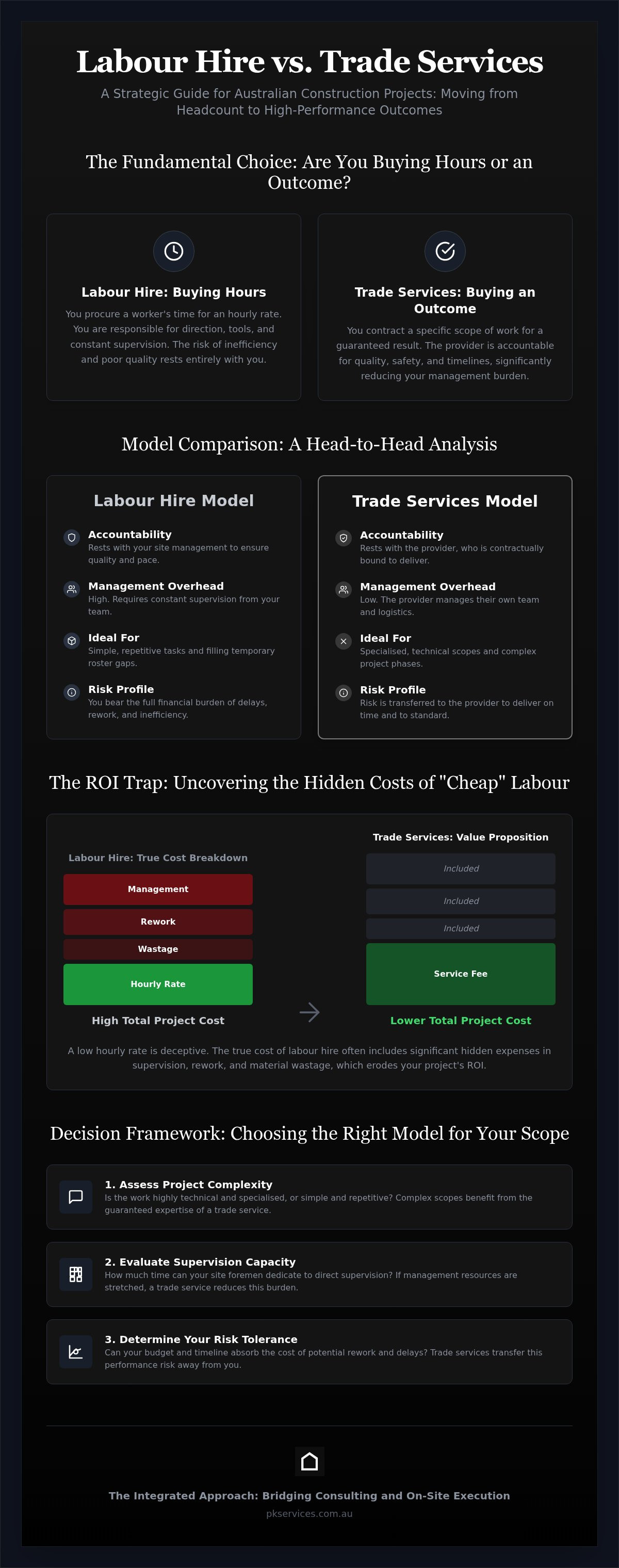
At its core, Labour hire in Australia is the provision of workers for an hourly rate. You are essentially buying time. The agency provides the person, but you provide the direction, the tools, and the supervision. The agency’s responsibility ends once the worker clears the site gate. If the work is sub-standard or the pace is slow, the financial burden of that inefficiency sits squarely with you. You own the output, regardless of its quality.
Trade services flip this model entirely. When you engage a trade service, you are contracting a specific scope of work. You aren't just buying hours; you are buying a guaranteed outcome. The provider is accountable for the final result, managing their own quality control, safety protocols, and delivery timelines. This shift in responsibility is the primary differentiator in the construction labor hire vs trade services debate. One provides a resource; the other provides a result.
PK Services has spent over 15 years refining a hybrid approach that bridges these gaps. We combine high-level business consulting with elite trade execution. This ensures that while you get the specialised hands you need, there is an underlying management framework that guarantees performance. We don't just supply bodies. We manage the entire process from start to finish, solving the management voids that often plague traditional sites.
The Labour Hire Model: Flexibility and Headcount
This model is built for agility. It's ideal for filling immediate gaps or scaling up for simple, repetitive tasks that don't require technical oversight from the provider. Whether you're operating in Sydney or Brisbane, labour hire allows you to manage fluctuating workforce needs without long-term commitments. However, the trade-off is high. You must provide the site foreman, the equipment, and constant supervision. Without strong internal management, labour hire can quickly become an expensive way to fill a roster.
Trade Services: Specialist Execution and Accountability
Trade services focus on delivering a specific technical result, such as structural works or specialist finishing. The provider manages their own team, brings their own tools, and handles the logistical details. This significantly reduces the management overhead for principal contractors and developers. Instead of chasing individual workers, you manage a single point of contact. This contact is contractually obligated to meet your quality standards and deadlines. It is a more professional, outcome-oriented way to execute complex project phases.
Performance and Productivity: Which Model Drives Better ROI?
A low hourly rate is often a trap. While general labour hire might look attractive on a spreadsheet, the true cost of "cheap" labour often hides in the shadows of your profit and loss statement. When you weigh up construction labor hire vs trade services, you're deciding how much of your own time you're willing to sacrifice to manage the outcome. If the workers you've hired require constant hand-holding, your ROI is already compromised.
Unskilled or unvetted workers on complex sites create a massive management burden. If a site foreman spends half their day correcting basic mistakes or explaining simple tasks, your project's efficiency is tanking. These hidden costs, such as material wastage and constant supervision, quickly erode any initial savings. Engaging specialist trade services significantly improves operational performance for construction firms by removing these friction points. You're paying for expertise that minimises rework from the start.
The Management Overhead Factor
Management overhead is the silent killer of project margins. With labour hire, your internal team carries the weight of planning, safety, and technical direction. Conversely, a trusted trade service partner allows for a "set and forget" mentality. They handle the micro-level execution while you focus on the macro-level milestones. This is where full cycle construction project management becomes invaluable. It integrates these roles so your senior staff aren't bogged down in the minutiae of hourly supervision. It's about working smarter, not just harder.
Quality Benchmarks and Rework
Meeting Australian Standards (AS/NZS) isn't optional. It's the baseline. Using trade services ensures that the people on your tools actually understand these requirements. This direct correlation between specialist skills and construction quality control management services cannot be ignored. In the construction industry, ROI is the delicate balance of speed, quality, and compliance. Cutting corners on skill levels usually leads to expensive rework that delays handover and damages your reputation.
Risk management is also a core productivity factor. Ensuring your providers meet Queensland labour hire licensing standards protects you from the operational downtime caused by legal scrutiny or project halts. If you want to see how elite trade management can stabilise your site and protect your bottom line, you might want to explore our integrated service models. We focus on results, not just filling rosters.
Navigating Compliance and Risk in NSW and Queensland
Compliance is more than a checklist. It is your project’s primary line of defence. When comparing construction labor hire vs trade services, the regulatory burden shifts significantly depending on your choice. In jurisdictions like Queensland, the law is clear: you are responsible for who you bring onto your site. The cost of a mistake isn't just a fine. It's a total project halt.
Engaging unvetted labour hire exposes you to massive liability. If an agency fails to meet its obligations, the principal contractor often catches the fallout. This makes vetting construction subcontractors in Australia a non-negotiable step in your risk management strategy. Specialist trade services often simplify this process. They arrive with their own established safety management systems and insurance cover, reducing your direct workers' compensation exposure. It’s a cleaner, safer way to build.
Labour Hire Licensing: What You Need to Know in 2026
The Queensland Labour Hire Licensing Act remains a critical hurdle for site managers. As of July 2026, it is a serious offence to engage an unlicensed provider. Penalties are substantial. While New South Wales currently has no state-based licensing scheme, federal workplace laws and Fair Work inspections are intensifying. You must verify a provider’s licence status in QLD and check their compliance with the 12% superannuation guarantee and the $26.44 per hour national minimum wage across both states. Payroll tax also differs; NSW sits at 5.45% while QLD is 4.75%. These details matter when auditing your supply chain for 2026 projects.
Safety and On-Site Liability
Who is responsible when an accident happens? With labour hire, the host employer usually carries the primary duty of care for on-site safety. You provide the supervision and the safe work environment. Trade services operate differently. They manage their own safety protocols and technical execution. This allows you to maintain a "safety-first" culture without the administrative nightmare of managing every individual worker’s induction and compliance. Professional trade partners carry their own liability, shielding your project from unexpected legal shocks. They bring a level of accountability that simple headcount agencies cannot match. In the construction labor hire vs trade services comparison, the trade model offers far superior risk insulation, particularly when combined with professional injury management from Persona Health to ensure every worker is fit for the demands of the site.
Decision Framework: Choosing the Right Model for Your Scope
Choosing between construction labor hire vs trade services isn't a coin toss. It's a strategic audit of your project’s technical needs and your own internal bandwidth. If you're managing a high-rise in Sydney or a civil project in Brisbane, the wrong choice will bleed your budget dry. You need to look beyond the immediate headcount and evaluate who actually owns the outcome of the work.
Start by assessing project complexity. Simple, repetitive tasks often suit the flexibility of labour hire. However, complex systems or high-spec finishes require the accountability of a trade service. You must also evaluate your internal management capacity. Do you honestly have enough foremen to supervise hourly workers every minute they're on site? If your senior staff are already stretched, adding unvetted labour hire will only trigger a management collapse. Consider the duration of the need as well. Short-term spikes for site cleanup are perfect for labour hire, but long-term project phases demand the stability of a contracted trade partner.
Handover accountability is the final piece of the puzzle. With labour hire, you sign off on the hours worked. With trade services, you sign off on the quality of the completed work. If your project requires a defect-free handover to a demanding client, the trade model is the only logical path. It places the burden of excellence on the provider, not your internal team.
When to Opt for Labour Hire
Labour hire is a tool for agility. It works best for general site cleanup, basic manual labour, or providing extra hands to assist your own qualified trades. It's the right move for unexpected absences where you just need a "warm body" to keep the site moving for a few days. Use this model only when your site manager has high-level control and enough spare bandwidth to provide constant direction. Without that oversight, productivity will stall.
When Trade Services are Non-Negotiable
Trade services are essential for any work requiring certification, such as electrical, plumbing, or structural components. They're non-negotiable for high-risk projects where a quality failure could lead to catastrophic delays or safety breaches. This model is a primary driver for improving construction business profitability in NSW. By outsourcing the risk and the management of specific scopes, you lock in your costs and guarantee a professional result. If you're ready to stop managing hours and start managing results, you should discuss your next project scope with our consulting team. We'll help you find the right balance for your specific site needs.
The PK Services Integrated Approach: Redefining Excellence
Excellence on site isn't accidental. It's engineered—a principle of high-end calibration that businesses like Oztrack Performance Tuning & Engines apply to mechanical systems to ensure they deliver maximum power and reliability. Most firms treat labour as a commodity, but we treat it as a strategic asset. Our 15 year track record proves that the construction labor hire vs trade services debate isn't really about cost. It's about vision. We've spent over a decade and a half solving the management voids that traditional labour hire leaves behind. We don't just supply people; we provide a framework for performance.
Our approach combines high level business consulting with elite trade execution. This end to end management model ensures that every person on your site understands the project's broader objectives. We manage the entire process from strategy to site execution, removing the friction that usually occurs when consultants and contractors don't speak the same language. This integration is the core of a successful construction business growth strategy. It allows you to scale your operations without losing control of your quality or your margins.
Bridging the Gap Between Strategy and Site
Our consulting background gives us a unique perspective. We understand the "big picture" of a build, from the initial feasibility to the final handover. This means our trade services are never delivered in a vacuum. They are aligned with your specific business goals and timeline. Our tradespeople are vetted for more than just their technical tickets. We look for professional conduct and a proactive mindset. They aren't just there to fill a gap; they're there to advance the project. This reduces the need for constant micro management and allows your senior team to focus on high value tasks.
Tailored Solutions for NSW and QLD
We have deep roots in the Sydney and South East Queensland construction markets. We know the local regulations, the site conditions, and the specific challenges of these regions. Whether you are navigating the 2026 licensing requirements in Brisbane or managing a complex structural project in Sydney, we provide the local expertise you need to succeed. We invite you to discuss your next project with our strategic advisory team. Let’s look at your scope and determine the most efficient way to deliver a high quality result. It’s time to move beyond basic supply. Let’s start redefining excellence on your site today.
Elevate Your Site Performance for 2026
The choice between construction labor hire vs trade services is ultimately a choice between managing people and managing results. You've seen how the trade model insulates your business from risk while protecting your project margins through superior efficiency. By prioritising accountability over a simple headcount, you ensure your site meets 2026 compliance standards without the constant need for micro-management. It's about securing an outcome that reflects your professional reputation for quality and reliability.
We bring over 15 years of specialist construction experience to every site across NSW and Queensland. Our elite consulting-led approach ensures your trade execution isn't just finished; it's perfectly optimised for your broader business goals. We have a proven track record of helping firms bridge the gap between high-level strategy and on-site reality. It's time to move beyond the limitations of traditional hire and embrace a more sophisticated way of working.
Partner with PK Services to redefine excellence on your next project. Let's build something exceptional together.
Frequently Asked Questions
What is the main difference between labour hire and trade services in Australia?
The primary difference is the nature of the contract and where accountability sits. In labour hire, you pay for hours and provide the on-site supervision and tools. In trade services, you pay for a specific scope of work and the provider handles the management, equipment, and quality control. This shift in responsibility is the core of the construction labor hire vs trade services choice. It determines who owns the final result.
Is a labour hire license required for construction work in Queensland?
Yes, a license is mandatory for any labour hire business operating in Queensland. Under the Labour Hire Licensing Act, it is an offence for a business to engage an unlicensed provider. As of July 2026, site managers must verify their provider's status to avoid significant penalties. While NSW doesn't have a state-based license, federal workplace laws still require strict compliance with Fair Work standards and safety regulations across all sites.
Which is more cost-effective: labour hire or trade services?
Trade services are often more cost-effective for technical or complex scopes. While labour hire might have a lower hourly rate, the hidden costs of supervision, material wastage, and rework can quickly erode your project margins. Trade services provide a fixed outcome, which stabilises your budget. When weighing up construction labor hire vs trade services, consider the total ROI rather than just the initial charge-out rate for general labourers.
Can I use labour hire for skilled trades like carpentry or plumbing?
You can, but it increases your operational risk. Using labour hire for skilled trades means you are responsible for their technical oversight and certification compliance on site. Trade services are a more reliable alternative for specialised work. They provide qualified professionals who work under their own management framework, ensuring that all structural or finishing work meets Australian Standards without requiring your constant intervention or technical direction.
How does using trade services affect my site safety obligations?
Trade services significantly reduce your direct safety management burden. Unlike labour hire, where you carry the primary duty of care for the worker’s daily actions, trade service providers manage their own safety systems and insurance. This doesn't remove your overall site responsibility, but it does lower your workers' compensation exposure. It allows you to maintain a high safety standard through a partner's established protocols rather than micro-managing individual headcount safety.
What should I look for in a construction labour provider in NSW?
Focus on compliance and industry reputation. Since NSW lacks a state-specific licensing scheme, you must vet providers for their adherence to the $26.44 per hour national minimum wage and the 12% superannuation guarantee. Look for a provider with a long-term presence in the Sydney market and a clear process for worker vetting. A reliable partner will always provide transparent documentation for payroll tax, workers' compensation, and insurance.
How does PK Services manage the quality of its trade services?
We use a consulting-led management framework to ensure elite standards. Every trade service we provide is overseen by experienced project managers who understand the big-picture goals of your build. We vet our tradespeople for both technical skill and professional conduct. This integrated approach ensures that the work isn't just finished; it's delivered to a standard that supports your project's overall ROI and long-term success without management voids.
Can trade services help with project recovery for delayed builds?
Trade services are highly effective for recovering delayed projects. When a build falls behind, you need more than just extra hands; you need specialist momentum and accountability. A trade service provider can take over a specific scope, manage the technical recovery, and guarantee a completion date. This reduces the pressure on your internal team and provides the professional focus needed to get the site back on track and meet your handover deadlines.


