

If your construction business can't survive a week without you on-site, you haven't built a company; you've bought a high-stress job. It's a common reality for many builders across NSW and Queensland who feel trapped by the daily grind. You're likely facing the pressure of chronic labour shortages and thinning profit margins caused by inefficient subbie management. It's frustrating when your back-office strategy feels completely disconnected from what's actually happening on the ground.
We understand that you want a business that runs like a well-oiled machine, not one that relies on you being everywhere at once. This guide to construction business process reengineering Australia will show you how to transform chaotic workflows into a scalable, high-performance model. You'll learn how to synchronise elite strategy with reliable site execution to stop losing money on every project. We'll explore the steps to reduce site downtime and create an integrated system that allows you to focus on growth instead of just survival.
Key Takeaways
- Understand why fundamental rethinking of your workflows is the only way to solve chronic site delays and margin erosion.
- Identify the "Silo Effect" and see how outdated manual systems are sabotaging your project logistics in NSW and QLD.
- Discover the core pillars of construction business process reengineering Australia to align your back-office strategy with real-world site execution.
- Follow a clear, two-step roadmap to audit your existing bottlenecks and redefine what excellence looks like for your firm's future.
- Learn how an end-to-end management approach allows you to scale your business without needing to be on-site every hour of the day.
What is Construction Business Process Reengineering (BPR) in Australia?
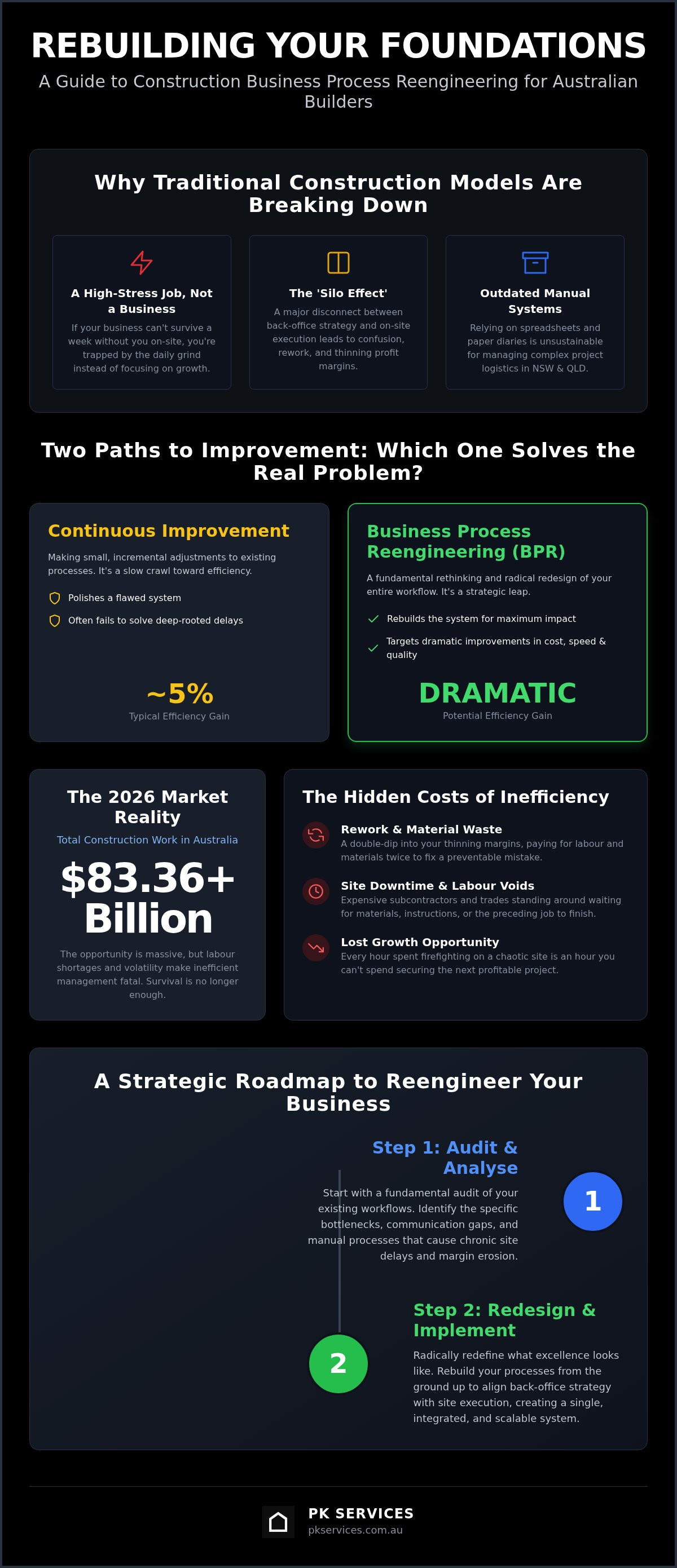
In the Australian building industry, we've often relied on "the way things have always been done." But in a market where margins are razor-thin and site delays are the norm, that mindset is a liability. Business Process Reengineering (BPR) isn't about making small, polite adjustments to your admin. It's the fundamental rethinking and radical redesign of your entire workflow. We're talking about a complete overhaul that targets dramatic improvements in cost, quality, service, and speed. For a local builder, construction business process reengineering Australia serves as the essential bridge between high-level business strategy and the gritty reality of site execution.
This isn't just a corporate exercise for the big end of town. It's a survival tactic for any firm that wants to stop the bleed of wasted hours and mismanaged materials. When you reengineer a process, you're looking at the end goal and working backwards. You're asking why a task exists and if there's a more efficient way to achieve the result. It moves your business beyond traditional habits and into a space where every action on-site adds direct value to the bottom line.
BPR vs. Continuous Improvement: The Aussie Distinction
Many firms confuse BPR with continuous improvement. While continuous improvement is a slow crawl toward efficiency, BPR is a strategic leap. If your current system for managing subbies or procurement is fundamentally broken, making it 5% better won't save your project. Incremental changes often fail to solve deep-rooted site delays because they don't address the core logic of the workflow. In the context of NSW and QLD project lifecycles, reengineering means stripping back the process to its bones and rebuilding it for maximum impact. You aren't just tidying the desk; you're redesigning the office to work for you.
The 2026 Reality for Australian Builders
The 2026 economic climate has forced a shift in how we operate. With total construction work in Australia reaching over $83,360 million in early 2026, the opportunity is massive, but the risks are equally high. Labour shortages across the Sunshine State and NSW haven't just made hiring harder; they've made inefficient management fatal. You can no longer afford to stay in survival mode, reacting to every crisis as it happens on-site. Embracing construction business process reengineering Australia is about moving toward operational excellence. It's about creating a business model that thrives even when the market is volatile. By redefining your processes now, you ensure that your firm isn't just busy, but actually profitable and scalable.
Why Traditional Construction Workflows are Breaking Down
The "Silo Effect" is a quiet profit killer in the Australian building industry. Traditional workflows often leave site supervisors and business owners speaking different languages. While the office focuses on long-term strategy and profit margins, the site team is busy putting out daily fires. This misalignment creates massive operational leaks. Without a unified vision, your strategic goals never actually reach the boots on the ground. It's a disconnect that leads to confusion, frustration, and ultimately, a lack of accountability.
Relying on outdated manual systems is another major hurdle, especially for complex NSW project logistics. In 2026, a spreadsheet and a prayer aren't enough to manage a modern site. When information is trapped in paper diaries or fragmented emails, delays are inevitable. These "labour voids" happen when trades aren't organised strategically, leaving expensive subcontractors standing around waiting for materials or instructions. Implementing construction business process reengineering Australia helps close these gaps by aligning every stakeholder with a single, efficient truth.
Poor process design is the root cause of thinning margins and missed deadlines. If your workflows were built for a smaller business, they'll likely buckle under the weight of larger, more complex projects. Without a commitment to construction business process reengineering Australia, most firms remain stuck in a cycle of reactive firefighting. This approach is exhausted and unsustainable in today's competitive environment.
The Hidden Costs of Inefficiency
Calculating the real price of site downtime is sobering. Rework isn't just a mistake; it's a double-dip into your thinning margins. You're paying for the labour, the materials, and the lost opportunity of being on the next job. Many builders think "throwing more bodies at the problem" is a solution, but it usually just increases the chaos. True efficiency comes from better systems, not just more people. For a deeper dive into protecting your bottom line, see our guide on Improving Construction Business Profitability in NSW.
Labour Gaps and Subcontractor Friction
In a competitive Australian market, top-tier subbies have their pick of projects. They actively avoid builders who haven't mastered their internal systems. Broken processes lead to subcontractor friction, which directly impacts site safety and finish quality. When communication breaks down, mistakes happen, and safety protocols can slip. The Australian Constructors Association highlights the importance of Nailing Construction Productivity to remain viable. If you're ready to fix these cracks, our business consulting experts can help you rebuild your workflows from the ground up.
The Core Pillars of a Reengineered Construction Business
Building a scalable firm requires more than just hard work. It demands a structural shift. A successful transition to a modern workflow relies on four non-negotiable pillars. These aren't just abstract ideas; they're the engine room of a profitable firm. First, Strategic Resource Planning ensures your skilled trades are perfectly aligned with project milestones. You aren't just booking a sparky; you're orchestrating their arrival for maximum impact. Second, Integrated Project Oversight provides real-time visibility from the office to the site. This transparency eliminates the guesswork that often plagues Australian projects. Third, Workflow Standardisation creates a consistent "Standard" for every project phase. Finally, Supply Chain Synchronisation manages subbies and materials without the usual mess. These pillars form the foundation of construction business process reengineering Australia.
The Construction 2030 Roadmap highlights that innovation in process is just as vital as innovation in materials. With total construction work in Australia reaching $83,360.6 million in early 2026, the sheer scale of the industry makes manual oversight impossible. Relying on luck or "gut feel" is no longer a viable strategy for growth. By focusing on these pillars, you move from a collection of loosely managed sites to a unified, high-performance business model.
Synchronising Strategy and Site Execution
Effective leadership requires moving away from reactive firefighting. Implementing construction business process reengineering Australia allows you to move toward proactive leadership. Proactive leadership happens when your strategic intent is visible in every site action. This synchronisation is the hallmark of professional excellence. It ensures that the promises made in the boardroom are actually delivered on the slab. For a deeper look at this integration, our Full Cycle Construction Project Management Guide provides a detailed breakdown for NSW and QLD firms. It's about maintaining process integrity from the first shovel in the ground to the final handover.
Leveraging Skilled Trades as a Strategic Asset
Trade supply is often treated as a simple HR or recruitment task. It isn't. In a reengineered business, trade supply is a critical process issue. If your onboarding is clunky, you lose productivity before the first nail is driven. Reengineering your trade integration improves site output instantly by removing friction. Vetting is a massive part of this equation. Our guide on Vetting Construction Subcontractors in Australia explains how to turn your subbie network into a competitive advantage. When your trades are treated as a strategic asset, your business becomes more resilient and far more attractive to top-tier talent.
Implementing BPR: A Strategic Roadmap for NSW and QLD Firms
Moving from theory to practice requires a clear, actionable plan. For firms in NSW and Queensland, this isn't a weekend project; it's a strategic evolution. Implementing construction business process reengineering Australia involves a disciplined five-step roadmap designed to modernise your operations without halting your current projects. This approach ensures your business remains functional while you rebuild the engine room.
- Step 1: Process Audit – Be honest about where your NSW or QLD operations are leaking cash. Identify specific bottlenecks, from slow procurement cycles to poor site handovers.
- Step 2: Vision Redefinition – Define what "excellence" looks like for your firm. It might be a 15% reduction in project duration or a total elimination of rework.
- Step 3: Workflow Redesign – Strip back the "fluff." Remove any administrative task or site activity that doesn't add direct value to the final build.
- Step 4: Resource Alignment – Secure the right skilled trades. Your new design is only as good as the people executing it on the slab.
- Step 5: Monitoring and Evolution – Use real-time performance data to see if the changes are sticking. Refine the process based on actual site feedback.
Navigating Local Regulations During Transformation
Compliance is non-negotiable during a process overhaul. Any redesign must align with the latest standards, such as the NSW Fair Trading and Building Legislation Amendment Bill 2026. In the Sunshine State, the Queensland Building and Construction Commission and Other Legislation Amendment Act 2025 has already modernised electronic processes for approvals and safety. Your new workflows must integrate these legal requirements from day one. Managing this transition requires a steady hand to ensure site safety remains the top priority while you update your internal systems.
Managing the Human Side of Change
Winning over your site teams is often the most challenging part of any reengineering project. Tradies and long-term subbies are naturally wary of "new ways" of doing things. The key to buy-in is minimalist, direct communication. Avoid burying them in corporate jargon. Instead, show them how the new process makes their job easier, their site safer, and their pay more predictable. Training and support are essential for success on Australian sites. When your team sees that construction business process reengineering Australia actually reduces their daily frustration, they'll become your biggest advocates. If you're ready to start your audit, our business consulting team can guide you through every step of this transformation.
Redefining Excellence: The PK Services Approach to BPR
PK Services brings a unique perspective to the Australian building industry. We've spent 15 years on the ground in NSW and Queensland. We know exactly what a failing site looks like and how to fix it. Our approach to construction business process reengineering Australia isn't just about high-level theory or academic reports. It's about practical, end-to-end management that produces real results. We don't just hand over a strategy document and leave you to figure out the rest. We help you execute the plan by supplying the skilled trades and managing the entire project lifecycle from start to finish. This dual focus bridges the gap between your boldest business goals and the daily reality of your projects.
We believe that a consultant should be as comfortable on a slab as they are in a boardroom. Our "End-to-End" philosophy means we take full responsibility for the process integrity we design. By integrating our trade supply with our strategic advisory, we eliminate the friction that usually happens when external advice meets internal execution. This synchronisation is what allows a business to scale without the owner needing to be on-site 24/7. We invite you to move beyond traditional consulting and enter a partnership that values your site's success as much as you do.
Why a Boutique Advisory Partner Matters
Choosing a boutique partner gives you a significant advantage in the Queensland and NSW markets. We understand the specific logistics of the Sunshine State and the shifting regulatory nuances of NSW. Our solutions aren't "cookie-cutter" or recycled from other industries. We tailor every workflow to your specific firm's needs, project types, and team culture. This local expertise ensures that your reengineered processes are actually workable in the real world. We're committed to redefining excellence across the Australian construction industry by proving that better systems lead to better builds and higher profits.
Start Your Transformation Journey
If your sites feel chaotic and your margins are thinning despite a full pipeline, you're ready for a change. A process overhaul isn't a sign of failure; it's a commitment to professional growth. The first step in a PK Services strategic partnership is a deep-dive audit of your current operations. We'll identify the operational leaks and build a clear roadmap to plug them. For a closer look at our methodology, read our guide on Construction Business Consulting Australia: Redefining Excellence. It's time to stop reacting to crises and start leading a business built for long-term performance.
Build a Business That Operates with Precision
Scaling a construction firm in NSW or QLD requires a superior operating model. It's about precision and foresight. By embracing construction business process reengineering Australia, you move beyond the daily chaos of reactive site management. You've seen how standardising workflows and synchronising your supply chain can protect your thinning margins. It's time to create a system where the office and the site finally speak the same language.
At PK Services, we bring 15+ years of Australian industry expertise to every partnership. We are full-cycle project management specialists with a dedicated trade and contractor network. We don't just provide advice; we help you execute a refined vision. This approach allows your business to grow without demanding your presence on-site every hour of the day. It's time to redefine what excellence looks like for your firm.
Ready to redefine your construction excellence? Partner with PK Services today.
The path to a scalable, high-performance business is clear. Let's build a future where your operations match your ambition.
Frequently Asked Questions
What is the first sign that my construction business needs reengineering?
The clearest indicator is the business owner feeling unable to leave the site without operations grinding to a halt. If you're constantly reactive and firefighting daily crises, your current processes have reached their limit. You might also notice thinning profit margins despite a full project pipeline. This suggests that your internal workflows are no longer efficient enough to support your current volume of work.
How long does a typical construction BPR project take in Australia?
A comprehensive overhaul typically takes between three to six months to fully embed within a firm. We focus on a phased rollout to ensure the changes are sustainable and don't overwhelm your team. You'll often see immediate improvements in site communication and scheduling within the first few weeks. The total duration depends on your firm's size and the complexity of your current NSW or Queensland projects.
Will reengineering my processes interfere with my current on-site projects?
We design the transformation to integrate seamlessly with your active sites. Our goal is to improve the system while it's running, not shut it down. We prioritise high-impact changes that cause minimal disruption to your daily builds. This ensures your project timelines remain intact while we build a more scalable and professional business model in the background.
How does BPR help with the current labour shortage in NSW and QLD?
Construction business process reengineering Australia addresses labour gaps by making your existing team significantly more productive. When workflows are clearly defined, your trades spend less time waiting for materials or instructions and more time building. An efficient, well-organised site also attracts top-tier subcontractors who prefer working for builders who respect their time and maintain high standards.
Is business process reengineering only for large-scale Tier 1 construction firms?
Reengineering is actually more critical for small-to-medium firms looking to scale safely. While Tier 1 companies have massive administrative teams, SMEs often rely on the owner's personal stamina to keep things moving. BPR allows smaller builders to compete with larger firms by operating with the same level of strategic precision. It’s about building a robust foundation that supports growth without increasing your personal stress levels.
What is the difference between BPR and simple digital transformation?
Digital transformation often just places new technology on top of old, broken habits. BPR is a fundamental rethink of the logic behind your work before any tools are applied. We fix the underlying process first, then use technology to support that new, efficient design. Without BPR, digital tools often just help you do the wrong things faster, leading to more chaos rather than less.
Can PK Services help with both the strategy and the supply of trades?
Yes, we provide a unique blend of strategic advisory and physical trade supply to ensure total process integrity. We don't just tell you how to improve; we provide the skilled contractors to help you execute the new plan. This end-to-end involvement ensures that the strategic designs we create are actually followed on the slab. It's a partnership that covers both the boardroom vision and the site reality.
How do we measure the ROI of a reengineered construction process?
ROI is measured through reduced site downtime, lower rework costs, and improved net profit margins on every project. We compare your "cost to build" before and after the reengineering process to track tangible financial gains. Most firms also see a significant return in "owner time," which allows you to focus on high-value business development instead of being trapped in daily site management.


