

With construction costs sitting 47% higher than they were before the pandemic, every hour your site stands still is a direct hit to your bottom line. It's a brutal reality in 2026, where reducing operational downtime in construction is no longer a choice, but a survival tactic. You likely feel the pressure of thinning margins and the headache of unreliable subcontractors causing scheduling bottlenecks. It's exhausting to manage a project when you're stuck in a cycle of reactive fixes rather than strategic growth. We know you want a business that runs like clockwork, even when you aren't on-site to oversee every detail.
This guide offers a redefined approach to site efficiency by mastering the balance between high-level oversight and site-level execution. You'll learn how to eliminate "dead time" through expert process management and skilled trade coordination. We'll outline the specific strategies needed to secure predictable timelines and protect your profit margins against market volatility. From implementing the latest NCC 2026 standards to solving the chronic labour shortage, we're showing you how to build a more resilient, efficient operation that thrives in the current climate.
Key Takeaways
- Identify the hidden "burn rates" on your site, including idle labour and extended plant hire fees, that quietly erode your profits.
- Master the "Uptime Trinity" framework for reducing operational downtime in construction by aligning your processes, people, and performance.
- Learn why software alone won’t fix site delays and how to prioritise strategic business consulting over tactical technology.
- Shift your management style from reactive firefighting to proactive forecasting with five actionable steps for QLD and NSW sites.
- Discover how end-to-end project lifecycle management eliminates friction and ensures your business runs efficiently without you being on-site 24/7.
Understanding the True Cost of Operational Downtime in Australian Construction
Downtime is often misunderstood as a simple mechanical failure. While a seized engine causes a stir, the real profit killer is idle labour and poor project sequencing. It's the hour spent waiting for a delivery that was supposed to arrive at 7:00 am. It's the trade team standing around because the previous stage wasn't cleared. Downtime is the delta between your planned programme and actual site progress. For Tier 2 and Tier 3 contractors in Australia, these gaps are where margins disappear.
With building costs rising by approximately 47% compared to pre-pandemic levels, every minute matters. Small delays compound quickly. By adopting Lean construction principles, firms can move beyond reactive management. Reducing operational downtime in construction isn't just a technical goal; it's a financial necessity in 2026. This isn't just about hardware. It is about the strategic alignment of every person on your site. Focusing on reducing operational downtime in construction allows you to protect your bottom line before the first brick is even laid.
The Financial Ripple Effect of Site Delays
Site delays create a toxic cycle for your cash flow. When one project stalls, it traps capital that should be funding your next start. A single day of downtime rarely stays contained to 24 hours. It often ripples out, creating a week of scheduling conflicts as subcontractors move to other jobs. In a high-inflation economy, these delays attract "hidden costs" like extended plant hire fees and mounting overhead burn rates. Protecting your margins requires a proactive shield against these avoidable leaks. Efficiency is the only way to combat the rising input prices for house construction, which rose by 2.5% in the March 2026 quarter.
Reputational Risk and Client Trust in NSW & QLD
Your reputation in Sydney and Brisbane is built on momentum. Developers and government bodies look for reliability, not just results. If your sites are consistently stagnant, your standing in the market drops. Operational excellence is the key to winning repeat business. Redefining excellence starts with punctuality and maintaining a steady site rhythm. When you eliminate friction, you prove to clients that you are a partner worth keeping. Consistent delivery ensures you remain the first choice for major infrastructure projects, where demand is expected to peak at 521,000 workers by mid-2027. Your ability to maintain site momentum is your most valuable asset.
The Strategic Pillars of Uptime: Labour, Logistics, and Leadership
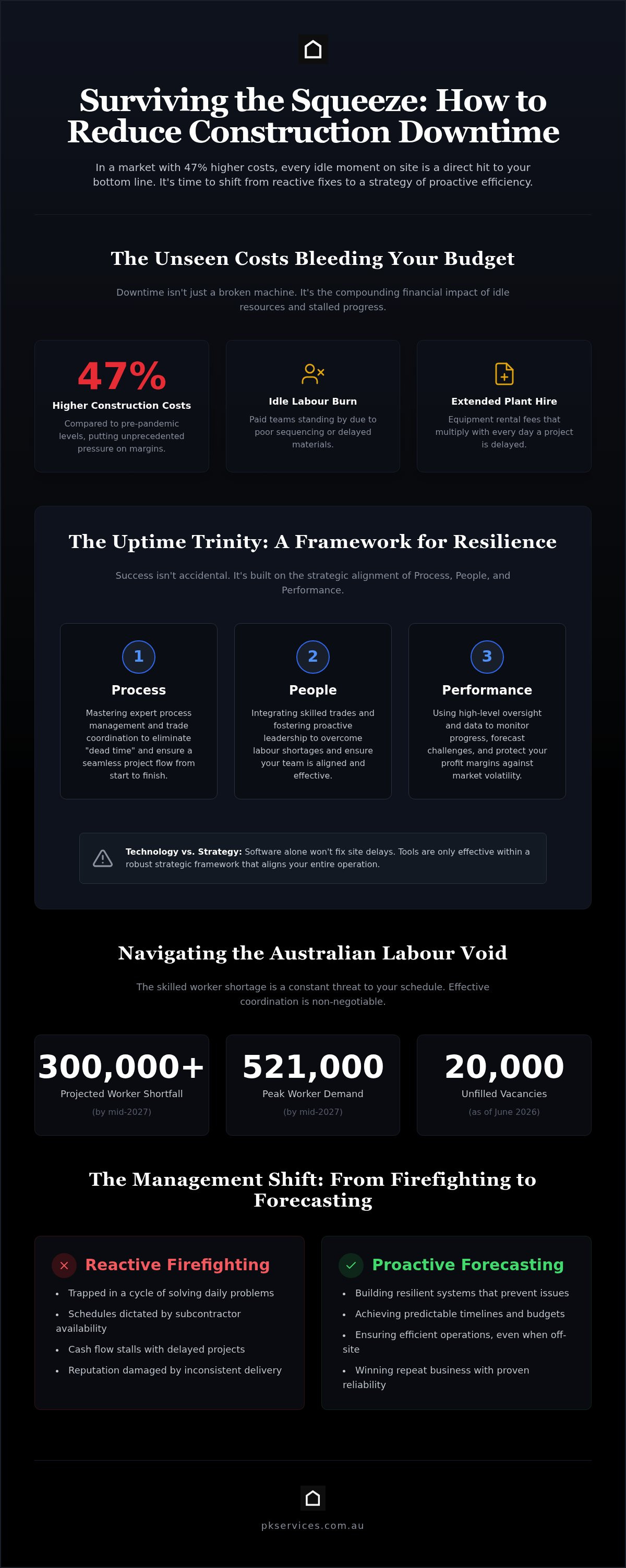
Success on a modern Australian site is never accidental. It relies on what we call the "Uptime Trinity": Process, People, and Performance. Many firms invest heavily in high-end hardware like Trimble, expecting technology to solve every delay. Tools are essential, but they fail without a robust strategic business advice construction framework. Leadership must be proactive. You can't wait for a problem to appear before you act. Synchronising these three pillars is the only way to achieve a truly seamless project flow. Reducing operational downtime in construction requires this high-level alignment between your strategy and your site team.
Master Builders Australia has recently pointed to declining construction productivity as a critical call to action for the industry. We're seeing a direct link between poor leadership structures and stagnant site progress. When leadership is reactive, the entire project suffers. A redefined approach to site management ensures that every pillar supports the other. This prevents the "stop-start" rhythm that destroys your margins. If you're looking to tighten your operations, you might reach out to our consulting team for a fresh perspective.
Labour Coordination and Skilled Trade Integration
The "labour void" is a constant threat to your schedule. Australia is currently facing a projected shortfall of over 300,000 construction workers by mid-2027. With 20,000 unfilled vacancies as of June 2026, even the best-laid plans can fall apart if a key trade doesn't show up. You need a reliable strategy to ensure skilled trades are on-site exactly when the programme requires them. PK Services utilises 15 years of industry experience to supply experienced trades that maintain high site standards. We fill the essential labour gaps that cause bottlenecks. This integration ensures that reducing operational downtime in construction becomes a daily reality rather than a distant goal.
Logistics and Resource Planning
Logistics in high-density areas like Sydney’s CBD or the Gold Coast require precision. Simple delivery tracking is no longer enough for Tier 2 and 3 contractors. You need "Just-In-Time" resource management to keep the site clear and the work moving. If materials arrive too early, they create a safety hazard and block access. If they arrive late, your labour costs skyrocket while teams wait. Resource planning must be integrated into the full cycle construction project management process. This bird's-eye view allows you to forecast needs weeks in advance. It removes the friction that typically slows down large-scale builds.
Technology vs. Strategy: Why Software Alone Won’t Fix Your Site Delays
Software is a tool. It isn't a solution. Many Australian contractors fall into the trap of believing a new app will automatically repair a broken business model. You can track a delay in real-time with the latest dashboard, but that doesn't stop the delay from happening. Tactical technology provides the "what," but it often fails to explain the "why." Mastering the art of reducing operational downtime in construction requires more than a subscription to a new platform; it demands a fundamental shift in how you lead your site.
Strategic transformation goes deeper than digital tracking. While software might flag that a trade is late, construction business consulting Australia identifies the cultural or process-driven root causes behind that tardiness. Is it a lack of clear communication? Is the sequencing flawed? High-level consulting looks at the entire ecosystem. It bridges the gap between having data and knowing what to do with it. Before you invest in more digital tools, evaluate if your problem is a lack of information or a failure in management execution.
True efficiency often comes from structural changes rather than digital ones. For instance, the Australian Constructors Association advocates for Modern Methods of Construction (MMC) as a primary strategy to boost productivity. This isn't just about a new piece of software; it's about redefining how we build. By shifting focus toward strategic methodologies, you create a foundation where technology can actually succeed. Reducing operational downtime in construction is only possible when your digital tools are supported by a robust, human-led strategy.
The "App Fatigue" Trap in Modern Construction
Site crews are increasingly overwhelmed by "app fatigue." When you force trades to use multiple, disconnected platforms for safety, time-tracking, and logistics, friction increases. Compliance drops. An integrated strategy beats a collection of "point solutions" every time. You need human-centric systems that your team will actually follow. If a system is too complex for a busy site foreman to use under pressure, it's a liability, not an asset. Excellence is found in simplicity and alignment, not in the number of icons on your home screen.
Bridging the Gap Between Data and Action
Software provides data, but strategic advisory provides the "so what?". A site report might show you're losing four hours a week to delivery bottlenecks, but it won't tell you how to renegotiate those supplier contracts. Turning site reports into actionable business improvements requires an experienced eye. An external consultant provides an unbiased view of your site inefficiencies that you might be too close to see. We help you move from simply measuring failure to actively engineering success through better resource allocation and smarter trade coordination.
Five Practical Steps to Minimise Downtime on QLD and NSW Sites
Site management in 2026 demands a total shift from reactive firefighting to proactive forecasting. You cannot afford to wait for a problem to stall your site before you address it. The first step in this evolution is conducting a construction business health check before you even break ground on a major new phase. This diagnostic tool ensures your internal systems can handle the pace of a high-growth project. Reducing operational downtime in construction is about closing the "pre-start" and "post-completion" loops of every stage. You want to capture lessons in real-time and apply them to the next trade handover immediately.
A proactive routine turns your site into a predictable machine. It moves the focus away from daily crises and toward long-term momentum. When you forecast your resource needs weeks in advance, you remove the friction that typically leads to "dead time." If you are ready to tighten your site operations, book a strategic consultation with our team today.
1. Conduct a Rigorous Site Execution Audit
You can't fix what you don't measure. A rigorous site execution audit identifies exactly where the minutes are leaking in your current workflows. You should look specifically for bottlenecks in materials handling and trade handovers. These are the two areas where time is most frequently lost. Using a professional site management audit helps you find hidden waste that internal eyes often miss. It turns vague site frustrations into concrete data points that you can actually solve. Once you see the leak, you can plug it.
2. Implement a Strategic Resource Buffer
Labour voids are project killers, but they are avoidable. Implementing a strategic resource buffer means having flex labour and on-call trades ready to jump in. This prevents site stalls when regular crews are unavailable due to illness or scheduling conflicts. Finding a reliable partner for skilled trades for construction sites is vital for maintaining this buffer. In the current market, the "cheapest" labour option often leads to the most expensive downtime. High-quality trades pay for themselves through speed, precision, and reliability. They keep the site moving when others would stand still.
3. Optimise the Project Lifecycle Communication
Information must flow without friction to keep a site active. You need to standardise how data moves from the head office to the site foreman. This reduces downtime caused by crews waiting for clarification on plans or variations. Utilise daily "toolbox talks" to align every trade on the day’s uptime goals. When every subcontractor knows exactly what success looks like for the next eight hours, momentum stays high. Clear communication ensures that reducing operational downtime in construction becomes a shared responsibility for everyone on the tools, not just the site manager.
Redefining Excellence: How Strategic Consulting Eliminates Site Friction
Excellence in construction isn't a static goal; it's a moving target that requires constant refinement. PK Services positions itself as a bold innovator in the Australian advisory space by bridging the gap between high-level strategy and site-level execution. Many consulting firms offer theories that look great in a boardroom but fail on a dusty site in Western Sydney or the Gold Coast. We operate differently. Our "Full Cycle" management approach removes the friction that typically exists between a project's business goals and its daily reality. We ensure your strategic vision translates directly into site momentum.
Reducing operational downtime in construction is the natural result of this alignment. When your strategy and your site team speak the same language, delays disappear. We bring over 15 years of industry expertise to every engagement, navigating the unique challenges of the NSW and QLD markets. Whether it's managing supply chain volatility or solving the chronic labour shortage, our experience allows us to forecast issues before they impact your margins. We help you build a high-performance business that is both elite in its results and accessible in its partnership.
The PK Services Difference: Beyond Traditional Consulting
We've redefined the standard for the modern Australian builder by combining high-end business advice with the provision of actual skilled trades. This dual approach is our greatest strength. Most firms provide a report and walk away, but we stay to ensure the labour voids are filled and the standards are met. As a boutique firm, we have a deep understanding of the Sydney and Brisbane landscape. We don't just understand the regulations; we understand the rhythm of the local industry. This ground-level insight ensures our strategic advice is always practical, actionable, and focused on your bottom line.
Your Next Step: Redefining Your Operational Standard
It's time to move from surviving the daily chaos to thriving through professional oversight. A PK Services engagement begins with a rigorous audit of your current site workflows to identify where your profits are leaking. From there, we lead a total site transformation. We implement the systems, provide the trades, and manage the processes that turn a stagnant project into a high-performance asset. You deserve a business that runs efficiently without requiring your presence 24/7. Take the first step toward a more predictable and profitable future today. Redefine your site excellence today with PK Services.
Take Control of Your Site Momentum
The landscape of Australian construction in 2026 is unforgiving for those who rely on reactive management. Success now requires a total alignment of your people, your processes, and your performance standards. By moving beyond a reliance on software and focusing on strategic oversight, you protect your margins from the hidden costs of idle labour and poor sequencing. Reducing operational downtime in construction is the only way to ensure your business remains resilient in the face of rising costs and labour shortages.
At PK Services, we bring 15+ years of Australian construction expertise to help you master these dynamics. We specialise in the unique NSW and QLD local market dynamics; providing full-cycle management that bridges the gap between high-level strategy and skilled trade provision. It's time to stop managing crises and start engineering excellence. Redefine your construction excellence with PK Services and secure your project’s future. We're here to help you build a business that runs with precision and purpose.
Frequently Asked Questions
What are the most common causes of operational downtime in Australian construction?
Common causes include labour voids, delivery bottlenecks, and poor sequencing of trades. In 2026, the lack of skilled trades in bricklaying and carpentry is a major driver of delays. These gaps create a ripple effect where one trade’s delay forces others to stand idle. By focusing on reducing operational downtime in construction, firms can address these process failures before they erode profit margins and stall site momentum.
How much does downtime actually cost a mid-sized construction firm in NSW?
While specific dollar amounts vary, the cost is substantial given that house construction costs rose by 2.5% in early 2026. For a mid-sized NSW firm, downtime includes extended plant hire fees, mounting overhead burn rates, and potential liquidated damages. These "hidden costs" often exceed the direct labour loss. Protecting your cash flow requires a proactive approach to site momentum to avoid these compounding financial drains on your business.
Can business consulting really help a site that is already behind schedule?
Strategic consulting is often the fastest way to recover a delayed programme. It involves a rigorous audit of current workflows to identify exactly where minutes are leaking. By re-sequencing tasks and providing experienced trades to fill labour voids, consultants help sites regain lost momentum. It's about moving from reactive firefighting to a structured, forecasting-based model that prioritises site uptime and protects your remaining profit margins.
What is the difference between labour hire and strategic trade services?
Traditional labour hire often provides general workers, whereas strategic trade services provide specialised, experienced tradespeople who understand site-level execution. PK Services utilises 15 years of industry expertise to supply trades that maintain superior standards. This approach ensures that workers aren't just present, but are actively contributing to the project's quality and schedule. It is a redefined standard of service that bridges the gap between high-level strategy and the tools.
How do I know if my construction business needs a strategic health check?
Your business needs a health check if you're stuck in a cycle of reactive management or seeing thinning margins despite a full pipeline. If site foremen are constantly waiting for plan clarifications or if subcontractors are causing frequent scheduling bottlenecks, your processes are likely failing. A strategic health check identifies these friction points. It allows you to transition into a high-performance business that runs efficiently without your constant on-site presence.
How does PK Services manage the entire project lifecycle from start to finish?
We provide end-to-end project lifecycle management by integrating strategic business advice with on-site trade provision. Our team oversees every phase, from initial process design to final completion. This "Full Cycle" approach ensures that the strategic vision is never lost during site execution. By managing the entire process, we eliminate the friction between the office and the tools, ensuring a seamless flow that maximises project profitability across NSW and QLD.
What role does site leadership play in reducing daily delays?
Leadership is the primary driver for reducing operational downtime in construction through proactive forecasting. Site leaders must synchronise the "Uptime Trinity" of process, people, and performance to maintain momentum. Instead of simply reacting to problems as they arise, effective leaders anticipate resource needs weeks in advance. This forward-thinking mindset reduces the "dead time" caused by waiting for materials or trade handovers, keeping the site moving at peak efficiency.
Is it possible to eliminate downtime in high-density urban projects in Sydney?
While total elimination is difficult, significant reduction is possible through "Just-In-Time" logistics and rigorous execution audits. High-density projects in Sydney require precise coordination of material deliveries and trade arrivals to avoid site congestion. By implementing a strategic resource buffer and standardised communication loops, builders can maintain a steady rhythm. This approach ensures that urban constraints don't become permanent barriers to project speed or your business's overall operational excellence.


