

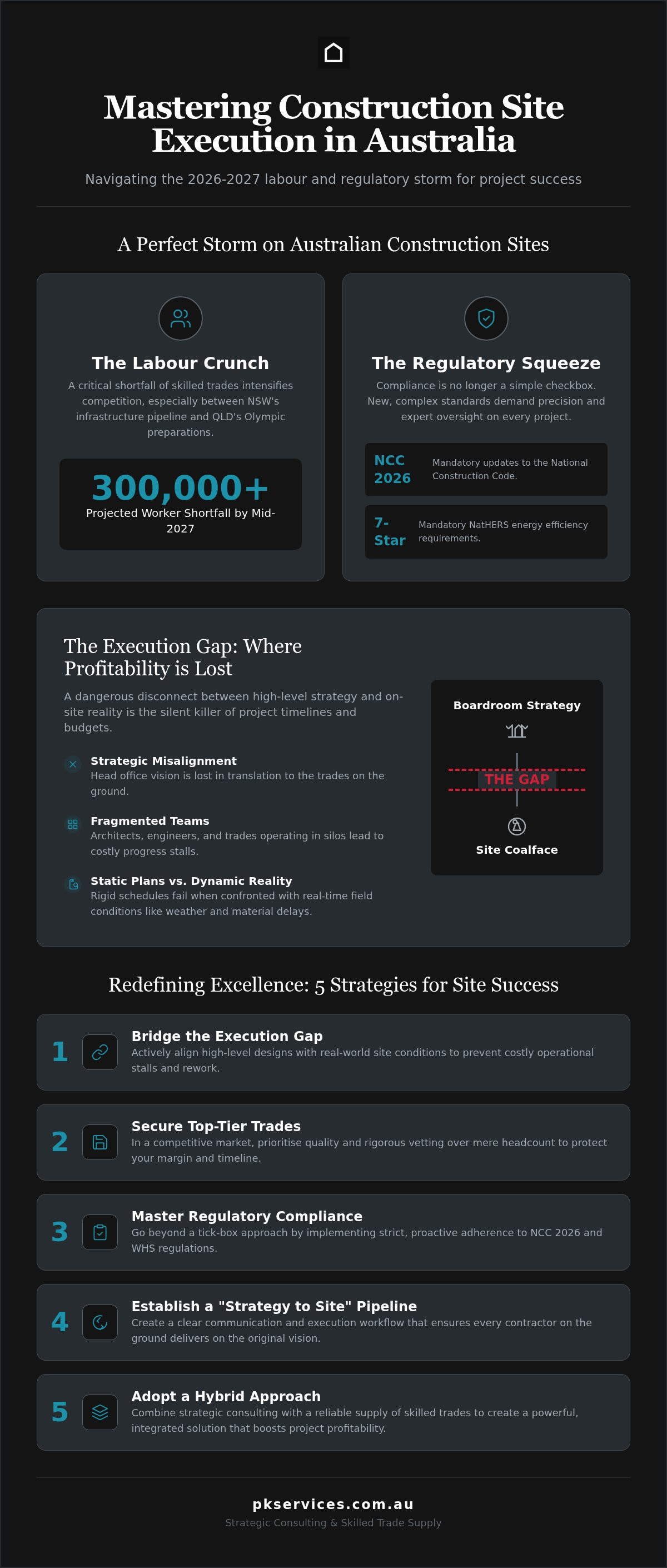
Australia is staring down a shortfall of over 300,000 construction workers by mid-2027. It is a staggering figure that highlights the intense pressure on every project manager from Brisbane to Sydney. You are likely already feeling the squeeze of common construction site execution challenges Australia presents; particularly with the recent adoption of NCC 2026 and the mandatory 7-star NatHERS requirements. Navigating these higher standards while managing volatile material costs requires more than just a solid plan. It requires a fresh approach to site leadership.
We understand that the disconnect between your boardroom strategy and the site coalface is where profitability usually bleeds out. This strategic guide promises to help you master these complexities by providing actionable insights into labour logistics and operational excellence. You will learn how to secure reliable trades, streamline your site workflows, and implement the redefined standards necessary to thrive in a high-regulation environment. We are moving beyond traditional fixes to offer a forward-thinking blueprint for site execution that protects your bottom line and your reputation.
Key Takeaways
- Bridge the execution gap by aligning high-level designs with real-world site conditions to avoid costly operational stalls.
- Secure top-tier trades in NSW and QLD by prioritising quality over mere headcount in a competitive 2026 market.
- Master common construction site execution challenges Australia presents through strict adherence to NCC 2026 and updated WHS regulations.
- Establish a "Strategy to Site" pipeline to ensure every contractor on the ground delivers on your original vision.
- Adopt a hybrid approach of strategic consulting and skilled trade supply to redefine excellence and boost project profitability.
What is Construction Site Execution and Why Does it Fail in 2026?
At its core, What is Construction Site Execution? It is the high-stakes phase where strategic plans and architectural designs finally become physical structures. In 2026, this transition is harder than ever. The "Execution Gap" has widened significantly over the last five years. Projects are now layers of complex sustainability requirements, digital twins, and strict compliance hurdles. This complexity is one of the most common construction site execution challenges Australia faces today.
Fragmented teams often make this worse. When architects, engineers, and trades operate in silos, progress stalls. Information gets lost in the hand-over. In a market governed by the NCC 2026 and the National Environmental Protection Agency (NEPA), the old "near enough is good enough" attitude is a liability. Precision is the new baseline for survival. If the execution fails, the strategy is irrelevant.
The Living System of an Australian Job Site
A typical site in NSW or QLD is a breathing organism with dozens of moving parts. Materials arrive, weather shifts, and labour fluctuates daily. Static project schedules rarely survive first contact with reality. Real-time field conditions often contradict the original plan, requiring immediate, expert adjustment. When execution falters, the damage goes beyond the budget. It erodes your brand reputation among developers and the community. Reliable execution ensures that field conditions inform the plan, rather than fighting against it.
Strategic Misalignment: The Silent Project Killer
Friction often starts at the top. A lack of full cycle construction project management creates a dangerous void between head office expectations and ground-floor reality. Strategy is useless if the person holding the tools doesn't understand the vision. This misalignment is a primary driver of common construction site execution challenges Australia encounters across major metropolitan builds. Site execution is a dynamic leadership challenge, not just a technical one.
The Labour Crunch: Solving the Skilled Trade Shortage
The 2026 Australian labour market is a battleground. It is no longer just about hiring; it is about survival. Infrastructure Australia projects a shortfall of over 300,000 workers by mid-2027. This labour crunch has transformed from a nuisance into a primary operational risk. Do not fall into the trap of filling voids with warm bodies. If you prioritise headcount over competence, you invite rework, safety failures, and project creep.
Quality is the only protection for your margin. Unvetted contractors are a liability in a high-compliance environment. This is why vetting construction subcontractors in Australia is a strategic necessity. It secures your timeline. It ensures the hands on your site match the standards in your head office. Excellence is not accidental; it is the result of rigorous selection.
Bridging the Trade Gap in NSW and QLD
Trade availability is not uniform across the east coast. Sydney's massive infrastructure pipeline competes directly with Brisbane's Olympic preparations. These regional pressures sharpen the common construction site execution challenges Australia faces daily. You need a reliable pool of experienced trades on call to avoid critical path delays. Many project leaders now engage specialist trade partners to bridge this gap with precision and speed.
Performance Management of Site Contractors
Site management has changed. Supervision is no longer enough. You must lead. Establish clear KPIs that align trade output with your specific project milestones. Elite skilled trades for construction sites do more than follow orders. They solve problems before they stall the schedule. This proactive mindset is the only way to overcome common construction site execution challenges Australia while protecting your professional reputation.
Regulatory Hurdles and Compliance in the Australian Market
Compliance in 2026 is no longer a "tick-box" exercise. It is a fundamental pillar of project viability. The regulatory landscape in New South Wales and Queensland has tightened. The establishment of the National Environmental Protection Agency (NEPA) on July 1, 2026, changed the game. NEPA now has the authority to issue "stop work" orders for environmental breaches. This makes common construction site execution challenges Australia even more critical to manage from day one. Cutting corners is a high-stakes gamble that few firms can afford.
Environmental and sustainability mandates are now mandatory execution requirements. The NCC 2026 enforces a minimum 7-star NatHERS rating and liveable housing design standards. These aren't suggestions. They are legal obligations. Managing the paper trail is vital. Every trade and process must be audit-ready at all times. If your documentation fails, your project stalls. Precision in record-keeping is just as important as precision in building.
Site Safety and Quality Control
Safety is the natural byproduct of a well-managed site. There is a direct link between construction quality control management services and overall site safety. High standards reduce rework. They also reduce the risk of injury. Shift your focus from reactive reporting to proactive risk assessment. Identify hazards before they become incidents. Compliance should be integrated into the daily workflow rather than added as an afterthought on top of it.
Logistics and Resource Management
Urban centres like Sydney and Brisbane present unique logistical nightmares. Tight footprints and strict traffic windows demand flawless coordination. One late delivery can derail an entire week. Supply chain volatility remains a persistent issue. Input prices for house construction rose 2.1% in the June 2026 quarter alone. Copper-related products, like electric cables, jumped 11.2%. Strategic resource planning is the only way to avoid the "waiting on gear" syndrome. You must secure materials and logistics early to maintain momentum. This foresight is what separates successful execution from costly delays.
Redefining Excellence: 5 Strategies for Site Success
Software alone cannot solve the common construction site execution challenges Australia faces in 2026. While digital tools provide data, execution lives or dies on the site floor. You need a robust "Strategy to Site" pipeline. This ensures your high-level vision is translated into clear, actionable instructions for every contractor. Excellence is a standard that must be communicated daily. It is not a one-time boardroom decision.
Profitability is often lost in the small gaps between tasks. You can improve construction business profitability in NSW by tightening these workflows. Identify the "underground boulders" before the excavators arrive. Proactive risk mitigation saves weeks of delays and thousands in unplanned costs. Foster a culture where transparency is expected and accountability is non-negotiable. When trades own their outcomes, site momentum remains high.
Finally, invest in professional site management to oversee the entire project lifecycle. Having an expert partner who manages the process from start to finish reduces the burden on your internal team. If you are ready to move beyond reactive fixes, redefine your site standards with a team that understands the Australian landscape.
Workflow Optimisation and Efficiency
Daily routines often hide significant inefficiencies. Bottlenecks in material handling or trade transitions can stall an entire programme. Adopt lean construction principles specifically tailored for the Australian environment. A construction business health check often reveals these hidden execution leaks. Fix the leak, and you fix the margin. Efficiency is about doing the right work at the right time, every time.
Effective Communication Frameworks
Messy group chats are a recipe for disaster. Information gets buried. Instructions get ignored. You need a structured reporting framework where the project manager is the single source of truth. Instructions must be clear, punchy, and declarative. This level of clarity reduces common construction site execution challenges Australia by removing ambiguity. When everyone on the ground knows exactly what is expected, the site moves with purpose and precision.
How PK Services Solves Execution Challenges
Execution is where strategy meets the dirt. For 15 years, PK Services has refined a model that bridges this gap. We don't just provide advice from a distance. We get involved at every level. Our unique hybrid approach combines high-level business consulting with direct trades and contractor services. This ensures that the standards set in the boardroom are actually met on the site floor. We solve the common construction site execution challenges Australia presents by being a partner who understands both the plan and the tools required to build it.
Local expertise is our foundation. We have a proven track record across NSW and QLD. We know the specific regional regulations and the unique logistical pressures of Sydney and Brisbane. We manage the entire process from start to finish. This end-to-end oversight removes the silos that typically stall progress. By taking full responsibility for the execution phase, we allow you to focus on growth while we handle the operational heavy lifting.
Strategic Advisory for Modern Builders
Scaling a construction firm requires more than just winning more work. It requires a resilient construction business growth strategy NSW builders can rely on. Our consulting solutions are tailored to your specific operational needs. We look for the hidden leaks in your performance and redefine your standards for excellence. Our approach is bold and innovative, yet remains grounded and down-to-earth. We provide the clarity you need to move from reactive management to proactive leadership.
Reliable Trade and Contractor Services
Finding the right hands is a primary concern in the 2026 market. We fill the labour void with skilled professionals who meet our uncompromising standards. These aren't just workers; they are an extension of our mission to redefine excellence. Our trades integrate seamlessly into your existing site structure, maintaining momentum without the friction of unvetted labour. We provide the muscle that matches your strategy. If you are ready to secure your project's future, contact us to discuss your next project. Let's solve your common construction site execution challenges Australia together.
Secure Your Site's Future in a High-Stakes Market
Mastering the common construction site execution challenges Australia offers in 2026 requires more than just a plan. It demands the seamless integration of high-level strategy with the physical muscle of skilled trades. By securing your labour supply and tightening your compliance frameworks, you turn operational risks into competitive advantages. Excellence is no longer an aspiration; it's a baseline for survival in a market governed by NCC 2026 and increasing regulatory oversight.
PK Services brings 15+ years of industry experience and specialised NSW and QLD expertise to your project. We provide end-to-end management that covers the entire project lifecycle, ensuring your vision is never lost between the boardroom and the site floor. Our hybrid model of consulting and trade supply is designed to protect your margins and your reputation. It's time to move beyond reactive fixes and embrace a redefined standard of operational excellence that drives real growth.
Take the first step toward a more profitable and reliable site. Redefine your site excellence with PK Services today. We are ready to help you lead the way.
Frequently Asked Questions
What are the most common causes of construction delays in Australia?
Delays often stem from a combination of chronic skilled labour shortages and supply chain volatility. In 2026, the adoption of NCC 2026 and new NEPA environmental standards has added layers of complexity to project timelines. These represent some of the most common construction site execution challenges Australia faces today. Projects also stall due to fragmented communication between architects and trades, which creates "underground boulders" that stop work before it even begins.
How can I improve site productivity without increasing my labour budget?
You can boost productivity by identifying and fixing "execution leaks" within your existing workflows. This often involves adopting lean construction principles and conducting a thorough business health check to reveal where time is being wasted. Improving the "Strategy to Site" pipeline ensures that every contractor understands their specific role and deliverables. By refining your internal processes, you can achieve higher output without the need to constantly recruit more expensive, unvetted labour.
Does my site in NSW have different compliance requirements than QLD?
Yes, while the National Construction Code (NCC) 2026 provides a uniform baseline, New South Wales and Queensland maintain distinct Work Health and Safety (WHS) frameworks. Additionally, local environmental regulations can vary significantly between Sydney and Brisbane. The establishment of the National Environmental Protection Agency (NEPA) in July 2026 adds a federal layer of scrutiny. You must stay informed about both state-specific duties and new federal "stop work" powers to avoid costly compliance breaches.
What is the difference between labour hire and professional trade services?
Labour hire typically focuses on filling a seat with a warm body, often without deep vetting. In contrast, professional trade services provide experienced, skilled professionals who are integrated into a larger strategic framework. PK Services specialises in supplying trades that meet a redefined standard of excellence. We don't just fill a void; we provide the muscle that understands the strategy. This approach reduces the rework and safety risks often associated with traditional recruitment.
How do I handle material supply chain issues on a live project?
Managing supply chain issues requires early procurement and strategic resource planning rather than reactive ordering. With input prices for house construction rising by 2.1% in the June 2026 quarter, you can't afford to wait for gear to arrive. Secure your critical materials well in advance and maintain a buffer for volatile items like copper cabling. Proactive risk mitigation helps you identify potential shortages before they impact your critical path, keeping the site moving forward.
What role does business consulting play in day-to-day site execution?
Business consulting provides the strategic blueprint that guides your daily site operations. It helps bridge the gap between head office expectations and the ground-floor reality of a complex build. By implementing tailored consulting solutions, you can redefine your operational performance and ensure that leadership is proactive rather than reactive. This high-level oversight is essential for overcoming common construction site execution challenges Australia presents in a high-compliance, high-cost environment like the current 2026 market.
How can I ensure my subcontractors are meeting Australian quality standards?
You ensure quality by establishing clear KPIs and a culture of transparency among all subcontractors. Move beyond simple supervision to active site leadership where performance is measured against specific Australian Standards and NCC 2026 requirements. Rigorous vetting before a contractor steps onto the site is the best way to prevent rework. When your trades understand that accountability is non-negotiable, they are more likely to deliver the high-tier results your brand demands.
What is full cycle project management and do I need it?
Full cycle project management involves overseeing the entire project from inception through to final completion. You need it if you want to ensure that your strategic vision is actually executed on the site floor without dilution. This end-to-end approach removes the silos between planning and building, which often cause project failure. By managing the entire process, PK Services ensures that every phase of the build is aligned with your profitability and quality goals.


