

Since 2020, Australian building material costs have surged by a staggering 38.3 per cent, leaving many contractors working harder just to stay afloat. It's a sobering reality that makes the traditional way of building feel increasingly unsustainable. You've likely felt the sting of dwindling margins and the headache of trade coordination that never quite clicks. It’s exhausting when business growth brings more chaos than actual profit, especially as new regulatory standards like the NCC 2025 add layers of complexity to every build.
There is a better way to operate. By integrating lean construction principles Australia, you can move beyond the daily fires and build a business defined by predictable timelines and professional excellence. This isn't just about theory; it's about connecting high-level strategy with the hands-on reality of the job site. We'll explore how to eliminate waste and reclaim your margins by aligning your office vision with site-ready trade execution. This guide provides the framework to ensure your projects run with precision, allowing you to step back while your business moves forward with confidence.
Key Takeaways
- Shift your focus from "business as usual" to a culture of continuous improvement that protects your margins in a volatile market.
- Identify exactly what your clients value in 2026 to eliminate unnecessary steps and streamline your project delivery from start to finish.
- Master the integration of lean construction principles Australia by aligning high-level strategy with the actual trades performing on your job site.
- Follow a practical, two-phase roadmap to audit your current operations and establish a new standard of professional excellence.
- Discover how end-to-end management and 15 years of industry experience can transform a chaotic project into a predictable, high-margin success.
Beyond the Buzzwords: The Reality of Lean Construction in Australia
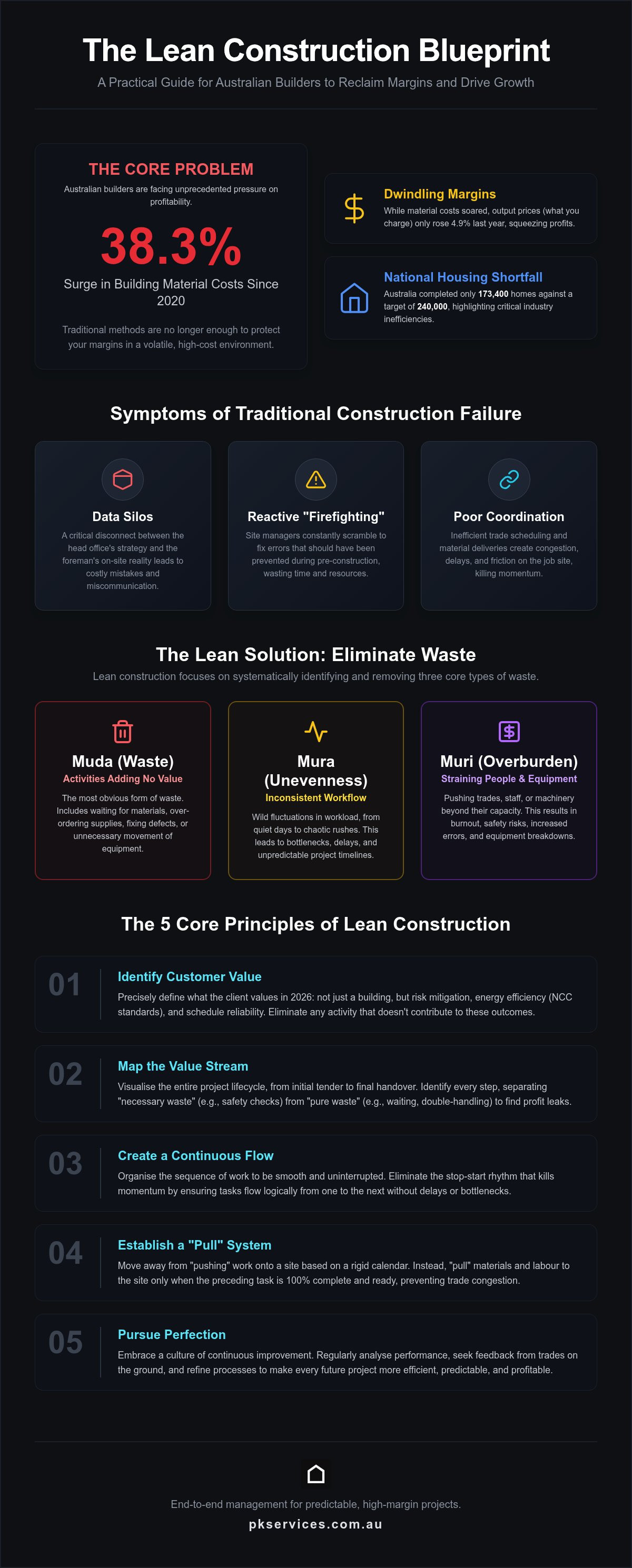
In 2026, the Australian construction industry faces a brutal math problem. Building material costs have climbed 38.3 per cent since 2020. While material inflation has slowed, output prices-what you actually charge-rose 4.9 per cent over the last year, outpacing general inflation. For firms in NSW and QLD, the old ways of padding quotes to cover inefficiencies no longer work in a high-interest environment. Success now requires a fundamental shift in how we build.
Lean construction is not a specific software or a trendy design phase. It is a culture of continuous improvement. By adopting lean construction principles Australia, builders focus on the relentless elimination of waste. This isn't just a site-level tactic; it's a strategic business decision that dictates how a firm organises its people and its capital. You can explore the foundational history of Lean construction principles to see how they evolved from manufacturing into the powerhouse of modern building, but the local application is where the profit lives.
To master this, you must understand the three types of waste that drain Australian projects. First is Muda (waste), the obvious activities that add no value, like waiting for a concrete pour or over-ordering timber. Second is Mura (unevenness), where workflows fluctuate wildly between quiet days and chaotic rushes. Third is Muri (overburden), where trades are pushed beyond capacity, leading to errors and safety risks. Addressing these requires more than a better schedule; it requires a new mindset.
The Symptoms of Traditional Construction Failure
Traditional builds often suffer from reactive decision-making. We see this daily on Sydney and Brisbane sites as "firefighting," where site managers scramble to fix errors that should have been caught in pre-construction. Data silos often exist between the head office and the foreman. This disconnect leads to profit leakage through massive material waste and poor trade coordination. It’s a cycle that turns growth into chaos.
Why 2026 is the Year for Lean Transformation
Current labour market pressures are immense. With Australia completing only 173,400 homes against a target of 240,000, every hour of trade time is precious. Implementing lean construction principles Australia provides a sharp competitive edge during high-stakes tenders by proving you can deliver certainty. It allows you to protect your margins despite rising wages. For the modern Australian builder, lean construction is the systematic pursuit of value through the total synchronisation of trade execution and strategic management.
The 5 Core Principles of Lean Construction for NSW and QLD Firms
Applying lean construction principles Australia wide requires a shift from simply "doing more" to "doing what matters." It begins with identifying customer value. In the 2026 market, clients aren't just paying for a physical structure. They're paying for risk mitigation, energy efficiency under the new NCC standards, and schedule reliability. If an activity doesn't directly contribute to these outcomes, it is a candidate for elimination.
Mapping the Value Stream in Local Markets
Visualising the project lifecycle reveals exactly where your profit leaks. In NSW and QLD, we distinguish between "necessary waste" and "pure waste." Necessary waste includes mandatory compliance checks, lead-free plumbing verifications, and safety inductions. Pure waste is anything else: waiting for a late delivery, double-handling materials, or over-ordering copper pipes that then sit idle on-site. By stripping away pure waste, you refine your construction business growth strategy NSW. This clarity ensures every dollar spent moves the project closer to handover.
Establishing Pull and Flow on the Job Site
Traditional scheduling "pushes" work onto the site based on a rigid calendar, which often causes trade congestion and conflict. Lean systems use "pull" logic. Labour and materials arrive only when the preceding task is 100 per cent complete. This creates a steady flow, preventing the stop-start rhythm that kills momentum and destroys margins. Organisations like Lean Construction Australia and New Zealand advocate for this level of synchronisation to manage regional supply chain disruptions effectively.
When your site has flow, you avoid the $40.19 per hour cost of idle plumbers or electricians waiting for access. Real-time communication between site leadership and subbies is the engine of this flow. It allows for immediate adjustments when a delivery is delayed or a trade is short-staffed. Finally, seek perfection. Use data-driven insights from completed projects to refine your next build. This cycle turns a one-off success into a repeatable, professional business model. If you're looking to eliminate chaos, it might be time to redefine your approach to project management and trade coordination.
Bridging the Gap: Why Office Strategy Fails Without Site-Ready Trades
High-level strategy is worthless if the trades on-site aren’t aligned with the vision. You can have the most sophisticated digital workflow in the country, but if your plumber or carpenter doesn't understand "pull" logic, your project will still stall. Strategy alone is a ghost. Execution is where the margin lives. For many Australian firms, the breakdown occurs because the office speaks the language of efficiency while the site remains stuck in reactive firefighting.
Integrating lean construction principles Australia requires more than just a site office memo. It demands a fundamental shift from traditional labour hire to integrated trade services. Traditional labour hire focuses on filling a hole with a warm body. It is a reactive approach that treats people as interchangeable units. In contrast, site-ready solutions involve teams that are already synchronised with the project’s lean objectives. These professionals don't just perform a task; they manage the flow of work to ensure the next trade can start on time.
Redefining Excellence Through Skilled Trades
Skilled trades are the hands of lean optimisation. At PK Services, we view trade supply as a core component of redefining construction excellence. We don't just provide labour. We provide a managed service that bridges the gap between high-level consulting and on-site reality. This approach ensures that the professional standards set during the planning phase actually manifest on the job site. Selecting the right partners is the first step in this process. You can learn more by reading our guide on vetting construction subcontractors Australia.
The Human Element of Lean Systems
Lean systems are powered by people, not just software. Building a culture of accountability means every trade on-site must feel empowered to identify waste. According to Lean Construction Australia and New Zealand, successful implementation relies heavily on this cultural alignment. When your site leadership respects lean digital workflows, the "chaos threshold" of your business drops. You can scale your firm without the usual increase in stress and owner intervention. Professional site management acts as the buffer, ensuring that as you take on more complex projects, your margins remain protected and your timelines stay predictable.
A Practical Roadmap for Implementing Lean Systems in Your Construction Business
Transitioning from traditional methods to a lean operation doesn't happen by accident. It requires a deliberate, phased approach that respects the realities of the Australian market. With material costs sitting 38.3 per cent higher than in 2020 and new NCC 2025 standards being adopted on 1 October 2026, your roadmap must be precise. Implementing lean construction principles Australia wide requires a structured approach that moves from the boardroom to the building site.
Phase 1: The Construction Business Health Check
Success begins with an honest diagnostic audit. You cannot fix what you haven't measured. This phase involves a deep dive into your project management, financial reporting, and current trade coordination. We look for the "leaks"-those recurring moments where profit disappears on NSW or QLD jobs due to poor sequencing or over-ordering. This audit is the foundation for improving construction business profitability NSW. It identifies exactly where your current systems fail to meet the standard of excellence you've set for your firm.
Once the audit is complete, you move into Phase 2: Strategic Redefinition. This is where you set the new standard for your firm’s excellence. It's followed by Phase 3: Process Standardisation. Here, you create the "playbook" for every project. This playbook ensures that whether you are building a custom home in Brisbane or a commercial fit-out in Sydney, the methodology remains consistent. Standardisation removes the guesswork for your team and your trades.
Phase 4: Field Adoption and Site Execution
The most common failure point for new systems is resistance from site crews. To overcome this, you must identify "champion" tradespeople-respected site leaders who understand that lean workflows make their own jobs easier. Site integration requires expert oversight to ensure strategy translates into physical results. You don't just hand over a manual; you demonstrate the value in real-time. Measure lean ROI in the first 90 days by tracking the reduction in unplanned trade downtime and material re-ordering costs against your baseline project budget.
Finally, Phase 5: Continuous Optimization allows you to scale. By using data from every completed project, you refine your playbook for the next one. This repeatable success is what separates a struggling contractor from a market leader. If you're ready to stop the profit leaks and start building with precision, it's time to partner with experts who understand the Australian construction landscape. We help you bridge the gap between high-level strategy and on-site reality.
Redefining Excellence: The PK Services End-to-End Advantage
Generic global firms often deliver reports that gather dust in a site office drawer. PK Services provides a different tier of service. We act as the bridge between your high-level strategy and the actual execution on-site. With 15 years of industry experience, we understand the specific pressures of the NSW and QLD markets. We know that lean construction principles Australia only work when they're backed by site-ready trades and rigorous project oversight. Our boutique approach ensures that your vision doesn't get lost in translation between the boardroom and the tool belt.
Scaling a construction business often feels like inviting more chaos into your life. It shouldn't be that way. By integrating professional business consulting with managed trade supply, we remove the operational burden from the owner. You shouldn't have to spend your weekends chasing subbies or fixing coordination errors. We provide the leadership required to ensure your projects run with professional excellence, allowing you to focus on high-level growth while we handle the daily mechanics of site precision.
Total Project Lifecycle Management
Success in the 2026 market requires total control over the project timeline. We manage the entire process from inception and strategy to the final handover. This end-to-end oversight ensures that every decision made during the planning phase is physically achievable on-site. Our team synchronises the office and the field, eliminating the data silos that typically lead to profit leakage. This holistic view is the core of full cycle construction project management. It transforms a series of disconnected tasks into a single, high-performance workflow.
Your Partner in Strategic Growth
We move beyond the typical vendor relationship to become a strategic construction partner. In a landscape where material costs remain nearly 40 per cent higher than pre-2020 levels, operational excellence is your primary driver of revenue. We help you implement lean construction principles Australia wide to protect your margins and build a reputation for reliability. This isn't just about finishing one job; it's about creating a repeatable model for long-term success. If you're ready to redefine what excellence looks like for your firm, it's time to take the first step. Organise a strategy session with PK Services today and discover the power of integrated project leadership.
Lead the Market with Precision and Professional Excellence
The 2026 construction landscape doesn't reward "business as usual." It rewards those who master lean construction principles Australia to protect their margins and deliver on their promises. You've seen how bridging the gap between high-level strategy and on-site trade execution transforms chaos into a predictable, professional operation. By focusing on flow and waste elimination, you aren't just building structures. You're building a resilient business that thrives despite market volatility and rising material costs.
PK Services brings 15 years of industry expertise to your projects across NSW and QLD. We provide the end-to-end management and skilled trade supply needed to turn your strategic vision into physical reality. It's time to step away from the daily fires and move toward a future of operational excellence. Redefine your construction excellence with PK Services and start building with the certainty your business deserves. Your next project is the perfect opportunity to set a new standard. Let's build something better together.
Frequently Asked Questions
What is lean construction in an Australian context?
Lean construction in Australia is a management methodology designed to maximise value while relentlessly eliminating waste. For local builders, it means moving away from reactive firefighting toward a culture of continuous improvement. It specifically addresses the unique pressures of the Australian market, such as high labour rates and strict safety compliance. By integrating lean construction principles Australia wide, firms ensure that every hour on-site directly contributes to the project's final handover.
How does lean construction reduce costs on NSW and QLD sites?
It reduces costs by targeting the hidden drains on your margin, such as idle trade time and material over-ordering. With building material costs up 38.3 per cent since 2020, precision is essential. Lean systems ensure trades like plumbers and electricians only arrive when the site is ready for them. This prevents the costly stop-start rhythm common on Sydney and Brisbane sites, protecting your profit from being eroded by inefficiency and coordination delays.
Can small construction firms implement lean principles effectively?
Small firms are often better positioned to implement these systems because they are more agile than large corporations. You don't need a massive overhead to start seeing results. By focusing on simple value stream mapping and better trade coordination, boutique builders can significantly reduce their chaos threshold. This allows owners to step back from daily site fires, creating a professional business that runs effectively with minimal owner intervention.
What is the difference between lean construction and traditional project management?
Traditional management relies on push scheduling, where work is forced onto a site based on a rigid calendar. This often leads to trade congestion and rework. Lean construction uses pull logic, where work only begins when the previous task is 100 per cent complete. While traditional methods often treat waste as an inevitable cost of doing business, lean systems view waste as a systemic failure that must be identified and removed.
How long does it take to see the benefits of a lean transformation?
You can see immediate improvements in site cleanliness and trade morale within the first few weeks of implementation. However, a full measurable ROI typically takes about 90 days to track accurately. During this period, you’ll notice a reduction in unplanned downtime and fewer material re-ordering requests. By the end of your first project using these systems, the financial benefits become clear through protected margins and more predictable delivery timelines.
Does lean construction require expensive software or IT systems?
No, lean is a cultural and process-driven shift rather than a software requirement. While digital tools can help with scheduling, the core of the methodology is about how you manage people and workflows. You can achieve significant results through better communication and standardised playbooks without investing in complex IT systems. The focus should always be on the human element and ensuring your trades are aligned with your strategic vision.
How do you manage skilled trade shortages using lean principles?
Lean principles allow you to do more with the labour you already have by eliminating idle time. When trades know your site is organised and they won't be delayed, you become the builder of choice for top-tier subbies. This reliability is crucial during chronic labour shortages. By synchronising trade arrivals and ensuring the site is ready for work, you maximise the productivity of every hour spent on the tools.
What are the specific 2026 regulatory requirements for lean sites in Australia?
While lean isn't a mandatory regulation, it is the most effective way to manage new 2026 standards like the NCC 2025. This code, adopted on 1 October 2026, introduces stricter energy efficiency and condensation rules. Additionally, the May 2026 deadline for lead-free plumbing requires tighter material control. Applying lean construction principles Australia wide helps you navigate these complexities by ensuring compliance checks are integrated into the daily workflow, preventing expensive rework during final inspections.


