

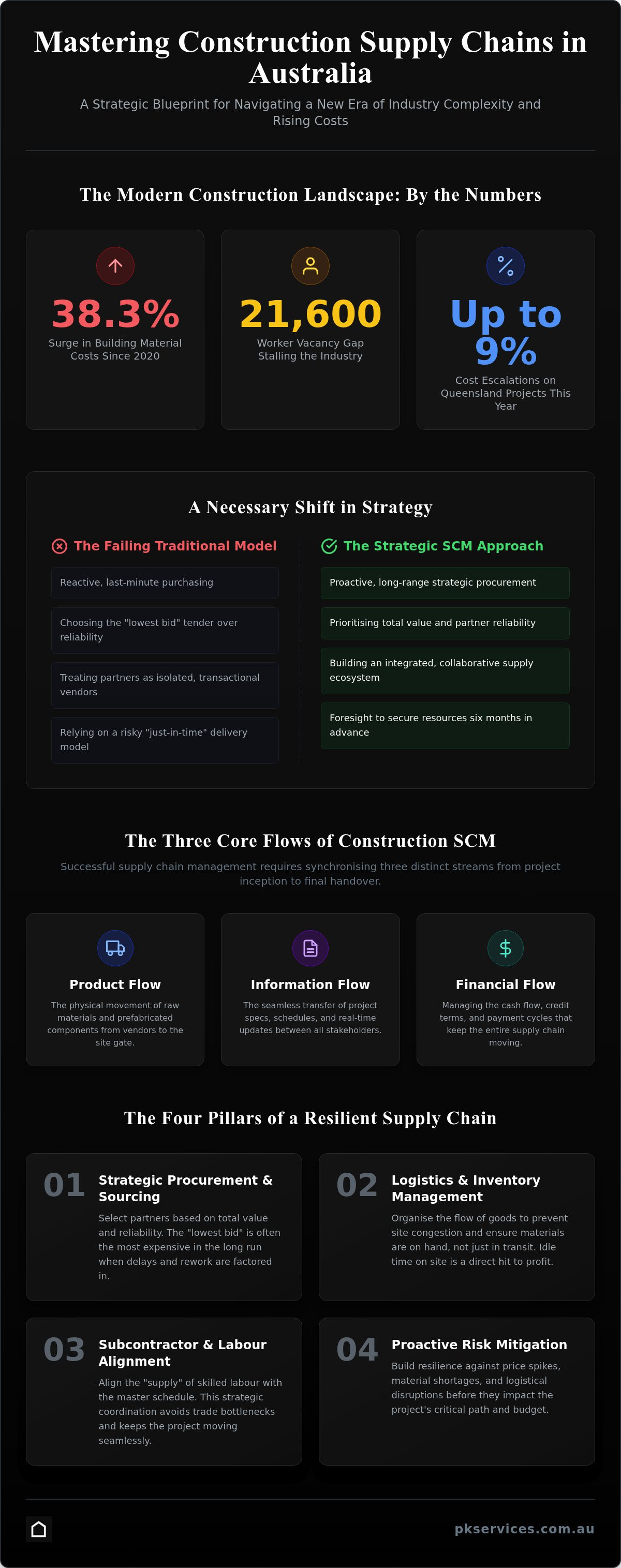
Did you know that building material costs in Australia have surged by a staggering 38.3 per cent since 2020? In a landscape where Queensland projects face cost escalations of up to 9 per cent this year, the old ways of handling logistics are failing. Effective supply chain management in construction projects has evolved from a back-office task into a high-stakes strategic lever. If your procurement process isn't as sharp as your site management, your profit margins are likely leaking through delays and trade shortages.
We know the headache of managing record diesel prices and the 21,600-worker vacancy gap currently stalling the industry. It's frustrating when the office strategy doesn't translate to the boots on the ground. This guide promises to help you master these complexities, offering a blueprint to eliminate delays and redefine project excellence. You'll learn how to bridge the gap between procurement strategy and on-site trade execution. We're moving beyond theory to give you predictable timelines and the seamless link your business needs to thrive in 2026.
Key Takeaways
- Define SCM as a total lifecycle strategy that synchronises trades, materials, and data from inception to handover.
- Master supply chain management in construction projects by prioritising partner reliability over the risks of the lowest tender.
- Navigate the specific logistical hurdles of the East Coast, including urban site access in Sydney and new 2026 regulations in Queensland.
- Bridge the gap between office planning and site reality by using a business health check to identify hidden operational bottlenecks.
- Learn how combining strategic consulting with the direct provision of skilled trades ensures your project stays on track and on budget.
What is Supply Chain Management in Construction?
Supply chain management is the strategic oversight of materials, information, and labour from the first design sketch to the final handover. It's not just a back-office function; it's the pulse of the site. At its core, Supply Chain Management involves coordinating every moving part to ensure the right resources arrive at the right time without compromising the budget.
Construction is fundamentally different from manufacturing. In a factory, you build the same product 10,000 times. In construction, every project is a unique prototype with its own set of constraints. This bespoke nature makes supply chain management in construction projects exceptionally complex. You're managing a shifting ecosystem of vendors and subcontractors rather than a static production line. Every site requires a tailored approach to logistics and procurement.
The industry is moving away from reactive purchasing. Redefining excellence means shifting toward proactive strategic procurement. It's about moving from "buying what we need now" to "securing what we need in six months." A synchronised supply chain ensures that high-level strategy isn't just a document in the office; it's the reality on the ground. This foresight is what separates successful developments from those plagued by delays.
The Three Main Flows of SCM
To master your logistics, you must manage three distinct streams simultaneously:
- Product Flow: The physical movement of raw materials and prefabricated components from vendors to the site gate.
- Information Flow: The seamless transfer of project specs, schedules, and real-time updates between all stakeholders.
- Financial Flow: Managing the cash flow, credit terms, and payment cycles that keep the entire chain moving forward.
Why Traditional Logistics is No Longer Enough
Global volatility has made local material availability unpredictable. The old "just-in-time" delivery model often fails on complex NSW and QLD sites where traffic, urban access, and labour shortages create constant friction. Relying on basic transport is a risk your project can't afford in the current climate. When materials are delayed, trades sit idle, and costs spiral.
Building resilience against these disruptions involves diversifying your vendor list and prioritising reliable Australian suppliers. For example, sourcing high-performance cladding and decking from Paveezzi Composites can help safeguard your project against the lead-time volatility often associated with imported materials.
Success in 2026 requires integrating professional site management with strategic consulting. It's about having a partner who understands both the boardroom strategy and the trade requirements on the tools. This integration ensures that supply chain management in construction projects actually delivers on its promise of efficiency. By bridging the gap between high-level advice and on-site execution, you turn a complex supply chain into a competitive advantage.
A modern approach to supply chain management in construction projects relies on more than just tracking delivery dates. It requires a structural shift in how we view partners and resources. Academic research into Supply Chain Management in the Construction Industry highlights that the most successful projects treat the supply chain as a single, integrated organism rather than a series of isolated transactions. To achieve this, your strategy must rest on four foundational pillars.
- Procurement and Sourcing: Selecting partners based on total value and reliability. The "lowest bid" is often the most expensive in the long run when delays occur.
- Logistics and Inventory: Organising the flow of goods to prevent site congestion. Idle time is a profit killer on high-density Australian sites.
- Subcontractor Management: Aligning the "supply" of skilled labour with the master schedule to avoid trade bottlenecks.
- Risk Mitigation: Building resilience against price spikes and material shortages before they hit the critical path.
Strategic Procurement and Vendor Partnerships
Transactional buying is a race to the bottom. In 2026, excellence is redefined through long-term strategic alliances. Early Contractor Involvement (ECI) allows you to de-risk the project by bringing specialist expertise to the table before the design is even finalised. This collaborative approach ensures that what's designed can actually be sourced and built. It's essential to vet construction subcontractors in Australia with a focus on their financial stability and proven performance on complex East Coast sites. These partnerships transform vendors from simple suppliers into invested project stakeholders.
Labour as a Supply Chain Component
We often discuss timber and steel, but skilled trades are your most volatile "resource." With a projected shortfall of over 300,000 construction workers by mid-2027, labour is now the primary constraint in the construction supply chain. You can't simply "hire" your way out of a shortage; you must manage labour as a strategic component. Solving the construction labour gap requires shifting from basic labour hire to integrated trade services. This ensures that the hands on the tools are as committed to the project outcome as the management team in the office. If you're looking to tighten your operations, professional business consulting can help align your procurement with your site reality. Treating labour with the same strategic rigour as material procurement is the only way to maintain momentum in a tight market.
Navigating the Australian Landscape: SCM in NSW and QLD
Mastering supply chain management in construction projects requires a deep understanding of the East Coast's unique friction points. In Sydney, the challenge is often physical access; navigating high-density urban sites requires surgical precision in delivery timing. Conversely, Queensland projects grapple with the "tyranny of distance" and a 7 to 9 per cent cost escalation forecast for 2026. A generic strategy won't survive the transition from a boardroom to a live site in Townsville or Parramatta.
The labour gap is also felt differently across the border. New South Wales is focusing heavily on prefabricated methods to offset the trade shortage, supported by the latest 2026 legislative shifts. Queensland is seeing a surge in demand for civil trades to support a massive infrastructure pipeline. Navigating these regional nuances requires a local advisory partner. You need someone who understands the specific subcontractor pools in Western Sydney and the regulatory shifts in Brisbane to keep project timelines predictable.
Regional Challenges and Solutions
Sydney's CBD and inner suburbs demand micro-logistics. You can't have a semi-trailer idling on a narrow street without risking heavy fines and site congestion. Success here depends on consolidated delivery centres and off-site staging. In Queensland, the sheer scale of regional projects drives up transport costs significantly. With diesel averaging $3.25 per litre in early 2026, every extra kilometre is a direct hit to your profit margin. Weather is the final variable. Tropical cycles in the North can halt material flows instantly, requiring a supply chain that is both flexible and resilient enough to pivot when the clouds roll in.
The Regulatory and Compliance Factor
Compliance is shifting rapidly in 2026. The NSW Building (Approvals and Practitioners) Act, passed in August 2026, has consolidated practitioner registration and introduced a statutory regime for modular construction. In Queensland, the new Procurement Policy effective from January 2026 has simplified government sourcing but demands higher transparency through the Procurement Assurance Model. Integrating construction quality control management services into your supply chain is no longer optional. It's the only way to ensure that materials sourced under pressure still meet Australian Standards and local building codes. Managing modern slavery reporting and sustainability requirements is now a standard expectation for any major AU supply chain, requiring rigorous documentation from every vendor in your network.
How to Optimise Your Project Supply Chain: A Practical Framework
Optimisation isn't about buying expensive software or chasing the latest AI trend. It's about process, discipline, and visibility. Many firms lose profit through "death by a thousand cuts" in their procurement cycles. To stop the bleeding, you must bridge the gap between high-level planning and the reality of the site gate. This is how supply chain management in construction projects moves from a theory to a tangible competitive advantage.
Step 1: Diagnostic and Strategy Alignment
You can't fix what you haven't measured. Start by conducting a construction business health check to identify hidden bottlenecks. This audit should look beyond material costs to find the "hidden" expenses of idle time and redundant shipping. Define exactly what excellence looks like for your specific project. Are you prioritising speed, cost, or quality? Once defined, set clear KPIs for vendor performance. If a supplier consistently misses delivery windows, they are a risk to your critical path. High standards require accountability at every link in the chain.
Step 2: Integrating Site Execution with Strategy
The most common failure point in construction is the disconnect between the office and the tools. Implementing full cycle construction project management closes this gap by ensuring total visibility across the lifecycle. Site supervisors must be empowered as the guardians of SCM integrity. They see the friction points first. By adopting "Lean Construction" principles, you can reduce waste and ensure that materials arrive exactly when needed, not three days early to sit in the mud. This synchronisation keeps the site flowing and the budget intact.
Standardise your communication. Protocols should be simple, direct, and consistent across vendors and trades. This eliminates the confusion that leads to double-handling and incorrect specs. Finally, focus on the human element. Invest in skilled trades who understand the broader project goals. When your team on the tools understands how their efficiency impacts the next trade, the entire supply chain accelerates. Effective supply chain management in construction projects requires more than just a spreadsheet; it demands a seamless link between the office and the site. If you're ready to redefine your project's performance, partner with an expert consultant who understands both the strategy and the execution. Real optimisation requires a partner who knows the tools as well as the spreadsheets.
Redefining Excellence: The PK Services Approach to Integrated SCM
PK Services operates on a simple truth. A brilliant strategy is worth nothing if it stalls at the site gate. We've spent over 15 years refining a model that bridges the gap between high-level consulting and the reality of the tools. In the NSW and QLD markets, where 2026 presents unique cost and labour pressures, this integrated approach is the only way to safeguard your margins. We don't just hand you a report and walk away. We stay to ensure the work gets done.
Effective supply chain management in construction projects requires a partner who understands the boardroom and the building site in equal measure. We move beyond the traditional role of a consultant. We act as an integrated extension of your leadership team. Our mission is to help you evolve from a standard builder into a high-performance construction firm. This evolution is necessary to navigate the structural inflation and trade shortages currently tightening the industry.
Consulting for Operational Performance
We start by redefining your business structure for better SCM. Many firms are held back by outdated procurement silos that create friction and double-handling. We design tailored solutions for businesses looking to scale in a volatile market. By auditing your internal processes, we identify exactly where communication breaks down between the office and the site. Our consulting doesn't just aim for incremental gains. We aim for a total transformation of your project ROI. We help you build a resilient foundation that can withstand the specific cost escalations currently impacting East Coast sites.
Filling the Gaps with Skilled Trades
Most consultants stop at the advice. We don't. Our provision of skilled trades is the "secret weapon" for your supply chain stability. By supplying the actual labour needed to fill essential voids, we ensure that the "supply" of trades matches your project schedule perfectly. This isn't just about filling seats. It's about providing professionals who understand the broader project goals. Our team on the tools is trained to work with the same precision our consultants bring to the strategy.
This direct oversight means we maintain elite standards of quality and safety that traditional labour hire simply can't match. We treat tradespeople as a critical strategic resource that needs careful management. When you integrate professional consulting with reliable site execution, you eliminate the uncertainty that plagues modern developments. You gain a seamless link between your vision and the finished build. It's time to expect a higher tier of service. Ready to redefine your site excellence? Let’s talk.
Build a High-Performance Future on Site
The landscape for supply chain management in construction projects has fundamentally shifted. Success in 2026 demands more than just ordering materials on time. It requires a synchronised approach that bridges the gap between high-level boardroom strategy and the boots on the ground. By prioritising long-term partnerships and treating skilled labour as a strategic resource, you can eliminate the delays that erode profit margins on complex East Coast sites.
PK Services brings over 15 years of industry expertise to your project. We specialise in the unique regulatory and logistical demands of the NSW and QLD markets. Our model is different because we offer a seamless integration of strategic consulting and direct trade provision. We don't just offer advice; we fill the essential labour voids that keep your project moving forward. This approach ensures your vision is backed by elite site execution every single day.
Partner with PK Services to Redefine Your Construction Excellence. It’s time to move beyond the traditional builder mindset and evolve into a high-performance firm. Let’s work together to set a new standard for your next development. Your project deserves a partner who understands the tools as well as the strategy.
Frequently Asked Questions
What is the most common cause of supply chain failure in construction?
Poor communication and fragmented data between the office and the site are the primary culprits. When site teams aren't aware of procurement delays, trade schedules collapse instantly. This lack of visibility leads to idle labour and the expensive double-handling of materials. It's rarely a single event; it's a series of small disconnects that eventually derail the critical path. Real-time coordination is essential to prevent these systemic breakdowns.
How does supply chain management improve construction project profitability?
It reduces waste and prevents expensive project overruns. By optimising the movement of goods and labour, you eliminate the hidden costs of site congestion and idle trades. Better procurement also allows for volume discounts and more favourable credit terms. In a market where material costs continue to climb, every efficiency gained through supply chain management in construction projects directly protects your bottom line and improves overall project ROI.
Why should I use a specialist consultant for SCM instead of an in-house manager?
Specialist consultants provide an external perspective and cross-industry benchmarks that in-house managers often lack. They bring specialised expertise in market trends and regulatory shifts, such as the 2026 changes to NSW building laws. Consultants also have broader networks of vetted partners. This allows your internal team to focus on core building activities while the expert handles the complex strategic orchestration of the entire chain.
Can SCM help small to medium-sized construction firms in Australia?
Smaller firms stand to gain the most from efficient logistics. SMEs often lack the massive cash reserves of tier-one builders, making them more vulnerable to price spikes and delays. A lean, strategic supply chain allows smaller businesses to compete on reliability and speed. It provides the operational discipline needed to scale without the overhead of a massive internal procurement department, turning efficiency into a significant competitive advantage.
What role does technology play in modern construction supply chains in 2026?
Technology acts as the nervous system of the modern supply chain. Cloud platforms and AI-enabled planning now provide real-time oversight of every delivery and trade movement. Predictive orchestration helps project managers anticipate disruptions before they happen. This connectivity ensures that the office and the site are always looking at the same data. It reduces errors and ensures that schedules remain realistic and achievable in a fast-paced environment.
How do I manage material price fluctuations in my supply chain?
You manage volatility through strategic alliances and flexible contract structures. Moving away from transactional buying towards long-term vendor partnerships helps lock in better rates. Using Early Contractor Involvement (ECI) allows you to secure materials months before they are needed on-site. Diversifying your supplier base also reduces reliance on a single source. This provides a safety net when local prices spike or global shipping routes face unexpected disruptions.
What is the difference between logistics and supply chain management in construction?
We bridge the gap between high-level advice and on-site execution. Our team provides the strategic consulting needed to restructure your operations and the skilled trades required to fill essential labour voids. With over 15 years of experience in the NSW and QLD markets, we understand the regional nuances that impact project delivery. We manage the entire process from start to finish, ensuring your strategy actually works on a live site.


