

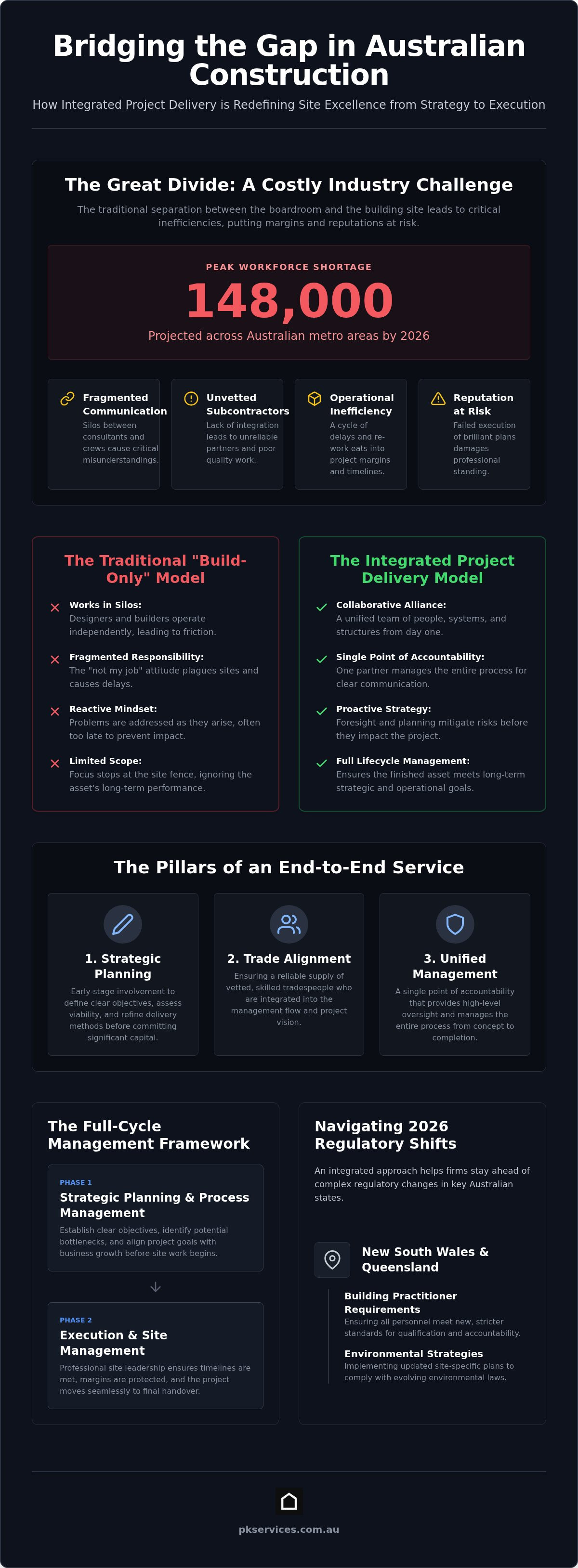
With Australian construction workforce shortages peaking at 148,000 across metropolitan areas in 2026, the traditional divide between the boardroom and the building site has become a costly liability. You've likely seen it firsthand. A brilliant strategic plan arrives from a consultant, only to fall apart during execution because of fragmented communication or unvetted subcontractors. It's a cycle of operational inefficiency that eats into your margins and puts your professional reputation at risk.
We believe there's a better way to build. By embracing integrated project delivery Australia, firms can finally bridge the gap between high level business consulting and the grit of on-site execution. This isn't just about managing a timeline; it's about setting a new standard for site excellence that ensures every project moves seamlessly from the first sketch to the final handover. You deserve access to reliable, skilled tradespeople and a delivery model that works as hard as you do.
This guide explores how these redefined services drive superior results for Australian firms. We will look at the shift toward modern methods of construction, the impact of new 2026 NSW and Queensland regulations, and how a unified approach to project management protects your bottom line.
Key Takeaways
- Learn how moving beyond the traditional build-only model to a strategic lifecycle approach ensures long-term asset performance and operational efficiency.
- Discover how integrated project delivery Australia combines high-level consulting with reliable site execution to eliminate fragmented communication and costly delays.
- Understand the competitive advantage of partnering with a firm that bridges the gap between strategic planning and the supply of vetted, skilled tradespeople.
- Stay ahead of 2026 regulatory shifts in New South Wales and Queensland, including the latest building practitioner requirements and site-specific environmental strategies.
- See how a boutique management model provides the personal connection and agile decision-making that large-scale global firms often struggle to deliver.
What is Integrated Project Delivery in the Australian Construction Landscape?
Construction isn't just about pouring concrete anymore. It's the comprehensive management of an asset's entire lifecycle. For years, the industry relied on a "build-only" approach where designers and builders worked in silos. That model is broken. In 2026, site excellence is redefined by how well you integrate strategy with site reality. What is Integrated Project Delivery involves a collaborative alliance of people, systems, and business structures. It's a framework designed to optimise results and reduce waste through every phase of design and construction.
Protecting project margins in a volatile market requires more than just a good foreman. It requires foresight. Implementing integrated project delivery Australia helps firms mitigate risk by identifying bottlenecks before the first shovel hits the dirt. This shift toward operational performance ensures that the finished asset actually meets the strategic goals set in the boardroom. It's about moving from a reactive mindset to a proactive standard of excellence.
The Evolution of Project Delivery Standards
Traditional project management often stops at the site fence. Modern delivery services go further. They function as strategic business consulting, helping firms in NSW and Queensland gain a competitive edge in a crowded market. Project delivery is the synergy of strategy and site execution. This evolution means moving away from fragmented communication and toward a unified vision where consultants and crews speak the same language. It's how bold innovators stay ahead of rising costs and shifting regulations.
Core Components of an End-to-End Service
A truly integrated service doesn't start on day one of construction. It begins with feasibility. For complex developments, this means assessing viability before committing significant capital. The core of this model is the seamless integration of trade services with high level management oversight.
- Strategic Planning: Early involvement to refine project goals and delivery methods.
- Trade Alignment: Ensuring skilled tradespeople are vetted and integrated into the management flow.
- Single Point of Accountability: One partner manages the entire process from start to finish.
This model removes the friction that usually occurs between design and build. By having one reliable partner manage the transition, you eliminate the "not my job" attitude that often plagues traditional sites. It creates a direct line of communication that protects the project's reputation and bottom line.
The Full-Cycle Management Framework: Delivering Projects from Concept to Completion
Success starts with clarity. We establish clear project objectives and performance benchmarks before the first contractor arrives. This early stage is when we identify potential bottlenecks in design and procurement that could cause issues later. By integrating construction business consulting Australia, firms can align their project goals with broader business growth. It's about setting a foundation that supports both the build and the company's long term reputation. We focus on getting the strategy right so the site work can proceed without interruption.
Phase 2: Execution and Site Management
Once the build begins, site leadership is essential. Managing logistics and contractor coordination requires precision to maintain peak efficiency. We use full cycle construction project management to track real time performance against our initial benchmarks. This phase isn't just about speed. It's about maintaining safety and quality standards that exceed the minimum requirements. Citing academic research on IPD and alliancing, collaborative models like this consistently outperform traditional methods in both quality and cost control. It turns the site into a high performance environment where everyone knows their role.
Phase 3: Commissioning and Final Delivery
Quality control doesn't happen at the end. It's embedded in every phase. However, the final delivery stage requires rigorous inspections and compliance verification, particularly with the NCC 2025 standards adopted in May 2026. We ensure a smooth transition of the asset from the construction team to the operator. Post project reviews are then conducted to capture insights for future operational excellence. This creates a cycle of improvement that informs every future development. If you want to redefine your site standards, it's worth considering how integrated project delivery Australia and professional project delivery can transform your results.
Bridging the Gap: Why Integrating Consulting with Skilled Trade Services Matters
Traditional construction models often separate the thinkers from the doers. Management sits in an office while labour works on-site. This disconnect is a primary driver of project failure. When the people planning the work don't understand the physical constraints of site execution, deadlines slip and budgets blow out. Integrating these two worlds is the only way to maintain site momentum. It ensures that strategic goals are actually achievable on the ground.
A consulting partner who also supplies vetted, skilled tradespeople provides a level of oversight that traditional firms can't match. This approach allows for labour solutions tailored to the specific technical needs of a project. Whether it's a complex remedial build or a large scale development, having a direct line between strategy and execution protects your margins. It turns a fragmented process into a single, high performance operation.
The Strategic Advantage of In-House Trade Knowledge
True excellence comes from consultants who understand the practicalities of site execution, not just spreadsheets. When your project partner knows the difference between a theoretical timeline and a realistic site schedule, risk disappears. This integrated approach significantly reduces the dangers involved in vetting construction subcontractors Australia. Instead of hoping for the best with unproven teams, you rely on a consistent standard of excellence across every trade discipline. It's about having a partner who speaks both the language of the boardroom and the language of the site.
Solving the Construction Labour Gap
Australia's construction industry is currently grappling with a peak workforce shortage of 148,000 people in metropolitan areas. In NSW and QLD, finding reliable, skilled trades is a major strategic bottleneck. A delivery partner who supplies vetted labour solves this problem instantly. Whether you need a casual labourer (CW1a) at the 2026 minimum of $35.55 per hour or a qualified carpenter (CW3) at $39.03 per hour, having a direct line to reliable tradespeople keeps your project moving. These rates include the necessary casual loadings and industry allowances, ensuring your site remains compliant with the Building and Construction General On-site Award.
Flexible labour supply allows you to scale up or down based on fluctuating project demands. This is especially critical in 2026 as firms navigate tighter margins and stricter compliance rules. Every contractor on-site must be aligned with the project's strategic goals. This alignment ensures that technical execution isn't just finished, but delivered to a standard that enhances your business reputation. Through integrated project delivery Australia, you aren't just hiring hands; you're securing the future of your asset.
Navigating Site Execution Challenges in NSW and Queensland
Project success in Australia is rarely a one size fits all equation. The distance between a Sydney high rise and a Brisbane development involves more than just kilometres. It involves distinct regulatory hurdles and environmental variables. In 2026, the complexity of integrated project delivery Australia has increased. Navigating these shifts requires a partner who understands the local landscape from the ground up. You need more than a manager; you need a navigator who can handle the specific demands of each state's building commission.
Managing site logistics in densely populated urban centres like the Sydney CBD adds another layer of difficulty. Restricted access, strict noise ordinances, and tight delivery windows can derail a project before it even begins. Effective execution means planning for these constraints during the feasibility phase. It's about ensuring that site reality matches the strategic vision, regardless of the postcode.
NSW Site Execution and Compliance
New South Wales has seen significant regulatory tightening recently. As of July 1, 2026, the Design and Building Practitioners Act 2020 has expanded to cover remedial work on Class 3 and Class 9c buildings. This change mandates professional indemnity insurance for all registered practitioners. Additionally, the Building (Approvals and Practitioners) Bill 2026, passed on August 4, 2026, has raised maximum penalties for certifiers breaching conflict of interest rules to $1.1 million. Navigating these laws is essential to avoid crippling fines. We ensure construction quality control management services meet these updated state benchmarks, protecting both the asset and your professional standing.
QLD Operational Performance and Logistics
Queensland presents its own set of unique geographical challenges. From the reactive soils of the South East to the humid climate that impacts curing times, delivery models must be agile. The Queensland Government updated its procurement policy on January 1, 2026. This update removed the requirement for "Best Practice Industry Conditions" in tenders, placing a new emphasis on local participation and sustainable practices. Managing subcontractors within the QBCC framework is now more about innovation than ever before. Strategic resource planning for large scale developments in the lead up to the 2032 Olympics requires a deep understanding of these shifting local dynamics. We help you stay compliant while maintaining the site momentum needed for project security.
If you are looking to master the complexities of your next development, it is time to partner with an expert in project delivery who understands the nuances of the NSW and QLD markets.
Redefining Excellence: The PK Services Approach to Modern Project Delivery
PK Services represents a fundamental shift in how Australian construction operates. We aren't just another management firm. We are bold innovators with 15 years of grounded expertise in the NSW and QLD markets. Our approach to integrated project delivery Australia focuses on superior standards and modern refinement. We value the simplicity of a direct, personal connection. This is the boutique advantage. You get the weight of an authoritative expert with the ease of a friendly, reliable guide. We don't just follow industry standards; we redefine them.
Global firms often feel detached from the local business owner. They offer massive scale but frequently struggle with the nuances of a specific site in Sydney or Brisbane. PK Services provides the modern alternative for ambitious firms. We manage the entire process from start to finish. This ensures a seamless transition from project inception to final handover. We bridge the gap between strategic consulting and the grit of on-site trade execution. It's a unified approach that protects your project margins and your professional reputation.
A Personalised Approach to Construction Excellence
You deserve more than a generic template. We provide direct access to senior advisors who understand your specific business goals. Our tailored solutions move beyond the "one-size-fits-all" consulting model prevalent in the industry. We focus on improving construction business profitability NSW by identifying efficiencies others miss. Whether it's better trade coordination or smarter procurement, we refine every detail. Excellence is found in the synergy between strategy and site execution. We make sure your vision is actually buildable.
Taking the Next Step Toward Superior Delivery
Elevating your site standards starts with a conversation. You can engage PK Services for a comprehensive project health check or full-cycle management. The immediate impact of professional site leadership is undeniable. It brings clarity to the site and confidence to the boardroom. Our team is ready to help you navigate the complexities of 2026, from labor shortages to new regulatory hurdles. Contact us to discuss how we can redefine your next construction project. Together, we can set a new benchmark for site excellence and drive superior results for your firm.
Setting a New Standard for Site Excellence
The traditional divide between consulting strategy and site execution is no longer sustainable for ambitious Australian firms. Success in 2026 depends on a unified approach that manages the entire process from start to finish. By adopting integrated project delivery Australia, you ensure that high level business objectives are actually met on the ground through reliable, vetted trades. This model eliminates fragmented communication and protects your project margins against rising costs and complex regulatory shifts.
PK Services offers a modern alternative to the cold, detached consulting of global giants. With 15 years of industry leading experience, we specialise in NSW and QLD project delivery. Our boutique service combines high level professional confidence with a grounded, personal connection. We don't just manage timelines; we redefine what's possible on a construction site. It's time to move beyond traditional build-only models and embrace a framework built for future growth.
Redefine your construction standards with PK Services today. We're ready to help you bridge the gap and achieve superior results on your next development. Let's build something better together.
Frequently Asked Questions
What is the difference between project management and project delivery services?
Project management is often tactical and focused on specific tasks or timelines. Project delivery is a comprehensive lifecycle approach. It encompasses strategic consulting, trade supply, and the total asset journey. While management handles the "how," delivery defines the "what" and "why" while ensuring boardroom strategy translates perfectly to the site floor. It is about end-to-end accountability rather than just ticking off a schedule.
How do project delivery services help in reducing construction costs?
Costs are reduced by eliminating the friction between design and execution. Integrated project delivery Australia identifies procurement bottlenecks and site inefficiencies during the feasibility phase. By having a single point of accountability, you avoid the costly re-work that occurs when consultants and site crews aren't aligned. Smarter resource planning and vetted trade supply also prevent margin erosion caused by unvetted subcontractors and fluctuating labour demands.
Does PK Services provide skilled trades for projects in both NSW and QLD?
Yes, we supply vetted, high-quality tradespeople across both New South Wales and Queensland markets. Our focus is on bridging the strategic gap in these specific regions. We understand the local site dynamics in Sydney and Brisbane, providing tailored labour solutions that meet state-specific technical needs. This regional expertise ensures that your project remains compliant with local building commissions while maintaining consistent site momentum.
Can project delivery services help recover a project that is currently behind schedule?
Project delivery services are highly effective for project recovery. We perform a rapid project health check to identify the root causes of delays. By implementing professional site leadership and injecting reliable trade labour, we can stabilise the timeline. Our approach focuses on redefining operational standards and improving communication between stakeholders. This immediate intervention helps get the build back on track while protecting your professional reputation.
What role does strategic consulting play in the construction project lifecycle?
Strategic consulting ensures that your project goals align with your broader business growth. It happens long before the first shovel hits the dirt. Consultants assess feasibility, manage risk, and establish performance benchmarks. This high-level oversight ensures the project is viable and profitable. It provides the roadmap that the site execution team follows, ensuring that every technical decision supports the long-term value of the asset.
How does PK Services ensure the quality of the tradespeople they supply?
Quality is ensured through a rigorous vetting process backed by 15 years of industry experience. We don't just supply hands; we supply proven professionals who align with our standards of excellence. Every tradesperson is checked for compliance, skill level, and reliability. By managing the supply ourselves, we maintain a consistent standard across all trade disciplines. This reduces the risks usually associated with fragmented subcontracting models.
Is end-to-end project management suitable for smaller construction firms?
Absolutely. Smaller firms often benefit the most from integrated project delivery Australia because it provides elite-level oversight without the need for a massive internal team. It allows boutique developers to compete with larger entities by leveraging our expertise and trade networks. This model provides the scalability and professional confidence needed to tackle complex projects while keeping overheads low and protecting business margins.
What are the main regulatory challenges for construction delivery in NSW in 2026?
The primary challenges involve the expanded Design and Building Practitioners Act and the new Building (Approvals and Practitioners) Bill 2026. These laws mandate professional indemnity insurance and introduce massive penalties for conflict-of-interest breaches. Navigating the legal recognition of prefabricated construction and the new dispute resolution scheme required by December 31, 2026, is also critical. Compliance requires meticulous record-keeping and a deep understanding of these shifting state standards.


