

What if the resource plan that looks workable in the office is already out of step with the site? Strategic construction resource planning connects project demand with the people, equipment and materials actually available, then keeps pace as priorities shift. Across Queensland and New South Wales, project conditions vary, so the plan needs to reflect what each site requires.
When you’re managing several projects at once, commitments can be hard to see clearly. Trade or equipment clashes can disrupt schedules, while a high-level forecast may not tell site teams what to do next. A useful plan shows where demand and capacity conflict, who owns the next decision and when the plan needs updating.
This practical framework shows how to build a repeatable process around project priorities, available capacity and on-site delivery. You’ll learn how to surface constraints earlier, assess competing demands and turn business forecasts into clear site actions. The result is a closer connection between planning and project execution, with a process that can adapt as work changes.
Key Takeaways
- Strategic construction resource planning links forecast project demand with the capacity your business and sites can actually deliver.
- Use a repeatable workflow to map committed and probable work, required skills, project stages and timing before allocating resources.
- Compare labour, materials and equipment across projects, then prioritise safety, critical-path work, milestones and continuity.
- Use a practical planning template to record resource needs, availability, constraints, ownership and the next review.
- Turn business priorities into clear actions for project owners and site teams, connecting planning with trade coordination and delivery.
What strategic construction resource planning solves before work reaches site
A project schedule can show when work is meant to happen. On its own, it can’t show whether the business has the people, equipment, materials, time and budget to deliver it alongside other commitments. Strategic construction resource planning matches forecast demand with real business and site capacity, then keeps those decisions connected as project needs change.
That’s the difference between a business-wide plan and a one-off schedule or daily task list. A schedule sets out activities for a project; task allocation directs work happening now. Strategic planning looks across projects and upcoming stages, so a commitment made at business level can be tested against the capacity needed to carry it out. It sits within the broader practice of construction management, which brings planning, cost management and resource allocation together.
Without that wider view, a project may be marked ready while a key trade is committed elsewhere, materials aren’t due in time, or equipment is already allocated to another site. The gap may only become clear when the work is ready to proceed, leaving teams to react under pressure. An early comparison of work-package dates, resource bookings and delivery dependencies can make these conflicts visible sooner.
Which construction resources belong in the plan?
Look beyond headcount. Record skilled trades, project leadership, materials, equipment, time and budget against the work they support. Separate what the business controls directly, such as its own equipment or internal project leadership, from external dependencies, such as supplier deliveries, specialist contractors or hired plant. Both affect whether work can start when planned. To see how specialised machinery suppliers manage niche access requirements, visit Ayr Tracked Plant & Equipment Hire.
Resource needs also shift by stage and work package. Early works may rely on different equipment and site leadership from fit-out or finishing. For each requirement, note when it is needed, how long it is expected to be used and whether another project needs it at the same time. This helps expose overlapping demand before allocations are finalised.
Why do contractors need a business-wide view?
Projects rarely move in isolation. Two sites may need the same trade, supervisor or piece of equipment in overlapping weeks. Looking only at each project’s schedule can hide the clash until it threatens a handover, milestone or sequence of work.
A business-wide view connects upcoming workload with capacity decisions across Queensland and New South Wales. Project conditions and requirements may differ between locations, so test assumptions against each site rather than copying them across the business. For a wider view of how strategic decisions connect with delivery, read this construction business consulting guide.
The aim isn’t to predict every change. It’s to make commitments visible early, assign ownership for resolving constraints and give project and site teams a clear basis for adapting the plan.
Strategic construction resource plan: demand to capacity
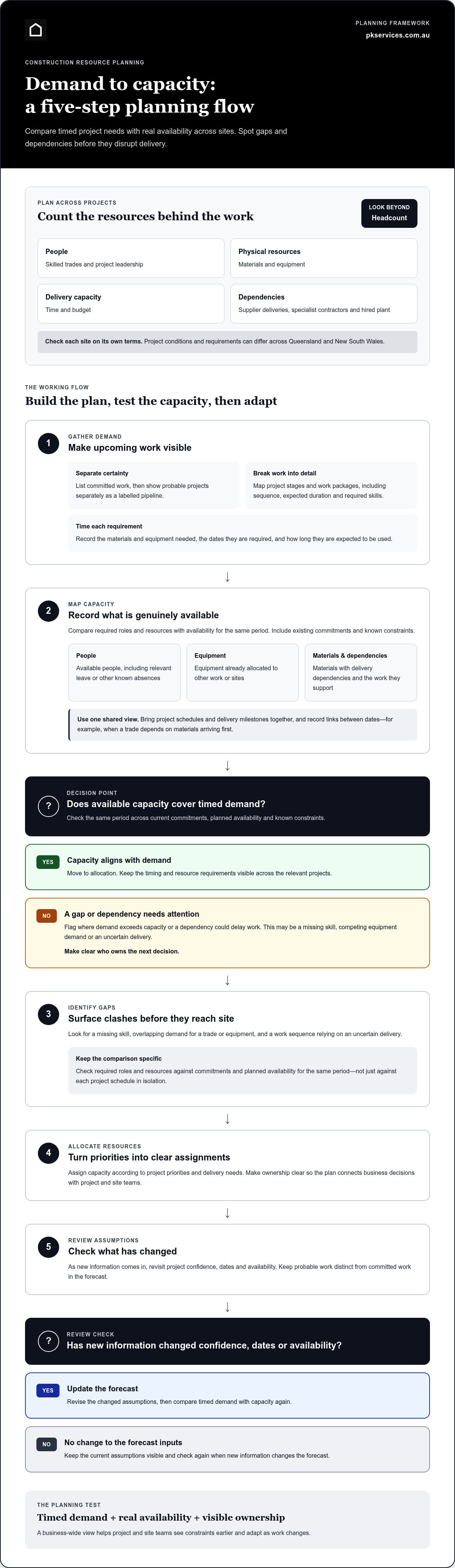
Turn the business-wide view into a working plan by comparing upcoming project needs with what’s genuinely available. A useful resource plan compares timed demand with available capacity, including existing commitments and known constraints. That simple test helps separate a realistic delivery plan from an optimistic list of project dates.
How should a contractor forecast resource demand?
Start with committed work, then add probable projects as a separate, clearly labelled pipeline. Break each project into stages and work packages. For each, note the sequence, expected duration, required skills, materials and equipment, plus the dates those resources are needed. Keep the confidence level visible so a potential project doesn’t quietly become a firm commitment in the forecast.
Use project schedules and delivery milestones as inputs to one shared view, not as isolated spreadsheets. This makes dependencies easier to see. For example, a trade may be required only after materials arrive, or a specialist resource may be needed across consecutive work packages. Record the relationship between these dates so a change to one activity prompts a review of the others.
How can teams identify capacity gaps early?
Compare each required role and resource against current commitments and planned availability for the same period. Include leave or other known absences where relevant, and account for equipment already allocated and materials with delivery dependencies. This reveals clashes before they reach the site, including a missing skill, competing equipment demand or a sequence that relies on an uncertain delivery.
For broader lifecycle context, see this full-cycle construction project management guide. It connects resource decisions to the stages and hand-offs involved in delivering work.
Apply this five-step workflow:
- Gather demand: List committed and probable work, its stages, work packages, skills and timing.
- Map capacity: Record available people, equipment and other resources, allowing for existing commitments and known constraints.
- Identify gaps: Flag periods where demand exceeds capacity, or where a dependency could delay the work.
- Allocate resources: Assign capacity according to project priorities and delivery needs. Make ownership clear.
- Review assumptions: Update project confidence, dates and availability as new information changes the forecast.
This is the discipline behind strategic construction resource planning: not just assigning resources, but testing the timing and assumptions behind each commitment. Practical guidance on effective workforce management can also help frame how labour, equipment and materials are allocated. For builders aligning commercial priorities with project delivery, PK Services connects business consulting with end-to-end project management and site execution.
How to balance labour, materials and equipment across competing projects
Shared resources create trade-offs. Moving a crew or machine to solve one site’s delay can affect another project’s sequence, material deliveries and milestone dates. Strategic construction resource planning makes those impacts visible before an allocation changes.
| Resource type | Planning question | Typical constraint | Review signal |
|---|---|---|---|
| Labour and trades | Are the right skills available for this work package and period? | Overlapping commitments, site access or travel between projects | A clash in dates, skills or site coverage |
| Materials | Will the required items reach the site before the work is due? | Delivery timing, storage or a dependent supply | A delivery date moves or a work front is not ready |
| Equipment | Is the required plant available where and when it’s needed? | Conflicting bookings, transport or site access | Equipment is reassigned or an activity’s sequence changes |
Use a clear order when demand competes: protect safety first, then assess critical-path activities, contractual milestones and continuity across each project. Don’t shift a resource simply because one request is more urgent or visible. Check how the change affects dependent tasks and other sites. For example, moving a shared machine may help one work package start but delay another activity that relies on it.
How should trade skills and contractor capacity be allocated?
Match the required competencies and experience to the work package, site conditions and timing. Check existing commitments, access arrangements and realistic travel between projects, including across Queensland and New South Wales. Conditions differ by site, so don’t treat a resource as available just because the calendar looks clear. Flag a capacity gap early and assess which suitable trade or contractor support can meet the work requirements. PK Services provides experienced tradespeople and contractors to support construction site requirements.
How do materials and equipment affect the resource plan?
Align deliveries and equipment bookings with the sequence of site activities. If a material is needed before installation, or plant is required to prepare a work area, a delay can leave workers waiting or prevent the next work front from opening. Track those dependencies alongside labour, not in a separate list. Cost assumptions matter too; the Australian Institute of Quantity Surveyors provides a professional reference for quantity surveying and cost management in Australia.
Plans will change. That doesn’t make them useless. Set a controlled update process: revise the affected allocation when a material date, project priority, site condition or commitment changes; record the reason and owner; then check downstream tasks and other projects before confirming the adjustment. This keeps the plan current without turning every change into an untracked reshuffle.
A practical construction resource planning template and review rhythm
A resource plan only helps if people can use it to make decisions. Keep the format simple enough to update, but detailed enough to show where demand, capacity and ownership don’t line up. Strategic construction resource planning relies on a living view, not a static spreadsheet that loses relevance as site conditions change.
What fields should a resource plan include?
Use one row for each project work package and resource need. Capture the essentials:
- Project and work package: Identify the job, stage and activity.
- Resource type and requirement: Record the skill, trade, material or equipment needed, including the amount or capacity required where known.
- Required dates: Note the date range and relevant sequence or milestone.
- Availability and allocation: Show available capacity, existing commitments and the identified gap.
- Owner and dependency: Name the person responsible for the next action and note any material, access or equipment dependency.
- Status and assumption: Label the need as confirmed or provisional, and record the source of the assumption.
- Actual usage and next review: Compare planned with actual allocation, record changes and set the next decision point or review trigger.
This structure makes it easier to see not just what a project needs, but what decision is outstanding, who owns it and what could change the plan. For example, a provisional project should remain visibly separate from confirmed work until its status changes.
How should the plan stay useful on live projects?
Set the review rhythm around decisions and changing conditions, rather than following an arbitrary interval. Review the relevant entries when project dates shift, a key resource becomes unavailable, a delivery changes, site progress differs from plan or a new commitment affects capacity. For stable work, routine project reviews may be enough; a material change should prompt an earlier check.
At each review, compare planned allocations with actual site progress. Update the affected dates, assumptions and availability, then record why the plan changed and who will act. If the change affects sequencing, a contractual commitment or another project, escalate it to the person with authority to resolve the trade-off. Keep the previous assumption visible where useful, so teams can understand what changed rather than relying on memory.
Resource decisions can also affect business performance. For a broader view, read this construction profitability planning guide. PK Services connects business consulting with project oversight and site delivery. Explore construction planning support to connect resource decisions with practical project coordination.
Connect strategic resource planning with construction project delivery
A resource plan creates value when it changes what happens on site. Business priorities need to become clear instructions for project owners: which work takes precedence, what capacity is committed, where a constraint sits and who will resolve it. Project owners then translate those decisions into work-package timing, site coordination and trade requirements.
This hand-off needs to work both ways. Site teams should be able to report when progress, access, materials or resource availability changes the original assumptions. Project oversight brings that information back into business-level decisions, so one site’s adjustment doesn’t create an unseen clash elsewhere. That’s how strategic construction resource planning stays connected to delivery rather than becoming a forecast that teams stop using.
When does external construction support help resource planning?
Additional perspective can help when projects overlap, capacity gaps emerge or delivery demands become difficult to coordinate across sites. Experienced project oversight can test business priorities against site requirements, clarify responsibilities and keep decisions moving from plan to execution. PK Services provides construction consulting, project management, and experienced trades and contractors, connecting support across the project lifecycle.
That combination matters when a plan identifies a gap but the business still needs to coordinate the response. Consulting can help shape priorities and the delivery approach; project oversight connects decisions with project owners and site teams; trade services can support on-site requirements. Each part should serve the project plan and the work sequence.
How can a contractor move from plan to action?
Start with the constraints that carry the greatest delivery risk. Assign each a decision owner, agree what needs to happen next, then make the action visible in the relevant project schedule and site coordination. Review progress against the plan and revisit the allocation when a change affects sequencing, commitments or another project.
- Map commitments: Bring current projects and upcoming work into one view.
- Surface gaps: Identify the people, materials or equipment that could restrict delivery.
- Set ownership: Give each constraint a clear decision-maker and next action.
- Align delivery support: Connect business priorities with project oversight and site requirements.
Keep the process practical. A clear hand-off helps teams understand what’s expected, while progress reviews show when the plan needs to change. To connect planning with project and site delivery, discuss construction planning and delivery with PK Services.
Turn your resource plan into confident site delivery
Strong strategic construction resource planning connects forecast demand with real capacity, so resource clashes and constraints can be addressed before they disrupt work. A shared view of labour, materials and equipment helps builders weigh competing project needs, while a practical review rhythm keeps decisions aligned with changing site conditions.
The next step is to make the plan actionable. Map current commitments, identify the constraints with the greatest impact and give each action a clear owner. Then connect business priorities with project oversight and site coordination, so the plan informs delivery rather than sitting apart from it.
PK Services provides construction consulting and project management across the project lifecycle, alongside experienced trades and contractors supporting site delivery. Discuss your construction resource planning needs with PK Services and take a practical step towards clearer coordination.
With the right people, equipment and decisions aligned, your team can move forward with greater clarity and confidence.
Frequently Asked Questions
What is strategic construction resource planning?
Strategic construction resource planning forecasts the people, materials, equipment, time and budget a construction business needs, then matches that demand with available capacity. Unlike a schedule for one project, it accounts for competing commitments across jobs. A useful plan connects business priorities to work-package timing and site requirements, then gets reviewed as conditions change. This helps teams spot clashes earlier and make informed decisions before constraints disrupt delivery.
How do you create a construction resource plan?
Start by listing committed projects and expected work, then break each job into work packages, timing and resource needs. Compare those needs with realistic availability, including current allocations and known constraints. Record gaps, dependencies, assumptions and decision owners in one plan. For example, note if a planned work package relies on a particular trade and a material delivery. Review the plan when project conditions or priorities change, and compare allocations with actual site progress.
Which resources should a construction resource plan include?
Include every resource that can affect delivery: skilled trades, project personnel, materials, equipment, time and budget. For each, record the type, required dates, availability, project allocation and key dependencies. Distinguish resources managed directly by the business from external supply or coordination needs. This makes constraints easier to locate and clarifies who owns the next decision. Resource requirements can also vary between project stages, so link each need to its work package.
How often should construction resource plans be reviewed?
Review the plan in time to support upcoming decisions, and whenever a material change affects project timing, resource availability or priorities. There’s no single review interval that suits every contractor or project. Link regular reviews to planning discussions and delivery milestones, then use clear triggers for changes between reviews. A shifted delivery date or newly identified capacity gap, for example, may require an earlier update so site teams can adjust sequencing.
How can contractors manage resource conflicts across projects?
Make competing demand visible by comparing each project’s resource needs with timing, capacity and delivery priorities. Assess safety first, then consider critical-path work, contractual milestones and the consequences of moving a resource elsewhere. A trade or machine reassigned to one job may affect another site’s sequence. Record the decision, its owner and any downstream changes. If the conflict can’t be resolved within the current plan, escalate it early to assess sequencing or delivery support options.
What should a construction resource planning template include?
A useful template records the project, work package, resource type, required dates, available capacity, allocation, dependencies, constraints and responsible owner. Add assumptions, status and the next review or decision trigger. These fields help teams compare demand with capacity and track why allocations change. Keep the template clear and manageable, and connect it with current project and site information. It should support ongoing decisions, not become a one-off document that quickly falls out of date.
How does resource planning improve construction project delivery?
Resource planning helps teams identify mismatches between upcoming work and available capacity before those gaps disrupt delivery. It brings trade requirements, material dependencies and equipment constraints into view across projects. For builders working across Queensland and New South Wales, plans should reflect each project’s own site needs rather than assume conditions are identical. Regular updates and clear decision ownership help teams respond to change and keep business priorities connected to on-site execution.


