

What if the project schedule looks sound on paper, but trades, materials and key decisions reach site in the wrong order? A construction site execution strategy connects project goals with clear work sequences, team responsibilities and daily controls. Without that link, priorities can become unclear and plans can quickly lose relevance when conditions change.
That’s a familiar pressure on projects in New South Wales and Queensland. Teams need more than a plan: they need to know what happens next, who owns each action and how to respond when resources or site conditions shift. A practical strategy turns project goals into coordinated site activity and gives everyone a clearer view of emerging issues.
This guide explains how to build a strategy that works in practice. You’ll learn how to sequence work, align trades and materials, set daily priorities and keep information moving as the job progresses. It also covers how project management and trade support connect planning with on-site delivery. Drawing on more than 15 years of construction industry experience, PK Services brings those moving parts together from project start to finish.
Key Takeaways
- See how a site execution strategy differs from a project schedule, site management plan and daily pre-start.
- Build a construction site execution strategy by defining outcomes, mapping work, assigning ownership, resourcing activities and setting controls.
- Use a simple coordination matrix to connect each activity with its trade, prerequisites, constraints, owner and review date.
- Keep the plan useful on site by reviewing planned work, actual progress and emerging constraints regularly.
- Understand how project management and experienced trade support connect planning with site delivery.
What a construction site execution strategy needs to achieve
A construction site execution strategy is the practical framework that turns project objectives into sequenced site work, with clear ownership, resource planning and controls for day-to-day decisions. It connects what the project must deliver with what teams need to do next, and how they’ll respond when conditions change.
It’s different from a project schedule, which sets out activities and timing. A site management plan addresses how the site will be managed, while a daily pre-start focuses on immediate work, hazards and team coordination. The execution strategy links these layers so on-site decisions stay aligned with broader project priorities. This reflects the planning, coordination and control functions outlined in Construction Management.
How the strategy connects project goals to site activity
Start with the agreed scope, milestones and delivery priorities. Break them into work packages, then identify the tasks, prerequisites, owner and decision pathway for each package. For example, a target to complete an internal fit-out can become a sequence of area preparation, trade work and follow-on activities. Each team needs to know what must be ready before its work starts and who can resolve a blocker.
Consider a delayed materials delivery that holds up work in one area. Without a clear sequence and owner, crews may arrive with no ready task, or teams may compete for the same work space. A useful strategy helps the site leader check dependencies, confirm what can safely proceed elsewhere and communicate changes to affected teams. The plan stays connected to the milestone even when the immediate sequence shifts.
Who uses the execution strategy on a construction project?
The strategy supports decisions across the project team. Project managers connect site priorities with scope, programme and resources. Site leaders coordinate daily activity and raise emerging constraints. Subcontractors and trades use the agreed sequence to prepare people, materials and work areas, and flag dependencies that could affect others.
Communication needs to work in both directions. Office planning needs current information from site, while site teams need timely decisions and updated priorities. Responsibilities should reflect the project’s structure and contract arrangements, so everyone knows who can approve a change, resolve a clash or update the sequence. That clarity makes the strategy a shared working reference, not a plan that sits apart from the job.
Build a construction site execution strategy around five essentials
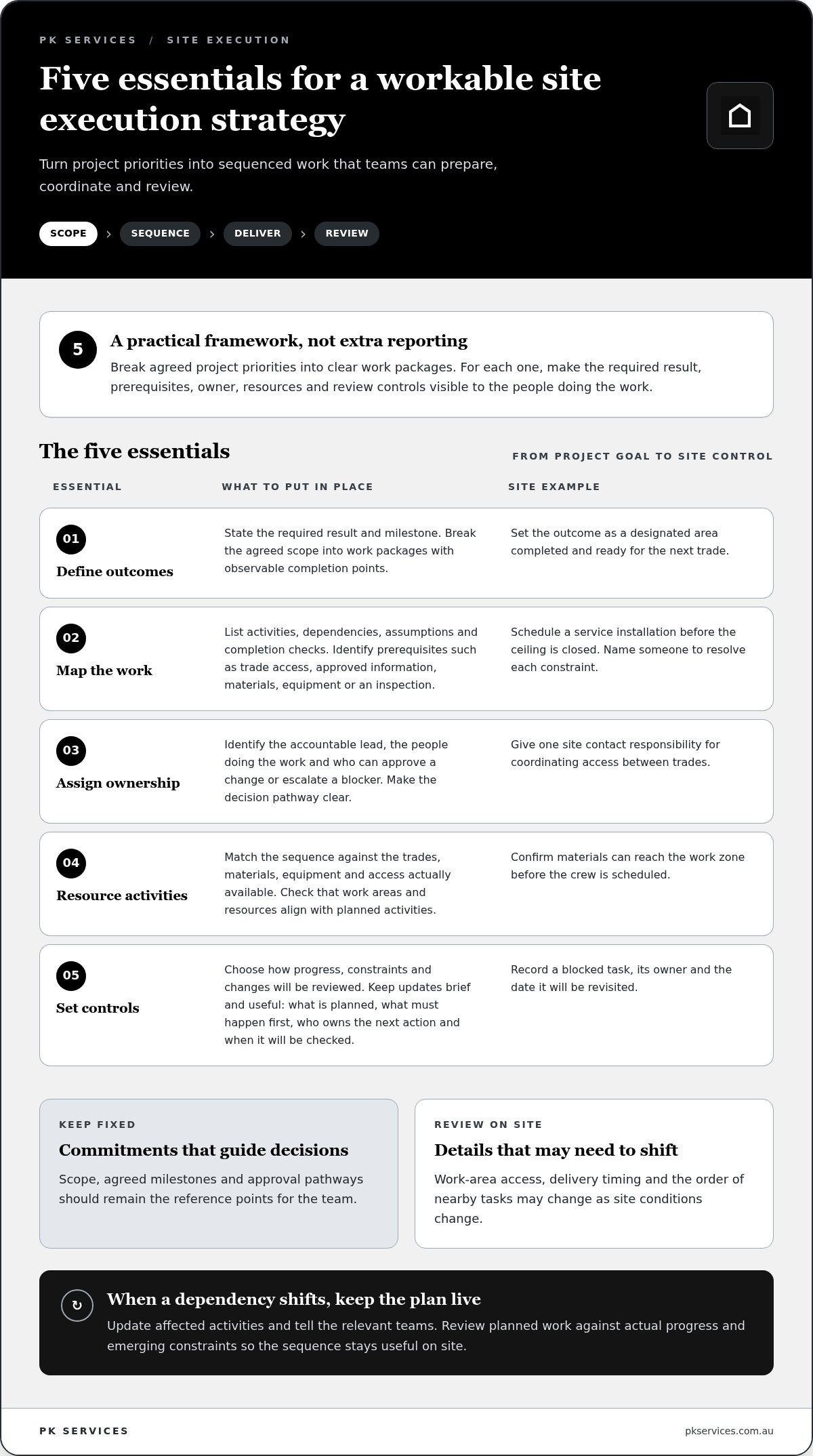
A practical construction site execution strategy turns agreed project priorities into work people can prepare for, coordinate and review. Build it in five steps, keeping the logic visible to the teams doing the work.
Turn scope and milestones into a workable sequence
Break the agreed scope into work packages with observable completion points. For example, a fit-out milestone might become room preparation, services installation, inspection and wall close-up. Record what each activity depends on: trade access, approved information, material delivery, equipment or an inspection. Capture assumptions too, then name someone to resolve each constraint before it disrupts the sequence.
Set responsibilities, resources and communication channels
For each package, identify the accountable lead, the people completing the work and who can approve a change or escalate a blocker. Match the sequence against the trades, materials, equipment and access actually available. Set a simple update path, such as raising an access clash with the site leader, who can coordinate affected trades and share any revised priority.
- Define outcomes. State the required result and milestone. Example: complete a designated area ready for the next trade.
- Map the work. List the activities, dependencies and completion checks. Example: schedule a service installation before the ceiling is closed.
- Assign ownership. Name a lead for each activity and a decision-maker for issues. Example: make one site contact responsible for coordinating access between trades.
- Resource activities. Check that people, materials, equipment and work areas align with the sequence. Example: confirm materials can reach the work zone before the crew is scheduled.
- Set controls. Choose how progress, constraints and changes will be reviewed. Example: record a blocked task, its owner and the date it will be revisited.
Keep fixed commitments distinct from details that need site review. Scope, agreed milestones and approval pathways should guide decisions. Work-area access, delivery timing and the order of nearby tasks may need adjustment as conditions change. When a dependency shifts, update the affected activities and tell the relevant teams rather than relying on an outdated sequence.
The aim isn’t to create more reporting. Keep records brief and useful: what’s planned, what must happen first, who owns the next action and when it will be checked. PK Services’ construction project management support connects planning and delivery in one working approach.
Coordinate trades, resources and constraints across NSW sites
Trade coordination depends on seeing how each activity connects to the next. A simple matrix makes dependencies, shared areas and unresolved constraints visible before they affect following work. For projects in New South Wales and Queensland, treat site conditions as specific to each job: access, delivery arrangements, site layout and surrounding activity vary from site to site.
Activity: Install services in Level 1 corridor | Trade: Services contractor | Prerequisite: Current drawings and clear access | Constraint: Shared corridor access | Owner: Site leader | Review date: Before work starts
Activity: Close ceiling | Trade: Ceiling installer | Prerequisite: Services work complete and checked | Constraint: Confirmation from relevant project representatives | Owner: Project manager | Review date: Before ceiling work is confirmed
This makes the handover between trades explicit. If services work is incomplete, the ceiling team can be held back or assigned another ready area, rather than arriving to a blocked work front. Sequencing also helps reduce avoidable clashes over corridors, access routes, equipment and shared work areas.
The strategy is an active coordination tool, not a substitute for technical planning, approved drawings, specifications or required project checks. It helps the team organise when and where work happens, while technical requirements continue to guide how work is carried out.
Compare planned work with site readiness
Before committing a crew, compare the planned activity with actual readiness. Is the work area accessible? Is the information current? Are materials available? A short status check lets the site leader surface blockers, assign a next action and review it before downstream work is affected.
Ready: Materials and information are available; access is clear. Owner: Trade lead. Next action: Confirm start. Review point: Daily coordination.
Blocked: Access is shared or information is outstanding. Owner: Named site representative. Next action: Resolve the constraint or resequence work. Review point: Before the affected activity begins.
Manage interfaces between trades and project stakeholders
Map each handover: what one trade must finish, what the next team needs to begin, and who confirms readiness. Include coordination with the client, designers, suppliers and site representatives, so a missing decision or delivery issue has a clear pathway to resolution. Strong subcontractor coordination starts with clear expectations; see this guide to vetting construction subcontractors in Australia.
Keep the construction site execution strategy live on site
A strategy earns its place by helping the team make better decisions. Treat it as a working reference, not paperwork to file away. A change in access, a delayed decision or an emerging site constraint can affect the planned sequence. Regular reviews help the team spot the change, decide what happens next and keep affected people informed.
Use site reviews to spot and resolve delivery issues
Use short, regular check-ins suited to the project’s pace. Compare upcoming work with actual progress, then discuss completed activities, current blockers and decisions that need escalation. Keep each issue practical: name the constraint, its impact and the person responsible for the next action.
- Issue: A work area isn’t ready for the next trade.
- Owner: The site lead coordinates with the relevant teams.
- Next action: Confirm what must be resolved, or identify suitable work that can proceed instead.
- Follow-up: Set a review point and update the sequence if the original plan no longer fits.
Record decisions and changes where the relevant project team can access them. Tell affected trades and project representatives what has changed, who owns any follow-up and whether the next activity is still on track. This closes the loop between site conditions and project planning.
Track progress without creating reporting overload
Choose a small set of measures that reflects the project’s priorities. For example, teams might track planned versus completed work, open quality items, safety matters requiring follow-up, and resource or access constraints. Set measures to suit the job rather than relying on universal benchmarks. The point is to prompt useful action, not produce more paperwork.
Clear, current records also support handovers and informed oversight. A new site leader or incoming trade can see what’s complete, what remains open and which decisions are pending. For more on maintaining consistent standards, read the guide to construction quality control management services.
Keep the construction site execution strategy current by updating it when decisions, resources or conditions change. PK Services provides project management support to connect planning with site delivery.
Connect site execution with project management and trade support
A clear site plan can still lose momentum if project decisions, available resources and daily delivery aren’t connected. Stronger coordination is useful when teams repeatedly encounter unclear ownership, unresolved dependencies or constraints that keep disrupting planned work. The aim isn’t to add another layer of process. It’s to keep site decisions aligned with project priorities and ensure issues reach the people who can act on them.
When integrated project oversight can help
Look for patterns: trades regularly waiting on information, recurring clashes between work areas, or decisions that sit unresolved while the programme moves on. Consistent oversight connects those site-level signals with broader project priorities. A project manager can assess the effect on upcoming activities, clarify who owns the response and coordinate any change with the relevant parties. For a wider view of delivery across project stages, see this guide to full-cycle construction project management.
This connection also helps distinguish a local adjustment from a decision that may affect scope, timing or resources elsewhere. Site teams raise what’s happening on the ground; project oversight considers the implications and communicates an agreed way forward. Keep the construction site execution strategy as the link between practical decisions and the outcomes the project is working towards.
Turn the strategy into coordinated action with PK Services
Resource gaps can affect even a well-sequenced plan. PK Services supplies experienced tradespeople and contractors to support project requirements within the agreed scope and coordination arrangements. That means considering which activities need support, when they fit into the sequence and how their work interfaces with other trades. Clear communication with project management and site leadership keeps the response connected to the plan rather than treating a resource need in isolation.
PK Services brings construction consulting, end-to-end project management, and trades and contractors together, drawing on over 15 years of construction industry experience. This integrated approach connects planning with site delivery while keeping decisions within the project team’s agreed structure.
For a practical conversation about your project’s coordination needs, Discuss your construction project with PK Services.
Put your site strategy into action
A reliable construction site execution strategy connects project priorities with a workable sequence, clear ownership and regular site reviews. Keep it current as constraints shift, and make sure trades know what’s ready, what’s blocked and who owns the next decision.
Strong coordination also links daily site activity with project-wide oversight. When planning, management and trade support work together, teams have a clearer path from agreed priorities to practical action.
PK Services brings over 15 years of construction industry experience, end-to-end project management and skilled trades and contractors for construction sites in Queensland and New South Wales. With connected planning and delivery support, your team can move from priorities to coordinated site action. Discuss your construction project with PK Services.
A clear strategy and the right coordination help your team move forward with confidence.
Frequently Asked Questions
What is a construction site execution strategy?
A construction site execution strategy sets out how a project’s objectives will be delivered through coordinated work on site. It links scope and milestones with sequencing, responsibilities, resources and communication. Unlike a schedule alone, it helps teams decide what to do when access, materials or information change. The level of detail should suit the project, its delivery model and the people responsible for planning, overseeing and completing the work.
How do you develop a construction site execution strategy?
Start by clarifying the required outcomes, then break the scope into activities with clear completion points. Map trade dependencies, access, materials and information needs. Assign an owner to each activity and agree how issues will be raised and decisions shared. Set review points and choose measures that reflect project priorities. Before work starts, compare the sequence with actual site readiness, then revise it when constraints or conditions change.
What should a construction execution plan include?
A construction execution plan should connect project scope and milestones with work sequencing, responsibilities, resources and coordination arrangements. It should also explain how the team will review progress, identify constraints, record decisions and communicate changes. For example, note which trade needs access first, what information or materials are prerequisites, and who confirms readiness for the next activity. Tailor the detail to the project’s complexity and contract arrangements, keeping it useful for site teams and project oversight.
How often should a construction site execution strategy be reviewed?
Review the strategy often enough to keep upcoming work, owners and constraints current. A project may use regular planning reviews alongside daily site coordination, with the rhythm suited to its pace and complexity. Revisit the plan when scope, access, resources or site conditions change. For instance, a delayed delivery may require resequencing work in an affected area. Record the decision, assign follow-up actions and make sure each affected team receives the update.
What is the difference between a construction schedule and an execution strategy?
A construction schedule shows planned activities and timing. An execution strategy explains how those activities will be delivered, including the sequence, people, resources, communication and response to constraints. The schedule can form part of the broader strategy, but timing alone doesn’t clarify who owns a dependency or what happens if a work area isn’t ready. Both should reflect project requirements and be updated when actual site conditions differ from the plan.
How can construction teams manage trade coordination on site?
Map how trades depend on one another, including shared work areas, access, materials and information. Name an owner for each handover and agree how readiness will be confirmed before the next activity begins. Review upcoming work, raise blockers early and assign actions with clear follow-up points. On projects in New South Wales or Queensland, tailor coordination to the site layout, project structure and applicable requirements rather than assuming every job has the same constraints.
What happens when the site execution strategy falls behind actual site conditions?
Reassess the work sequence as soon as it no longer reflects site conditions. Identify what has changed, which activities and teams are affected, and what decisions are needed. Then update the plan, name owners for follow-up actions and communicate the revised priorities to affected people. Avoid making decisions from outdated assumptions. Keep a record of important changes and review progress again to check whether the updated sequence is workable.


