

Reliable commercial carpentry delivery depends on more than getting labour on site. The commercial carpentry contractor services Sydney projects need are shaped by a clear scope, well-defined trade interfaces and coordination that keeps work moving in sequence. When these details are unclear, comparing proposals becomes harder and delays can follow.
If you’re weighing up trade-only support against a more coordinated contractor model, look beyond the task list. Experience, quality expectations and clear communication all influence how carpentry work fits into the wider programme. This guide explains how to define the scope, identify project hand-offs and compare delivery approaches. It also shows how contractor support and end-to-end project management can link planning with on-site execution. PK Services provides consulting, contractor services and project management for construction projects in New South Wales and Queensland. Use this guide to plan your Sydney project with greater clarity.
Key Takeaways
- Commercial carpentry contractor services Sydney projects need vary by job, so define the required outcomes and work boundaries before comparing service models.
- Use drawings, specifications, site access and staging details to create a clear contractor brief and reduce uncertainty around trade interfaces.
- Compare trade-only support, subcontracted packages and coordinated services by who owns the scope, sequencing, communication and management.
- Plan delivery from the initial site review through to handover, accounting for access, occupied spaces and neighbouring trades.
- Consulting, project management and skilled contractor support can connect planning with on-site execution. PK Services provides these services for construction projects in New South Wales and Queensland.
What commercial carpentry contractor services in Sydney can cover
Commercial carpentry contractor services in Sydney are project-specific trade works delivered to an agreed scope within a commercial build. A package might cover selected carpentry elements, associated joinery, or both. It does not automatically include every timber-related task or responsibility for managing the wider project. The drawings, specifications and agreed work boundaries define what is included.
Carpentry involves working with timber and other materials to create or install building elements. The Carpentry overview offers background on the trade, but a commercial brief needs to identify the specific items, locations and interfaces required on site. Joinery may sit alongside carpentry, but describe it clearly rather than assuming it forms part of every package.
Which commercial projects may require carpentry contractor support?
Carpentry support may form part of a Sydney office or retail fit-out, refurbishment or new commercial construction. Depending on the documented scope, work could include partitions, doors, fixtures or other specified elements. These are examples, not a standard package. Approved drawings and the scope establish the work, including exclusions and where responsibility passes to another trade.
Where does carpentry scope sit within a wider build?
A carpentry package often depends on preceding work being ready and must leave the site prepared for following trades. Access, set-out information and completed adjoining work can affect how carpentry proceeds. Installed elements may then need to align with later fit-out tasks. Clear interfaces help prevent overlaps and gaps in responsibility.
A defined trade package covers agreed carpentry work. End-to-end project coordination is broader: it connects planning, contractor input, sequencing and delivery across the project lifecycle. PK Services provides consulting, skilled contractor support and project management to link site requirements with wider delivery. For more on this distinction, see Full Cycle Construction Project Management: A Strategic Guide for NSW & QLD Firms.
How to assess commercial carpentry contractor services for a Sydney project
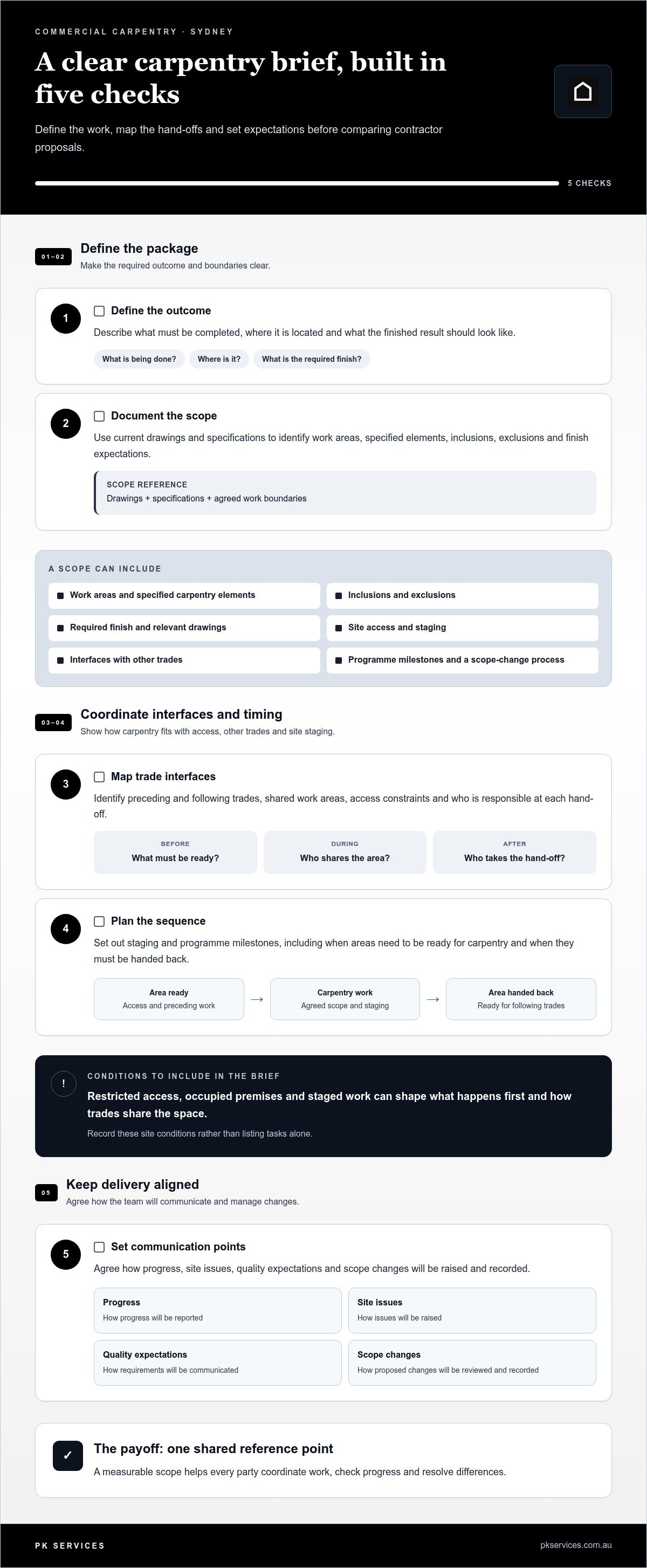
A clear brief makes proposals easier to compare and helps align carpentry work with the wider site programme. Use this framework before engaging commercial carpentry contractor services for your project:
- Define the outcome. Describe what must be completed, where it is located and what the finished result should look like.
- Document the scope. Use current drawings and specifications to set out work areas, inclusions, exclusions and finish expectations.
- Map interfaces. Identify preceding and following trades, shared work areas, access constraints and who is responsible at each hand-off.
- Plan sequencing. Set out staging and programme milestones, including when areas need to be ready for carpentry and when they must be handed back.
- Set communication points. Agree how progress, site issues, quality expectations and scope changes will be raised and recorded.
A measurable scope gives every party the same reference point for coordinating work, checking progress and resolving differences. On Sydney sites, restricted access, occupied premises and staged work can shape what happens first and how trades share the space. Include those conditions in the brief instead of listing tasks alone.
What belongs in a commercial carpentry scope of work?
Record the work areas, specified carpentry elements, inclusions, exclusions and relevant drawings. Describe the required finish, site access arrangements, staging and interfaces with other trades. Include programme milestones and a clear process for reviewing proposed scope changes. This makes adjustments visible and agreed rather than assumed.
How can you compare contractor capability and delivery fit?
Look beyond a capability list. Compare relevant experience, how trade coordination will work, what progress reporting is proposed and how quality expectations will be communicated. Consider how the contractor will work with the project manager and neighbouring trades, especially when progress depends on access or another package being complete. Master Builders Australia provides wider context on the national construction industry, while Vetting Construction Subcontractors in Australia: The 2026 Strategic Guide explores subcontractor assessment in more depth.
PK Services provides consulting, skilled contractor support and project management, connecting strategic planning with site delivery. Learn more about PK Services.
Trade-only support or coordinated contractor services: what suits the job?
The right delivery model depends on the project’s complexity, your team’s capacity and how site responsibilities are organised. A focused carpentry package may suit a clearly defined task, while work with multiple trade interfaces may need closer coordination. Neither model is automatically better. Match responsibilities to the demands of the job.
| Delivery model | Scope ownership | Site interfaces and sequencing | Communication and management |
|---|---|---|---|
| Trade-only support | Carpentry tasks are defined by the engaging party. | The builder or site team coordinates access, hand-offs and work order. | Communication focuses on the trade package; wider site management sits elsewhere. |
| Subcontracted package | A set carpentry scope is allocated to a subcontractor. | Interfaces are coordinated with the project team, with responsibilities set out for the package. | Package progress and issues are communicated through agreed project channels. |
| Coordinated contractor services | Trade delivery is connected with broader project planning, according to the agreed role. | Sequencing and trade interfaces receive closer attention across the work. | Communication and coordination can link site activity with wider delivery oversight. |
When can a defined trade package be enough?
A focused package can work well when drawings are clear, the sequence is established and site management has capacity to coordinate trades. For example, a contained carpentry task within a larger fit-out may not need separate project-level oversight if access, hand-offs and quality expectations are already managed. Scope clarity still matters, whichever model you choose.
When does coordinated contractor support add value?
Closer coordination may help when carpentry depends on several trades, work is staged or site communication needs active oversight. Linking planning with on-site execution keeps trade requirements visible across the project lifecycle. PK Services brings consulting, contractor support and end-to-end project management together for construction projects in New South Wales and Queensland. For a broader view, see Managing Construction Contractors for Peak Performance.
For work in NSW, refer to NSW Fair Trading carpentry licence requirements for official guidance on carpentry work. Applicable requirements depend on the work and project context. A delivery model does not replace understanding the relevant obligations. Match commercial carpentry contractor services to the scope, site interfaces and management capacity involved.
Plan carpentry contractor delivery across a Sydney commercial site
A clear delivery process connects the carpentry brief to the realities of the site. For commercial carpentry contractor services Sydney projects rely on, plan from the initial review through to handover, with clear owners for decisions, interfaces and updates.
- Brief and review the site: Confirm the work areas, drawings, specifications, access arrangements and constraints. In Sydney, planning may need to account for occupied premises, staged access or limited space for materials and movement.
- Align the scope: Match the agreed work package to the project documents. Clarify inclusions, exclusions, finish expectations and interfaces with other trades before work begins.
- Set the sequence: Tie carpentry activities to the construction programme, site access and readiness of preceding work. Make dependencies visible to the wider team.
- Coordinate execution: Set a routine for progress updates, decisions and issue escalation. Keep the site team informed when access, staging or a change affects planned work.
- Review and hand over: Check completed work against the agreed scope and record outstanding items, their owner and close-out status.
Clear trade interfaces make site delivery more predictable by showing who does what, when areas are ready and how changes are shared. That clarity matters on a live commercial site, where a change in one work area can affect neighbouring trades or the next stage.
How should carpentry work be sequenced with other trades?
Map dependencies against the approved drawings and construction programme. Before each stage, identify access needs, material requirements and any preceding work that must be complete. If conditions or scope change, record the impact and communicate it promptly to the project manager and affected trades. A visible sequence helps the team coordinate hand-offs and adjust plans with fewer surprises.
Communication works best when the team knows how progress is reported, who can make decisions and where issues should be escalated. Tailor the routine to the project, but make responsibilities and communication channels clear from the outset.
What should project teams review at completion?
Review finished work against the agreed scope, drawings and finish expectations. Log outstanding items and assign an owner for each close-out action. Handover information should give the client or site management team a clear record of completion and any relevant follow-up details. Where safety or building-code considerations apply, the project team should identify the relevant SafeWork NSW guidance and National Construction Code requirements for that specific work.
PK Services connects consulting, contractor support and project management to link project planning with site delivery. Explore PK Services’ project support.
How PK Services supports commercial contractor delivery in Sydney
Commercial projects need more than a list of trades. Planning, contractor support and site delivery must connect to the agreed scope and wider programme. PK Services provides business consulting, skilled contractor support and end-to-end project management to help construction firms align strategic decisions with on-site requirements. With over 15 years of construction industry experience, PK Services understands the value of keeping project priorities and practical delivery in view.
How does PK Services connect planning with site execution?
Good delivery starts with understanding what the project needs. Strategic advice can help shape a practical plan around the brief, programme, site conditions and trade interfaces. Contractor support can then address site delivery needs within that plan, while project management connects decisions and activities across the project lifecycle.
For commercial carpentry contractor services Sydney projects require, this joined-up approach helps teams consider how a defined carpentry scope fits alongside other site work. The trade package and responsibilities are shaped around the project. PK Services connects the planning conversation with practical delivery requirements, rather than treating contractor support as separate from the wider build.
This approach can suit projects that need tailored support, clearer coordination between work packages or oversight across more than one delivery stage. The level of involvement can align with the project structure and the responsibilities already held by the client, builder or site team.
What are the next steps for a Sydney project team?
A concise project brief gives the discussion a practical starting point. Bring together the information that describes the work and the conditions it must fit:
- Project brief and drawings: Outline the required scope, relevant plans and expected finish outcomes.
- Key dates and staging: Share programme milestones and how work areas will be accessed or handed over.
- Site constraints: Note occupied areas, access limits, neighbouring trades and other known conditions.
- Interfaces and communication: Identify who manages adjacent work, makes decisions and needs progress updates.
- Delivery priorities: Explain where you need trade support, project coordination or oversight across the lifecycle.
These details help shape an approach around the project’s actual needs. They also make it easier to plan how consulting, contractor input and site execution fit together, without assuming every project needs the same level of support.
To start planning, prepare your scope, site requirements and delivery priorities for discussion with PK Services.
Set your project up for confident delivery
Strong commercial carpentry contractor services Sydney plans start with a well-defined scope. Clarify the work, finishes and trade interfaces, then choose a delivery model that fits the project’s complexity and your team’s capacity. A clear sequence, regular communication and considered handover help connect carpentry work with the wider site programme.
PK Services brings over 15 years of construction industry experience, skilled trades and contractor support for construction sites, and project management spanning the project lifecycle. Its consulting and delivery services help connect planning with on-site execution for projects in New South Wales and Queensland.
Ready to put your scope and site priorities into a practical plan? Discuss your project delivery needs with PK Services.
Frequently Asked Questions
What do commercial carpentry contractor services in Sydney include?
Commercial carpentry contractor services can cover specified carpentry work within a commercial construction project. The package may include elements such as partitions, doors or fixtures, depending on the approved drawings and agreed scope. Associated joinery may be included when clearly defined, but should not be assumed. The scope varies by job, so set out work areas, finishes, exclusions and trade interfaces before delivery begins.
How do I choose a commercial carpentry contractor for a Sydney project?
Start by matching the contractor’s role to your scope, site conditions and project structure. Compare relevant construction experience, how trade interfaces will be managed, proposed communication and reporting, and how the work fits the programme. A clear brief makes these points easier to assess. PK Services provides skilled contractor support and project management that can span the project lifecycle, alongside over 15 years of construction industry experience.
What is the difference between a carpentry contractor and labour hire?
A carpentry contractor is generally engaged to deliver an agreed trade scope, while labour hire typically supplies workers who perform tasks under the direction of the hiring business. Precise responsibilities depend on the contract and site arrangements. A contractor package may define work, interfaces and communication, whereas labour hire usually focuses on providing labour capacity. Be clear about who directs the work, coordinates the site and owns delivery responsibilities.
When should commercial carpentry work be planned in the construction programme?
Plan carpentry once the relevant design information and scope are clear, and before the programme depends on the work being complete. Identify when the area will be accessible, what preceding work needs to be finished and which following trades rely on carpentry handover. Include staging, material access and communication for changes in the sequence. Early coordination helps the project team see dependencies and plan trade hand-offs more clearly.
What information should I provide for a commercial carpentry scope?
Provide the project brief, current drawings and specifications, work locations, required inclusions and exclusions, and expected finish outcomes. Add key dates, staging details, access arrangements and known site constraints, such as occupied areas or neighbouring trades. Identify who coordinates interfaces and how proposed scope changes will be reviewed. This gives the project team a shared basis for comparing delivery responsibilities and aligning carpentry work with the wider programme.
Do commercial carpentry projects in Sydney need to meet specific safety or building requirements?
Project-specific safety and building requirements depend on the work, site and applicable approvals. The project team should identify which current requirements apply to the scope, including relevant work health and safety guidance and National Construction Code provisions. Do not assume the same requirements apply to every carpentry package. Record relevant obligations and responsibilities in project planning so site delivery, trade interfaces and handover align with the project’s requirements.
Can contractor services support more than one stage of a commercial project?
Yes. Contractor support can be arranged around a defined trade package or connected with broader project management across multiple stages. The right approach depends on the project’s needs and responsibilities. PK Services provides skilled trades and contractor support alongside project management spanning the lifecycle, linking strategic planning with site execution. For teams in Sydney and across New South Wales and Queensland, this can bring trade needs into the wider delivery plan.


