

What if taking on bigger projects didn’t mean taking on more chaos? The answer isn’t another spreadsheet or software platform. Effective construction business systems optimization connects business strategy with the decisions and workflows that keep work moving on site.
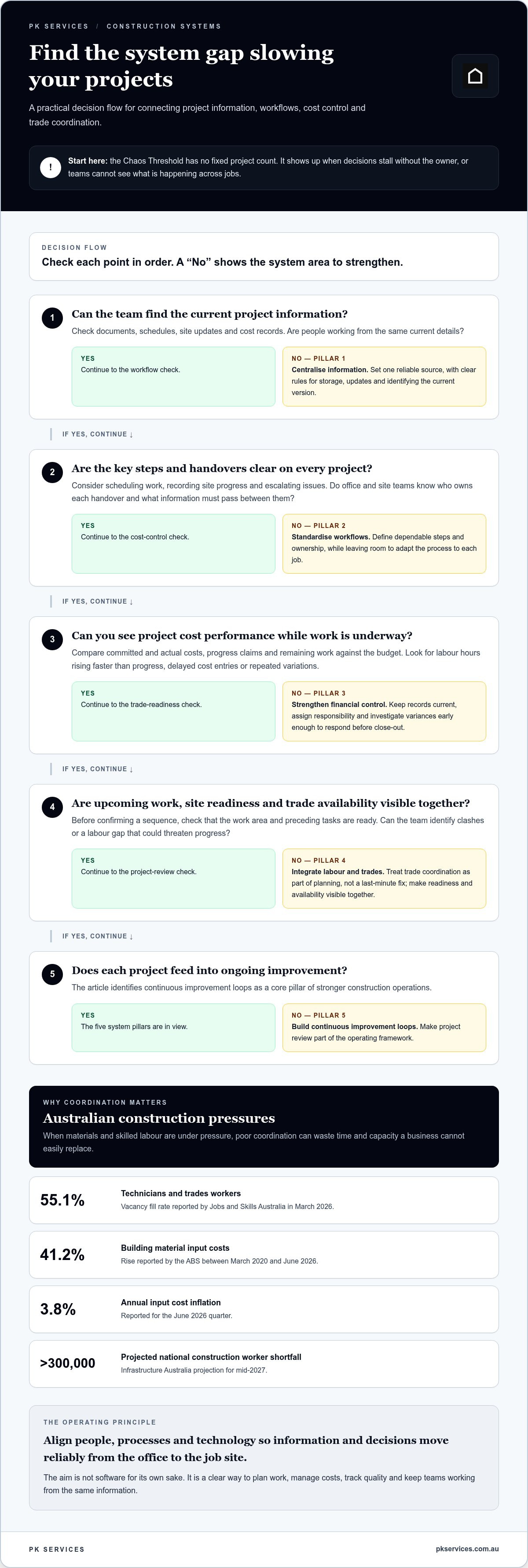
If you’re juggling disconnected data, chasing updates and dealing with unreliable subcontractor availability, you’re not alone. Growth can outpace the systems behind it, leaving the owner to solve every problem and exposing margins to delays and rework. Skilled trade shortages add pressure: Jobs and Skills Australia reported a vacancy fill rate of just 55.1% for technicians and trades workers in March 2026.
This guide shows how to bring planning, people and project execution into sync, so your business can run more efficiently without constant owner oversight. You’ll find practical ways to streamline workflows, improve visibility and strengthen access to skilled trades. With over 15 years of industry experience, PK Services understands both the boardroom and the job site, and the value of making strategy work on the ground across NSW and Queensland.
Key Takeaways
- Use construction business systems optimization to connect people, processes and technology before growth stretches your capacity.
- Recognise when managing multiple sites through personal oversight is no longer working, then address the bottlenecks causing it.
- Bring project information into one reliable flow and standardise site workflows to create consistency across jobs.
- Align office plans with capable on-site execution, including the skilled trades needed to maintain quality.
- Build a practical improvement roadmap for your NSW or Queensland business, drawing on PK Services’ industry experience.
The Cost of Chaos: Why Construction Systems Fail in 2026
Construction business systems optimization means aligning people, processes and technology so information and decisions move reliably from the office to the job site. It isn’t about adding software for its own sake. It’s about establishing a clear way to plan work, manage costs, track quality and keep teams working from the same information. These are core parts of Construction management.
Every growing builder reaches a Chaos Threshold: the point where the owner can no longer keep multiple sites on track through memory, calls and personal follow-up. It doesn’t arrive at a fixed number of projects. It becomes apparent when decisions stall unless the owner steps in, or when teams can’t see what’s happening elsewhere. Growth then magnifies weak processes rather than strengthening the business.
The Symptoms of Systemic Failure
Spreadsheet silos are a common warning sign. A site foreman tracks labour in one file, the office updates costs in another, and the latest programme sits in someone’s inbox. When those records don’t match, managers make decisions using old or incomplete information. Changes can go unnoticed until they affect purchasing, scheduling or a project’s margin. A practical first step is to identify which record holds the current version of each key item, then set a clear owner and update process for it.
The disruption reaches people, too. Disorganised scheduling can leave trades waiting for work, double-booked or given short notice. That frustration can wear down staff and subcontractor relationships. Office teams may assume a task is underway while the foreman is working to a different priority. Reactive management turns each missed handover into another scramble, taking attention away from prevention, planning and consistent delivery. You can’t control every site issue, but you can reduce how often avoidable surprises dictate the day by making responsibilities, updates and escalation steps clear.
The 2026 Australian Construction Landscape
Pressure is particularly sharp across NSW and Queensland. The ABS reported that building material input costs rose 41.2% between March 2020 and June 2026, with annual input cost inflation at 3.8% in the June 2026 quarter. Infrastructure Australia also projected a shortfall of more than 300,000 construction workers nationally by mid-2027. When materials and skilled labour are under pressure, poor coordination can waste time and capacity a business can’t easily replace.
“Just getting by” leaves firms exposed when jobs become more complex or workloads increase. A deliberate operating model can help leaders spot bottlenecks earlier, use trade capacity more effectively and protect quality as the business grows.
In 2026, operational excellence in Australia means delivering safe, well-coordinated construction work through clear, consistent systems that keep people, project information and site execution aligned.
The 5 Pillars of Construction Business Systems Optimization
Strong systems turn project information into clear decisions, from the first estimate to the final handover. The Australian Productivity Commission’s review of Decades of falling productivity underscores why improving how construction work is organised matters. These five pillars give builders a practical framework for improving operations without treating technology as a fix on its own.
Pillar 1: Centralised Information Management
Create one reliable source of project information. Cloud-based systems can connect documents, schedules, site updates and cost records, giving project managers access to current details in the field. Set clear rules for where information is stored, who updates it and how teams identify the current version. This reduces double-handling between trades and administration, and lowers the risk of teams acting on outdated plans.
Pillar 2: Standardised Workflow Execution
Define the key steps that should happen on every project, from scheduling work and recording site progress to escalating issues. A consistent workflow doesn’t mean every site is identical. It provides a dependable baseline while leaving room to adapt to each job. Write down who owns each handover and what information needs to pass between the office and site. Foremen and office staff can then share expectations instead of relying on informal habits.
Pillar 3: Financial Control and Real-Time Reporting
Monthly reports can tell you what has already happened. Regular project cost tracking helps you see what’s happening now. Compare committed costs, actual costs, progress claims and remaining work against the budget. Watch for early warning signs such as labour hours rising faster than progress, delayed cost entries or repeated variations. Assign responsibility for keeping records current, then investigate variances early enough to respond before close-out.
For a deeper look at protecting margins, read this guide to improving construction business profitability in NSW.
Pillar 4: Labour and Trade Integration
Treat trade coordination as a core part of project planning, not a last-minute fix. Keep upcoming work, site readiness and trade availability visible together. Before confirming a sequence, check that the work area and preceding tasks are ready. This makes it easier to identify clashes, plan work sensibly and respond when a labour gap threatens progress. Reliable trade supply and clear site coordination help turn the programme into deliverable work.
Pillar 5: Continuous Improvement Loops
Close each project with a short review of what the numbers and site experience reveal. Compare tender assumptions with actual labour use, material needs, delays and variations. Record the reasons for differences, then use those lessons to refine future estimates, programmes and workflows. Construction business systems optimization works best as an ongoing cycle: plan, deliver, review and improve.
For NSW and Queensland firms, strategic advice grounded in job-site realities can help connect these pillars into a workable operating approach. PK Services brings business consulting, project management and skilled trade experience together to support that alignment. Explore construction business support.
Bridging the Strategy-to-Site Gap: Integrating Skilled Trades
A polished project plan only matters if the work on site matches it. If trades arrive before the area is ready, use outdated instructions or miss a quality check, office systems won’t prevent disruption. Construction business systems optimization must connect planning with the people carrying out the work, not stop at dashboards and reports.
Skilled trades are therefore a strategic part of delivery. Experienced tradespeople bring practical judgement to the job, help maintain workmanship standards and can flag site issues before they become larger problems. PK Services combines skilled trade supply with project management, connecting decisions made in the office to conditions on the ground across NSW and Queensland.
Redefining Excellence on the Ground
There’s a difference between filling a gap in the roster and integrating trade services into a project plan. The first addresses headcount. The second considers work sequence, site readiness, scope and quality expectations, so trades can contribute to the job’s objectives. PK Services’ end-to-end approach brings these considerations together from project inception to completion.
Clear scope, defined handovers and consistent site expectations also make collaboration easier. For practical guidance on assessing subcontractor fit, see this guide to vetting construction subcontractors in Australia.
A site-ready culture starts with making the system useful to the people expected to follow it. Keep instructions accessible, explain why each process matters and involve foremen in shaping workable routines. For example, a briefing on a new digital workflow should show where to record progress, how to flag a blocker and who acts on that update. When the process fits the work, following it becomes part of the job rather than extra admin.
Managing the Human Element of Systems
Introduce digital workflows around real site tasks, then give teams time to practise them. Project oversight should confirm that updates are being captured accurately and that decisions flow back to the right people. The University of Melbourne’s construction management course shows the breadth of capability leaders develop to kick start your career in the construction industry, from managing projects to understanding the built environment.
RFID or GPS tools may help track equipment, movement or attendance where they suit a project, but tracking alone won’t improve performance. Use information to identify coordination issues and support better planning, not to watch every individual. Professional site management gives teams clear priorities, resolves handover gaps and keeps strategy grounded in physical progress. With over 15 years of industry experience, PK Services brings a boots-on-the-ground perspective to aligning business advice with site execution. Explore construction project management support.
A Roadmap for NSW and QLD Firms: Implementing Change
Change works best when it starts with the realities of your operation, not a generic software rollout. For construction business systems optimization to last, each phase should solve a defined problem and make work clearer for the people managing projects across NSW or Queensland.
Phase 1: The Construction Business Health Check
Map how projects are planned, how trade availability is coordinated and how costs move from site records into financial reporting. Compare estimates with actual project outcomes, then trace recurring delays, rework, missed handovers and cost surprises back to their causes. Prioritise the underlying process gaps rather than patching symptoms. For further ideas, explore this construction business growth strategy for NSW.
Phase 2: Strategic Alignment
Define what better performance means for your firm. Agree on priorities such as dependable project visibility, consistent delivery or stronger margin control. Then give leaders, project managers and site teams shared measures of success. A system should support the business you want to build, not simply digitise the habits you’re trying to change.
Phase 3: System Selection and Customisation
Choose tools around your workflows, team capability and project requirements. For work in NSW and Queensland, make sure processes can manage the records, approvals and evidence relevant to each project’s applicable building requirements. Keep the setup practical: if a site team can’t use a process during a normal shift, simplify it before rollout.
Phase 4: Site-Level Implementation
Trial the new approach on one suitable project before expanding it. Explain what’s changing and why, demonstrate the workflow using real site tasks, and invite feedback from the people doing the work. Select respected field champions who can help colleagues troubleshoot and show how the system supports delivery. Measure success in the first 90 days by tracking consistent workflow use, timely project updates and whether the trial reduces the bottlenecks identified in the health check.
Phase 5: Scaling and Optimisation
Review the pilot, adjust what didn’t work and document the refined process before introducing it to other projects. Expand in manageable stages, checking that trade coordination, project oversight and reporting remain clear as the workload grows. Use reliable delivery records to understand which opportunities suit your team and capacity before pursuing larger contracts.
PK Services brings strategic business advice, project management and skilled trade experience together across NSW and Queensland, supporting change from planning through site delivery. Discuss your construction business roadmap.
Redefining Excellence: The PK Services End-to-End Advantage
Business advice only creates value when it changes what happens on site. PK Services bridges the gap between strategic decisions and physical delivery, bringing a boots-on-the-ground understanding to projects across NSW and Queensland. With over 15 years of industry experience, the team connects operational priorities with the practical demands of complex construction work.
That connection matters for construction business systems optimization. A process designed in the office needs to work for project managers, foremen and trades on site. Skilled trade supply and project oversight help turn plans into coordinated action, while giving business owners a clearer view of progress without requiring them to personally chase every detail.
Total Project Lifecycle Management
Projects don’t run in isolated stages. Decisions made during early planning shape trade coordination, sequencing, quality and handover. PK Services manages the process from inception to completion, aligning strategic advice, project management and site execution around the needs of the job. That continuity helps keep responsibilities and priorities visible as work progresses.
From setting direction and coordinating delivery to monitoring progress and preparing for handover, full-cycle management gives the owner one connected view of the project. It also helps surface issues while there’s still an opportunity to respond, rather than leaving the owner to piece together updates from separate teams. Learn more about full cycle construction project management.
The aim isn’t to remove the owner from important decisions. It’s to reduce avoidable day-to-day follow-ups, so their time can go towards leadership, clients and sustainable growth. Clear oversight, skilled trades and aligned workflows make that shift more achievable.
Your Partner in Strategic Growth
A vendor relationship can solve a single task. A strategic partnership keeps attention on how the whole operation performs. A focused advisory partner can shape recommendations around the firm’s projects, people and priorities, then stay connected to how those decisions work on site. That’s a practical alternative to applying a broad, one-size-fits-all model that may not reflect local delivery realities.
Operational excellence is more than a tidy process. Consistent planning, coordinated trades and clear project oversight can support reliable delivery and help a business assess growth opportunities with greater confidence. Over time, lessons from completed work can inform future decisions and strengthen the foundations for sustainable revenue growth.
PK Services brings strategic business advice, skilled trade supply and end-to-end project management together for firms in NSW and Queensland. If you’re ready to connect your business strategy with project delivery, organise a strategy session with PK Services today.
Build a More Resilient Construction Business
Sustainable growth takes more than new software. It comes from aligning people, processes and technology, then making sure the plan works on site. Construction business systems optimization gives your team clearer workflows, stronger project visibility and a better foundation for managing growth.
Start by identifying the bottlenecks that drain time and margin. Standardise the workflows that matter, track project health early and keep skilled trades integrated with the programme. Most importantly, connect office strategy with site execution so better systems lead to better delivery.
PK Services brings over 15 years of Australian construction industry experience to firms across NSW and Queensland. With strategic business advice, skilled trades and end-to-end management from strategy to site execution, PK Services helps turn operational priorities into practical project action. The goal is a business that can deliver more consistently without relying on the owner to oversee every detail.
Ready to take the next step? Redefine your construction excellence with PK Services and build a stronger path for sustainable growth.
Frequently Asked Questions
What is construction business systems optimization?
Construction business systems optimization is the alignment of people, processes and technology so a construction business can plan and deliver work more consistently. It can include centralising project information, setting clear workflows, tracking costs and coordinating trades. The aim isn’t to add complexity. It’s to make reliable information available to the right people, from office to site, so decisions don’t depend on the owner personally chasing every detail.
How long does it take to see ROI from business systemisation?
There’s no fixed timeframe for seeing a return. It depends on the problems you’re addressing, how well the new processes are adopted and how you measure results. Start by recording a baseline, such as how often project updates are late, how closely actual costs track the budget or how frequently scheduling clashes occur. Review those measures during a pilot and after rollout to see whether the changes are improving delivery and financial visibility.
Do we need to change our software to optimise our business?
No. First check whether your current tools can support clear workflows and dependable information sharing. Sometimes the main issue is how people use the software, where records are stored or whether teams follow the same process. If essential information remains disconnected or hard to access, a change may be worth considering. Base the decision on specific operational needs, including what project managers and site teams need in practice.
How does PK Services help with skilled trade shortages in NSW and QLD?
PK Services supplies experienced tradespeople and contractors to help fill labour gaps on construction projects across NSW and Queensland. The focus is on connecting trade capability with project delivery, so labour planning supports the work sequence and site requirements. PK Services also provides strategic business advice and full-cycle project management, bringing an understanding of operational planning and on-site execution to complex projects.
What is the difference between business consulting and project management?
Business consulting looks at how the construction business operates and where strategy, workflows or decision-making could improve. Project management coordinates a specific project from planning through delivery, including its people, tasks and progress. The two work well together: consulting helps set the direction, while project management helps put it into practice. PK Services provides strategic business advice alongside end-to-end project management for construction firms in NSW and Queensland.
Can small construction firms benefit from systems optimisation?
Yes. Smaller firms can benefit because clear processes reduce reliance on one person holding every detail in their head. Start with the pressure points that affect day-to-day work, such as tracking job costs, coordinating subcontractors or sharing current plans with the site team. Keep the approach proportionate to the size and complexity of the business. The goal is a practical system that supports reliable delivery, not extra administration for its own sake.
How do you ensure site teams actually use the new systems?
Make the system useful on site and involve the people who will use it. Explain what’s changing, demonstrate each workflow using real project tasks and give teams time to practise. Ask foremen where the process creates friction, then simplify it where possible. Field champions can help colleagues build confidence and solve everyday issues. Track whether updates are being recorded consistently and whether the change is easing the bottlenecks it was introduced to address.
What are the specific regulatory requirements for construction systems in Australia for 2026?
There isn’t one national rule requiring construction businesses to use a particular management system or software. The National Construction Code (NCC) 2025 was published on 1 May 2026, but NSW and Queensland have delayed its commencement until 1 May 2027, so transitional arrangements matter. The applicable code is generally tied to the building approval application. NSW’s 2026 building legislation also changes approval terminology. Check the requirements relevant to each project and its location.


