

What if the first day on site arrives and deliveries have no clear access, essential facilities aren’t ready, or safety controls haven’t been confirmed? A construction programme can look organised on paper and still be unprepared for work. This construction site setup checklist NSW projects can use brings the key pre-start tasks into a practical order, so teams can identify gaps before they disrupt the start.
It’s not always obvious what needs to happen first. Approvals, site conditions, safety planning, access, deliveries and contractor coordination all need attention, and project-specific requirements can vary. You need a clear way to check what’s in place, what’s outstanding and who is responsible.
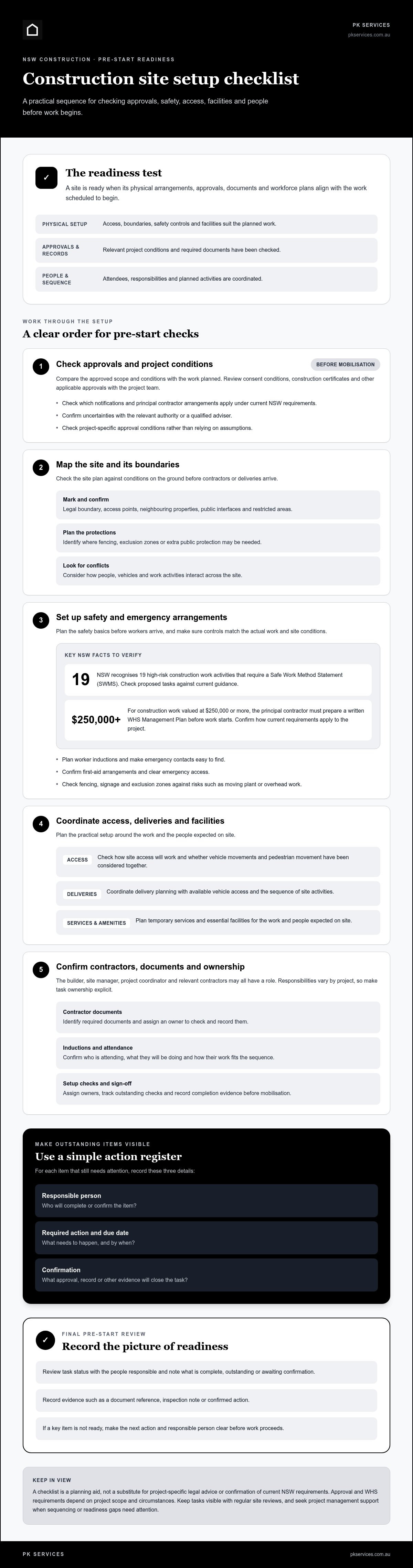
This guide provides a usable pre-start checklist for coordinating site readiness, safety, logistics, people and facilities before construction begins. It also highlights why you should confirm current NSW requirements and project approval conditions, rather than rely on assumptions. Work through the steps to build a more reliable picture of readiness, from initial checks to the final pre-start review.
Key Takeaways
- Use a construction site setup checklist NSW projects can adapt to confirm readiness before work begins.
- Check approval conditions, site boundaries and safety responsibilities against the project’s specific scope.
- Plan access, deliveries, temporary services and amenities around the work and people expected on site.
- Assign owners to contractor documents, inductions and setup checks, then record sign-off before mobilisation.
- Keep tasks visible with regular site reviews, and consider project management support when sequencing or readiness gaps need attention.
Why a NSW construction site setup checklist matters before work starts
Site setup is the coordinated preparation of a construction site before work begins, so access, safety arrangements, facilities and resources are ready for the planned tasks. It involves more than placing barriers or arranging a site shed. Approvals, documents and workforce coordination also need attention.
A construction site setup checklist NSW builders can tailor to their project makes those tasks visible. It helps the team spot dependencies early. For example, a delivery plan may need to account for vehicle access, while site activities and pedestrian movement need to be considered together. Without that coordination, teams may face avoidable delays, confusion or unplanned changes once work is under way.
A checklist is a planning aid, not a substitute for project-specific legal advice or confirmation of current NSW requirements. Check approval conditions and applicable duties with the relevant authorities and qualified advisers. For a general introduction to construction site safety principles, consider how hazards and risk controls shape decisions before workers arrive.
Who should use the checklist on a NSW project?
The builder, site manager, project coordinator and relevant contractors may all use the checklist, depending on the project’s arrangements. Their responsibilities aren’t automatically identical across sites. Clarify who is responsible for each task, including checks that rely on input from another party. Record completion evidence, such as a document reference, inspection note or confirmed action, so the team can see what’s done and what still needs attention.
What makes a site ready to start?
Readiness means the site’s physical arrangements, approvals, documents and workforce plans align with the work scheduled to begin. Physical setup covers practical conditions such as access and facilities. Approvals and documentation confirm that required project information has been checked. Workforce readiness includes knowing who is attending, what they’ll be doing and how their work fits the sequence.
Finish with a recorded pre-start review. Confirm the current status with task owners and note any unresolved gaps, rather than relying on assumptions or verbal updates. If a key item isn’t ready, make the next action and responsible person clear before work proceeds.
Check NSW approvals, site boundaries and safety arrangements first
Start with the project’s approval documents and the actual site. Check that the approved scope, conditions and permits align with the work planned, then confirm any uncertainties with the relevant authority or qualified adviser. Approval and WHS requirements depend on project scope and circumstances, so don’t rely on a checklist alone to determine what applies.
Map the site before contractors or deliveries arrive. Mark the legal boundary, access points, neighbouring properties, public interfaces and any restricted areas. A clear plan helps the team identify where fencing, exclusion zones or extra public protection may be needed, and reduces the risk of people, vehicles and work activities conflicting.
Confirm approvals, notifications and project responsibilities
Review consent conditions, construction certificates and other applicable approvals with the project team. Check which notifications and principal contractor arrangements apply under current NSW requirements. For construction work valued at $250,000 or more, the principal contractor must prepare a written WHS Management Plan before work starts. Confirm the current requirements and how they apply to your project.
Keep a simple action register for each outstanding item:
- Responsible person: who will complete or confirm it.
- Required action and due date: what needs to happen, and by when.
- Confirmation: the approval, record or other evidence that closes the task.
Prepare the site safety and emergency basics
Before mobilisation, plan how workers will be inducted and where they’ll find emergency contacts, first-aid arrangements and clear emergency access. Identify high-risk construction work and confirm the required Safe Work Method Statements (SWMS) are prepared before that work begins. NSW recognises 19 high-risk construction work activities that require a SWMS, so check the proposed tasks against current guidance.
Then compare the site plan with conditions on the ground. Check that fencing and signage are positioned for the actual risks, and that exclusion zones protect workers and the public from hazards such as moving plant or work overhead. Revisit the arrangements if the work sequence or site conditions change.
A construction site setup checklist NSW builders can use should make each approval, safety control and boundary check traceable to an owner and confirmation. If coordinating approvals, contractors and on-site execution is proving difficult, construction project management support may help connect the planning with the work ahead.
Compare site access, temporary services and facilities for NSW conditions
Access and services need to suit the work planned, the site layout and local constraints. A delivery route that works for a small ute may not suit a truck carrying long materials or plant. Map vehicle routes, unloading points, pedestrian paths and plant movement areas together. Check turning space, overhead or ground-level obstructions, neighbouring properties and any limits on when deliveries can arrive.
Use the comparison below to turn decisions into assigned, checkable actions. Tailor each item to the site rather than assuming one setup will suit every project.
| Requirement | Site decision | Responsible person | Confirmation |
|---|---|---|---|
| Vehicle access and deliveries | Route, vehicle sizes, delivery timing and unloading point | Named owner | Access plan and delivery arrangements confirmed |
| Pedestrian and plant movement | Separate paths and movement areas where practical | Named owner | Routes marked on site plan and checked on site |
| Storage | Secure locations that keep access and emergency routes clear | Named owner | Storage areas shown and communicated |
| Temporary services | Power, water, lighting and communications for planned tasks | Named owner | Capacity and installation arrangements checked |
| Facilities and site conditions | Amenities, drainage, dust, noise and waste controls suited to site risks | Named owner | Readiness reviewed before work starts |
Plan deliveries, traffic flow and storage
Show delivery routes, unloading locations, pedestrian paths and plant movement areas on one current site plan. If access is constrained, agree booking and communication arrangements with contractors before mobilisation. Set a process for notifying the site contact about arrival changes. Choose storage locations that are practical for the work sequence, secure where needed and clear of accessways and emergency routes.
Also assess weather exposure, drainage, dust, noise and waste against actual site conditions and planned activities. For example, consider where runoff could affect work areas, or whether a dusty task needs controls before nearby work begins. Record the chosen controls and who will check them.
Set up temporary services and worker facilities
Confirm who will arrange temporary power, water, lighting and communications, and by when. Check that each service can support the planned work and workforce. Have qualified people verify safe installation and applicable requirements. Plan suitable amenities and welfare arrangements for the people expected on site, then confirm they’ll be available before the first workday.
A construction site setup checklist NSW builders can rely on links each decision to an owner and confirmation. Review the plan with relevant contractors so access, services and facilities are ready for the sequence of work, not just listed on paper.
Pre-start checklists for contractors, plant and documents
A reliable pre-start process turns plans into clear actions. Use this sequence to check that contractors, plant and documents are ready before mobilisation:
- Assign owners. Name the person responsible for each setup item, document check and follow-up.
- Confirm documents. Check that required project and contractor records are available, current and relevant to the planned work.
- Coordinate resources. Confirm who is attending, what they’ll do, the plant they’ll use and how their work fits with other trades.
- Inspect the setup. Walk the site and compare access, facilities, safety arrangements and work areas with the plan.
- Record sign-off. Note completed checks, outstanding actions, owners and target dates before work proceeds.
Before engaging or mobilising a subcontractor, clarify their scope, relevant competencies, site access, induction requirements and interfaces with other work. For a deeper look at contractor checks, read this guide to vetting construction subcontractors in Australia.
Confirm contractor, workforce and plant readiness
Build a clear picture of who is coming to site and what each person or contractor will do. Check that access arrangements and inductions are understood, the required documentation has been reviewed, and plant inspection records are available where relevant. Look for clashes in work sequencing, such as trades needing the same work area at the same time. If a trade or contractor gap emerges, name who will resolve it and by when.
Run and record the final pre-start review
Walk the site with the relevant people. Compare actual conditions with the setup plan, including work areas, access routes and the arrangements needed for upcoming tasks. Record each incomplete item with an accountable owner, target date and any control needed before the affected work proceeds. Documented checks also support consistent oversight as work progresses. See this guide to construction quality control management services for related considerations.
Use the construction site setup checklist NSW as a live working record, not a one-off form. If you need help connecting project planning with on-site execution, explore coordinated construction project support from PK Services, including project management and trades and contractor services.
Keep NSW site setup on track with clear ownership and project support
Site setup doesn’t stop once the first checks are complete. Plans shift, deliveries change and new work can affect earlier decisions. Keep one current checklist as the shared record, so the team can see what’s ready, what’s outstanding and who owns the next step.
Turn the checklist into an active site control
For each task, record its status, responsible person, evidence and next action. Review open items at coordination meetings, and update the checklist whenever the scope or site conditions change. If an approval, safety or access issue remains unresolved, escalate it to the appropriate project decision-maker before it affects the relevant work.
Regular reviews help reveal dependencies. A delivery plan, for example, may need updating if access changes or another trade needs the same area. Keep the record practical and current. A long list that nobody reviews won’t help the team make informed decisions.
Decide when external project support makes sense
Consider project management support when responsibilities are unclear, setup spans several workstreams or multiple trades need close sequencing. It may also help when readiness gaps remain open and the team needs clearer coordination between planning and on-site execution. A construction site setup checklist NSW project teams can use should make these pressures visible early, not just capture tasks after they’re missed.
PK Services provides construction consulting, end-to-end project management and trades and contractor services. Its support can be relevant when a project needs coordinated oversight from planning through delivery, or when a site readiness review highlights a workforce gap. The right scope depends on the project’s needs. For a broader view of coordination across a project, read this guide to full-cycle construction project management.
Keep ownership clear, act on open items and revisit the checklist as work evolves. If you’re planning a NSW project and want to discuss the support that may fit, Discuss your NSW construction project with PK Services.
Set your NSW project up for a confident start
A reliable site start comes down to coordination. Confirm approvals and safety arrangements, plan access and essential facilities, then check that contractors, plant and documents are ready for the work ahead. Keep a live checklist with named owners so outstanding tasks stay visible as the project develops.
Use the construction site setup checklist NSW approach as a practical planning tool, and verify current requirements and project-specific conditions before work begins. Clear ownership helps turn setup decisions into coordinated action on site.
PK Services brings over 15 years of construction industry experience, with end-to-end project management and experienced trades and contractors. If you’d like to discuss support for your project, discuss your NSW construction project with PK Services. With the right people and preparation in place, you can move into the next stage with greater clarity and confidence.
Frequently Asked Questions
What should be included in a construction site setup checklist in NSW?
A construction site setup checklist NSW builders use should cover approvals and conditions, site boundaries, safety arrangements, access, deliveries, temporary services, worker facilities, contractors, plant and required documents. Assign an owner and completion evidence to each task. Include a recorded site walk-through before work starts, then note unresolved items, who will address them and any controls needed before the affected work proceeds.
Who is responsible for setting up a construction site in NSW?
Responsibility depends on the project arrangements and applicable NSW duties. The builder, site manager, project coordinator, principal contractor and relevant contractors may each have setup tasks. Confirm who owns each item rather than assuming another person will handle it. For projects valued at $250,000 or more, the principal contractor must prepare a written WHS Management Plan before work starts. Verify current requirements for your project.
Do I need approval before setting up a construction site in NSW?
Some site preparation may depend on project approvals, consent conditions or permits, so check what applies before starting work. Review the approved scope and conditions against the site and planned activities, and confirm uncertainties with the relevant authority or a qualified adviser. Requirements vary with the project and circumstances. A setup checklist helps track approvals, but it doesn’t replace project-specific advice or authorisation.
What safety documents should be ready before construction starts?
Have the project’s required safety documentation ready for the planned work. This may include the WHS Management Plan where required, site induction information, emergency arrangements and Safe Work Method Statements (SWMS) for high-risk construction work. NSW identifies 19 high-risk construction work activities that require a SWMS. Confirm which tasks apply, who prepares each document and that workers can access the relevant information before the work begins.
What facilities should a construction site have before workers arrive?
Plan facilities around the work and the people expected on site. Consider suitable amenities and welfare arrangements, as well as temporary power, water, lighting and communications needed for the tasks. Confirm who will arrange each service, whether its capacity is suitable and that installation is checked by qualified people. Also review site-specific needs such as drainage, weather exposure and safe access before the first workday.
How do you prepare a construction site for deliveries and contractors?
Mark delivery routes, unloading points, pedestrian paths, plant movement areas and storage locations on a current site plan. Check that routes suit the vehicles and materials expected, and arrange delivery bookings and communications if access is constrained. Before contractors mobilise, confirm their work scope, site access, induction, required documents, relevant competencies and work sequencing. Keep emergency routes clear and tell each contractor who to contact on arrival.
When should a construction site setup checklist be reviewed?
Review it before mobilisation, during the final site walk-through and at coordination meetings while setup tasks remain open. Update it whenever the scope, work sequence, site conditions or access arrangements change. Record each item’s status, owner, evidence and next action. Escalate unresolved approval, safety or access matters to the appropriate project decision-maker. This keeps the checklist useful as work develops across projects in NSW and Queensland.


