

What if a contract that offers flexibility also leaves you carrying more of the cost risk? That’s the trade-off many NSW clients need to understand before work begins. If the final bill is hard to predict, claimed costs are difficult to check, or responsibilities between you, your builder and your project manager aren’t clear, it’s reasonable to ask for stronger controls. Effective construction cost-plus contract management NSW starts with visibility, clear decisions and consistent follow-through.
This guide explains how the cost-plus model works, why the final cost can change, and how active project oversight can help you stay informed without promising a fixed outcome. You’ll learn what to clarify about eligible costs and the builder’s fee, how to organise cost tracking and written variation approvals, and how to define who is responsible for each decision. We’ll also cover NSW requirements to check for your project and when construction management support may help align reporting, coordination and site execution.
Key Takeaways
- Check that the contract clearly sets out eligible costs, the builder’s fee, exclusions and how costs will be recorded.
- Agree who can approve spending and changes, and how allowances and provisional items will be tracked before work starts.
- Cost-plus pricing doesn’t cap the final cost. Compare it with a fixed-price approach based on your project’s scope certainty, need for flexibility and capacity to manage changes.
- Use a delivery workflow that connects the budget baseline, cost records, forecasts, variation approvals and site progress to project decisions.
- Construction cost-plus contract management NSW can involve coordinating reporting, decisions and site execution. Consider whether consulting or end-to-end project management support would help your team.
What a construction cost-plus contract means for a NSW project
In plain English, a cost-plus contract means the client pays the actual agreed project costs, calculated under the contract’s pricing rules, plus the builder’s agreed fee or margin. The contract defines what counts as a project cost and how the fee is calculated. The Cost-plus contract overview provides a general explanation, but the terms agreed for your project are what matter.
“Actual costs” doesn’t automatically mean every expense can be charged to the client. The contract should explain eligible costs, exclusions, required supporting records, how the fee is calculated, and how spending and changes are approved. For example, it should say whether a particular delivery charge is reimbursable and what evidence is needed to support the claim.
Unlike a fixed-price arrangement, where a price is agreed for defined work, cost-plus pricing links payment to costs incurred and the agreed fee. Neither model suits every project. A fixed price can make the price for the defined scope clearer, while cost-plus may offer more flexibility as details develop. In both cases, the contract wording and the process for handling changes are central.
How cost-plus pricing is typically structured
The pricing usually has two parts: reimbursable project costs and a builder’s fee or margin. The contract should explain how each part is identified and calculated. It may specify what records support a claim, how often costs are reported, and whether the fee is a percentage or another agreed amount. There’s no universal list of eligible expenses or standard margin to assume. Review the proposed terms against your project before signing.
When a cost-plus approach may be considered in NSW
An evolving scope may prompt a discussion about cost-plus pricing. For instance, a renovation may reveal existing conditions only once work is underway, or the owner may still be choosing finishes. Flexibility can help accommodate decisions as they emerge, but it also makes regular cost reporting and timely approvals important. Document changes clearly so everyone can see what was decided and how it affects the work and forecast.
Cost-plus doesn’t itself set a cap on the final cost. The client therefore needs to understand the financial risk and be prepared to make decisions as information changes. Consider the project’s scope, your tolerance for uncertainty and your capacity to review reports before choosing a model. For project-specific interpretation of contract terms or NSW requirements, seek advice from a NSW construction lawyer. Strong construction cost-plus contract management NSW depends on clear wording and disciplined administration, not the pricing label alone.
What the cost-plus contract should make clear before work starts
Before work begins, make sure the contract explains how costs will be identified, checked, forecast and approved. Clear terms give the client and builder a shared process for managing spending and changes. They also make it easier to identify gaps before they lead to disagreements.
Which costs, fees and exclusions need definition?
Check how the contract distinguishes direct project costs from overheads and other charges. Don’t assume an expense is reimbursable just because it relates to the build. The wording should explain how materials, subcontractor charges, rework, variations and allowances are treated, and what supporting records are required. It should also set out the fee calculation method, without relying on assumptions about a standard margin.
Agree how allowances and provisional items will be tracked against actual commitments. If a selection changes or an item costs more than allowed, record the revised amount, its effect on the forecast and who authorised the decision. The HIA guidelines for cost-plus contracts provide further industry context on estimates and managing cost changes.
Who approves costs, changes and commitments?
Name the people authorised to approve purchases, subcontractor commitments and scope changes. Set written approval limits and specify how decisions will be recorded. For residential building work, check which NSW contract and consumer requirements apply to your project. A NSW construction lawyer can review the proposed terms and explain how they apply. Don’t treat a general checklist as legal advice.
Use a practical document or control for each key question:
| Contract question | Document or control to agree |
|---|---|
| What work is included? | Defined scope, drawings and specifications |
| Which costs can be claimed? | Cost categories, exclusions and evidence requirements |
| How is the fee calculated? | Written calculation method and examples, where useful |
| Who can approve spending or changes? | Named decision-makers and written approval limits |
| How will costs and forecasts be reviewed? | Agreed reporting frequency and supporting records |
Set a reporting rhythm before site work starts. Agree when the client receives invoices, receipts or other supporting records, and how often the forecast is updated. For a broader view of coordinating delivery responsibilities, see PK Services’ full-cycle construction project management guide. If your team needs help coordinating reporting and project decisions, you can also discuss construction management needs with PK Services.
How to control cost-plus contract risks without expecting a fixed price
Cost-plus pricing doesn’t itself cap the final cost. If eligible costs rise or the scope changes, the amount payable may rise too, depending on the contract. Strong controls can help you see emerging cost pressure and make informed decisions. They can’t guarantee a final cost or prevent every change.
Choose a contract model by weighing the project’s scope, need for flexibility and capacity for active oversight. Neither approach is automatically right for every build.
Cost-plus versus fixed-price: what changes for the client?
| Consideration | Cost-plus | Fixed-price |
|---|---|---|
| Pricing basis | Eligible costs plus the agreed fee, as defined by the contract | An agreed price for the specified work, subject to contract terms |
| Scope changes | Costs may change as work or selections evolve, following the agreed process | Changes may affect the price and require agreement under the contract |
| Reporting needs | Regular cost records and forecasts help the client track spending | Progress and change reporting still matter, especially for exclusions and variations |
| Uncertainty | Final cost depends on costs incurred and contract rules | Price applies to the agreed scope, but exclusions and changes can affect the total |
A fixed price doesn’t promise that every possible expense is covered. Its usefulness depends on how clearly the scope, exclusions and change process are set out. Compare both models against your project’s detail and risk, and seek project-specific professional and legal advice before deciding.
A practical cost-control rhythm for project teams
Keep a live forecast that separates three figures: actual costs already incurred, committed costs agreed with suppliers or subcontractors, and forecast costs expected for the remaining work. This helps show whether a cost is already recorded, committed, or still an estimate.
At regular review points, compare the forecast with the current budget baseline. Check new variations, procurement commitments, programme changes and decisions still waiting on the client. Record each change, its expected cost and timing effect, who approved it, and any follow-up needed. If a finish selection is undecided, show it as an unresolved item rather than burying it in a general contingency.
This review cycle supports earlier, clearer conversations. For broader commercial context on construction business performance, see PK Services’ construction business profitability guide. Effective construction cost-plus contract management NSW connects cost information with programme decisions and site progress, while making the limits of any forecast clear.
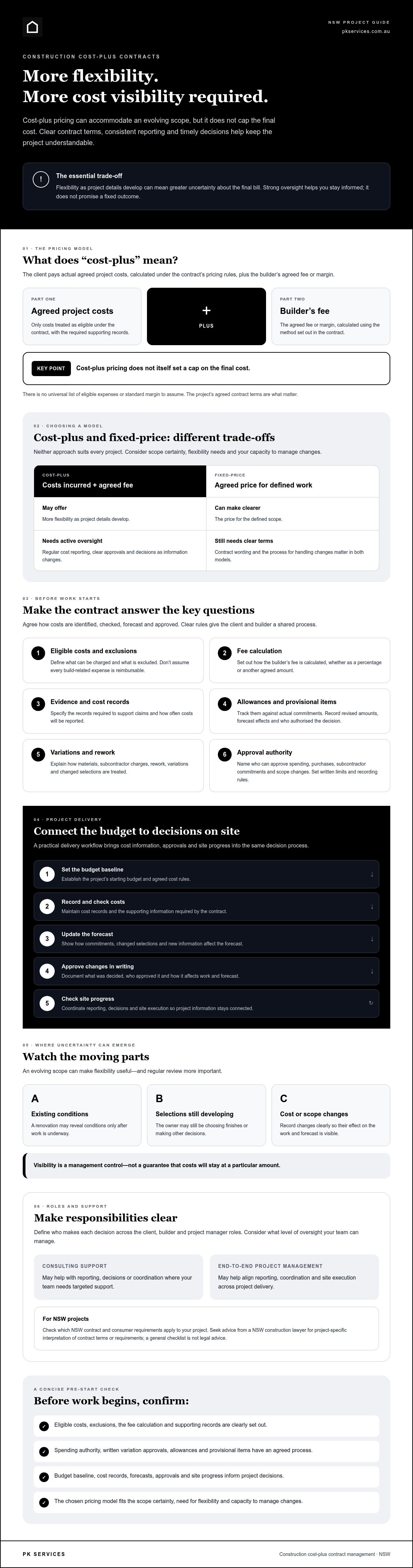
A NSW cost-plus contract management checklist for project delivery
A reliable workflow connects the contract’s cost rules with what’s happening on site. Agree at the outset who prepares reports, who checks them, who can approve commitments, and how often the team will review costs. These arrangements help owners and construction businesses work from the same information.
Before work begins: establish the baseline
Start with a documented reference point. Confirm the agreed scope, budget assumptions, exclusions, approval roles and reporting format. Set up a shared register for actual costs, committed expenditure, variations, risks and outstanding decisions. Have appropriately qualified NSW advisers check the contract and any compliance requirements that apply to the specific project.
During delivery: review, record and act
Use this sequence as a working checklist. Adapt the review frequency and responsibilities to the project and contract.
- Confirm the baseline. Record the current scope, budget assumptions, exclusions and programme information used to plan the work.
- Capture commitments. Log approved purchase orders, subcontractor commitments and other expenditure, with supporting records and approval details.
- Reconcile costs. At agreed intervals, compare invoices and other supporting documents with reported actuals and committed amounts. Query differences before carrying them forward.
- Update the forecast. Show actual, committed and forecast costs separately. Note what has changed, why it has changed and which assumptions remain uncertain.
- Review site progress and changes. Compare completed work and programme movements with the forecast. Record variations, their status and approval, plus any unresolved decision that could affect the next stage.
- Close out the records. Reconcile final reported costs against supporting documents, document outstanding items and retain the agreed project records.
Make each review lead to a clear action: approve, query, revise the forecast or escalate a decision. For example, show a delay to a scheduled activity alongside its potential effect on upcoming commitments, not only in a separate site update. This links financial reporting to delivery decisions.
Cost records are only one part of the picture. Quality observations and site progress can reveal issues that may affect rework, sequencing or procurement. PK Services’ construction quality control management guide explores how site oversight connects with broader project delivery.
For support coordinating reporting, project decisions and site execution, discuss your construction management needs with PK Services. Consistent construction cost-plus contract management NSW can improve visibility and support informed action, but it can’t guarantee a final cost or eliminate project changes.
When construction project management support can add value
Extra project-management capacity may help when cost reporting, site coordination and timely decisions are competing for the same people’s attention. An owner may need support connecting supplier commitments with progress updates. A construction business may need help coordinating trades and keeping delivery information organised. In either case, the right support depends on the project’s scope and the tasks that need covering.
What to look for in a project-management partner
Look for relevant construction experience, clear communication and a disciplined approach to reporting. Ask how the proposed support will connect cost information with site activity, programme updates and decisions that need your input. A useful partner should be able to explain what they will deliver and where their role begins and ends.
Before appointing anyone, clarify:
- Responsibilities: Who prepares reports, checks information and follows up decisions?
- Authority: What can the project manager coordinate, and what requires your approval?
- Escalation: How will delays, emerging cost pressures or unresolved issues be raised?
- Deliverables: What updates, records and site coordination are included in the agreed scope?
Confirm how the proposed role fits alongside your builder, legal adviser, accountant and other construction professionals. Project-management support should complement their responsibilities, not blur them. Contract interpretation and legal advice should come from an appropriately qualified legal professional.
Discuss your NSW project requirements with PK Services
PK Services provides construction consulting, end-to-end project management, and experienced trades and contractors for construction sites. The business has more than 15 years of industry experience and supports projects in New South Wales and Queensland. Whether that experience and scope suit your cost-plus project depends on what you need. Discuss the proposed responsibilities directly, including whether the support needs to cover reporting, coordination, site execution or broader project delivery. No management approach can guarantee a final cost or project outcome.
Before speaking with a potential partner, be ready to outline your project stage, how settled the scope is, what reporting you receive now and where delivery feels stretched. This makes it easier to assess the fit and define a practical scope of support. If you’re considering added capacity, discuss your construction project with PK Services.
Build better visibility into your next project
A cost-plus contract can offer flexibility, but it doesn’t set a ceiling on the final cost. Clear contract terms, agreed approval roles and regular cost reviews help everyone understand what’s being spent and which decisions are coming up. Connect those records with site progress and programme changes, and you’ll have a stronger basis for action.
Effective construction cost-plus contract management NSW is about making informed decisions throughout delivery, not relying on the contract label to provide certainty. Project-specific legal advice can help clarify contract terms and requirements, while practical management support may help coordinate reporting, trades and site activity.
PK Services brings more than 15 years of construction industry experience, with end-to-end project management and experienced trades and contractors. If you’re weighing up your project’s scope, reporting needs or delivery challenges, discuss your construction project with PK Services. A clear conversation can help you identify the support that fits your next steps.
Frequently Asked Questions
What is a cost-plus construction contract in NSW?
A cost-plus construction contract charges agreed project costs under the contract’s rules, plus an agreed builder’s fee or margin. The wording should explain which costs are eligible, what’s excluded, what records support claims, and how approvals and reporting work. The contract and project determine the details, so don’t rely on a generic template to interpret your obligations. Ask a NSW construction lawyer to review the proposed terms before signing.
Is a cost-plus contract more expensive than a fixed-price contract?
Not automatically. The final cost depends on the project scope, costs incurred, contract terms and how changes are managed. Cost-plus may offer flexibility if project details evolve, but it doesn’t use the same stated price basis as a fixed-price agreement. A fixed price also depends on the agreed scope, exclusions and variation terms. Compare the risks and controls for your project with appropriate construction and legal advisers before choosing.
How do you control costs under a cost-plus contract?
Set a clear scope, agree which costs can be claimed, and confirm who can approve spending and changes. Track actual expenditure, committed costs, variations and the forecast to complete. Review those figures against site progress and programme updates, then record decisions and follow-up actions. Effective construction cost-plus contract management NSW improves visibility and supports timely choices. It can’t guarantee a final project cost or eliminate uncertainty.
What records should a builder provide under a cost-plus contract?
The contract should specify which supporting records the builder provides and how often. Depending on the agreed terms, these may include documents relating to labour, materials, subcontractor charges, commitments and variations. Agree the format, review process and reporting frequency before work starts. If a claim is unclear, ask which contract provision supports it and request the relevant documentation. Seek project-specific advice if you’re unsure whether a record is required.
Can a cost-plus contract have a maximum price in NSW?
A contract may include an agreed cost limit or another spending control, but its effect depends on the precise wording and requirements that apply to the project. Don’t assume a budget, estimate or stated cap has a particular legal effect. Ask a qualified NSW construction lawyer to explain how the mechanism works, what it excludes and what happens if the limit is approached. Confirm the arrangement before signing.
Who should manage a cost-plus construction contract?
The client and builder should agree who handles approvals, cost records, reporting and changes. A project manager may help coordinate information, monitor progress and support decisions within an agreed scope, but doesn’t replace legal or accounting advice. Confirm responsibilities, authority limits, deliverables and reporting arrangements in writing. PK Services provides construction consulting and end-to-end project management in New South Wales and Queensland, alongside experienced trades and contractors for construction sites.
When should I get advice before signing a cost-plus contract?
Get project-specific advice before signing, especially if the scope is incomplete, cost categories are unclear, approval authority is uncertain or reporting arrangements are vague. A construction lawyer can review legal terms, while suitable project and financial professionals can assess delivery and cost controls. Early review gives you an opportunity to raise questions and clarify proposed arrangements before work begins. Check which NSW requirements apply to your particular project and contract.


