

A construction project can have a clear business plan and capable trades, yet still lose momentum when advice, project management and site delivery sit in separate silos. Strategic construction partnerships connect these moving parts around shared priorities, helping teams coordinate without adding unnecessary complexity.
When responsibilities are unclear, teams can duplicate effort, miss handovers and strain working relationships. Businesses also need flexible site capability while keeping oversight and accountability in place. Simply bringing in more people won’t solve the problem. The support needs to match the project’s goals, current delivery stage and capability gaps.
In this article, you’ll learn what makes an effective construction partnership, how shared goals, clear roles and consistent communication support delivery, and how strategic advice can connect with project oversight and on-site execution. With more than 15 years of construction industry experience, PK Services manages projects from inception through to completion and provides trades and contractors to address site capability gaps across Queensland and New South Wales.
Key Takeaways
- Strategic construction partnerships work best when business priorities and delivery decisions are tied to shared outcomes.
- Set clear roles, decision rights and communication rhythms to make handovers easier to manage.
- Compare separate providers, a specialist engagement and an integrated partnership to find the right fit for your project.
- Use a practical five-step framework to shape the partnership around your needs and delivery stage in Queensland or New South Wales.
- PK Services connects construction advice, project management and site capability, drawing on more than 15 years of industry experience.
Strategic construction partnerships: why connected delivery matters
A business may set a clear growth target, a project manager may develop a workable programme, and the site team may have the skills to deliver. But when these parts operate separately, priorities can get lost between planning, decisions and daily work. A scope change, for example, can affect sequencing or site capability before the people responsible for those areas have a chance to coordinate.
A strategic construction partnership is an ongoing working relationship in which parties align decisions, responsibilities and capabilities around shared business or project outcomes. It goes beyond completing a single task. It connects the reason for the work with how it’s managed and carried out, while keeping accountability visible. The idea is explored through Construction partnering, which distinguishes project-level partnering from longer-term strategic relationships.
A specialist supplier can still be the right choice. If a builder needs a defined piece of work completed, a focused engagement may be efficient and straightforward. Partnership isn’t a better label for every arrangement. Its value depends on whether ongoing coordination is needed, responsibilities are clear, and the working relationship fits the project.
What makes a construction partnership strategic?
Start with alignment. The parties should understand the project or business objectives, what’s within the agreed scope, and who can make each decision. Set expectations for how changes, constraints and competing priorities will be raised. These agreements turn broad goals into practical ways of working. They don’t transfer responsibility from one party to another: each remains accountable for its own role and commitments.
That’s the difference between a strategic relationship and a transaction limited to one task. A supplier may deliver a defined service and then step away. A strategic partner maintains a wider view of how its contribution connects with other work. The relationship still needs boundaries: agreed scope, named decision-makers and a clear route for resolving issues. Without them, “partnership” can become a vague promise rather than a useful operating arrangement.
When does a construction business need a partner?
A partnership may be useful when a business has a capability gap, several workstreams to coordinate, or project demands that are likely to change. For example, a Queensland builder taking on work beyond its usual delivery pattern may need stronger project oversight alongside additional trades and contractors. A contractor working across New South Wales projects may need support connecting business priorities with planning and site execution as workloads change.
These are examples, not a template for every job. A small, clearly scoped task may call for a specialist supplier. A more involved project may benefit from ongoing coordination across advice, management and site capability. Ask whether the current arrangement gives everyone enough clarity to act, raise issues and keep the work aligned as delivery progresses.
Before choosing a structure, identify where the disconnect sits: planning, decision-making, resourcing or handover. That makes it easier to shape the relationship around the actual need, rather than adding layers the project doesn’t require.
How strategic construction partnerships align people, decisions and delivery
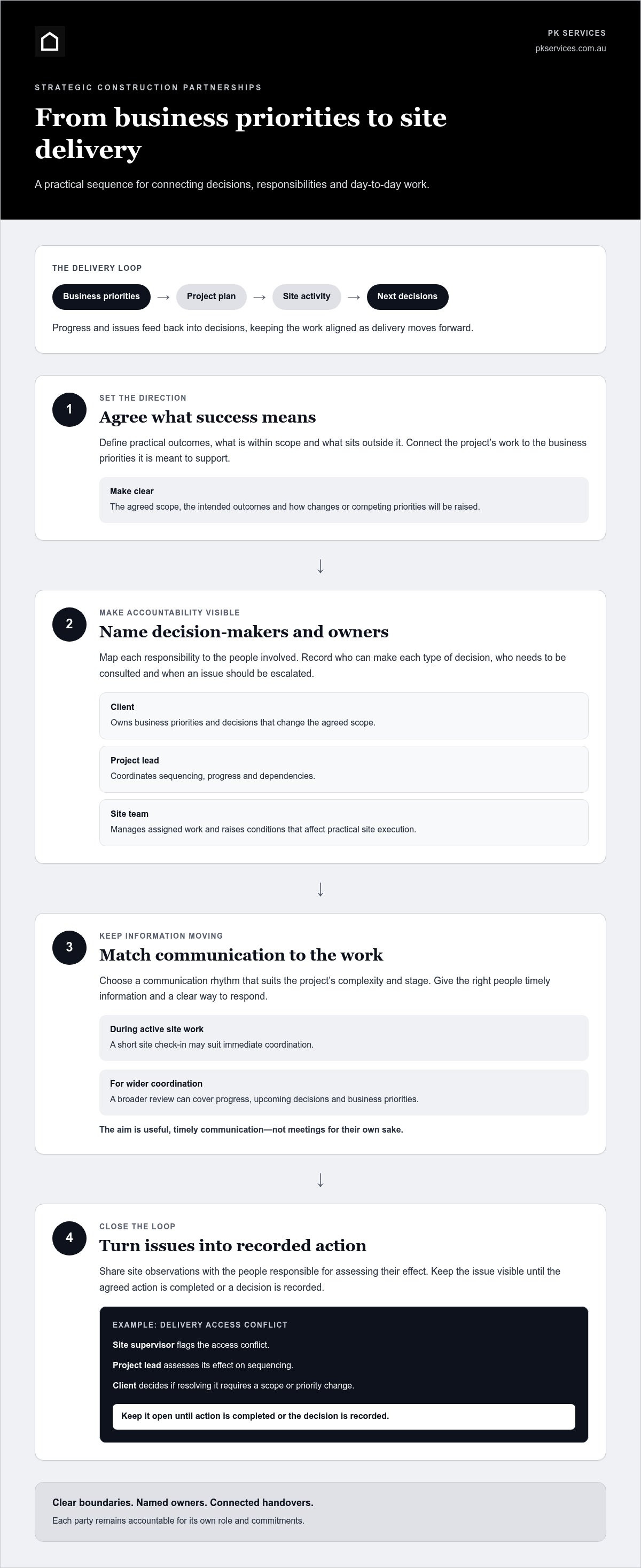
Alignment needs to show up in everyday decisions, not just in an initial discussion about shared goals. A useful working structure connects business priorities to a project plan, translates that plan into site activity, then uses progress and issues to inform the next decisions. Each handover should give the next person enough context to act without guessing what matters most.
Clear accountability keeps construction delivery coordinated: everyone knows who owns the decision, who carries out the action and when an issue needs to be escalated. The exact arrangements vary by project, but the principles stay consistent. Agree the boundaries, keep information moving and make follow-up visible.
Agree on outcomes, roles and decision rights
Before work begins, define what success means in practical terms, what’s in scope and what falls outside it. Then map responsibilities to the people involved. The client might own business priorities and decisions that change the agreed scope. A project lead may coordinate sequencing, progress and dependencies. The site team can manage assigned work and raise conditions that affect safe, practical execution.
These are useful distinctions, not a universal contract structure. Record who can make each type of decision and who needs to be consulted. Agree on an escalation path too. For example, if a site supervisor identifies a delivery access conflict, they can flag it to the project lead, who assesses the effect on sequencing. If resolving it requires a scope or priority change, the client makes that decision. Keep the issue open until the agreed action is completed or a decision is recorded.
Keep communication connected from office to site
Communication should match the project’s complexity and stage. A short site check-in may suit active work, while a broader review can cover progress, upcoming decisions and business priorities. The aim isn’t to create meetings for their own sake. It’s to give the right people timely information and a clear way to respond.
Keep updates practical. A site observation should explain what has changed, which work or decision it affects, and when a response is needed. A simple action record can capture:
- Issue or change: what’s been observed and where it affects delivery.
- Owner: who will investigate, decide or carry out the next step.
- Due point and status: when an update is needed and whether the matter is open or resolved.
This makes unresolved dependencies easier to spot before they become last-minute surprises. It also connects site conditions back to the original priorities, so teams can discuss trade-offs with context instead of relying on informal messages or memory.
For businesses that need support connecting planning with on-site coordination, construction project management can bring those moving parts into a clearer working rhythm.
Integrated partner or separate providers: which construction model fits?
The right structure depends on how closely business advice, project oversight and site delivery need to interact. Separate providers can work well when each scope is distinct and someone in the business can coordinate the interfaces. A single specialist engagement suits a focused capability gap. An integrated partnership can make more sense when decisions in one area regularly affect the others.
Compare the options by looking at the work involved, not just the number of providers. Strategic construction partnerships can bring related support into a connected arrangement, but integration only helps when ownership stays clear. A broader relationship shouldn’t obscure who makes decisions, delivers each task or follows up outstanding matters.
| Consideration | Separate providers | Single specialist engagement | Integrated partnership |
|---|---|---|---|
| Coordination effort | The client or project team links each provider’s work. | Coordination is focused on one defined scope. | Related activities can be coordinated through an agreed working relationship. |
| Continuity | Can vary across providers and handovers. | Usually centred on the specialist task and engagement period. | Can connect planning, project oversight and site activity across relevant delivery stages. |
| Accountability | Responsibilities sit across separate scopes, so interfaces need attention. | Responsibility is clearer within the specialist’s defined scope. | Roles still need to be set out, including who owns decisions and follow-up. |
| Complementary expertise | Different expertise can be engaged independently. | Provides a specific area of expertise. | Can bring complementary business, project and trade capability into one coordinated approach. |
When separate specialist providers may be the right fit
Separate providers can suit work with clear boundaries, limited interfaces and established internal coordination. A builder might engage a specialist for a defined task while its own project team manages the wider programme and site handovers. This approach keeps expertise targeted. The trade-off is that the client or project team remains responsible for connecting schedules, decisions and information between providers.
When an integrated construction partnership can help
An integrated approach may fit when business priorities, project management and on-site capability influence one another. If plans need to adapt as site requirements become clearer, connected support can help carry relevant information between those areas. It doesn’t guarantee a particular cost, schedule or quality result. Instead, it gives the team a structure for aligning work and making responsibilities easier to see.
Partnerships can sound like extra administration. Keep the working boundaries clear: what’s included, who leads each activity, who approves changes and how open actions are tracked. With those points agreed, integration can simplify interfaces rather than add layers. Choose the lightest structure that still gives the project the coordination it needs.
A practical framework for building construction partnerships in Queensland and NSW
A useful partnership starts with the delivery need, not a preferred arrangement. A builder in Queensland may need extra site capability as project stages change, while a contractor in New South Wales may need closer coordination between business planning and project oversight. The details differ. A short, written framework helps clarify the relationship from the outset and adapt it as the work changes.
Use these five steps to shape the arrangement:
- Define the need. Name the gap the partnership should address, such as project coordination, additional trades or a connection between business planning and delivery.
- Align outcomes. Separate essential results from preferred methods. Agree what success looks like for the business and the project.
- Map roles. Record who owns each activity, decision and handover. Clarify boundaries between the client, project lead and site team.
- Agree ways of working. Set communication channels, update frequency, escalation steps and how decisions will be recorded.
- Review the fit. Check whether the arrangement still matches the work, responsibilities and capability required as delivery progresses.
Start with the project need and shared outcomes
Keep the initial brief grounded in the actual project. Note its current stage, the people already involved, where coordination is breaking down and what capability is needed next. For work spanning locations, consider how site access, travel between work areas and the timing of handovers affect communication. These are planning prompts, not assumptions about every Queensland or NSW project.
A practical partnership brief can fit on one page. Include its purpose and scope, key interfaces with existing teams or providers, decision owners, communication arrangements, and dates or stages for review. Flag assumptions separately from agreed requirements. This makes it easier to adjust the approach without confusing a preferred method with a necessary outcome.
Set working rules and review the relationship
Agree how updates will be shared and who needs to receive them. For example, a site issue affecting planned work should have a clear route to the person coordinating the project and, if priorities or scope may change, to the relevant decision-maker. Record the issue, its owner, the next action and when it will be reviewed. The communication rhythm can change as the project moves from planning to active delivery.
Review the partnership against its agreed outcomes and responsibilities, not a general sense that things are going well. Ask whether the original gap remains, whether roles are still clear, and whether new work or site conditions have changed the capability needed. For more detail on lifecycle planning, see this full-cycle construction project management guide. PK Services connects construction businesses’ project needs with construction business consulting and project support.
How PK Services connects construction strategy with project and site delivery
Construction businesses need support that fits the work in front of them. PK Services brings business consulting, end-to-end project management, and experienced trades and contractors together, connecting strategic priorities with project oversight and site capability. Support is shaped around the business, project stage and delivery requirements rather than applying the same structure to every job.
With over 15 years of construction industry experience, PK Services carries direction through to delivery. Business consulting helps clarify priorities and the capability a project needs. Project management links that direction to planning, coordination and progress from inception through to completion. When a site capability gap is identified, experienced trades and contractors contribute to the work required.
One relationship across advice, management and site support
The connection between these areas matters. Advice can inform project decisions; project oversight can keep tasks and dependencies visible; and site input can bring practical delivery needs into the conversation. Each part has a distinct purpose, but aligning them helps keep business priorities in view as work moves forward. For more on the advisory side, explore construction business consulting in Australia.
This approach can suit a business refining its delivery plans, managing a project across several stages or addressing a site capability gap. The level of involvement can reflect the need: support may focus on a particular stage or connect advice, management and trades across the project lifecycle. Clear scope and agreed responsibilities remain central, so an integrated relationship adds coordination without blurring accountability.
Start a conversation about your construction project
For construction businesses in Queensland and New South Wales, start by outlining the project stage, the outcomes you’re working towards and where coordination feels difficult. This gives the discussion a practical focus: what needs to happen, what capability is required and how the parts of delivery can connect. If subcontractor coordination is a concern, define the relevant scope, handovers and decision owners as part of the project plan.
PK Services works with construction clients to connect business advice, project management and site support around their needs. For more insight into a related service, read the construction subcontractor vetting guide.
Make your next delivery decision count
The strongest strategic construction partnerships aren’t built on assumptions. They take shape when a business is clear about the decision or delivery pressure in front of it and the support that would make the next step easier to manage.
Start with one practical question: where could a clearer connection between business priorities and project activity help your team move forward? It might be an upcoming handover, a change in project direction or an emerging capability need. Naming the issue gives you a grounded starting point for a useful conversation, without committing to a structure before you understand the need.
PK Services works with construction businesses across Queensland and New South Wales. Discuss your construction project with PK Services to explore an approach suited to your priorities and project stage.
Frequently Asked Questions
What is a strategic construction partnership?
A strategic construction partnership is a continuing working relationship in which a construction business and its partner coordinate their contributions towards agreed project or business aims. Unlike a one-off purchase, it can adapt as priorities or delivery needs change. For example, a builder may draw on advice during planning, then engage project oversight as work progresses. Each party still owns its agreed tasks and decisions.
How can strategic partnerships improve construction project delivery?
Strategic partnerships can support delivery by giving teams a shared way to pass information on and act on it. For example, if a site observation affects the next stage of work, the person recording it can identify who needs to assess the impact and make a decision. Regular updates and tracked actions help keep that exchange visible. They support coordination but don’t guarantee a particular project result.
What is the difference between a construction partner and a subcontractor?
A subcontractor is generally engaged to complete defined work under agreed terms, such as a particular trade package. A construction partner describes the purpose and scope of a broader working relationship, which may connect advice, coordination and delivery across stages. The roles can overlap: a subcontractor may contribute to a partnership, but the label alone doesn’t change their agreed scope, obligations or accountability.
When should a construction business bring in a strategic partner?
Consider a strategic partner when a business can identify a gap that its current team or arrangements aren’t addressing. Triggers might include taking on a project with unfamiliar coordination demands, needing project oversight while internal capacity is stretched, or finding that business plans aren’t translating into clear site priorities. Define the gap first. That helps determine whether ongoing support is useful or a focused specialist engagement is enough.
Can a strategic construction partnership work across Queensland and New South Wales?
Yes. A partnership can support work across Queensland and New South Wales when communication and coordination are planned around the actual project locations and teams. Consider who needs updates at each site, how decisions will be shared, and how travel or distance affects handovers. Project requirements differ, so regional planning should reflect the specific scope, delivery stages and people involved rather than rely on one standard arrangement.
How do construction partners share responsibilities and manage decisions?
Partners share responsibilities by documenting who leads each activity, who approves changes and who needs to be consulted. For example, a site lead may report a sequencing issue, while the project lead assesses its effect and refers any change to scope to the nominated decision-maker. Agreeing how urgent issues are escalated helps prevent stalled decisions. Keep the arrangement consistent with each party’s agreed responsibilities.
How can a construction business measure whether a partnership is working?
Review the partnership against specific outcomes agreed at the outset. Check whether actions have clear owners, information reaches the people who need it, and identified capability or coordination gaps are being addressed. Also consider whether the original scope still fits the project. A short review at key stages can surface changes early. Record what’s working, what needs adjustment and who will take the next action.


