

An empty workface can turn a carefully planned programme into missed milestones, rising costs and another long day for an already stretched site supervisor. How can you keep projects on track when skilled trades are hard to secure? Effective construction labor gap solutions start with a smarter resource strategy, not simply a scramble to find more people.
Labour gaps put pressure on budgets, schedules and the people coordinating a site. A practical response is to identify which skills are needed, when they are needed and what could prevent crews from working productively. This article covers ways to plan resources, coordinate delivery and reduce avoidable pressure on site teams while maintaining project standards.
PK Services brings more than 15 years of Australian construction industry experience, providing business consulting, skilled trade services and end-to-end project management for projects in NSW and Queensland. The following steps show how to plan resources, coordinate work and identify bottlenecks before they disrupt delivery.
Key Takeaways
- Understand how changing trade requirements and workforce pressures can create a mismatch between project demand and available skills.
- Use process mapping to find where site logistics and workflows may be wasting productive time.
- Match trade capability to the work and its timing instead of treating headcount as the only measure of progress.
- Use practical construction labor gap solutions, from reviewing business processes to aligning project plans with trade requirements.
- Connect business consulting with on-site delivery through coordinated project management and trade services.
Understanding the Construction Labour Gap in Australia
Australia’s construction labour gap is a mismatch between the people and skills available and the trades needed to deliver housing, infrastructure and commercial work. It is not simply a matter of having too few workers. The right skills may be committed elsewhere, needed at a different stage or spread across projects with competing deadlines.
Two forces are reshaping the workforce. Experienced tradespeople are leaving as the workforce ages, while demand shifts between specialisations. A worker available for one type of job may not have the experience or trade skills another project requires. Recruitment that focuses on filling vacancies one at a time can struggle to keep pace if it does not also account for skill requirements, work sequencing and coordination across the project.
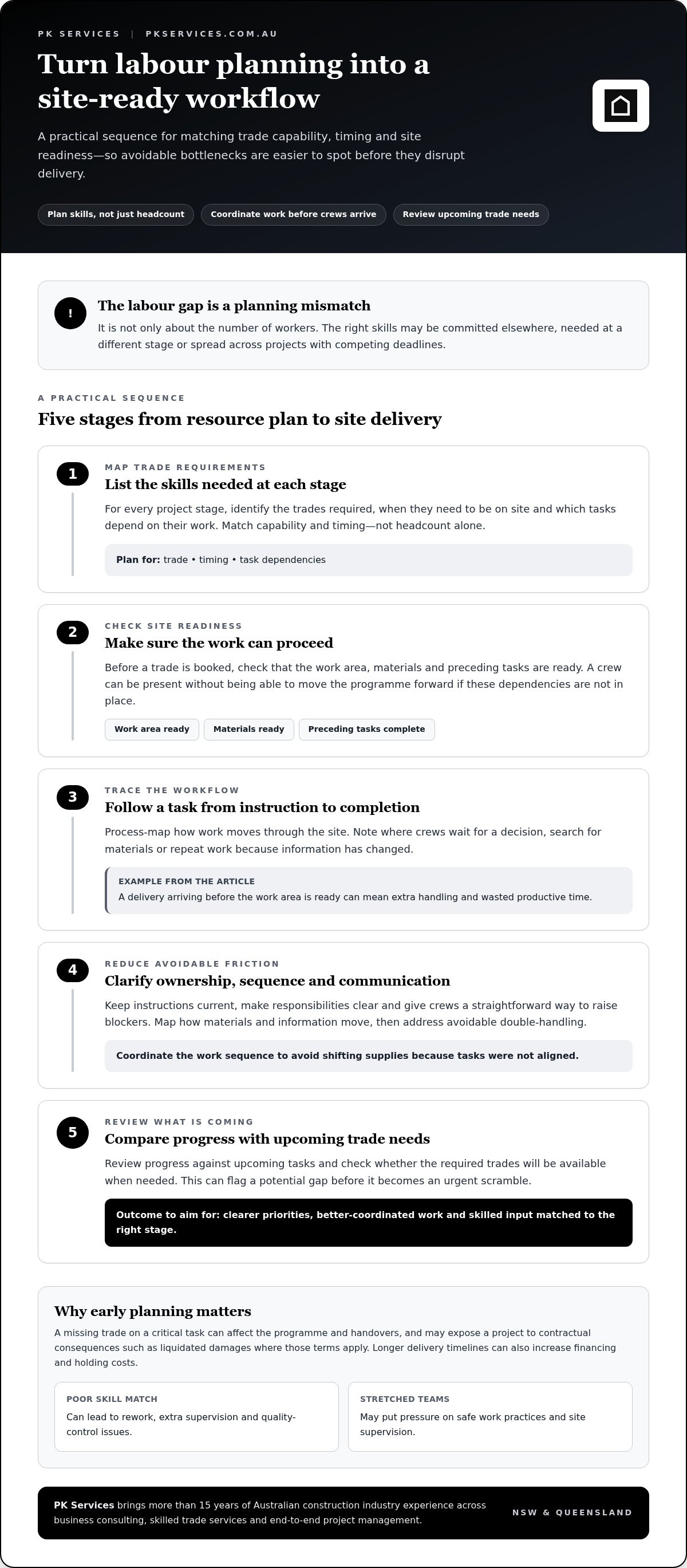
Effective construction labor gap solutions treat labour as a resource to plan, not just a headcount to fill. Start by listing the trades required for each stage, when they need to be on site and which tasks depend on their work. This makes it easier to spot clashes and avoidable downtime before they affect the programme.
The State of Play in NSW and QLD
Infrastructure activity in South East Queensland adds pressure to a competitive market. Large programmes draw on trades also needed for housing and commercial construction. In Sydney, residential and commercial projects likewise compete for experienced workers, so a delay in securing a specialist trade can affect the order and pace of work on site.
The article’s 2026 projections point to a broader shortfall of around 126,000 tradespeople and labourers by mid-2027, but do not provide separate shortage figures for carpenters and electricians.
For builders in NSW and Queensland, a useful pipeline plan shows when each trade is required, how long its work is expected to take and which activities depend on it. If a trade is booked before the work area, materials or preceding tasks are ready, the role may be filled without the crew being able to move the programme forward.
The Real Cost of the Shortage
Higher labour costs are only one pressure. If a missing trade holds up a critical task, the delay can flow through the programme, affect handovers and expose a project to contractual consequences such as liquidated damages, where those terms apply. Longer delivery timelines can also increase financing and holding costs.
Trying to bridge a gap with workers who lack the skills for the task can lead to rework, extra supervision and quality-control issues. It may also put pressure on safe work practices if people are asked to take on unfamiliar tasks or supervisors are stretched too thin. Filling a shift is not a reliable shortcut if the capability or site coordination is wrong.
Strong planning helps identify bottlenecks before they become site delays. PK Services brings more than 15 years of Australian industry experience to business consulting, skilled trade services and end-to-end project management for construction projects in NSW and Queensland.
Strategic Business Consulting as a Labour Multiplier
Adding people will not fix a workflow that wastes their time. Strategic consulting looks at how work moves from planning to site delivery, then identifies practical ways to reduce friction. Clearer priorities and better coordination can help a team make more effective use of the skills already available. Explore how construction business consulting Australia can connect operational planning with on-site performance.
Process mapping makes inefficiencies easier to see. Trace a task from instruction to completion and note where the crew waits for a decision, searches for materials or repeats work because information has changed. For example, a delivery that arrives before the work area is ready can require extra handling and waste productive time. Addressing this requires clear ownership, sensible sequencing and reliable communication.
Strategic advice can help organise workflows so each task has the right skills at the right stage, with fewer hand-offs and less rework. The aim is not to cut corners or ask people to work outside their roles. It is to make skilled input count and give supervisors a clearer view of priorities and upcoming trade requirements. That is a practical foundation for construction labor gap solutions.
Redefining Excellence through Process
Good project oversight connects the office plan with site conditions. Keep instructions current, make responsibilities clear and give crews a straightforward way to raise blockers. Map how materials and information move, then address avoidable double-handling, such as shifting supplies because the work sequence was not coordinated. Reviewing progress against upcoming tasks can also flag when a trade gap may disrupt the programme, before it becomes an urgent scramble.
The Aspirational Firm: Attracting Talent through Organisation
Skilled tradies and contractors value a site where the job is organised, instructions are clear and decisions are made in time for work to proceed. Effective site leadership helps reduce unnecessary pressure, support consistent standards and let people focus on their tasks. Clear planning can also help build productive working relationships with contractors and avoid repeatedly bringing people in without addressing the conditions that make delivery difficult.
For businesses in NSW and Queensland, sound advice needs to connect with practical delivery. PK Services brings consulting, skilled trade services and end-to-end project lifecycle management together. See how PK Services’ project management approach can support a more organised path from strategy to site.
Labour Hire vs. Strategic Trade Services: Making the Right Choice
Labour solutions do not all provide the same thing. A labour hire arrangement generally supplies workers to fill a short-term headcount gap. Strategic trade services focus on the skills a project needs, how those trades fit the work sequence and what coordination will help them contribute effectively. A person on site is not automatically the right person for the task.
Filling a gap with workers whose experience or trade skills do not match the work may lead to rework, extra supervision and delays. Those indirect costs can outweigh the apparent benefit of filling a shift. A service delivery approach starts with the project requirement and considers trade capability, timing and site coordination together. When assessing construction subcontractors in Australia, consider whether their experience and delivery approach suit the work at hand.
The Pitfalls of Traditional Labour Hire
Worker capability and continuity can vary between placements. If people change frequently, site leaders may spend extra time repeating inductions, clarifying tasks and checking work. That can disrupt a team’s rhythm. Accountability also needs to be clear: supplying a worker is different from coordinating trades and managing delivery against project needs. A placement may fill a gap, but it does not by itself resolve a sequencing issue or stalled workfront.
Look beyond the headline charge or placement fee. Consider the full delivery picture: who coordinates the work, how trade requirements are communicated and how delays are managed. The goal is not simply to bring people through the gate. It is to ensure the right skills are contributing to progress.
The Strategic Trade Supply Model
A strategic model connects trade expertise with project oversight. Plan trade requirements within the wider programme, taking account of dependencies, site conditions and the skills needed at each stage. This is the purpose of full-cycle construction project management: coordinate the work from planning through delivery, rather than treating trade supply as a standalone transaction.
On a stalled site, adding skilled trades may help only if the causes of the hold-up are addressed too. The project may also need clearer sequencing, resolved decisions or prepared work areas before extra people can make a difference. PK Services brings more than 15 years of Australian industry experience to its skilled trade services and end-to-end project lifecycle management for construction projects in NSW and Queensland.
This joined-up approach is central to practical construction labor gap solutions. It shifts the focus from filling a number on a roster to aligning capable trades, project priorities and on-site coordination.
5 Steps to Protect Your Project from Labour Shortages
You cannot control the whole labour market, but you can make your project less vulnerable to gaps. Review how work is delivered, plan trade requirements and improve coordination. These steps apply to projects already under way as well as those still on the drawing board.
- Run a business health check. Review programme slippage, rework, material delays and time spent waiting for decisions. Look for recurring bottlenecks, not just the most visible labour gap. A task-by-task review can show where current resources are being lost.
- Pair advice with trade capability. Work with a strategic partner that connects business consulting with skilled trades and contractor services. This links workforce decisions to the actual work rather than treating each vacancy as a separate problem.
- Manage the full project lifecycle. Map dependencies from planning through delivery. Check which tasks rely on a particular trade, prepare work areas ahead of time and adjust sequencing when priorities change. Better coordination helps existing resources go further.
- Back site leadership. Give supervisors clear priorities, current information and a practical way to flag blockers. Strong oversight helps keep quality and safe work practices in view without leaving site leaders to absorb every coordination problem themselves.
- Build strategic partnerships. Move beyond a last-minute hiring mindset. Develop working relationships with trade partners in NSW and Queensland, and plan how their skills may fit future project stages.
Optimising On-Site Execution
Start each shift with a short stand-up to confirm tasks, responsibilities, dependencies and required materials. Check that deliveries and work areas match the sequence, so tradies are not left waiting or shifting materials unnecessarily. Keep expectations consistent too. “Redefining Excellence” should be reflected in how teams communicate, prepare and take responsibility for quality, not just in what is handed over.
Long-term Resource Planning
Where project visibility allows, forecast labour needs 6 to 12 months ahead. Break the programme into stages and note when specialist trades are likely to be required, where demand may overlap and which decisions could affect timing. Keep a considered group of trade partners across NSW and Queensland, with a clear record of relevant experience and project fit. This is a planning tool, not a guarantee that every trade will be available on demand.
Consulting can help a firm improve delivery capacity by refining workflows and coordinating specialised trade support, rather than automatically adding permanent overheads. These practical construction labor gap solutions shift the focus from reacting to each shortage to managing resources with intent.
For support aligning business strategy with trade delivery, explore PK Services’ consulting and project management.
Redefining Excellence: The PK Services Approach
Construction projects need more than a plan on paper. They need capable trades, clear decisions and coordination that carries through from early planning to on-site delivery. PK Services brings these elements together, connecting business strategy with the practical demands of construction work.
When a project falls behind, the issue may not be a shortage of trades alone. The work sequence, unresolved decisions or readiness of the next work area may also need attention. PK Services combines business consulting, skilled trade services and end-to-end project lifecycle management to align the response with project needs. The focus is on identifying what is holding delivery back and coordinating resources around the work.
From Strategy to Site: A Unified Model
With more than 15 years of Australian industry experience, PK Services understands the importance of connecting advice with site realities. A strategic review can identify priorities and resource requirements; specialised contractors can then contribute within a coordinated delivery plan. This approach helps connect decisions about what needs to happen with the practical steps required to move work forward.
PK Services provides construction consulting, trade services and project management focused on the needs of each project. Its “Redefining Excellence” approach connects clear planning with practical site delivery.
Your Partner in NSW and QLD Construction
Construction conditions vary between projects and locations. Local knowledge can help make planning relevant to work across NSW and Queensland. PK Services’ experience in these markets informs how consulting, trade requirements and project coordination come together, including on complex projects that call for specialised trade services.
For builders seeking construction labor gap solutions, the value is in managing the whole process, not treating trade supply as a separate transaction. Clear oversight connects project priorities with the people and skills needed at each stage, supporting coordinated delivery from start to finish.
Ready to strengthen your project’s delivery approach? Contact PK Services about construction consulting and trade services.
Build a Stronger Resource Strategy for What’s Ahead
Project performance does not depend on headcount alone. Clear workflows, well-planned trade requirements and strong site leadership can help make available skills go further. Effective construction labor gap solutions connect strategic planning with practical delivery, so workforce decisions support the whole project lifecycle.
PK Services brings more than 15 years of Australian industry expertise to construction projects, combining end-to-end project lifecycle management with skilled trade services for NSW and Queensland. This approach connects resource planning with the practical requirements of local projects.
Ready to take a more considered approach to resource planning and site performance? Redefine your construction excellence with PK Services.
Frequently Asked Questions
What are the best construction labour gap solutions for small builders?
Practical construction labor gap solutions for small builders combine careful planning with site coordination. Start by reviewing where work stalls, such as delayed materials, unclear instructions or trades booked before a work area is ready. Then map upcoming trade needs against the programme and build relationships with trade partners. Business consulting and project management can help smaller teams focus limited resources on the tasks that move the project forward.
How does strategic consulting help with the skilled worker shortage?
Strategic consulting helps businesses use available skills more effectively and identify where project processes waste time. A consultant can review task sequencing, site logistics, communication and resource planning, then recommend changes suited to the business. For example, clearer coordination between the office and site can reduce delays caused by missing information or materials. Consulting does not create more skilled workers, but it can help teams deploy available trades more effectively.
Is labour hire the same as trade services in Australia?
No. Labour hire generally refers to supplying workers to meet a workforce need, while trade services provide people with relevant trade skills for specific project work. The arrangement depends on the service and contract. Consider what the site needs: a headcount for general tasks or specialist trade capability coordinated with the project sequence. PK Services provides skilled trades and contractor services alongside consulting and project management.
Can project management software solve the labour gap on its own?
No. Project management software can help teams track schedules, tasks, dependencies and progress, but it cannot supply skilled trades or resolve every site bottleneck. The information also needs to be accurate, current and acted on by the right people. Use software to support communication and forward planning, alongside sound site leadership, practical workflows and appropriate trade expertise.
How much does it cost to hire a construction consultant in NSW?
The cost depends on the project’s scope, complexity, duration and the level of consulting or project management involved. Some engagements may focus on a defined business or process review, while others may cover coordination across the project lifecycle. There is no single figure that applies to every NSW builder. Define the outcomes and support required first so the engagement can be aligned with the work.
What trades are currently in the highest demand in Queensland for 2026?
Demand varies by location, project type and timing, so a single statewide ranking may not reflect a particular site’s needs. Construction projects can compete for specialist trades such as carpenters and electricians, but the priority for your programme depends on the tasks ahead and their dependencies. Map the skills needed at each stage, then plan trade requirements early for Queensland projects rather than relying on a general demand list.
How can I improve my construction site efficiency with fewer workers?
Make each shift easier to deliver. Set clear daily tasks, confirm materials and work areas are ready, and resolve decisions before they hold up a crew. Review hand-offs between trades to identify repeated handling or avoidable rework. Keep supervisors informed about upcoming priorities and blockers. These steps do not replace skilled workers, but they can reduce wasted time and help your team focus on productive, appropriate work.
What is the role of project oversight in managing labour risks?
Project oversight helps identify labour risks early and coordinate a response. Compare progress with upcoming tasks, check whether the required trades and materials are aligned, and flag work that depends on decisions or earlier activities. Clear oversight also helps supervisors maintain visibility of quality and safe work practices. For projects in NSW and Queensland, end-to-end project management can connect planning, trade coordination and on-site delivery.
To discuss construction consulting, trade services and project management for your NSW or Queensland project, contact PK Services.


