

What if a construction project manager’s greatest value isn’t adding another layer, but connecting project decisions with what happens on site? For Queensland projects, that link can make responsibilities clearer and help planning, contractors and delivery work together. That’s the focus of effective construction project management services QLD.
It’s reasonable to want a clear picture of what you’re handing over. Who coordinates each stage? How will external management fit your team’s capacity? And how can gaps between planning and site execution be reduced? The right scope depends on the project, but strong management should bring people, priorities and practical delivery into alignment.
This guide explains what to expect from a construction project manager, how to assess the fit and what to define in an engagement. It also shows how PK Services connects construction consulting, end-to-end project management and skilled trades and contractor support across Queensland. With over 15 years of construction industry experience, PK Services brings project-level oversight closer to on-site execution, tailored to each project’s needs.
Key Takeaways
- Spot when project complexity is stretching your team’s time, oversight or coordination capacity.
- Map the project lifecycle to clarify where planning, coordination, delivery and close-out support are needed.
- Weigh an external lead against an in-house approach by considering project complexity, internal capacity and coordination demands.
- Assess construction project management services QLD by how clearly the scope, responsibilities, outcomes and reporting are defined.
- See how PK Services connects consulting, project management and trade support to suit project needs.
When QLD Construction Project Management Makes a Difference
A Queensland construction project can start with a clear brief, then grow in complexity as design decisions, contractors, approvals and site work need attention at the same time. If coordination competes with your day-to-day responsibilities, decisions can take longer and teams can end up working from different assumptions. The challenge isn’t always a lack of expertise. It may be a lack of time and clear oversight to keep the moving parts aligned.
Construction project management services QLD provide coordinated oversight of planning, decisions, people and delivery. A project manager helps maintain a shared view of priorities, responsibilities and progress. They don’t perform every design or trade task. Instead, they provide a defined point of coordination while the relevant specialists carry out their work.
Project management connects project objectives, decisions and on-site work through defined oversight. When requirements shift or ownership is unclear, this link helps the team identify what needs a decision, who is responsible and how a change could affect other work. The aim is clearer coordination, not extra process for its own sake.
Signs a Queensland construction project may need external oversight
External support is worth considering when coordination takes time away from other responsibilities or exceeds the internal team’s capacity. Look for practical signals:
- Several contractors or workstreams depend on one another’s timing.
- Decisions or updates are spread across people, with no clear owner.
- Internal staff have limited capacity to track actions, progress and site issues.
Regional logistics, site access and project-specific conditions also belong in early planning. Travel, deliveries or access constraints can affect how work is sequenced, so account for them before they create coordination problems. Not every project needs a dedicated external manager. The fit depends on complexity, workload and the oversight already in place.
What a project manager is accountable for
A project manager coordinates agreed responsibilities, tracks decisions and keeps communication flowing between the client, contractors and other project participants. They don’t replace specialist designers or tradespeople, or automatically take on every technical task. Their role is to help the right people understand what’s needed, when it’s needed and how their work connects with the wider plan.
Clear ownership makes it easier to raise issues, record decisions and follow through on agreed actions. It also gives the client a consistent view of progress without requiring them to chase every conversation. For more context on how oversight can span project stages, explore the full-cycle construction project management guide.
What construction project management services cover across the project lifecycle
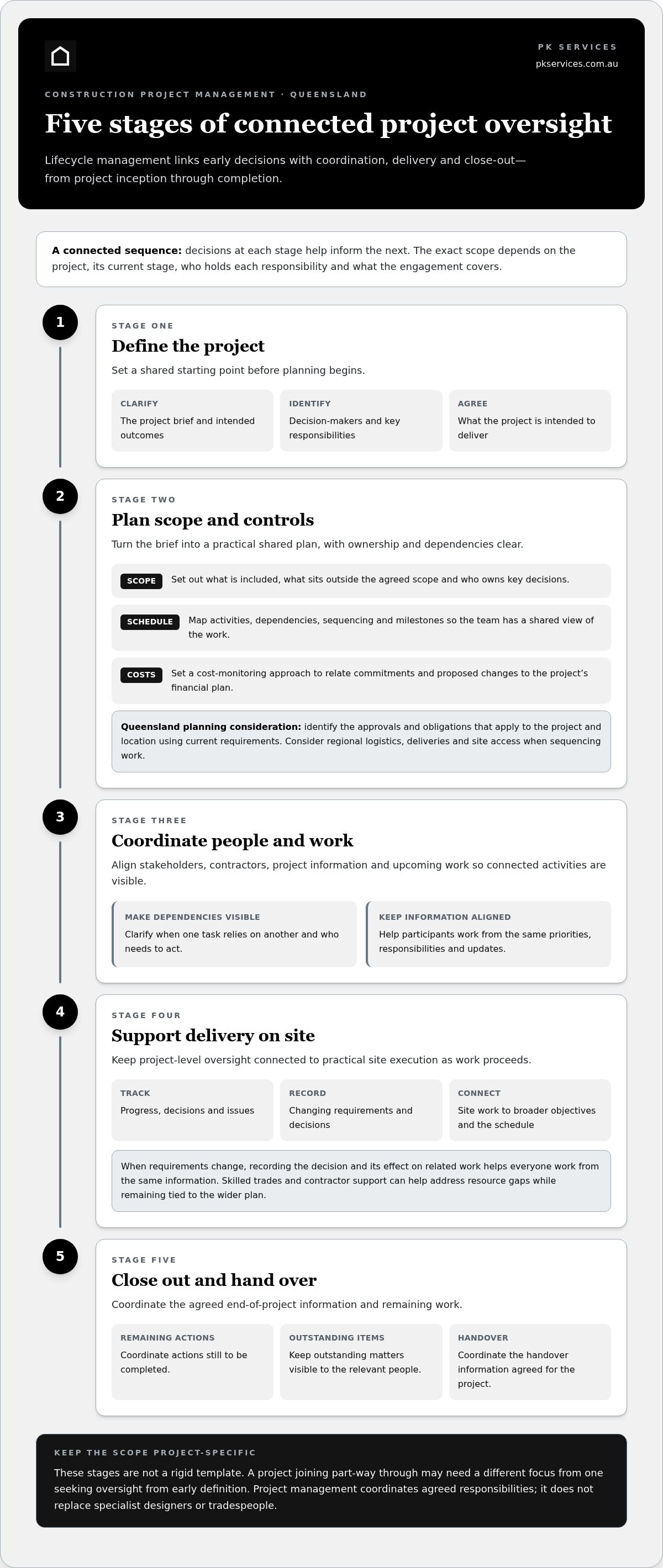
Project management is most useful when each stage informs the next. Early decisions shape the plan, the plan guides coordination, and information from delivery helps the team manage changes and prepare for close-out. Lifecycle management is coordinated oversight from project inception through completion.
The work can be viewed as a connected sequence:
- Define: clarify the project brief, intended outcomes and decision-makers.
- Plan: set out scope, responsibilities, dependencies, schedule and cost-monitoring approach.
- Coordinate: align stakeholders, contractors, information and upcoming work.
- Deliver: track progress, decisions, issues and changing requirements as work proceeds.
- Close out: coordinate remaining actions, outstanding items and the handover information agreed for the project.
These stages aren’t a rigid template. The scope of construction project management services QLD depends on the project’s needs, its current stage, who holds each responsibility and what the engagement covers. A project joining part-way through, for example, may need a different focus from one seeking oversight from early definition.
Planning, scope and project controls
At the outset, clarify what’s being delivered, what sits outside the agreed scope, which activities depend on others and who owns key decisions. A schedule gives the team a shared view of sequencing and milestones. Cost monitoring can show how commitments and proposed changes relate to the project’s financial plan. These controls support informed decisions, but don’t promise a particular outcome. For Queensland work, identify the approvals and obligations that apply to the project and location using current requirements before building them into the plan.
Delivery coordination and site execution
During delivery, coordination turns the plan into practical communication between the client, contractors and on-site teams. If one task depends on another being completed first, the project manager can make that dependency visible and clarify who needs to act. When requirements change, recording the decision and its effect on related work helps everyone work from the same information.
Oversight also needs to stay connected to site conditions. Skilled trades and contractor support can help address resource gaps, while project-level coordination keeps that work tied to broader objectives and the schedule. For a closer look at how delivery oversight relates to workmanship, explore construction quality control management services.
PK Services connects consulting, end-to-end project management and trade support across Queensland and New South Wales. If your project needs joined-up planning and site execution, explore PK Services’ construction project support.
External project manager or in-house lead: which approach fits your QLD project?
External project management should fill a defined need, not duplicate a capable internal lead. The choice depends on the work ahead, the time your team can commit and the coordination the project requires. Before deciding, map who owns decisions, tracks actions and connects contractors. A gap in one of these areas may call for targeted support rather than a wholesale handover.
Use these factors to compare the two approaches:
| Factor | An in-house lead may fit when… | External support may fit when… |
|---|---|---|
| Project complexity | Workstreams and decisions are relatively straightforward to oversee internally. | Several workstreams or project interfaces need active coordination. |
| Internal capacity | The lead has enough time and relevant experience for the project’s demands. | Existing responsibilities leave limited time for consistent oversight. |
| Coordination load | Stakeholders and contractors can stay aligned through current processes. | Updates, dependencies and decisions need a dedicated coordination focus. |
| Desired oversight | The organisation has the visibility and controls it needs. | The client needs additional project-level visibility or structured reporting. |
Neither arrangement is automatically better. Choose the one that covers the real work without creating overlapping authority. Define who recommends, approves and communicates decisions, then record how the internal lead and project manager will work together. The client retains project decisions according to the agreed governance and responsibilities; external management supports coordination within that arrangement.
When an in-house lead may be sufficient
An internal lead can suit a project with manageable coordination and capable oversight already in place. They still need clear authority, enough time to follow through and access to current project information. If those conditions are present, adding an external manager may not provide meaningful extra capacity. Review workload and project demands as they change.
When hiring a construction project manager can add capacity
External support can help when complex interfaces, limited internal capacity or a need for consistent project controls make coordination harder to absorb in-house. PK Services connects consulting insight with project management and practical site delivery, tailoring involvement to the project’s requirements. Related construction business consulting in Australia explores how strategic thinking can connect with delivery.
Illustrative example, not a client case study: A business managing a fit-out alongside other operations may have an internal decision-maker but limited time to coordinate several contractors. A tailored scope could leave approvals and key decisions with that person, while assigning agreed coordination, action tracking and progress reporting to an external project manager. If the workstream is simple and internal oversight is available, the same project may not need external support.
How PK Services scopes construction project management support in Queensland
A useful scope starts with the project, not a standard package of tasks. PK Services shapes construction project management support around the stage of work, its complexity, the people involved and the client’s internal capacity. This focuses the engagement on real coordination needs and helps it sit alongside existing roles rather than overlap them.
The scoping conversation can follow four practical steps:
- Understand the project. Review its current stage, objectives, known constraints, stakeholders and work already completed. This establishes what needs attention now, rather than assuming support must begin at the start.
- Define the outcomes. Clarify what the client needs the management support to achieve, such as clearer progress visibility, coordinated contractors or structured decision tracking. Outcomes guide the scope without promising a particular project result.
- Agree responsibilities. Set out who leads each activity, who provides information and who has authority to approve decisions. This helps prevent crossed wires between the client, project manager and contractors.
- Establish reporting. Agree how the team will share progress, decisions, emerging issues and upcoming dependencies. The approach should suit the project and its stakeholders, rather than default to a fixed frequency or system.
These steps connect the client’s objectives with the practical work of delivery. A project in early planning may need emphasis on scope and dependencies. One already under way may need attention on contractor interfaces or clearer reporting on open decisions. The engagement reflects what the project needs and what the client can manage internally.
Define scope, responsibilities and reporting
Before delivery work proceeds, make communication pathways and decision rights clear. For example, agree who raises a site issue, who reviews its effect on the plan and who makes the final decision. PK Services aligns management activities with the project’s objectives, then sets out how progress, decisions, emerging issues and upcoming dependencies will be shared. Clear boundaries help the project manager coordinate without taking over decisions that remain with the client.
Reporting should help people act, not just record activity. A useful update might distinguish completed work from pending decisions, flag a dependency affecting the next stage and identify who owns the follow-up. The format can be tailored to the project’s stakeholders and agreed scope.
Coordinate contractors and site requirements
Contractor coordination can include aligning responsibilities, work interfaces and communication with on-site teams as part of the agreed scope. Planning should also account for site access, regional logistics and other project-specific constraints that may influence sequencing. PK Services connects project-level oversight with skilled trades and contractor support, linking site execution to the wider project plan. Considerations around vetting construction subcontractors in Australia can also inform how subcontractor responsibilities are approached.
For a tailored discussion about project stage, responsibilities and reporting, Discuss your Queensland project with PK Services.
Hire PK Services for connected construction project management in QLD
Choosing construction project management services QLD is about more than assigning someone to track tasks. The value lies in connecting project direction with the practical demands of delivery. PK Services works across Queensland and New South Wales, bringing together construction consulting, end-to-end project management and skilled trades and contractor support. With over 15 years of construction industry experience, the team connects project oversight with site execution, with support shaped to each project’s needs.
One connected approach from strategy to site
Business advice can help clarify priorities and inform decisions about how a project should proceed. Project management brings those priorities into delivery planning and coordination. Where a project has a site resource need, skilled trades and contractor support can be part of the solution too. These capabilities work together without assuming every project needs the same mix of support.
That connection matters because strategic decisions affect work on site. A change in priorities, for instance, may influence sequencing, contractor coordination or the resources required. Keeping advice, management and practical work connected helps the project team understand how decisions relate to delivery. PK Services manages projects from start to finish, tailoring the engagement to the requirements at hand.
Depending on the project, connected support may help to:
- Bring project objectives into delivery planning.
- Keep coordination aligned with changing project needs.
- Address site resource gaps through trade and contractor support.
- Link practical delivery considerations with project-level oversight.
This isn’t a promise of a particular time, cost or quality outcome. It’s a way to bring relevant capabilities together around agreed project requirements while keeping responsibilities and decisions clear.
Take the next step with PK Services
A useful starting point is a clear outline of where the project stands and what support would help. Share the current stage, intended objectives, delivery challenges and areas where your team needs additional capacity. That context helps shape a scope around the work ahead, your stakeholders and internal resources, rather than applying a one-size-fits-all approach.
PK Services tailors management support to the project. Talk through what needs to happen next, where coordination is most needed and how strategic advice, project oversight or site support can fit together.
Talk with PK Services about your project.
Set your next project decision in motion
The clearest way to move forward is to turn project uncertainty into a short list of decisions. What needs attention first? Which decisions are holding up progress? Where would added oversight make the biggest practical difference? Answering these questions gives your team a useful starting point and keeps the conversation focused on the project, not a generic service checklist.
As you consider construction project management services QLD, think about what you want to retain internally and where you need extra capacity. You don’t need every detail settled before taking the next step. A clear picture of the current stage, priorities and pressure points can help shape a scope that fits.
PK Services brings over 15 years of construction industry experience, end-to-end project management and skilled trades and contractors to support site delivery needs. Share what your project is working towards and where coordination is most challenging.
Talk with PK Services about your Queensland construction project and take the next step with confidence.
Frequently Asked Questions
How much do construction project management services cost in QLD?
Fees depend on the project’s scope, stage, complexity, duration and agreed responsibilities. A defined coordination role on a project already underway may differ from end-to-end oversight that begins during planning. PK Services tailors project management support to the work required rather than applying a universal package. To discuss construction project management services QLD, share your project requirements, including the stage and support you’re considering.
Can a construction project manager join a project that is already underway?
Yes. Support can be shaped around work already underway. A considered transition starts with understanding the current scope, who owns decisions, what progress information is available and where coordination is needed now. For example, an active project may need clearer visibility of outstanding decisions or dependencies before responsibilities are adjusted. Reviewing these details helps define a practical remit and next steps without assuming earlier work can be recovered or a particular outcome is assured.
Does hiring a construction project manager mean giving up control of the project?
No. Hiring a project manager doesn’t automatically transfer control. The client’s governance and engagement arrangements define which decisions remain with the client and what coordination the manager handles. For clarity, set out approval pathways for scope changes, who can instruct contractors and how key decisions are recorded. The manager can organise information and follow up agreed actions while the client retains authority over decisions assigned to them.
When should I hire a construction project manager for a QLD project?
The right timing depends on the project and your team’s capacity. Bringing support in early can help shape the brief before plans and responsibilities become harder to adjust. Later involvement may still help clarify open issues, coordination needs or priorities for the remaining stages. For a Queensland project, consider what decisions are coming up and whether your team has time to manage them. PK Services can discuss the project’s current stage with you.
Can a construction project manager coordinate trades and contractors on site?
Yes. Trade and contractor coordination can form part of an agreed project management scope. Define how work packages connect, what information contractors need and how site teams raise issues or changes. The project remit should also make clear who directs work and who makes decisions. PK Services’ skilled trade and contractor support can help address project-specific site resource needs as part of a connected approach to delivery.
What should I include when asking for construction project management support?
Share the project location, current stage, objectives, known constraints, key stakeholders and the support you’re looking for. A short note about the main delivery challenge, such as coordinating overlapping work or limited internal capacity, can help focus the discussion. You don’t need every project document ready. PK Services can use the information available to understand your requirements and shape a suitable scope for work in Queensland or New South Wales.


