

A construction change agreed beside the site gate can become a dispute when the invoice arrives. Effective construction change order management Sydney projects rely on turns each change into a documented decision, with clear responsibility for scope, cost and timing. For NSW residential building work under contracts over A$5,000, variations must be in writing and signed by both parties before the work begins.
Late design updates and unexpected site conditions can put pressure on the programme and trade coordination. It’s understandable to want work moving, but proceeding without clear records makes it harder to establish who approved a change, what it will cost and how it may affect delivery.
This guide sets out a practical process to record, assess, approve and deliver construction changes. You’ll learn how to make scope, cost and programme impacts visible before work proceeds, and how to connect decisions with site execution. With more than 15 years of construction industry experience, PK Services understands the value of joined-up oversight from project planning through to completion.
Key Takeaways
- Use a consistent workflow to log, assess, approve, implement and close out each change, with clear responsibility at every step.
- Construction change order management Sydney projects benefit from assessing scope, cost, programme and delivery risks before work proceeds.
- Separate direct work costs from knock-on effects, including resequencing, procurement changes and revised site access.
- Keep decisions connected to current drawings, instructions, programme updates and subcontractor coordination through shared project records and regular reviews.
- Connect change control with end-to-end project oversight so commercial decisions translate clearly into site delivery.
Construction change order management in Sydney: why changes need control
A revised finish, a design adjustment or an unexpected site condition can alter what a project needs to deliver. Without a clear record, it can also blur the line between agreed work and extra work. Effective construction change order management Sydney projects need makes each proposed change visible before it affects commitments on site.
A change order is a documented proposal to alter agreed scope, cost, time or delivery requirements. It records what is changing and gives the project team a basis for assessing the effects. The term “variation” is also common in Australian building contracts, but terminology and procedures differ. This Change order reference provides a useful overview of the concept.
What counts as a construction change order?
Consider a Sydney renovation where the owner requests a different floor finish after the original selection has been documented. That request may change the scope, with possible effects on material orders, installation and timing. A revised drawing that changes a wall layout could also require a formal change proposal. In either case, record the requested outcome, affected documents and likely delivery implications.
Not every site issue is a change order. A clarification explains an existing requirement, while a defect concerns work that doesn’t meet the agreed standard. A coordination issue may need trades to resolve interfaces, and an unforeseen site condition may prompt a proposed adjustment. Any of these issues may lead to a change, but first establish what happened and what the contract says. A proposal is not automatically an authorised instruction to proceed.
Why informal site decisions create project risk
A quick verbal direction can feel efficient, especially when a trade is ready to continue. Without a written record, however, it may be unclear who had authority to approve the work, what was requested or how cost and timing were assessed. The contractor may understand “move the fitting” differently from the person who gave the direction. That gap can later become a payment or responsibility dispute.
Unrecorded decisions can also ripple through the programme. A finish change may require a different supplier or lead time. A revised layout can affect trade sequencing, access or completed work, increasing the risk of rework. Even a small instruction can change another subcontractor’s commitments.
Change control is the documented review of a proposed change before an authorised person approves its implementation. The right steps depend on the contract and project governance, so don’t assume one process applies to every job. For NSW residential building work under contracts over A$5,000, the Home Building Act 1989 requires variations to be in writing and signed by both builder and homeowner before variation work starts. Clear records support accountability, but the contract remains central to assessing each change.
Managing construction variations from request to close-out
A dependable variation process gives every request a clear owner, a recorded decision and a path through to site delivery. The approval steps and decision-making authority depend on the contract and project governance. Set roles at the outset, so the person assessing a change knows who can authorise it and the site team knows whose instruction to follow.
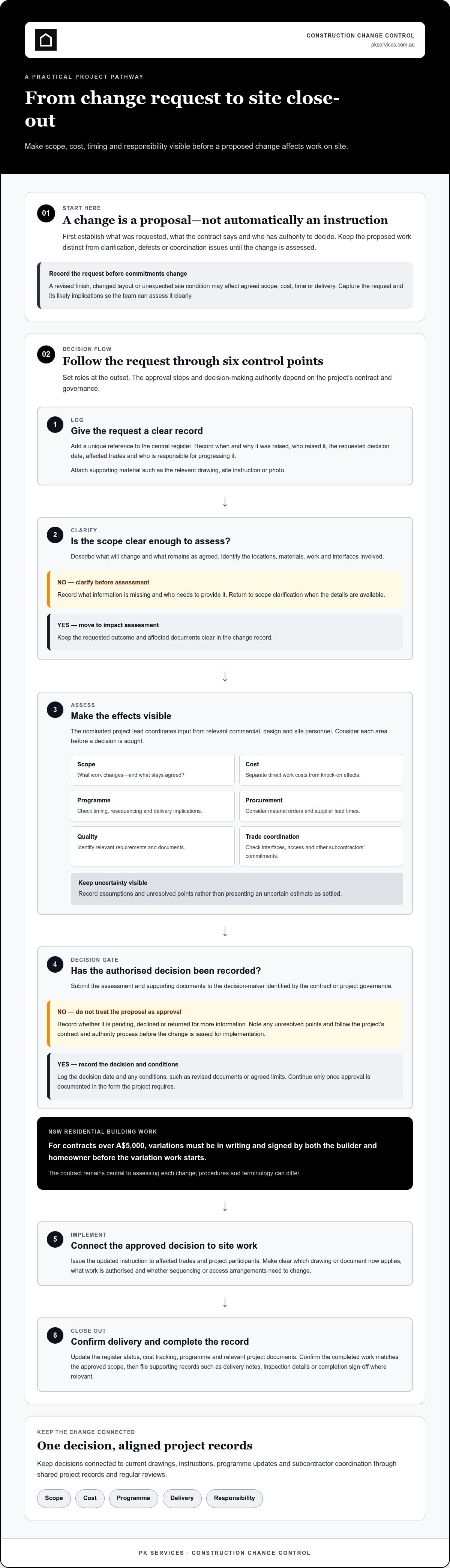
Log, clarify, assess, approve, implement and close: a practical sequence for managing changes, with each decision made under the project’s own contract and authority structure.
- Log the request. Give each proposed change a unique reference in a central register. Record when it was raised, who raised it, why it’s needed, the requested decision date, affected trades and the person responsible for progressing it. Attach the relevant drawing, site instruction, photo or other supporting document.
- Clarify the scope. Describe what will change and what remains as agreed. Identify the locations, materials, work and interfaces involved. If the request is unclear, note the missing information and who needs to supply it before assessment can be completed.
- Assess the effects. The nominated project lead coordinates input from relevant commercial, design and site personnel. Consider scope, cost, programme, procurement, quality and trade coordination. Record assumptions and unresolved points instead of presenting an uncertain estimate as settled.
- Seek an authorised decision. Submit the assessment and supporting documents to the decision-maker identified by the contract or project governance. Record whether the proposal is approved, declined or returned for more information. Include any conditions, such as revised documents or agreed limits, and the date of the decision.
- Implement and communicate. Once approval is documented in the form the project requires, issue the updated instruction to affected trades and project participants. Make clear which drawing or document now applies, what work is authorised and whether sequencing or access arrangements need to change.
- Close the record. Update the register’s status, cost tracking, programme and relevant project documents. Confirm that the completed work matches the approved scope, and file supporting records such as delivery notes, inspection details or completion sign-off where relevant.
Keep assessment and approval distinct
The person coordinating an assessment isn’t automatically authorised to approve the change. Make that distinction visible in the register. The assessment owner gathers the facts and presents the implications; the authorised decision-maker applies the contract and governance arrangements. This helps prevent a site discussion or preliminary estimate from being mistaken for permission to proceed.
Make the record useful on site
A register should work as a live project tool, not just an archive. Use clear status labels such as “under assessment”, “awaiting decision”, “approved” and “closed”, and link each entry to its latest documents. At project reviews, scan outstanding requests and upcoming decision dates. This can reveal procurement or sequencing dependencies while there’s still time to coordinate them.
Good change administration connects commercial decisions with practical delivery. For project teams seeking oversight from planning through site execution, PK Services’ end-to-end project management connects project planning with delivery.
How to assess a change’s cost, time and delivery impact
A useful change assessment compares the proposal with what the project has already approved. First gather the relevant scope, drawings, specifications, current programme and cost assumptions. Then describe the difference plainly. For example, “replace the specified floor finish in the entry” is easier to assess than “upgrade flooring”.
Separate direct work from its consequences. Direct effects may include the changed material and the labour to install it. Consequential effects could include cancelling or revising an order, resequencing trades, changing access arrangements or revisiting completed work. Record the basis for each assessment, including supplier information, drawing references and assumptions. If details are missing, flag them rather than presenting an estimate as certain.
Compare the proposal with the project baseline
Trace programme impacts through the current sequence of activities. Identify which tasks the change affects, what must happen before those tasks can start and whether other work depends on their completion. A revised finish, for instance, may affect ordering, delivery and installation. Don’t assign a delay without evidence; state the dependencies and information still needed to assess timing.
Weigh the options against project priorities
Change control isn’t paperwork for its own sake. It gives decision-makers a clear view of trade-offs before commitments are made and records why a particular option was chosen. Compare proceeding as proposed with revising or deferring the change. Consider cost, timing, quality, usability and coordination together; the right balance depends on the project’s objectives and constraints.
Quality deserves specific attention. A different finish may affect appearance, performance or how it meets the documented specification. Check the relevant requirements and inspection points before approving a revised approach. The construction quality control management guide offers further context on keeping quality considerations visible during delivery.
For construction change order management Sydney teams can rely on, keep the assessment concise but evidence-based. State what is known, what remains uncertain and what decision is needed. This gives the project team a shared basis for action instead of leaving cost, programme and responsibility assumptions to be resolved after work is done.
Sydney project controls for clearer change approvals and site delivery
On a live Sydney project, a change can affect several people at once: the person approving the scope, the team updating drawings, and subcontractors arranging labour or materials. Clear project controls keep those decisions connected. They also show what’s awaiting review, what’s authorised and what has reached the site. Teams working across New South Wales and Queensland should also keep the relevant project location and contract requirements clear in their records.
Set up practical change-control routines on a live site
Agree project roles early. Document who can raise a change, who assesses its impacts, who makes a recommendation and who has authority to approve it under the project’s governance and contract. A site supervisor may identify a clash, for example, but that doesn’t automatically make them the authorised decision-maker. Clear boundaries reduce mixed messages and help requests reach the right person.
Use a shared, current register as the reference at project meetings. Review open, overdue and upcoming decisions regularly. Focus on items that could affect procurement, access, sequencing or subcontractor commitments. Record each decision, owner and next action, then carry unresolved matters into the next review rather than letting them disappear into meeting notes.
Keep each change traceable across project records. Link its register entry to the relevant instruction, current drawing revision, programme update and communications with affected trades. If an updated layout changes a service location, for instance, confirm that the relevant subcontractors are working from the same issued information. Retain superseded documents in line with project procedures so the record shows what changed and when.
Keep contract and NSW requirements in view
Project controls should reflect the actual contract, not a generic template. Check the applicable variation clauses, notice steps, approval authority and records needed to support assessment or valuation. Make sure the team understands where formal notices must go, who must receive them and how instructions are recorded. If the contract requires a particular form or process, the register should help track it rather than replace it.
Separate practical administration from conclusions about contractual rights. Where a change raises a question about legal obligations or statutory timeframes, check current NSW legislation and authoritative guidance before relying on it. Requirements can depend on the project and contract context. Keep a note of the source and date checked, and seek legal advice where interpretation is needed. For projects in Queensland, consider the applicable state requirements as well as the contract.
Consistent controls make construction change order management Sydney projects more visible from the office through to site delivery. They help the team match approved decisions with the documents, programme and trade coordination needed to carry them out. For a broader view of connected project delivery, explore full-cycle construction project management.
PK Services provides project management support that links project decisions with site execution. Explore project management support from PK Services.
How PK Services can connect change control with project delivery
A change register is useful, but it can’t manage a project on its own. Decisions need to flow into the right project records, programme and site communications, with the people doing the work clear on what’s been agreed. That’s how change control becomes part of coordinated project oversight, rather than a standalone paperwork exercise.
Bring strategy, project controls and site execution together
PK Services provides end-to-end project management from project inception through to completion. Joined-up oversight connects a project decision with the information and actions needed to deliver it. A change may require updated drawings, revised planning, coordination with affected trades or a new sequence of site activities. Keeping those parts aligned helps prevent a commercial decision from becoming a disconnected instruction on site.
With more than 15 years of construction industry experience, PK Services understands how project planning and delivery meet. Construction business consulting can support the wider operational picture, while project management oversight connects decisions with site execution. Where project needs call for it, experienced trades and contractors can support construction work. The aim is a clear line between what has been decided, what the team needs to do and how delivery is progressing.
For broader strategic support, construction business consulting in Australia can help connect business priorities with practical project delivery. This wider view can be useful when change requests point to recurring challenges, such as unclear decision pathways or gaps between planning and site communication.
Choose a clear next step for your Sydney project
Start by mapping where changes currently slow down or become difficult to track. Are requests reaching the right decision-maker? Do approved changes make it through to current drawings, programme updates and trade instructions? Are cost and delivery implications visible before work proceeds? Reviewing a few recent changes can help identify a bottleneck and clarify what support would be useful.
Every project has its own priorities, contract arrangements and delivery pressures. PK Services tailors consulting and project management support to project circumstances, connecting oversight with the practical demands of delivery. For construction firms reviewing their construction change order management Sydney approach, a clear picture of the current process is a useful starting point.
Discuss construction project support with PK Services and outline the change-control challenges your team wants to address.
Set your next project up for clearer decisions
Your next project is a chance to make change decisions easier to see and act on. Before work ramps up, pinpoint where requests tend to stall: at intake, during assessment, in approval or when instructions reach the site. Choose one bottleneck to address, assign someone to lead the improvement and review how it’s working at a project meeting.
That practical first step can help your team build a more consistent approach without adding process for its own sake. Strong construction change order management Sydney projects rely on isn’t about slowing decisions down. It’s about giving the right people the information and authority to make them confidently.
To strengthen project oversight and connect commercial decisions with delivery, discuss project management support for your Sydney construction project with PK Services. Start with a shared view of what your team needs next.
Frequently Asked Questions
Can a construction change order be approved verbally?
A verbal discussion shouldn’t be treated as sufficient approval where the contract or law requires a written variation. In NSW, variations to residential building contracts over A$5,000 must be in writing and signed by both the builder and homeowner before work starts. For other project types, check the contract’s approval process. Follow up site conversations with a clear written record so the parties can verify what was agreed.
What happens if work starts before a change order is approved?
Starting early can leave the parties exposed to disagreement about who authorised the work, what was included and how payment should be assessed. For NSW residential contracts over A$5,000, starting variation work before the required written, signed agreement may jeopardise the builder’s ability to claim payment for it. If work has already begun, document the instruction and work completed, then address the issue under the contract before proceeding further.
How quickly should a construction change order be submitted?
Submit a proposed change as soon as it’s identified, and before ordering materials or committing trades to the changed work. The contract may set specific notice periods or steps, so check those requirements promptly rather than relying on a general timeframe. For projects spanning NSW and Queensland, confirm which contract and jurisdiction apply. Early submission gives the team time to assess dependencies and make a decision before site commitments change.
Who is responsible for preparing a construction change order?
The responsible party depends on the contract and project procedures. A builder, client, designer or site representative may raise a change, while the builder or nominated project administrator often coordinates the written proposal and supporting details. For example, a designer may identify a needed adjustment, but the project’s designated person should check the required scope information and route it to the authorised decision-maker. Confirm roles at project start to avoid requests being missed.
Can a client reject a proposed construction change order?
A client can reject a proposal where the contract gives them the relevant approval right, but the contract governs the process and any consequences. Record a rejection clearly, including whether the client wants the original scope retained or a revised option prepared. For instance, if a proposed material change doesn’t suit the project’s requirements, document the decision and ensure the site team continues against the current authorised documents.
Should subcontractors receive approved change-order information?
Yes, share the approved details with every subcontractor whose work, sequence, access or materials are affected. Give each trade the relevant current instruction or drawing revision, not just a brief verbal summary. For example, a change to a service location may affect both the installing trade and the team responsible for subsequent finishes. Limit distribution to relevant project participants, and make clear which documents have been superseded so work isn’t completed to outdated information.


