

A project can lose a day before anyone realises the programme is at risk. A trade arrives before the work area is ready, a material delivery slips, or an unresolved design decision leaves the next work front on hold. If you’re searching for how to prevent construction project delays Sydney builders face, start by managing these connections before they become site stoppages.
Small hold-ups can quickly stack up when approvals, site access, weather or neighbouring activity disrupt the plan. Delays can’t always be avoided, but early warning signs are easier to act on when each risk has an owner, a trigger and a clear response.
This guide explains how to identify risks to the critical path, coordinate trades, procurement, approvals and site logistics, and respond when the programme starts to slip. It also shows how integrated project management connects planning decisions with on-site work, helping keep people, information and work fronts moving together.
Key Takeaways
- Identify how incomplete information, approvals, procurement, trade sequencing and site constraints can block a work front before they disrupt the wider programme.
- Learn how to prevent construction project delays Sydney teams face by checking dependencies early and assigning an owner to each risk.
- Compare practical controls for tracking materials, coordinating trades, securing design sign-offs and managing site logistics.
- Build a repeatable routine for project start-up, weekly coordination, daily site checks and timely escalation.
- See how integrated project management connects planning, decisions and on-site execution, while supporting work continuity when labour gaps arise.
Why construction projects in Sydney fall behind, and where delays begin
A missed handover can hold up more than one trade. If the next crew can’t start, planned work may need to shift, deliveries may need rescheduling and the programme can lose valuable time. A blocked work front is often the visible sign of an earlier problem, such as an unresolved design detail or a material order placed before the specifications were settled.
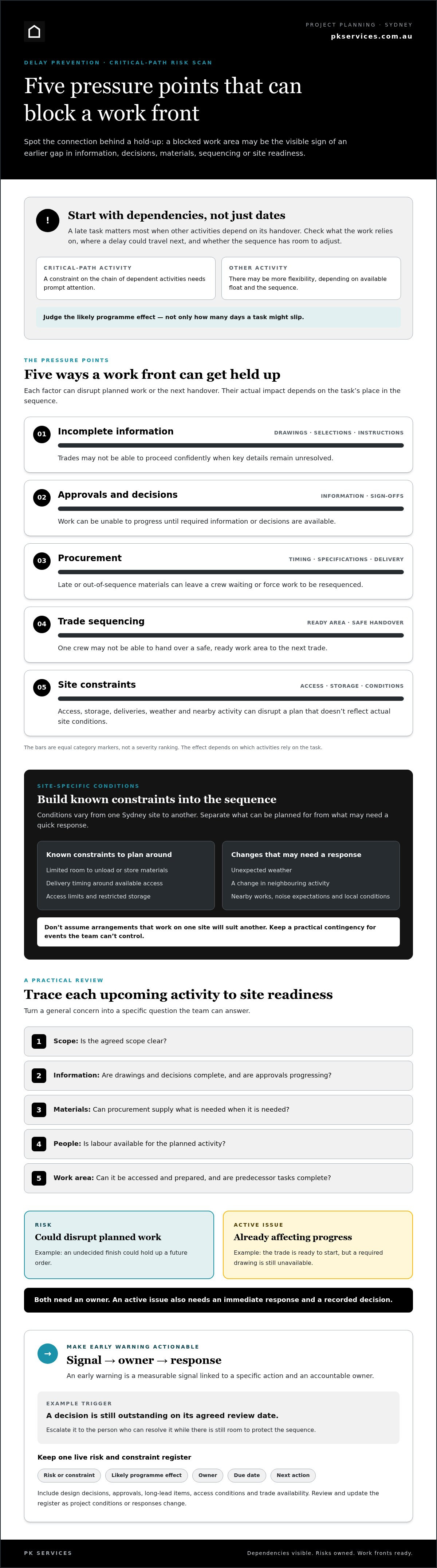
To understand how to prevent construction project delays Sydney teams may encounter, look at how tasks connect, not only at the date each task is due. Common pressure points include:
- Incomplete information: Trades can’t proceed confidently when drawings, selections or instructions leave key details unresolved.
- Approvals and decisions: Work may be unable to progress until required information or decisions are available.
- Procurement: Late or out-of-sequence materials can leave a crew waiting or force work to be resequenced.
- Trade sequencing: One crew may not be able to hand over a safe, ready work area to the next.
- Site constraints: Access, storage, deliveries, weather and nearby activity can disrupt a plan that doesn’t reflect actual site conditions.
These factors can compound. A delivery delay may be manageable if another task can proceed, but disruptive if it holds up work that other activities depend on. The Understanding Construction Delays overview describes how delays can be classified and how their effects vary. On site, the practical questions are which activities depend on the delayed task and whether there’s room to adjust the sequence.
Which delay risks are most visible on Sydney sites?
Conditions vary from one Sydney site to another. A tight urban block may have limited room to unload or store materials, while a busy street frontage may require delivery times to be planned around available access. Nearby works, noise expectations, weather exposure and local conditions can also affect when and how a work area is ready.
Separate known constraints from surprises. Access limits and restricted storage may be identified during planning; unexpected weather or a change in neighbouring activity may call for a quick response. Build known conditions into the sequence and keep a practical contingency for events the team can’t control. Don’t assume arrangements that work on one site will suit another.
How small coordination gaps become programme delays
Imagine a trade waiting on a final design detail. Until the detail is confirmed, the work can’t be planned with confidence and materials may not be ordered. If those materials arrive late, the work area may not be ready for the following trade at the planned handover. One unresolved decision has affected procurement, site readiness and the next activity.
A late predecessor task can hold up every critical-path activity that depends on its handover. The impact depends on where the task sits in the sequence, not simply how long it takes. A short hold-up on a task with no immediate successor may be absorbed; the same hold-up on a task with dependent work can push the programme out. Make dependencies visible so the team can identify knock-on effects early.
How to identify construction delay risks before they hit the critical path
A useful delay review follows each upcoming activity from definition through to site readiness. Start with the agreed scope, then trace what the work depends on. Check whether drawings and decisions are complete, approvals are progressing, materials can be obtained when needed, labour is available and the work area can be accessed and prepared. This turns a general concern into a specific question the team can answer.
Prioritise risks by their effect on the critical path, the chain of dependent activities that determines when key milestones can be reached. A constraint on this chain needs prompt attention. A delay elsewhere may allow more flexibility, depending on available float and the sequence. Focus on the likely effect on the programme, rather than just counting how many days a task might slip.
Distinguish a risk from an active issue. A risk could disrupt planned work if it occurs, such as an undecided finish holding up a future order. An issue is already affecting progress, such as a required drawing that’s still unavailable when the trade is ready to start. Both need an owner, but an active issue also needs an immediate response and a recorded decision.
An early warning is a measurable signal linked to a specific action and an accountable owner. For example, a decision still outstanding on its agreed review date can trigger escalation to the person who can resolve it. Clear triggers make it easier to act while there’s still room to protect the sequence.
Build a live risk and constraint register
Maintain one register that the project team can review and update. For each item, record the risk or constraint, its likely programme effect, an owner, a due date and the next action. Include design decisions, approvals, long-lead items, access conditions and trade availability. Set a review rhythm that suits the project’s complexity and how quickly site conditions change. Update each entry whenever its status or response changes.
Use look-ahead planning to test site readiness
A short look-ahead plan focuses on upcoming work fronts alongside the master programme. Test each activity against current drawings, materials, access, labour and completion of predecessor work. Ask relevant teams to flag constraints early, then record decisions, actions and owners so blockers don’t get lost in meeting notes. Recheck readiness as the work approaches.
For a practical review, work through these checks in order:
- Confirm the scope and information needed to do the work.
- Map dependencies and identify activities linked to key milestones.
- Check approval progress, procurement status and expected material availability.
- Confirm labour, access and site readiness for each planned work front.
- Assign an owner, action and due date to every risk or active issue, then escalate threats to the critical path.
This disciplined review is central to how to prevent construction project delays Sydney teams can still influence. Construction consulting can strengthen these controls, while end-to-end project management connects planning decisions with on-site coordination.
Compare delay-prevention controls for procurement, trades, and site coordination
Not every control needs the same level of formality. A simple comparison helps the team decide what to track, when to review it and who acts if a constraint threatens planned work. Include design sign-offs as well as procurement and site coordination: delivery tracking is only useful if specifications and decisions are settled in time.
Use a control register with these fields: control, risk addressed, trigger, owner, review rhythm, effort and escalation action. For example:
- Procurement tracking: Addresses late or out-of-sequence materials. Trigger: a decision, order or delivery milestone is at risk. Owner: the person coordinating procurement. Review progress against required-on-site dates and escalate uncertainty before it affects installation.
- Trade coordination: Addresses clashes, incomplete handovers and gaps between crews. Trigger: a prerequisite or work area won’t be ready. Owner: the site or project lead coordinating the interface. Review upcoming handovers and agree the next action with affected trades.
- Design sign-offs: Address work held up by unresolved information. Trigger: a required decision remains open as a work front approaches. Owner: the person responsible for obtaining the decision. Review at planned decision points and escalate to the relevant decision-maker.
- Site logistics: Address access, delivery, storage and work-area conflicts. Trigger: a planned movement or activity clashes with site conditions. Owner: the person overseeing site coordination. Review when logistics or neighbouring activity changes, then adjust the sequence where practical.
The effort involved depends on the detail needed to make each control useful. A straightforward activity may need a brief status check; a constrained site or complex sequence may need closer coordination and clearer records. Match the approach to project scale, contract structure, site constraints and risk exposure. No single tool suits every Sydney project, so keep the process practical enough for the team to maintain.
Match procurement controls to item lead times
Start with items that could hold up following activities. Track the decision needed, order status and delivery progress against the date the item is required on site and its place in the installation sequence. If a date becomes uncertain, raise it early with the owner and assess whether resequencing or another approach is workable within the project. Make any agreed change visible to affected trades.
Coordinate trade interfaces and site logistics
Map each handover: what must be complete, which area is needed and what access the incoming crew requires. Plan delivery timing, storage and routes around the actual site, rather than generic assumptions about Sydney conditions. If labour gaps emerge, experienced trade support can help address continuity needs. It doesn’t remove the need to coordinate availability and sequence. These practical controls support how to prevent construction project delays Sydney project teams can influence.
A practical Sydney construction delay-prevention routine for project teams
A useful routine turns programme monitoring into clear actions. Decide who leads each check, what gets recorded and when a constraint needs escalation. Adapt the process to the project’s scale and agreed arrangements. The roles below are practical examples, not prescribed contract duties.
Use this sequence to create a consistent rhythm from mobilisation through site delivery:
- At project start-up, the project lead reviews milestones, dependencies and decision points with the relevant team. Record the baseline programme, key assumptions, named action owners and the process for raising constraints.
- At the weekly coordination review, the project or site lead checks upcoming activities, outstanding decisions, procurement status, labour needs and work-front readiness. Record each action with an owner and due date, then revisit overdue items at the next review.
- During daily site checks, the site supervisor or nominated site lead confirms that planned work can proceed. Check the work area, predecessor completion, crew and material readiness, plus site-specific access, delivery arrangements, surrounding activity and weather. Record blockers and immediate actions in the site log.
- When a constraint threatens a key activity, the responsible owner raises it with the project lead rather than waiting for the next routine review. Record the issue, affected work, decision required, escalation and agreed next step.
Run a focused weekly coordination review
Keep the meeting focused on what’s coming up and what could prevent it from starting or finishing as planned. Check decisions and procurement against need dates, confirm labour and work-front readiness, and consider whether access, deliveries, weather or neighbouring activity have changed the plan. Give each action an owner and due date. Escalate constraints that may affect critical activities or agreed milestones.
Create a clear delay response and recovery plan
If work is already affected, establish the cause and identify the activities and milestones at risk. Check available float, dependencies and any immediate safety or quality implications before changing the sequence. Then assess practical options, such as resequencing work, increasing coordination or adjusting resources. Record the decision, accountable owner, affected teams and follow-up date. Check downstream effects before treating a revised plan as workable.
A consistent project rhythm helps teams act on early signals without treating every disruption as a programme-wide delay. PK Services’ end-to-end project management support connects project planning with on-site coordination.
How integrated project management helps keep Sydney construction moving
Delay controls work best when someone connects planning decisions with the work happening on site. If design information, procurement, trade sequencing and site conditions are managed separately, gaps can persist between teams. Integrated project management gives the project a consistent view of what needs to happen next, what is holding it up and who needs to act.
That oversight doesn’t guarantee a project will avoid delays. It can make emerging constraints easier to see and help teams respond with clearer priorities. A changed decision can be traced through its effects on materials, the work sequence and the next trade, rather than treated as an isolated update.
When a project needs joined-up oversight
Recurring coordination gaps, unresolved constraints and unclear ownership are signs that a project may need closer oversight. So is a pattern of decisions reaching site teams after work has been planned around them. Lifecycle project management connects early planning, decision-making and delivery, so changes are considered in context and site progress informs the next steps. Clear records also support quality checks by showing what was agreed and what remains open.
PK Services provides end-to-end project management from inception to completion, alongside construction business consulting. With over 15 years of construction industry experience, the team supports project coordination and operational processes across New South Wales and Queensland. The focus is on linking project needs with practical delivery, rather than treating each stage as a separate exercise.
Connect project planning with the people doing the work
A programme only becomes real when the people, materials and work areas are ready to match it. Clear sequencing helps each trade understand its prerequisites, handover point and access needs. Regular communication gives teams a way to flag constraints before they disrupt the next activity, while documented decisions reduce confusion about what has changed.
Where a site has a labour gap, access to experienced trades and contractors can help support work continuity. That support needs to fit the project’s sequence and coordination plan. It doesn’t replace readiness checks or confirming how one crew’s work affects another. Joined-up oversight keeps those details visible to the people making and carrying out decisions.
If recurring delays are exposing gaps between planning and site execution, a more connected approach can bring those moving parts together. PK Services provides project management, construction consulting and trade support across New South Wales and Queensland.
Make your next project decision count
Keeping a project moving isn’t about reacting faster to every setback. It’s about making the next decision visible, giving it an owner and acting while there’s still room to adjust. Start with an upcoming milestone. Work backwards to identify the decision or handover that could put it at risk, then make the next action clear to everyone involved.
That habit makes how to prevent construction project delays Sydney projects face a practical part of everyday delivery. It also gives your team a clearer basis for deciding where closer oversight or additional support could make a difference.
PK Services brings construction project management, consulting and experienced trades and contractors together to support project needs from planning through delivery. The team works across New South Wales and Queensland, drawing on more than 15 years of industry experience.
Talk with PK Services about keeping your project on track with construction project management, consulting and trade support.
Frequently Asked Questions
Can construction project delays in Sydney be prevented completely?
No. A project team can’t control every event or guarantee a delay-free build. The practical aim is to reduce avoidable risks and notice changes early enough to respond. To prevent construction project delays Sydney teams can influence, treat weather, approval progress, supply conditions and site constraints as planning variables, not certain disruptions. Keep contingencies proportionate and revisit assumptions as conditions change. Risk controls support sound decisions; they don’t replace them.
How early should a construction team start planning for project delays?
Start during project planning, before key commitments and work sequences become difficult to change. Early reviews can reveal dependencies between design decisions, approval pathways, long-lead items, access arrangements and trade interfaces. For example, if a selected item affects dimensions or installation order, flag the decision before procurement and downstream work are locked in. Keep reviewing as the design develops and site conditions change. A checklist completed once won’t stay reliable throughout delivery.
What happens if a critical-path activity is delayed?
First, check which activities depend on the delayed task, how much float remains and which milestones could be affected. Confirm the cause, then assess safe, practical responses with the people responsible for the impacted work. Record the decision, action owner and any programme changes. A slip doesn’t automatically move the completion date; the effect depends on the sequence and available flexibility. Any formal contractual response should follow the project’s own terms.
Can extra trades recover time after a construction delay?
Sometimes, but additional trades only help if the task can support them. Check whether the work area has enough room, materials are ready, supervision is available and safety and quality controls remain effective. On a confined site, extra people could create congestion or interfere with other work. Compare the proposed resource change with resequencing or other practical options, then consider the downstream effects. More labour alone doesn’t guarantee faster progress.
How often should a Sydney construction project review its programme?
Set the review rhythm according to project size, complexity, risk and how quickly conditions are changing. Pair broader programme reviews with shorter look-ahead checks so teams can respond between formal reviews. For example, a change to a delivery date or design decision may require an immediate update to affected activities rather than waiting for the next meeting. Keep programme assumptions current, including those relating to approvals, labour and site access.
Does bad weather always delay construction work in Sydney?
No. Weather affects different activities in different ways. Rain may affect exposed work or access on one site, while other tasks can continue safely under suitable conditions. Monitor forecasts alongside the planned activity, site conditions and available protection. Consider feasible alternatives, but don’t assume work can proceed if conditions make it unsafe or could compromise quality. Avoid applying a fixed weather allowance without considering the project’s location, sequence and actual exposure.
How can a project team manage late design information without stopping the site?
Identify exactly which work depends on the missing detail, and don’t proceed on an unsafe or unapproved assumption. State the decision needed, assign it to the person who can resolve it and set a due date. In parallel, check whether independent work can continue without creating clashes or rework. Once resolved, record the agreed information, notify affected teams and update the programme where needed so the uncertainty doesn’t carry into later tasks.


