

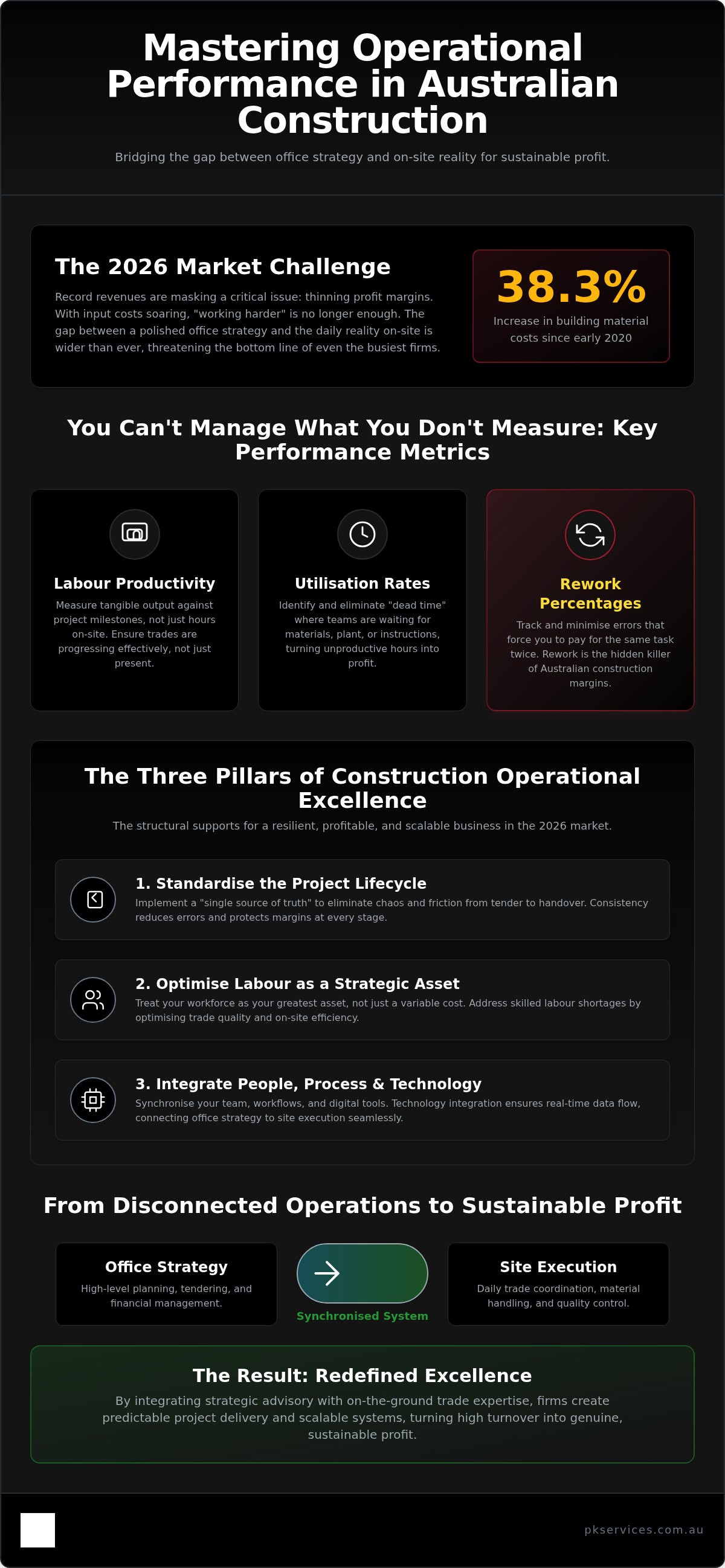
Building material costs in Australia are now 38.3% higher than they were in early 2020. Despite record revenues, many directors find themselves working harder for smaller slices of the pie. You probably know the frustration of a packed pipeline that somehow fails to move the needle on your bottom line. It's a common struggle; the disconnect between a polished office strategy and the daily reality of a site in QLD or NSW is wider than ever.
We are here to help you bridge that gap. This article outlines how to master the operational performance construction firms require to drive efficiency and protect margins in the 2026 market. You'll learn the exact frameworks needed to build predictable project delivery and create scalable systems that don't require your constant presence on-site. We'll explore how to synchronise high-level strategy with trade execution to turn high-volume turnover into genuine, sustainable profit.
Key Takeaways
- Understand how to measure output value against input costs to benchmark your firm against the 2026 Australian market standard.
- Discover the three pillars of excellence that drive the operational performance construction firms need to protect thinning profit margins.
- Learn to solve chronic skilled labour shortages by optimising trade quality and synchronising office-led strategies with site-level reality.
- Identify bottlenecks in your current workflows and implement scalable systems that allow your business to grow without constant owner oversight.
- Explore how integrating strategic advisory with on-the-ground trade expertise creates a redefined standard of excellence for builders in NSW and QLD.
Benchmarking Operational Performance in the 2026 Australian Construction Market
Revenue is peaking, but profits are flat. The Australian construction industry generated approximately $641.1 billion in revenue this year; however, for many directors in NSW and QLD, the bank balance doesn't reflect the hustle. Traditional "hard work" no longer guarantees a healthy bottom line in a market defined by volatility. True operational performance is the ratio of output value to input costs across the entire project lifecycle. It's the difference between a business that survives and one that scales. Operational performance is the synchronisation of people, process, and technology.
The 2026 market has forced a fundamental shift. Volume-based growth is now a high-risk strategy when margins are this thin. Leading operational performance construction firms prioritise efficiency-led stability over chasing every tender. They understand that a smaller, high-performing pipeline is often more profitable than a bloated, chaotic one. This requires moving away from reactive management and toward a redefined standard of excellence.
Key Metrics for Modern Construction Firms
You can't manage what you don't measure. In the current climate, labour productivity is your most critical indicator. It's not about how many hours your trades are on site; it's about the tangible output they produce per shift. Many savvy firms are now adopting Project Production Management principles to treat construction sites like sophisticated production lines. This approach targets three main areas to find hidden profit:
- Labour productivity: Measuring real-time output against project milestones to ensure trades aren't spinning their wheels.
- Utilisation rates: Identifying "dead time" where teams are waiting for materials, plant, or instructions.
- Rework percentages: Tracking errors that force you to pay for the same task twice.
Rework is the hidden killer of Australian construction margins. Building material costs in Australia are 38.3% higher than in early 2020, meaning every mistake on site is significantly more expensive than it was five years ago. Minimising these errors is the fastest way to protect your bottom line.
The 2026 Margin Squeeze
Input price pressures are redefining what we call "acceptable" performance. A 5% margin was once a safety net; today, it's a tightrope. This squeeze means Tier 2 and Tier 3 firms can no longer rely on informal or legacy systems. To survive, smaller builders must adopt the robust frameworks typically found in Tier 1 organisations. Professionalism is the new barrier to entry. If your office strategy doesn't mirror site reality, your margins will continue to bleed. High-performing firms are closing this gap by standardising their project lifecycles and protecting their profit from the ground up.
The Three Pillars of Construction Operational Excellence
The 2026 strategy for operational performance construction firms relies on three non-negotiable pillars. These aren't just abstract concepts; they are the structural supports for your bottom line. By focusing on strategic process management, labour optimisation, and technology integration, you create a business that is resilient to market shifts. This holistic approach is at the heart of construction business consulting Australia, where we bridge the gap between boardroom ambition and site reality.
Standardising the Project Lifecycle
Standardisation is the antidote to chaos. In many firms, the transition from tender to handover is riddled with friction. Information gets lost, site teams ignore office directives, and margins bleed out. Creating a "single source of truth" ensures that every stakeholder is working from the same playbook. This is where full cycle construction project management becomes invaluable. It maintains standards from inception to completion, ensuring the project you priced is actually the project you build. Consistency reduces the cognitive load on your team and prevents expensive errors from slipping through the cracks.
Labour as a Strategic Asset
Labour is often your largest variable cost and your greatest risk. The Infrastructure Australia Market Capacity Report highlights that workforce shortages are a structural constraint on the sector, with shortages for trades workers forecast to peak at 126,000 by mid-2027. Solving this isn't about finding more bodies; it's about finding better ones. Moving away from "body shop" labour hire toward high-quality, skilled trade services reduces the need for constant, expensive site oversight. When your team is capable, your operational performance improves naturally. Effective vetting construction subcontractors Australia ensures you only bring the best onto your sites, protecting both your reputation and your profit.
The final pillar is integrated technology. Spreadsheets are no longer enough to manage a modern building firm. Real-time site data is the only way to catch delays before they become disasters. Integrated technology allows for instant feedback loops between the site and the office. This visibility is essential for maintaining operational performance construction firms in a fast-paced environment. If you want to see how these pillars can work for your business, consider how professional strategic advisory can redefine your internal systems and drive sustainable growth.
Bridging the Gap Between Strategy and Site Execution
Strategy is useless if it stops at the site gate. Many directors feel their instructions disappear into a black hole once they reach the project fence. This "Communication Chasm" is a primary reason why operational performance construction firms struggle to maintain consistent margins. It isn't usually a lack of effort from the team. It is a lack of alignment between office expectations and site realities. Closing this gap requires more than just better talk; it requires integrated systems that feed data in both directions.
The Nailing Construction Productivity report by the Australian Constructors Association highlights that lifting productivity is a multi-billion dollar opportunity for the national economy. For your firm, this starts with bringing site realities back to the boardroom. Implementing robust feedback loops ensures that the challenges faced on-site today inform the strategic decisions made in the office tomorrow. This prevents the "management tax" where owners spend their days solving the same problems over and over again.
Site-Level Strategy Execution
Stop treating foremen like messengers. Start treating them like managers. Empowering site leadership with real-time data allows for immediate course correction before a delay becomes a disaster. Daily huddles and weekly reviews should be the pulse of your operations, not just tick-box exercises. When you align subcontractor incentives with project performance goals, you turn external trades into invested partners. This shift ensures everyone is pulling in the same direction, protecting the project timeline and your profit.
The Role of Professional Site Management
Professional oversight is often viewed as an overhead. In reality, it's a high-yield investment. Dedicated construction quality control management services ensure that work meets the required standard the first time. This eliminates the rework that currently plagues the industry. We have observed that implementing better site management systems can save up to 15% on project duration by simply removing avoidable friction and scheduling conflicts.
You might feel you don't have time for consulting or system overhauls. However, the cost of inaction is far higher than the investment in better frameworks. If your current processes mean you're paying for the same task twice due to poor coordination, you don't have a time problem; you have an efficiency problem. Addressing these site-level execution gaps is the only way to ensure your operational performance construction firms remain competitive in a tightening 2026 market. High standards are not an accident. They are the result of deliberate site leadership.
Scalable Systems: Optimising Workflows for NSW and QLD Builders
Growth without systems is just a faster way to fail. For operational performance construction firms, scalability depends on how well you remove the owner from the day-to-day grind. It's about building a machine that runs itself. When your workflows are standardised, you stop reacting to fires and start managing for profit. This transition requires a deliberate, five-step approach to workflow optimisation.
- Step 1: Audit your current "as-is" workflows. You can't fix what you haven't mapped. Document every touchpoint from the first client enquiry to the final defect sign-off to find where time is leaking.
- Step 2: Implement a unified project management platform. Stop using three different apps for one job. A single source of truth reduces data entry errors and ensures site teams have the latest plans.
- Step 3: Standardise reporting. This is a non-negotiable step for improving construction business profitability NSW. Consistent reports allow you to compare project performance across your entire portfolio.
- Step 4: Train and upskill staff. Protocol is only as good as the person clicking the button. Invest the time to ensure both office and site staff understand the "why" behind new protocols.
- Step 5: Review and refine. The 2026 market is fast-moving. Set a quarterly schedule to review your systems and trim any new administrative bloat.
Workflow Automation in 2026
Administrative bloat is a silent margin killer. Automating site diaries and progress claims can save your site managers five to ten hours every week. This isn't just about saving time; it's about accuracy. AI-driven scheduling now allows firms to predict weather delays or material shortages weeks in advance. These tools are the foundation of a modern construction business growth strategy NSW, allowing you to take on larger projects without increasing your office headcount.
Data-Driven Decision Making
Hard data wins every time. "Gut feel" is a liability in a high-cost environment where material prices have risen 38.3% since 2020. You need to know your numbers in real-time. Every construction owner should track three KPIs weekly: project gross margin, labour productivity ratios, and schedule variance. Data without action is just noise; your systems must trigger an immediate response the moment a project drifts from its baseline. If you're ready to stop guessing and start growing, book a workflow audit with PK Services to see where your systems are holding you back.
Redefining Excellence: How PK Services Drives Operational Growth
Excellence in construction is a deliberate choice. It requires a partner who understands the grit of the building site and the precision of the boardroom. At PK Services, we've spent 15 years refining this balance across NSW and QLD. We don't believe in surface-level fixes. We believe in a new standard of service that integrates high-level business consulting with practical trade expertise. This unique combination is why we're the preferred choice for improving the operational performance construction firms need to thrive in 2026.
Our mission is simple. We aim to redefine what you expect from a consultancy. We manage the entire process from start to finish, ensuring that your strategic goals are actually met on the ground. Whether it's streamlining your project lifecycle or filling critical site gaps, we provide the end-to-end support required for peak performance. We're a modern alternative to traditional firms; we value results over jargon and personal connection over stiff formality.
Strategic Advisory Meets Site Execution
Most consultants identify problems but leave the execution to you. We do things differently. We identify the operational gaps that generic advisors often miss, such as the subtle friction between office scheduling and site-level trade availability. Because we supply skilled trades and contractor services ourselves, we can step in to maintain project momentum when others stall. This isn't just about filling a hole in the roster; it's about ensuring your project delivery remains predictable and your margins stay protected.
Our partnership model is focused on long-term transformation. We don't just hand over a report and walk away. We work alongside your team to implement the systems discussed in this article. By aligning our trade expertise with strategic advisory, we help you build a business that is scalable, resilient, and no longer reliant on the owner for every minor decision. We understand both the boardroom strategy and the site reality, allowing us to bridge the communication chasm that holds most firms back.
Getting Started with PK Services
Transformation begins with a clear understanding of where you stand today. Our initial assessment process for NSW and QLD firms is thorough and direct. We audit your current workflows, identify your most significant bottlenecks, and look for hidden margin leaks. This isn't a "one size fits all" approach. Every business is different, and your strategy should reflect that. From this assessment, we develop a bespoke performance roadmap tailored specifically to your firm's goals.
You deserve a business that works as hard as you do. If you're ready to move beyond thin margins and chronic shortages, it's time for a fresh approach. Let's build something better together. Contact PK Services today to redefine your operational standards and secure your firm's future in the 2026 market.
Building Your 2026 Competitive Advantage
The Australian construction landscape no longer rewards volume alone. It rewards precision. Safeguarding your profit against rising costs requires synchronising site execution with high-level strategy. By standardising your project lifecycle and automating administrative bloat, you shift from reactive firefighting to proactive growth. This transition isn't just about survival. It's about setting a new benchmark for excellence within your organisation.
Mastering the operational performance construction firms need to scale requires a partner who understands both the boardroom and the building site. PK Services brings 15+ years of industry experience as specialists in the NSW and QLD markets. We offer end-to-end project management and strategic advisory to ensure your business runs as a high-performance machine. It's time to stop chasing turnover and start building sustainable, predictable success.
Redefine your construction excellence with PK Services and take the first step toward a more profitable future.
Frequently Asked Questions
What are the main drivers of operational performance in construction?
Process standardisation, labour quality, and real-time data visibility are the primary drivers. High-performing operational performance construction firms focus on synchronising office strategy with site execution to eliminate waste. It isn't about working more hours; it's about ensuring every hour on-site contributes directly to project completion. Clear communication loops and standardised project lifecycles prevent the "management tax" that often drains profit margins.
How can mid-sized construction firms compete with Tier 1 efficiency?
Mid-sized firms compete by adopting robust, Tier 1 systems that are scaled for their specific needs. Professionalism is the new barrier to entry in the 2026 market. By implementing unified project management platforms and automating administrative tasks, smaller builders can achieve the same level of oversight as major contractors. This allows you to protect your margins without the massive overhead costs typically associated with large-scale operations.
Why is labour productivity so low in the Australian construction industry?
Low productivity often stems from a disconnect between boardroom planning and site-level reality. Chronic skilled labour shortages and structural constraints on the sector also play a significant role. When site teams lack real-time data or clear instructions, "dead time" increases and rework becomes common. Lifting productivity requires a deliberate shift toward high-quality trade services and better site leadership to ensure work is completed correctly the first time.
What role does technology play in improving site performance in 2026?
Technology provides the "hard data" needed to move away from unreliable gut feelings. In 2026, AI-driven scheduling and automated progress claims are essential for predicting delays before they happen. These tools allow operational performance construction firms to maintain visibility across multiple sites simultaneously. Technology shouldn't be a burden; it should be a tool that saves administrative hours and provides a single source of truth for the entire team.
How do I measure the ROI of construction business consulting?
You measure ROI by tracking improvements in project gross margins, reduced rework percentages, and shorter project durations. Effective consulting should pay for itself by identifying hidden bottlenecks and margin leaks that you might miss in the daily grind. Look for a reduction in the "management tax" on your time. If the business can scale and deliver predictable results without your constant presence, the ROI is clear.
Can operational performance be improved without hiring more staff?
Yes, operational performance can be significantly improved by optimising your existing workflows. Automation of site diaries and reporting can free up your current team to focus on higher-value tasks. By removing friction from your project lifecycle, you increase the capacity of your existing staff. This allows you to take on more work or larger projects without the risk and cost of increasing your permanent headcount.
What are the common bottlenecks in the construction project lifecycle?
The transition from tender to handover is the most common bottleneck in the industry. Friction points often occur when information is lost between the office and the site team. Other significant delays include poor material scheduling and scheduling conflicts between subcontractors. Standardising these workflows ensures that every stakeholder is working from the same playbook, which naturally smooths out these transitions and keeps the project moving.
How does PK Services help with both strategy and site labour?
PK Services provides a unique blend of strategic advisory and on-the-ground trade supply. We identify operational gaps through our consulting arm and then provide the skilled trades needed to maintain site momentum. This end-to-end approach ensures that the strategies we develop are actually implemented on-site. With 15 years of experience in NSW and QLD, we understand how to bridge the gap between high-level planning and site reality.


