

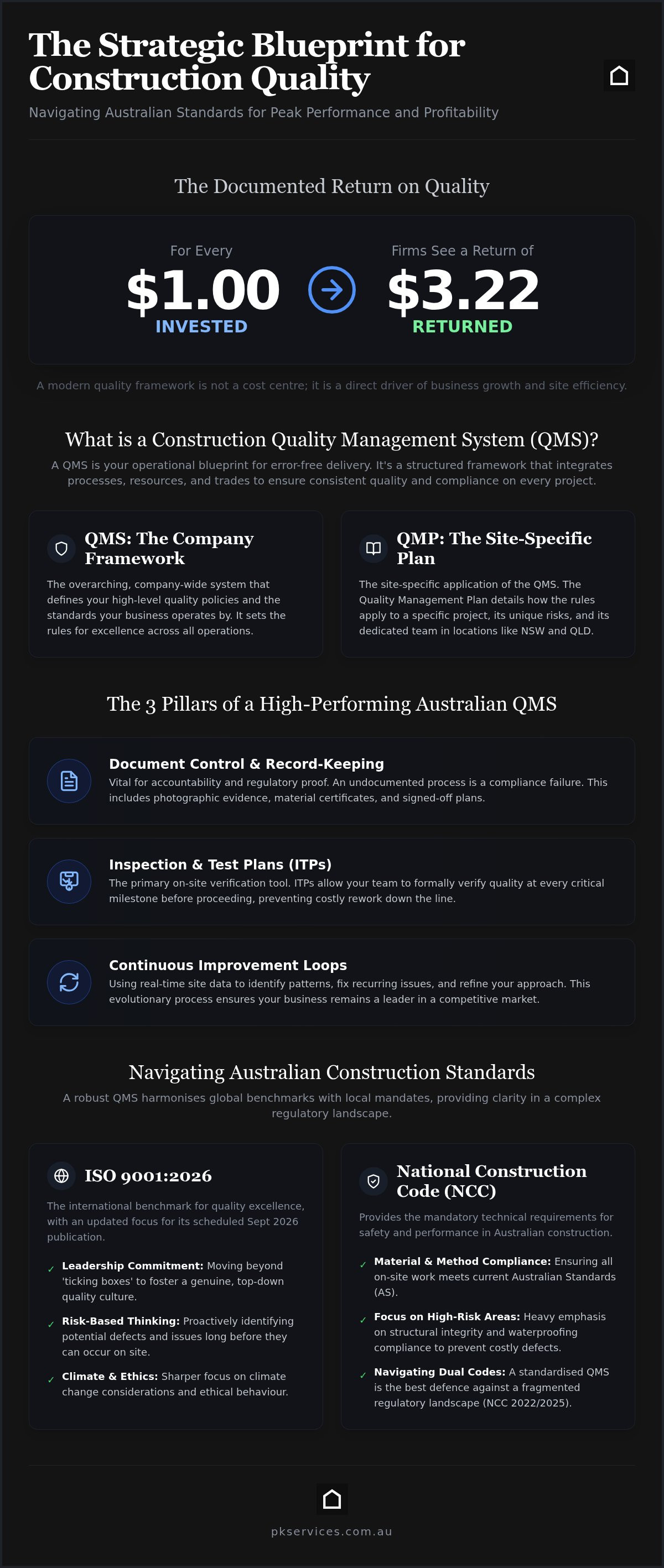
Did you know that for every dollar invested in a modern quality framework, civil firms are seeing a documented return of $3.22? In the evolving landscape of construction quality management systems Australia, this isn't just a statistic; it's a blueprint for business growth. You likely feel the sting of high rework costs and the mounting confusion surrounding NCC 2026 compliance. It's a common frustration to see quality protocols as a hurdle that slows down your site trades rather than a tool that empowers them.
This guide will show you how to turn that compliance burden into a strategic asset that drives site efficiency and long-term value. You'll discover how to slash operational waste, secure government tender eligibility, and maintain total oversight of your contractors from start to finish. We'll explore the shift toward ISO 9001:2026 standards and provide clear steps to ensure your quality strategy delivers elite results on every project.
Key Takeaways
- Learn how a structured framework integrates skilled trades to deliver consistent quality across every project.
- Navigate the transition to ISO 9001:2026 and the latest NCC updates with professional confidence.
- Discover how construction quality management systems Australia drive profit by minimising rework and site waste.
- Master a streamlined implementation process that turns complex compliance into simple, impactful site procedures.
- Gain the oversight required to manage contractors effectively and secure eligibility for major government tenders.
What is a Construction Quality Management System (QMS)?
A Quality Management System (QMS) is much more than a collection of policy folders on a server. It is a structured framework used to manage and improve construction quality consistently across every project. By integrating your internal processes, physical resources, and skilled trades, a QMS ensures you meet both client expectations and strict regulatory requirements. Think of it as your operational blueprint for error-free delivery. It's the engine that powers high-level strategy and translates it into tangible site results.
Quality management is a core discipline within the broader field of Construction Management. It ensures that excellence is never left to chance. In 2026, construction quality management systems Australia have become essential for mitigating risks. With the industry facing a dual-code environment where both NCC 2022 and NCC 2025 may apply depending on your location, a robust system is your only defence against compliance failures. It provides the clarity needed to navigate a fragmented regulatory landscape while maintaining a focus on site efficiency.
QMS vs. QMP: Understanding the Difference
It's easy to confuse these two terms, but they serve different purposes. Your QMS is the overarching company-wide system. It defines your high-level policy framework and the standards your business lives by. In contrast, the Quality Management Plan (QMP) is the site-specific application of those policies. You need both to ensure project-level compliance in NSW and QLD. While the QMS sets the rules, the QMP outlines exactly how those rules apply to a specific build, its unique risks, and its dedicated team.
The Core Components of an Australian QMS
A high-performing system relies on three fundamental pillars. First, document control and record-keeping are vital for accountability. If a process isn't documented, it effectively didn't happen in the eyes of a regulator. Second, Inspection and Test Plans (ITPs) act as your primary on-site verification tool. These plans allow your team to verify quality at every critical milestone before moving to the next stage. Finally, the system must include continuous improvement loops. By using real-time site data, you can identify patterns, fix recurring issues, and refine your approach. This evolution ensures your business remains a leader in a competitive market.
Australian Standards: ISO 9001 and the NCC 2026
ISO 9001:2026 remains the international benchmark for quality excellence in the building sector. Scheduled for publication in September 2026, this updated standard places a sharper focus on quality culture, ethical behaviour, and climate change considerations. For local firms, aligning with these global expectations is no longer optional. It is the price of entry for high-value contracts. The National Construction Code (NCC) provides the mandatory technical requirements that sit alongside these standards. It ensures that every build meets the minimum safety and performance levels required by law.
Navigating the nuances between NSW and QLD site requirements can be challenging. We are currently operating in a dual-code environment. While NCC 2025 was published on 1 May 2026, and corrected on 4 June 2026, state-specific adoption varies. This fragmentation creates a significant compliance burden for growing firms. Standardising your construction quality management systems Australia is the most effective way to reduce this pressure. It transforms complex, shifting regulations into a single, repeatable process that your team can follow with confidence.
Navigating ISO 9001:2026 Requirements
Quality starts at the director level. Under the 2026 standard, leadership commitment is scrutinized more than ever. It's about moving beyond "ticking boxes" to fostering a genuine quality culture. Risk-based thinking is another core pillar. This involves identifying potential defects long before they occur on-site. By integrating internal audits into your weekly routine, you maintain certification readiness. This proactive approach ensures that when a formal audit arrives, your business is already performing at the required tier.
Meeting NCC and Australian Standards on Site
On-site execution is where the theory meets the reality of the build. You must ensure all materials and methods meet current Australian Standards (AS). The 2026 updates have placed a heavy emphasis on structural integrity and waterproofing compliance. These are the areas most prone to high-cost rework. To prove compliance during building inspections, you need a meticulous paper trail. This includes photographic evidence, material certificates, and signed-off ITPs. If you want to organise your entire quality process, start by aligning your site documentation with these specific technical mandates. This creates a transparent record that protects your business and your reputation.
The Strategic ROI of Quality Management Systems
Quality is often viewed as a compliance hurdle. This is a mistake. When implemented strategically, construction quality management systems Australia become powerful profit drivers. Research into civil construction firms has shown a return of $3.22 for every dollar spent on an upgraded QMS. This isn't just about avoiding fines. It's about capturing lost value and turning site discipline into a competitive advantage.
Reducing rework is the most immediate win for your bottom line. Industry benchmarks suggest that a robust system can save between 10% and 15% of total project costs by catching errors before they're baked into the build. One engineering firm reported a 35% reduction in error-related delays within just 12 months of implementing their system. These aren't just minor tweaks; they're transformative shifts in how projects are delivered. They ensure that profit isn't leaked through preventable mistakes or site confusion.
Beyond immediate site savings, a certified QMS is a prerequisite for major NSW infrastructure projects. Government bodies demand proof of quality before you even reach the shortlisting stage. By maintaining these standards, you build a brand reputation that justifies premium pricing. Clients pay more for certainty. They want to know their project is in the hands of a professional partner who organises the entire process with precision and care.
Operational Excellence and Waste Reduction
Efficiency isn't just about working faster. It's about working smarter by eliminating redundant processes and unnecessary delays. A QMS streamlines workflows and bridges the communication gap between project managers and site trades. When everyone understands the standard, the path to completion becomes clear. For those looking at the bigger picture, this is a core part of improving construction business profitability NSW. It turns your site into a high-performance environment where waste is systematically identified and removed.
Risk Mitigation and Liability Protection
Data is your best defence in a litigious industry. A QMS provides the evidence needed to defend against defect claims and legal disputes. By tracking every inspection and sign-off, you create an airtight record of compliance that lasts long after the project is handed over. This protects your builder's licence and your financial future. Orderly site management also naturally enhances safety outcomes. When a site is organised and standards are clear, the risk of accidents drops. It's a comprehensive approach to protecting your assets, your reputation, and your people.
Implementing QMS: From Strategy to Site Execution
Moving your quality strategy from a digital folder to the site floor requires a deliberate, phased approach. Many construction quality management systems Australia fail because they are too complex for the people actually doing the work. A successful implementation focuses on clarity and usability. It starts with a rigorous gap analysis to evaluate your current processes against the latest Australian Standards. From there, you must design a system that is minimalist yet impactful. If a procedure is too long to read during a toolbox talk, it won't be followed on-site.
Effective implementation follows five critical steps:
- Step 1: Gap Analysis. Benchmark your existing workflows against ISO 9001:2026 and NCC requirements.
- Step 2: System Design. Create lean, direct procedures that staff can access and understand instantly.
- Step 3: Trade Engagement. Educate your team on why these standards matter for project success.
- Step 4: Site-Specific QMPs. Tailor your overarching system to meet the unique risks of every project environment.
- Step 5: Monitoring & ITPs. Execute rigorous inspections at every critical hold point to verify compliance.
The Role of Skilled Trades in Quality Outcomes
A quality system is only as good as the hands that build the project. Even the most sophisticated framework will fail without competent tradespeople to execute the details. This is why vetting construction subcontractors Australia is a vital part of your quality strategy. You need a workforce that respects protocols and understands the "why" behind every inspection. At PK Services, we supply skilled trades who are trained to maintain site standards. We bridge the gap between high-level strategy and practical execution, ensuring your QMS remains a living, breathing part of the build.
Managing Inspection and Test Plans (ITPs)
ITPs are the heartbeat of site-level quality control. They allow you to identify "Hold Points," where work must stop for inspection, and "Witness Points," where work can be observed. In 2026, digital ITPs have largely replaced paper checklists. They provide real-time data and allow for instant photo uploads, which are essential for proving compliance. You must ensure every subcontractor provides evidence of acceptability at every stage. This creates a transparent, undeniable record of quality. If you are ready to manage your entire quality process with professional precision, focusing on these digital verification tools is the best place to start. It protects your business and ensures every milestone meets the required tier of excellence.
Redefining Excellence: PK Services as Your Quality Partner
Quality management is where high-level strategy meets site-level reality. At PK Services, we bridge this gap. Many consulting firms offer advice that looks impressive in a boardroom but fails in the mud. We don't. With over 15 years of industry experience, we ensure your construction quality management systems Australia are built for the real world. We understand the pressure of site deadlines and the complexity of modern builds. Our approach is grounded in practical execution, not just theoretical compliance.
We manage the entire process from start to finish. This includes everything from strategic advisory to supplying the skilled trades needed to maintain your standards. By combining professional consulting with hands-on trade supply, we provide a level of oversight that traditional firms simply cannot match. It's time to redefine your standards and move beyond simple box-ticking. We help you build a culture of excellence that resonates through every level of your organisation.
Tailored Advisory for NSW and QLD Firms
We design bespoke systems for your specific business size and project types. Whether you are a growing mid-tier builder or a large-scale developer, your QMS should evolve with your business transformation goals. Our local expertise in the Sydney and Brisbane markets allows us to navigate state-specific hurdles with ease. We don't believe in one-size-fits-all solutions. Instead, we provide strategic advice that fits your unique operational needs. This ensures your system is an asset that supports growth rather than a weight that slows you down.
End-to-End Project Oversight
True excellence requires a clear view of the entire project lifecycle. We integrate quality into the full cycle construction project management. This ensures a seamless transition from the initial design intent to the final handover. We oversee every detail, ensuring your vision is never compromised by poor execution or contractor confusion. Our team manages the trades, monitors the ITPs, and maintains the records. This end-to-end involvement protects your reputation and your bottom line. Contact us today to start your journey toward construction excellence. Let's redefine what is possible for your next project.
Secure Your Quality Advantage
Quality management is the engine of your business growth. It transforms compliance from a hurdle into a strategic asset. By aligning with ISO 9001:2026 and the latest NCC mandates, you protect your reputation and your bottom line. Success in construction quality management systems Australia requires more than just digital paperwork. It demands a seamless connection between boardroom strategy and every action taken on-site. When you bridge this gap, you eliminate waste and secure a significant competitive edge in a crowded market.
PK Services brings 15+ years of industry-leading expertise to your projects. We are specialists in the NSW and QLD markets, redefining excellence from strategy to site. We manage the entire process, providing the skilled trades and end-to-end project oversight needed to deliver elite results every time. It's time to elevate your operations and outpace the competition. Redefine your site standards with PK Services and build with total professional confidence. Your journey toward a higher tier of service starts today.
Frequently Asked Questions
Is a Quality Management System (QMS) mandatory for Australian construction companies?
A formal QMS isn't legally mandated for every private residential build, but it's often a contractual requirement for high-tier commercial and government projects. While the NCC sets the technical rules, a QMS is the system you use to prove you've followed them. Most agencies in NSW and QLD won't even consider your bid for major works without a certified system in place.
How does the NCC 2026 update affect my current quality management plan?
The 2026 updates require your plan to account for stricter structural and waterproofing verification protocols. You'll need to update your site-specific ITPs to reflect these corrected technical standards and ensure your record-keeping aligns with the current dual-code environment. This proactive adjustment prevents compliance gaps during the transition periods between different code versions across various states.
What is the difference between quality control and quality assurance in construction?
Quality Assurance (QA) is the process-oriented prevention of defects, while Quality Control (QC) is the product-oriented detection of defects. QA focuses on the systems and procedures you use to ensure quality before the work begins. QC is the physical inspection on-site to confirm the finished work meets the standard. You need both pillars to maintain elite site standards.
Can a small construction business benefit from ISO 9001 certification?
Yes, certification allows smaller firms to compete for larger contracts and significantly reduces the cost of rework. Implementing construction quality management systems Australia helps smaller builders scale by creating repeatable, reliable processes. It shifts the business from relying on the owner's memory to a system-driven operation that justifies premium pricing and builds long-term brand trust.
How often should I audit my construction quality management system?
You should conduct internal audits at least quarterly, with formal external audits occurring annually to maintain your certification. Regular internal checks allow you to catch minor issues before they evolve into expensive site defects. This consistent frequency keeps your team focused on excellence and ensures your business is always ready for a surprise inspection or a formal audit.
What are Inspection and Test Plans (ITPs) and why are they critical?
ITPs are documents that outline the specific inspections and tests required at every critical stage of the construction process. They are critical because they define "Hold Points" where work must stop until a qualified person verifies the quality. This prevents substandard work from being covered up by the next stage of construction, saving you from high-cost rework later.
How do I ensure my subcontractors follow our quality standards on site?
You ensure compliance by making your quality standards a non-negotiable part of the subcontract agreement and the site induction process. Require every subcontractor to sign off on specific ITP milestones and provide photographic evidence of their work before payment. Using skilled trades who already understand and respect these protocols makes the oversight process much more efficient for your project managers.
What documentation is required for NSW Government construction tenders in 2026?
You typically need a certified QMS manual, recent audit reports, and project-specific Quality Management Plans to be eligible for government work. NSW procurement guidelines place a heavy emphasis on alignment with the ISO 9001:2026 standard. Having documented evidence of your past quality performance and your current system maturity is essential for proving you can manage high-value infrastructure projects.


